Quick Answer
UV filtration refers to the use of ultraviolet disinfection as the final treatment step in a water filtration system — positioned after physical filtration (sand, multimedia, cartridge, or membrane) to inactivate any microorganisms that passed through the filter or that are released during filter backwash cycles. UV at 40 mJ/cm² achieves ≥4-log (99.99%) inactivation of bacteria, viruses, and protozoa including Cryptosporidium — the one pathogen that membrane filters cannot reliably remove and chlorine cannot inactivate at practical doses. In a well-designed water treatment system, filtration removes turbidity and particles (which would otherwise shield pathogens from UV exposure), and UV then inactivates any surviving pathogens in the clear, filtered water. The combination of filtration + UV is the standard treatment train for drinking water, food and beverage process water, pharmaceutical purified water, and tertiary-treated STP effluent for reuse in India. UV filtration systems range from 500 LPH single-lamp units for food processing applications to multi-lamp arrays delivering 2,00,000 LPH for municipal water treatment plants.
What "UV Filtration" Actually Means
The term "UV filtration" is widely used but technically imprecise — UV does not filter anything. It is more accurately called ultraviolet disinfection, and it belongs at the end of the filtration train, not as a replacement for it. Understanding this distinction is the foundation of correct UV filtration system design.
Physical filters — sand, multimedia, activated carbon, cartridge, ultrafiltration membranes — work by physical mechanisms: straining, adsorption, or size exclusion. They are highly effective at removing suspended solids, turbidity, colour, organic chemicals, and large microorganisms. But they have two microbial limitations: (1) no filter removes 100% of bacteria and viruses, because some organisms are smaller than filter pores and pass through; (2) filters can harbour and release biofilm — communities of bacteria that grow on filter media and are periodically sloughed off during backwash cycles or under high-flow conditions.
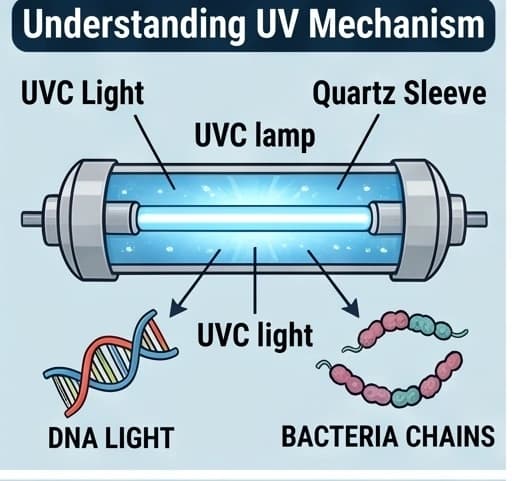
UV disinfection addresses exactly these two limitations. It is effective regardless of organism size (it works by DNA damage, not by physical retention), and it inactivates organisms released during filter disturbance. This is why the correct system design is always filtration → UV, in that order. UV must come after filtration because turbidity in unfiltered water blocks UV penetration and reduces dose delivery.
UV Filtration with Different Treatment Technologies
UV + Sand / Multimedia Filtration
Sand filtration and multimedia filtration (sand, anthracite, garnet layers) remove turbidity, suspended solids, and some bacteria by physical straining and adsorption. A well-maintained sand filter achieves 0.5–1 NTU outlet turbidity, which is within the ≤1 NTU requirement for UV disinfection. The treatment train is: raw water → coagulation/flocculation → sedimentation → sand filtration → UV disinfection → storage/distribution.
This is the standard treatment train for municipal drinking water treatment in India under CPHEEO guidelines. UV disinfection at 40 mJ/cm² positioned after sand filtration achieves BIS IS 10500 zero E. coli compliance without the trihalomethane formation risk of chlorine as the primary disinfectant. Many Indian municipalities use UV as the primary disinfectant barrier, with low-level chlorine residual (0.2 mg/L) maintained for distribution system protection only.
UV + Activated Carbon Filtration
Granular activated carbon (GAC) filtration adsorbs dissolved organic compounds, chlorine, chloramines, pesticides, and taste-and-odour compounds from water. However, activated carbon beds are warm, dark, and nutrient-rich — ideal conditions for bacterial growth. Carbon filters that have not been properly backwashed or periodically sanitised can release high bacterial counts into the product water, even when inlet water is microbiologically acceptable.
UV disinfection positioned immediately downstream of the GAC filter is the standard engineering solution for this problem. The UV reactor inactivates any bacteria released from the carbon bed before the water reaches the point of use. This combination — GAC (for chemical removal and dechlorination) → UV (for microbial control) — is the standard treatment train for food and beverage process water in India where chlorine removal from municipal supply is required before UV disinfection can work effectively, as residual chlorine absorbs UV light at 254 nm and reduces dose delivery efficiency.
UV + Reverse Osmosis (RO)
RO membranes remove dissolved salts, heavy metals, pharmaceuticals, endocrine disruptors, and most microorganisms by size exclusion. However, RO membranes have a bacteria passage rate that varies with membrane integrity — a virgin RO membrane may show 99.9% bacteria rejection, but a membrane with a pinhole defect or compromised O-ring seal can allow bacterial passage. Additionally, the RO permeate storage tank and distribution pipework downstream of the membrane are potential biofilm sites — the low-TDS, low-nutrient RO permeate water is paradoxically susceptible to bacterial regrowth precisely because no disinfectant residual is maintained.
UV disinfection after RO is the standard final barrier for: pharmaceutical purified water systems (Schedule M, USP compliance), food and beverage process water (FSSAI HACCP compliance), hospital water systems (NABH compliance), and high-purity industrial process water (microelectronics, semiconductor fabrication). The UV system is positioned on the permeate side of the RO membrane, just before the storage tank or point-of-use distribution. A second UV system before the point of use (at the loop return) is standard in pharmaceutical water systems where distribution loop microbial control is critical. For detailed guidance, see our guide on combining UV with RO reverse osmosis.
UV + Ultrafiltration (UF) Membranes
Ultrafiltration membranes (0.01–0.1 micron pore size) remove bacteria, protozoa, colloids, and large viruses by size exclusion, but do not reliably remove small viruses (norovirus, hepatitis A virus, adenovirus have diameters of 20–80 nm — smaller than UF pore sizes). UV disinfection at 40–100 mJ/cm² following UF provides the viral inactivation step that UF cannot deliver.
The UF → UV combination is the preferred treatment train for surface water sources in India (rivers, lakes, reservoirs) where viral contamination from untreated sewage discharge is a significant risk. This treatment train — coagulation → UF → UV → low-level chlorine residual — meets CPHEEO guidelines for surface water treatment and is increasingly specified for Jal Jeevan Mission (JJM) rural piped water schemes where conventional treatment plant infrastructure is impractical to build and operate.
UV + Cartridge Filters
5-micron cartridge filters are the most common pre-treatment upstream of UV in small industrial and commercial systems. They remove suspended particles and protect the UV reactor quartz sleeve from fouling. For food and beverage applications, the pre-filter specification is typically: 20-micron sediment pre-filter → 5-micron polishing filter → UV reactor → storage. This train is validated under FSSAI Schedule IV GMP requirements for process water in food manufacturing.
UV Filtration System Applications in India
Drinking Water Treatment
UV filtration is the primary disinfection technology for groundwater-fed drinking water systems across India — borewell water, open well water, and spring water supplies where surface contamination is a seasonal risk. After sediment and iron removal, UV at 40 mJ/cm² provides the terminal disinfection step before distribution. Municipal water treatment plants, housing society water treatment systems, and rural community water supply schemes all use UV as the final treatment step after conventional filtration.
Food and Beverage Process Water
FSSAI requires process water used in food and beverage manufacturing to meet BIS IS 10500 microbiological standards at the point of use. UV filtration — positioned after activated carbon (for dechlorination) and a 5-micron cartridge filter — is the FSSAI-accepted final treatment step that generates continuous monitoring records for HACCP CCP documentation. Applications include: brewing, dairy processing, bottled water, soft drinks, packaged foods, meat and poultry processing.
Pharmaceutical Purified Water
Schedule M (Good Manufacturing Practice for Pharmaceuticals, India) and USP/EP pharmacopoeia require purified water with total viable count (TVC) below 100 CFU/ml for non-sterile applications and 10 CFU/100 ml for water for injection (WFI). UV filtration at 40–100 mJ/cm² is the standard disinfection step in pharmaceutical water systems, used in conjunction with RO membranes, electrodeionisation (EDI), and hot storage loops. Two UV reactors are typically used: one after RO/EDI, and one on the distribution loop return before re-circulation.
STP Effluent — Tertiary Treatment and Reuse
CPCB and State Pollution Control Board (SPCB) environmental clearance conditions increasingly mandate tertiary UV disinfection for STP effluent before surface discharge or reuse. After secondary biological treatment and sand filtration, UV at 40–80 mJ/cm² achieves CPCB General Standards for fecal coliforms (≤1,000 MPN/100 ml) without the chlorination/dechlorination cost and trihalomethane risk of chemical disinfection. Housing society STPs, industrial township STPs, and municipal STPs are all subject to this requirement. For more detail, see our guide on UV disinfection for STP plants in India.
Swimming Pool UV Filtration
Swimming pools use UV in combination with conventional sand filtration and chlorine dosing. The UV reactor — typically a medium-pressure system — is positioned on the recirculation line between the sand filter outlet and the pool return. UV at 40–80 mJ/cm² simultaneously inactivates Cryptosporidium (which passes through sand filters and is resistant to practical chlorine doses) and destroys chloramines (combined chlorine species that cause eye irritation and pool odour). The result is measurably better bather comfort and pathogen control without increasing chlorine dose. See our guide on UV disinfection for swimming pools in India.
UV Filtration System Sizing: Key Parameters
Sizing a UV filtration system correctly requires three site-specific inputs:
- Design flow rate: Peak instantaneous flow through the UV reactor, not average flow. For continuous process water systems, peak flow is the maximum process demand. For STP treatment, peak flow is typically 2–3× average daily flow (morning usage surge). The UV system must deliver the required dose at peak flow — undersizing is a common and serious mistake.
- UV transmittance (UVT) of filtered water: Measure with a UV spectrophotometer after the pre-treatment step. Clean RO permeate: 98–99% UVT. Carbon-filtered municipal supply: 88–92% UVT. Sand-filtered surface water: 80–88% UVT. Secondary-treated STP effluent after sand filter: 65–80% UVT. Lower UVT requires larger reactor or higher lamp power.
- Required UV dose: 40 mJ/cm² for most drinking water and food process water applications; 80 mJ/cm² for STP effluent reuse and aquaculture; 100 mJ/cm² for pharmaceutical water. See our dose calculation guide at how to calculate UV dosage.
UV Filtration in Indian Water Treatment Standards
| Standard | UV filtration requirement | Dose | Applies to |
|---|---|---|---|
| BIS IS 10500:2012 | Zero E. coli/100 ml at point of supply | ≥40 mJ/cm² | All potable water systems |
| CPHEEO Manual on Water Supply | UV as primary disinfection after filtration | ≥40 mJ/cm² | Municipal WTPs |
| CPCB General Discharge Standards | ≤1,000 MPN fecal coliforms/100 ml | ≥40 mJ/cm² | STP/ETP effluent discharge |
| FSSAI Schedule IV | IS 10500 compliance at point of food contact | ≥40 mJ/cm² | Food and beverage FBOs |
| Schedule M (GMP) | TVC <100 CFU/ml purified water | ≥40–100 mJ/cm² | Pharmaceutical manufacturers |
| NABH FMS Standards | Legionella control, Water Safety Plan | ≥40 mJ/cm² | NABH-accredited hospitals |
UV Filtration Systems from Alpha UV System
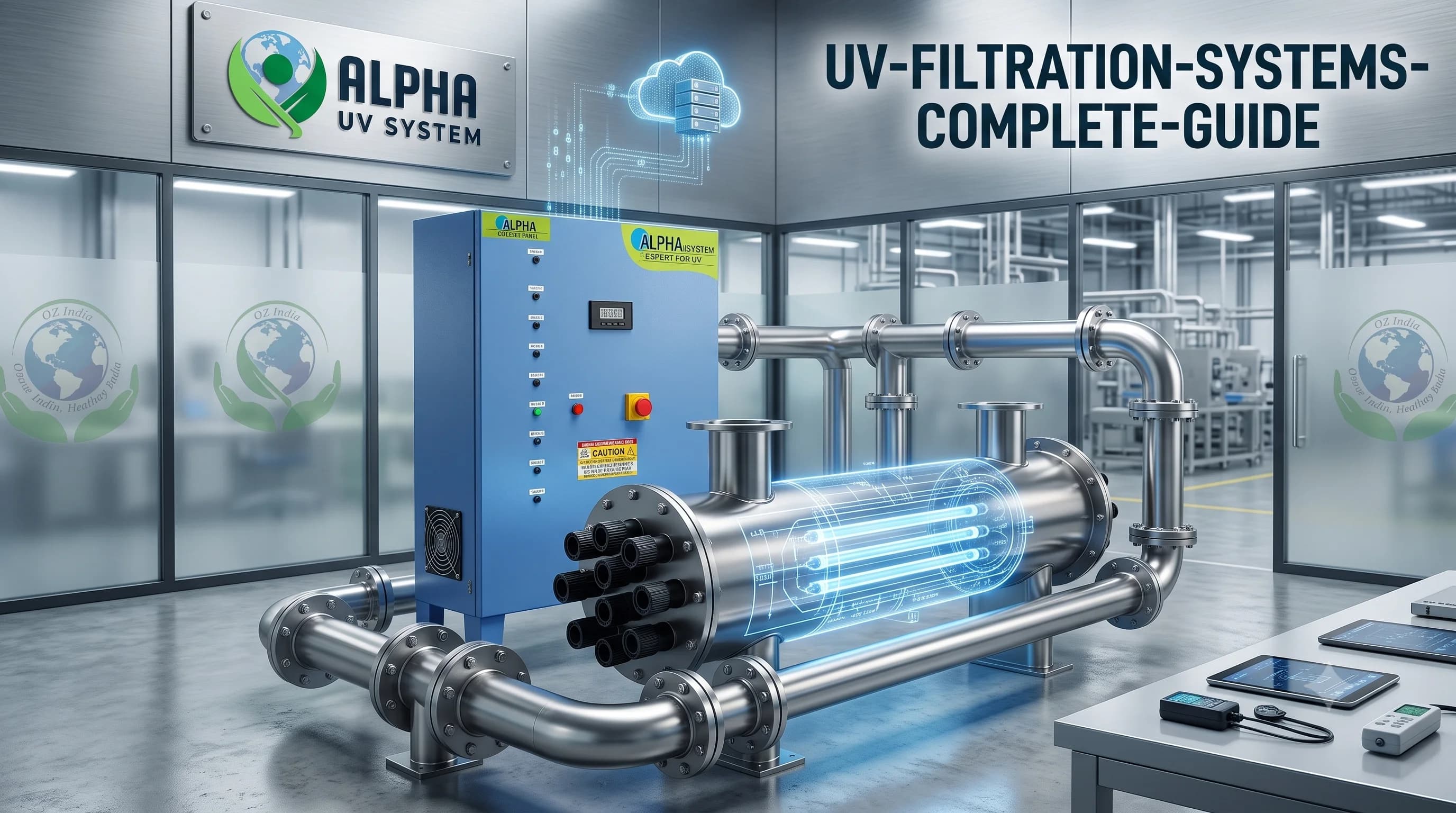
Alpha UV System designs UV filtration systems — UV disinfection reactors and complete treatment trains — for every application described in this guide. Our IIT-trained engineering team assesses your existing filtration system, measures actual UVT, and specifies the UV reactor and any additional pre-treatment steps required to guarantee dose delivery at your peak flow rate.
All UV filtration systems use Philips UV-C lamps, SS316L reactor chambers with material certificates, and IP65 control panels with UV intensity alarm and Modbus/4–20 mA output for SCADA integration. MSME Udyam registered manufacturer based in Greater Noida, with 24–48 hour site response for NCR and nationwide project support.
Contact us to specify a UV filtration system for your application: WhatsApp +91 93183 05878 or call +91 95995 00580.
Related guides: UV disinfection systems — complete buyer's guide | Do I need a filter before UV water treatment? | Combining UV with other water treatment methods
Recommended UV Systems
Alpha UV System products for this application — powered by genuine Philips UV-C lamps.
Commercial UV Water Purification System
500 – 5,000 LPH
HACCP-compliant UV water purification for hotels, restaurants, and offices
Industrial UV Water Treatment System
5,000 – 50,000 LPH
Schedule M 2025 and HACCP compliant UV for pharma, food & beverage, and process water
Not sure which system suits your application? WhatsApp our engineers for a free recommendation →
Related solutions
See how Alpha UV System applies this to your industry or city.
Need a UV system?
Talk to our UV engineers — WhatsApp for a quote in 2 hours, or browse the full catalog on IndiaMART.