What UV Disinfection Does for Swimming Pool Water — Quick Answer
UV disinfection for swimming pools solves two problems that chlorine alone cannot resolve: it destroys chloramines (the combined chlorine species responsible for eye irritation, skin irritation, and the characteristic "pool smell") and it inactivates Cryptosporidium parvum oocysts, which are completely resistant to practical chlorine doses. A pool UV system does not replace chlorine — it works alongside a reduced chlorine dose, with UV handling pathogen inactivation and chloramine destruction while chlorine maintains a low residual for ongoing surface disinfection. The result is measurably better water quality, dramatically lower bather complaint rates, and reduced chemical operating cost. For hotels, sports academies, and school pools across India, UV disinfection for swimming pools has become the standard of care in facilities where bather experience and compliance matter.
This guide covers the chemistry of why chlorine alone is insufficient, how medium-pressure UV addresses both problems, how to size a pool UV system India for any pool type, what changes in chemical management after UV is installed, compliance standards applicable in India, and case studies from hotel and sports facility pools.
The Two Core Problems UV Solves in Swimming Pools
Swimming pool water treatment India is more chemically demanding than drinking water or STP disinfection because the pool is a closed system continuously contaminated by bathers — through sweat, urine, exhaled breath, skin cells, cosmetics, and sunscreen. Chlorine is added to manage this load, but its chemistry in a bather-loaded pool produces two failure modes that cannot be corrected by adding more chlorine.
Problem 1 — Chloramine Formation
When free chlorine reacts with nitrogen-containing compounds in bather waste — primarily urea (from sweat and urine), amino acids, and creatinine — it forms chloramines: monochloramine (NH2Cl), dichloramine (NHCl2), and trichloramine (NCl3). These combined chlorine species are the chemical reality behind what bathers call "pool smell." The paradox of chloramine pool UV is important to understand: the characteristic irritation symptoms that bathers attribute to "too much chlorine" are actually caused by chloramines — which form because there is insufficient reactive free chlorine to complete the disinfection cycle. The pool smells not because it has too much chlorine but because it has too little free chlorine relative to the nitrogen load.
Trichloramine is particularly problematic — it is volatile, transferring readily from pool water to the pool hall air, causing respiratory irritation in competitive swimmers and in the staff of indoor pool facilities. In India, hotel pool UV and sports facility pools with significant bather loads accumulate chloramines faster than ventilation and breakpoint chlorination can manage them.
Problem 2 — Cryptosporidium Resistance to Chlorine
Cryptosporidium parvum is a protozoan parasite that forms environmentally resistant oocysts. Crypto is the most common cause of recreational water illness outbreaks globally — and it is completely resistant to chlorine at any concentration practical in a swimming pool. The CT value required to achieve 4-log (99.99%) inactivation of Crypto with free chlorine at pH 7.5 is approximately 7,200 mg·min/L. At a pool residual of 1.5 mg/L free chlorine, achieving this CT would require 80 hours of contact time — longer than most pools are operated without water changes. Cryptosporidium pool treatment India is therefore a UV problem, not a chlorine problem.
Chloramine Science: Chemistry, Formation, and Health Effects
Understanding chloramine chemistry is essential to understanding why chloramine pool UV using medium-pressure lamps is the correct technical solution and why simply raising chlorine dose makes the problem worse, not better.
| Chloramine Species | Formation Reaction | Disinfection Efficacy | Primary Health Effect | Volatility |
|---|---|---|---|---|
| Monochloramine (NH2Cl) | NH3 + HOCl → NH2Cl + H2O | ~50× weaker than free Cl | Eye and mucous membrane irritation | Low |
| Dichloramine (NHCl2) | NH2Cl + HOCl → NHCl2 + H2O | ~5× weaker than free Cl | Strong eye and respiratory irritation | Medium |
| Trichloramine (NCl3) | NHCl2 + HOCl → NCl3 + H2O | Negligible disinfection value | Severe respiratory irritation, "pool smell" | High — transfers to air |
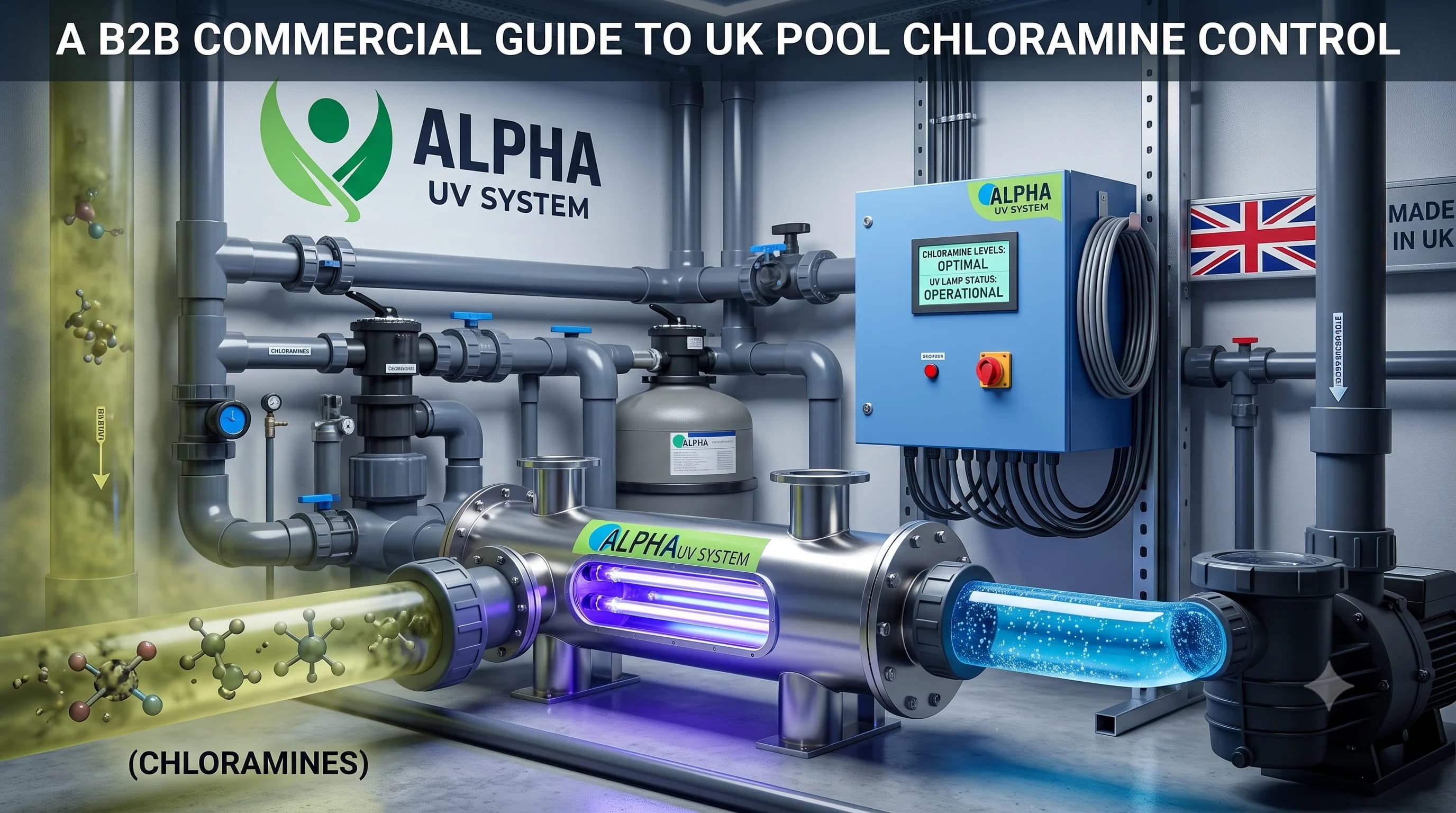
The chlorine chemistry in a bather-loaded pool naturally progresses toward trichloramine formation unless the combined chlorine is destroyed — either by breakpoint chlorination (raising free Cl to 10× the combined Cl level, which is impractical at high bather loads) or by UV photolysis. Medium-pressure UV-C photons at wavelengths across the 200–300 nm spectrum directly cleave the N–Cl bonds in all three chloramine species, converting combined chlorine back to inorganic nitrogen compounds and releasing free chlorine back into solution. This is the fundamental mechanism of chloramine pool UV.
For swimming pool water treatment India — particularly in indoor hotel pools and school pool applications where ventilation is limited and bather density is high — the inability to control trichloramine through chlorine management alone makes pool UV system India the only engineering solution.
Cryptosporidium in Pools: Why Chlorine Fails
The CT value framework (concentration × time = log inactivation) makes the Cryptosporidium problem in pools quantitative and unavoidable. The following comparison table shows why Cryptosporidium pool treatment India requires a technology different from chlorine.
| Pathogen | CT for 4-log inactivation (mg·min/L at pH 7.5, 25°C) | At 1.5 mg/L free Cl — contact time required | Practical in a pool? | UV dose for 4-log inactivation (mJ/cm²) |
|---|---|---|---|---|
| E. coli O157:H7 | 0.5 mg·min/L | ~20 seconds | Yes | 10 mJ/cm² |
| Giardia lamblia cysts | 150 mg·min/L | ~100 minutes | Borderline | 10 mJ/cm² |
| Cryptosporidium parvum oocysts | 7,200 mg·min/L | ~80 hours | No | 10–12 mJ/cm² |
The UV dose column is striking: while chlorine's effectiveness against Cryptosporidium is 14,400 times lower than against E. coli, UV's effectiveness is essentially the same for all three pathogens at 10–12 mJ/cm². This is because UV inactivation works by damaging nucleic acids — a mechanism that is equally effective against protozoan oocysts, bacteria, and viruses. Chlorine inactivation relies on oxidative penetration of the cell or oocyst wall, and Cryptosporidium's oocyst wall provides exceptional chemical resistance.
In India, Cryptosporidium pool treatment India is a real risk — not a theoretical one. Hotel pools, sports facility pools, and school pools with high bather turnover and variable water quality management are settings where Crypto contamination events can occur. UV disinfection for swimming pools eliminates this risk at UV doses well within practical system design parameters.
Medium-Pressure UV vs Low-Pressure UV: Why Pools Require MP UV
Not all UV systems are equivalent for pool applications. The distinction between medium-pressure (MP) and low-pressure (LP) UV lamps determines whether a system can address chloramines — the more commercially important problem for most Indian pool operators.
| Characteristic | Low-Pressure UV (LP) | Medium-Pressure UV (MP) |
|---|---|---|
| Output spectrum | Monochromatic, primarily 254 nm | Polychromatic, 200–400 nm |
| Chloramine photolysis | Limited — 254 nm has poor absorption by chloramines | Effective — 200–260 nm range cleaves N–Cl bonds |
| Cryptosporidium inactivation | Effective at 10–12 mJ/cm² | Effective at 10–12 mJ/cm² |
| Lamp power per unit | Low (0.5–2 kW per lamp) | High (2–10 kW per lamp) |
| Lamps required per system | Many (larger footprint) | Few (compact) |
| Operating temperature | 40°C — sensitive to water temp and flow variation | 600–900°C — stable output across flow and temperature variations |
| Recommended for pools? | Only if chloramine control is not required | Yes — standard for all public and hotel pool applications |
Alpha UV System swimming pool UV units use Philips medium-pressure UV-C lamps — providing the polychromatic output across the 200–300 nm range that both inactivates pathogens and destroys chloramines on every recirculation pass through the system. For any hotel pool UV, competition pool, or school pool application in India, MP UV is the correct specification.
How Pool UV Is Installed: Recirculation Circuit Position
A pool UV system India is installed in the pool's recirculation circuit — the pipework through which pool water is continuously pumped through the filtration and chemical treatment system and returned to the pool. The position within that circuit matters for optimal performance.
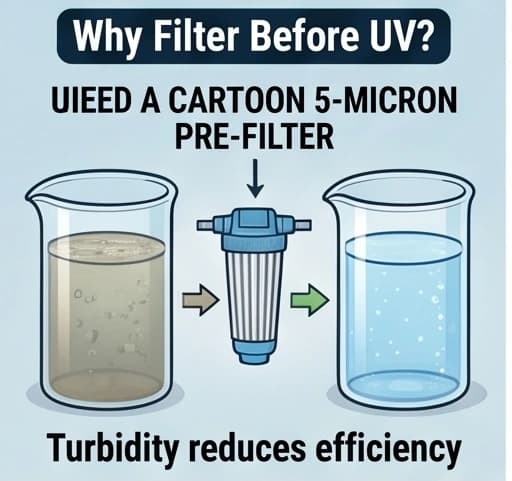
The standard installation sequence in a well-designed pool plant room is: pool water intake → balance tank → circulation pump → pre-filter (sand filter) → UV system → chlorine dosing point → pH correction dosing → return to pool. This sequence is important for two reasons. First, positioning the UV system after the sand filter ensures that water reaching the UV chamber has been filtered to remove particulate that would scatter UV light and reduce the effective UV dose. Second, positioning chlorine dosing after the UV system means that freshly dosed free chlorine is not immediately photolysed before it reaches the pool — the UV acts on recirculating water containing combined chlorine (chloramines), not on the freshly dosed free chlorine.
The UV chamber itself is a flow-through reactor: water passes through a stainless steel or HDPE pressure vessel containing the Philips medium-pressure UV-C lamp (enclosed in a quartz sleeve), is exposed to the UV dose for the calculated contact time determined by the lamp power and chamber geometry, and exits to the chlorine dosing point. The lamp is powered by a ballast unit mounted adjacent to the chamber, with a UV intensity sensor monitoring actual dose delivery and triggering an alarm or flow interlock if dose falls below the design minimum.
Pool UV Sizing Calculation
Swimming pool UV system sizing is based on the pool recirculation flow rate, not the pool volume directly. The calculation proceeds in two steps: first determine the recirculation flow rate from pool volume and turnover standard, then select a UV system rated for that flow rate at the required UV dose.
Step 1 — Recirculation flow rate:
Flow rate (LPH) = Pool volume (L) × Turnovers per day ÷ 24
Step 2 — UV dose specification:
For Cryptosporidium protection: minimum 40 mJ/cm² validated dose. For chloramine control in addition to Crypto protection: 60–80 mJ/cm² (higher dose increases the fraction of chloramines destroyed on each pass). Most pool UV system India specifications are set at 60 mJ/cm² as the standard.
Worked example — Hotel leisure pool (25 m):
Pool dimensions: 25 m × 12.5 m × 1.8 m average depth = 562,500 L. Standard turnover: 5 per day (hotel leisure pool standard). Flow rate = 562,500 × 5 ÷ 24 = 117,188 LPH ≈ 120,000 LPH. UV system specification: rated for 120,000 LPH at 60 mJ/cm², typically a single medium-pressure UV unit with one or two Philips MP lamps.
Pool Type Sizing Reference Table
| Pool Type | Typical Dimensions | Volume (L) | Turnovers/Day | Recirculation Flow (LPH) | UV Dose Target | Lamp Configuration |
|---|---|---|---|---|---|---|
| Competition pool (50 m) | 50 m × 25 m × 2 m | 2,500,000 | 5 | 520,000 | 60 mJ/cm² | 4× MP lamps (twin-chamber) |
| Hotel leisure pool (25 m) | 25 m × 12.5 m × 1.8 m | 562,500 | 5 | 117,000 | 60 mJ/cm² | 1–2× MP lamps (single chamber) |
| School / club pool (25 m) | 25 m × 12.5 m × 1.5 m | 468,750 | 4 | 78,000 | 60 mJ/cm² | 1× MP lamp (single chamber) |
| Residential / villa pool | 10 m × 5 m × 1.5 m | 75,000 | 4 | 12,500 | 40–60 mJ/cm² | 1× MP lamp (compact unit) |
These flow rates are starting points. Actual system sizing for any UV disinfection swimming pool India project should account for site-specific UVT (UV transmittance) of the pool water, fouling factors for the quartz sleeve, and any flow rate safety margin required by the project specification. Alpha UV System provides a detailed sizing calculation with every quotation.
Chemical Management After UV Installation
Pool UV system India installation changes the chemical balance of the pool in measurable ways. Understanding these changes allows pool operators to adjust dosing protocols and realise the full cost and quality benefit of the UV system.
| Parameter | Chlorine-Only Pool (Typical) | Pool with UV Disinfection | Practical Implication |
|---|---|---|---|
| Free chlorine residual target | 1.5–3.0 mg/L | 0.5–1.0 mg/L | Lower chlorine purchase and dosing cost |
| Combined chlorine (chloramines) | Often 0.3–1.0 mg/L | <0.2 mg/L (WHO guideline) | Eliminated bather irritation and pool smell |
| Breakpoint chlorination frequency | Weekly or more frequent | Rarely required | Reduced operator time and chemical shock cost |
| pH management | Daily adjustment typically required | More stable — less acid demand from lower Cl dose | Reduced acid consumption and operator intervention |
| Cyanuric acid (for outdoor pools) | 30–50 mg/L stabiliser often used | Can be reduced — UV not affected by stabiliser | Simpler outdoor pool chemical management |
| Chemical operating cost (indicative) | Baseline | 35–55% reduction | 3–5 year UV system payback for most hotel pools |
It is critical that pool operators do not eliminate chlorine residual entirely after UV installation. UV provides no residual disinfection protection — water that leaves the UV chamber and re-enters the pool is not continuously protected. The low free chlorine residual (0.5–1.0 mg/L) maintained in a UV-equipped pool provides ongoing surface disinfection of pool walls, fittings, and any contamination introduced between recirculation passes. The UV handles the heavy lifting of pathogen inactivation and chloramine destruction; chlorine handles the residual protection role at a fraction of the dose a chlorine-only pool requires.
Bather Experience Improvements: The Data
The bather experience improvements from UV disinfection for swimming pools in India are measurable and commercially significant for hotel pools and sports academies where guest satisfaction and member retention depend on pool quality perception.
Eye irritation in pools is caused primarily by trichloramine and dichloramine, not by free chlorine at normal pool residuals. Studies at European pool facilities with measured chloramine levels show that trichloramine air concentration above 0.5 mg/m³ correlates directly with bather eye irritation complaints. Medium-pressure UV reduces trichloramine to levels consistently below this threshold in indoor pools.
Skin irritation and dryness following pool swimming is reduced in UV-equipped pools because the lower free chlorine residual (0.5–1.0 mg/L versus 2–3 mg/L) significantly reduces the chlorine contact dose on skin and hair over a one-hour swim session. Hotel guests frequently report improved skin comfort as the most noticeable immediate benefit of a UV-equipped hotel pool UV system.
Pool smell — the "chlorine smell" that is actually trichloramine — is essentially eliminated in indoor pools with properly sized medium-pressure UV. For hotel pool UV applications, the elimination of pool smell is one of the most commercially visible improvements: it affects guest perception of the entire pool facility and reflects directly in guest satisfaction scores.
Respiratory health for competitive swimmers is a significant consideration for sports facility and school pool applications. Chronic trichloramine exposure in indoor pool environments has been associated with increased asthma risk in competitive swimmers. UV disinfection for swimming pools in school pools and sports academies eliminates the primary source of this chronic exposure.
Compliance Standards for Pool UV Systems in India
Swimming pool water treatment India does not yet have a single unified national standard for pool UV systems equivalent to the DIN 19643 standard used in Germany (which mandates UV for public pools). However, several compliance frameworks are applicable to pool UV installations in India in 2026.
BIS and water quality standards: The Bureau of Indian Standards IS 3328 (specifications for swimming pool water quality) specifies free chlorine, pH, turbidity, and coliform count limits for pool water. UV-equipped pools achieve these limits more consistently than chlorine-only pools at equivalent operating conditions. For any pool subject to BIS water quality inspection, UV installation is a compliance risk reduction measure.
International hotel brand standards: International hospitality chains operating in India — including five-star hotel properties across Delhi NCR, Mumbai, Bengaluru, and Hyderabad — specify UV disinfection for swimming pools in their engineering standards. Hotel pool UV requirements in brand standards typically specify medium-pressure UV, minimum validated dose (usually 40 mJ/cm²), and UV intensity monitoring with continuous logging. Alpha UV System supplies the compliance documentation required by major international hospitality brand engineering standards, including Philips lamp certificate of analysis, UV intensity validation records, and commissioning test reports.
Sports facility compliance: Sports Authority of India (SAI) facilities and state-level sports authority pools are increasingly specifying UV disinfection as part of renovation and new construction specifications, particularly for pools hosting national and international competitions where water quality standards equivalent to international norms are required.
CE marking: Alpha UV System pool UV units carry CE marking for machinery and electrical equipment, confirming compliance with European machinery safety directives. This is required for pools associated with international hotel brands and is increasingly specified by Indian architects and project consultants for premium pool projects.
Safety interlocks: All pool UV system India units supplied by Alpha UV System include UV lamp operation interlocks that prevent the system from signalling safe water quality if the UV lamp is not operating at design intensity. This interlock connects to the pool's Building Management System (BMS) or can trigger a direct alarm output.
UV vs Chlorine for Pool Disinfection — Comparison
The following comparison covers the two practical options for swimming pool water treatment India: UV disinfection (with low chlorine residual maintenance) versus chlorine-only disinfection. This comparison is specific to pool applications and covers the parameters that matter to pool operators and facility managers.
| Parameter | UV + Low Chlorine Residual | Chlorine Only |
|---|---|---|
| Chloramine (pool smell) control | Effective — MP UV destroys all chloramine species | Poor — breakpoint chlorination is impractical at high bather loads |
| Cryptosporidium inactivation | Effective — 4-log at 10–12 mJ/cm² | Ineffective — CT of 7,200 mg·min/L is not achievable in pools |
| Eye and skin irritation | Significantly reduced — lower Cl residual and no chloramines | Common at bather loads that drive chloramine formation |
| Chemical operating cost | 35–55% lower than chlorine-only | Baseline — higher chlorine consumption at high bather loads |
| Chemical storage requirements | Minimal — small volume of hypochlorite for residual only | Larger storage volumes required; compliance obligations for hazardous chemical storage |
| Operator intervention frequency | Reduced — stable chemistry, fewer breakpoint events | Higher — frequent adjustment required at variable bather loads |
| Residual disinfection in pool water | Yes — maintained at 0.5–1.0 mg/L free Cl | Yes — maintained at 1.5–3.0 mg/L free Cl |
| Capital cost | UV system: ₹3,50,000–18,00,000 depending on pool size | Lower capital — dosing system only |
| Bather experience quality | High — no smell, no eye irritation, softer water feel | Variable — declines sharply at high bather loads |
| Compliance with international brand standards | Required by most international hotel brand pool standards | Does not meet international hotel brand engineering standards |
Case Study: 5-Star Hotel Pool, Delhi NCR
A five-star hotel property in Delhi NCR with a 25 m leisure pool (dimensions: 25 m × 10 m × 1.8 m average depth; pool volume approximately 450,000 L) was experiencing persistent bather complaints about eye irritation and pool smell despite chlorine residuals within standard range. Combined chlorine readings consistently showed 0.4–0.8 mg/L — well above the WHO guideline of 0.2 mg/L maximum combined chlorine for pool water.
Alpha UV System supplied and commissioned a medium-pressure UV system rated for 95,000 LPH at 60 mJ/cm² (sized for the pool's 5-turnovers-per-day recirculation rate of approximately 93,750 LPH) using a Philips medium-pressure UV-C lamp in a single-chamber stainless steel reactor installed after the sand filter in the pool's recirculation circuit.
Results at 60-day post-commissioning review:
- Combined chlorine: reduced from 0.4–0.8 mg/L to consistently <0.1 mg/L
- Free chlorine residual target: reduced from 2.0 mg/L to 0.7 mg/L operational target
- Chlorine consumption: reduced by approximately 48% (sodium hypochlorite procurement cost)
- Bather complaint log: zero eye irritation or pool smell complaints recorded in the 60 days post-commissioning (versus 12 complaints in the 60 days pre-installation)
- Guest satisfaction pool rating: improved in post-stay survey data
The hotel engineering team confirmed that the system met the requirements of their international brand's engineering standards, including UV intensity logging integration with the property's BMS and commissioning documentation in the format required by the brand's pool compliance protocol.
Case Study: Sports Facility Pool, Public Bather Load
A sports academy in North India operating a 25 m competition pool with a high-bather-load schedule (up to 80 bathers per session, multiple sessions per day) required UV disinfection for swimming pools specifically for Cryptosporidium protection following a pool-related illness cluster in a peer facility in the region. The facility management also sought to address chronic bather complaints about eye and skin irritation from coaching staff and competitive swimmers who trained daily in the pool.
Pool specifications: 25 m × 12.5 m × 2 m depth; pool volume 625,000 L; recirculation rate 6 turnovers per day (standard for competition pools with high bather loads) = 156,250 LPH recirculation flow rate.
Alpha UV System supplied a twin-lamp medium-pressure UV system rated for 160,000 LPH at 60 mJ/cm² — providing both the Cryptosporidium inactivation the facility required and the chloramine destruction necessary at the pool's bather load. The system was installed in the pool's existing plant room with minimal civil works, connecting into the recirculation circuit after the sand filters and before the existing chlorine dosing point.
Results:
- No Cryptosporidium-related illness events in the 12 months following installation
- Trichloramine (measured at pool water surface): reduced from 0.6–0.9 mg/m³ (above WHO discomfort threshold) to <0.3 mg/m³
- Coaching staff respiratory complaints: eliminated within the first month of operation
- Swimmer complaints about eye irritation: reduced by approximately 90% based on pre/post bather feedback surveys conducted by the facility
- Chlorine consumption: reduced by 40% despite no reduction in bather load
Maintenance for Pool UV Systems
A pool UV system India requires a straightforward maintenance programme. The principal maintenance tasks are lamp replacement, quartz sleeve cleaning, and system safety checks.
Lamp replacement: Philips medium-pressure UV-C lamps have a rated operational life of 8,000–12,000 hours (approximately 1 to 1.5 years of continuous operation at 20 hours per day for a pool facility operating 7 days per week). The UV intensity sensor monitors effective lamp output — when the sensor reading falls below the design minimum dose threshold, the system raises an alarm indicating that the lamp should be replaced. Lamp replacement should not be deferred past this alarm point, as the system may not be delivering the validated UV dose. Lamp replacement is a straightforward procedure: isolate the UV unit, drain the chamber, remove the old lamp from the quartz sleeve, install the new Philips MP lamp, and recommission with a lamp-on intensity check.
Quartz sleeve cleaning: In pool water applications, calcium carbonate scale and iron deposits can gradually reduce quartz sleeve UV transmittance, reducing the effective UV dose delivered to pool water passing through the chamber. Quartz sleeves should be inspected and cleaned with a 5% citric acid solution every 3–6 months depending on pool water hardness. In Delhi NCR and other areas with hard municipal supply water, quarterly quartz sleeve cleaning is advisable.
O-ring and seal inspection: The lamp end seal O-rings should be inspected at each lamp replacement. O-rings that show signs of compression set or surface cracking should be replaced — a failed O-ring allows pool water to contact the lamp's electrical connections, creating a safety hazard and causing premature lamp failure.
Safety interlocks: The UV system's lamp-failure interlock should be tested annually. This test confirms that a lamp output below the design threshold triggers the alarm or flow shutoff as configured. The test procedure involves reducing the lamp power via the ballast control panel (not by extinguishing the lamp) and confirming the interlock response. Records of interlock tests should be maintained in the pool plant room log for compliance documentation purposes.
Frequently Asked Questions — UV Disinfection for Swimming Pools
Does UV disinfection replace chlorine in a swimming pool?
No. UV disinfection for swimming pools works alongside chlorine — it does not replace it. UV handles pathogen inactivation (including Cryptosporidium, which chlorine cannot kill at pool concentrations) and destroys chloramines on each recirculation pass through the UV chamber. Chlorine continues to provide an ongoing residual disinfection effect in the pool water itself — protecting against contamination introduced between recirculation cycles. What changes is the required chlorine dose: a UV-equipped pool typically operates at 0.5–1.0 mg/L free chlorine versus 1.5–3.0 mg/L in a chlorine-only pool. This reduction in chlorine dose eliminates the irritation side-effects and reduces chemical cost without compromising microbiological safety.
Does UV protect against Cryptosporidium in pools?
Yes — this is one of the strongest arguments for UV disinfection swimming pool India. Medium-pressure UV achieves 4-log (99.99%) inactivation of Cryptosporidium parvum oocysts at a UV dose of 10–12 mJ/cm², which is well within the operating parameters of a correctly sized pool UV system. Chlorine cannot achieve meaningful Cryptosporidium inactivation at any practical pool concentration — the CT value required (7,200 mg·min/L) would require an 80-hour contact time at normal pool residuals. For public pools, school pools, hotel pools, and any facility with significant bather turnover, UV is the only technology that addresses Cryptosporidium risk.
Does UV eliminate pool smell and chloramine irritation?
Yes, effectively. The "pool smell" (which is trichloramine, not free chlorine) and the associated eye and respiratory irritation are eliminated in correctly sized pool UV system India installations using medium-pressure UV lamps. Medium-pressure UV emits across the 200–300 nm wavelength range that directly photolyses the N–Cl bonds in monochloramine, dichloramine, and trichloramine. Combined chlorine readings typically drop from 0.4–1.0 mg/L in a chlorine-only pool to below 0.2 mg/L (the WHO guideline for pool water) within days of UV commissioning. The improvement is immediate and sustained across all bather load conditions, not just at low bather loads.
Does UV work for any pool size?
UV disinfection is applicable to all pool sizes from small residential pools (10 m × 5 m) to full 50 m competition pools. The system is simply sized for the recirculation flow rate of the specific pool. A residential pool with a 12,500 LPH recirculation rate uses a compact single-lamp UV unit; a competition pool with a 520,000 LPH recirculation rate uses a multi-lamp twin-chamber configuration. The sizing formula is: Flow rate (LPH) = Pool volume (L) × Turnovers per day ÷ 24. Contact Alpha UV System with your pool dimensions and we will provide a detailed sizing recommendation and quotation within 24–48 hours.
How often does a pool UV system need maintenance?
The primary maintenance task is lamp replacement, which is required every 8,000–12,000 operating hours (typically once per year to once every 18 months for a pool operating 8–12 hours per day). The quartz sleeve should be cleaned with citric acid solution every 3–6 months. O-ring seals are inspected and replaced as needed at lamp replacement intervals. Safety interlock function should be confirmed annually. Compared to the daily chemical management demands of a chlorine-only pool, UV maintenance is significantly less time-intensive. The UV intensity sensor monitors lamp performance continuously and raises an alarm when lamp replacement is required — the system is self-indicating.
What does a pool UV system cost in India?
Pool UV system India capital cost depends on pool size and recirculation flow rate. For a hotel leisure pool (25 m, approximately 100,000–120,000 LPH recirculation), a single medium-pressure UV system with Philips lamp, stainless steel chamber, and UV intensity monitoring is in the range of ₹4,50,000–7,50,000 supply and installation. For a competition pool (50 m, approximately 500,000 LPH), a multi-lamp twin-chamber system is in the range of ₹12,00,000–18,00,000. Residential pool UV systems (12,500–25,000 LPH) start at approximately ₹1,50,000–2,50,000. These capital costs should be assessed against the 35–55% reduction in chlorine operating cost, with typical payback periods of 3–5 years for hotel and commercial pool applications. Contact Alpha UV System for a detailed quotation based on your specific pool dimensions and turnover rate.
Conclusion — UV Disinfection for Swimming Pools in India
UV disinfection swimming pool India addresses the two fundamental failures of chlorine-only pool management: chloramine accumulation and Cryptosporidium resistance. Medium-pressure UV destroys chloramines on every recirculation pass, eliminating the pool smell and bather irritation that are the most visible markers of inadequate pool water quality. It simultaneously inactivates Cryptosporidium at doses that are entirely practical for pool system design — something chlorine cannot achieve.
For hotel pool UV applications, the improvement in guest experience is immediate and measurable in satisfaction surveys. For school pools and sports academies, the elimination of trichloramine air contamination protects the long-term respiratory health of regular swimmers. For any public pool in India where Cryptosporidium risk is real, UV is the only technology that provides meaningful protection.
Alpha UV System manufactures medium-pressure pool UV systems using Philips UV-C lamps, sized for any pool from residential villa pools to full competition pools. Every system is supplied with commissioning documentation, UV intensity validation records, and Philips lamp certification — meeting the compliance requirements of international hotel brands and sports authority specifications.
To receive a detailed sizing recommendation and quotation for your pool, contact our team with your pool dimensions and current turnover rate. We provide sizing calculations and quotations within 24–48 hours. For technical specifications of our pool UV range, see our swimming pool UV application page.
Recommended UV Systems
Alpha UV System products for this application — powered by genuine Philips UV-C lamps.
Commercial UV Water Purification System
500 – 5,000 LPH
HACCP-compliant UV water purification for hotels, restaurants, and offices
Industrial UV Water Treatment System
5,000 – 50,000 LPH
Schedule M 2025 and HACCP compliant UV for pharma, food & beverage, and process water
Not sure which system suits your application? WhatsApp our engineers for a free recommendation →
Related solutions
See how Alpha UV System applies this to your industry or city.
Need a UV system?
Talk to our UV engineers — WhatsApp for a quote in 2 hours, or browse the full catalog on IndiaMART.