Quick Answer
UV disinfection kills pathogens but cannot remove chemicals, heavy metals, TDS, or sediment. For complete water treatment, combining UV with other water treatment methods always starts with at least a 5-micron sediment pre-filter — and often includes iron removal filters, activated carbon, or RO depending on your water quality. UV must always be the last treatment stage before consumption. Never place anything that can introduce bacteria into water after the UV unit.
The Multi-Barrier Principle
The World Health Organisation's guidelines for drinking water quality define safe water as water protected by multiple independent barriers against contamination. No single technology — not UV, not RO, not chlorination — provides complete protection on its own. Each technology addresses a different class of contaminant, and combining UV with other water treatment methods is what makes a system genuinely complete.
UV-C disinfection is the biological barrier. A Philips UV-C lamp operating at 254 nm delivers a germicidal dose that inactivates bacteria, viruses, and protozoa including chlorine-resistant cysts like Cryptosporidium and Giardia. What UV cannot do is remove dissolved iron, reduce total dissolved solids, absorb pesticide residues, strip chlorine taste, or reduce fluoride and arsenic levels. Those contaminants require physical or chemical treatment stages — sediment filtration, activated carbon, iron removal media, or reverse osmosis membranes.
The result of combining UV with other water treatment methods correctly is a multi-barrier system where each stage has a defined role:
- Physical barriers (sediment filters, iron removal filters): remove particles and dissolved metals that interfere with UV performance
- Chemical barriers (activated carbon, RO membranes): remove dissolved chemical contaminants that UV cannot touch
- Biological barrier (UV): inactivates all categories of waterborne pathogens
One rule governs the entire system: UV is always the last treatment stage before the tap. Nothing that can harbour or introduce bacteria — storage tanks, carbon beds, resin vessels — goes downstream of the UV unit. This is not optional. It is the foundational constraint that every treatment train design must satisfy.
Combination 1 — UV + Sediment Pre-Filter
This is the minimum configuration for any UV installation. There are no exceptions. Combining UV with a sediment pre-filter is not optional — it is a technical requirement for UV to work at specification.
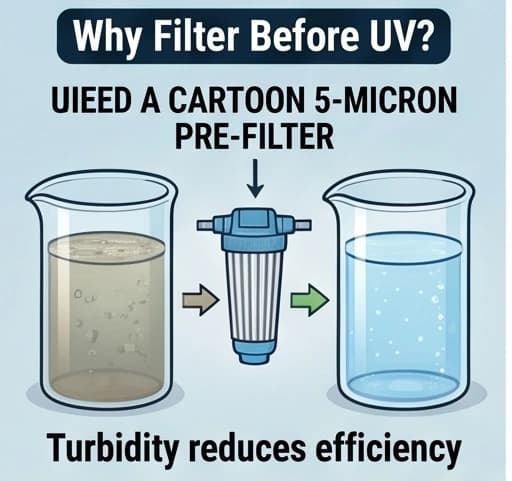
UV-C light travels through water in a straight line. Any suspended particle — a grain of sand, a rust flake, a silt particle — casts a shadow in which pathogens are shielded from UV-C radiation and survive. Beyond shielding, turbidity scatters UV-C light, reducing the effective dose delivered to pathogens at the far side of the chamber. The USEPA UV Disinfection Guidance Manual specifies a maximum turbidity of 1 NTU for UV disinfection to achieve the required log inactivation credits. Without pre-filtration, most Indian water sources fail this requirement.
What the sediment filter removes: sand, silt, rust, suspended clay, precipitated iron particles. A 5-micron polypropylene spun cartridge is the standard specification — fine enough to protect the UV chamber, coarse enough not to restrict flow.
Indian water context: Municipal supply in Delhi NCR, Mumbai, and Chennai delivers treated water, but distribution pipe age means rust particles and occasional turbidity spikes are common. Borewell water across India — especially in monsoon season — carries significant silt loads. Turbidity in borewell water can exceed 5–10 NTU during monsoon, making sediment filtration critical.
Correct stage order: Sediment filter → UV
Maintenance: Replace the cartridge every three months in normal use. During monsoon season, particularly for borewell installations in UP, Bihar, and West Bengal, monthly replacement is appropriate — turbid water loads cartridges faster. A blocked cartridge reduces flow rate and pressure, and may indicate the UV chamber is receiving turbid water.
Cost: Cartridge replacement costs Rs. 100–300 per change. This is the lowest-cost maintenance item in any treatment train and the one most directly responsible for UV performance. Skipping cartridge replacement is the single most common cause of UV system failure in the field.
Combination 2 — UV + Activated Carbon + Sediment
Combining UV with activated carbon and sediment filtration is the standard configuration for municipal water treatment at the point of use. It addresses the two most common problems with urban tap water across India: chlorine taste and biological contamination risk from distribution system failures.
What activated carbon does: Carbon block or granular activated carbon (GAC) media adsorbs chlorine, chloramines, volatile organic compounds (VOCs), taste and odour compounds, and some pesticide residues. It works through physical adsorption — contaminants bind to the enormous surface area of activated carbon particles and are removed from the water stream.
Why carbon must go before UV, not after: This is a critical safety point when combining UV with other water treatment methods. Chlorine present in municipal water absorbs UV-C radiation at 254 nm — the same wavelength used for disinfection. High chlorine levels reduce the effective UV dose delivered to pathogens. Removing chlorine before the UV stage improves UV efficiency. More importantly, an exhausted activated carbon bed — one that has exceeded its adsorption capacity — becomes a biological growth medium. Bacteria colonise exhausted carbon at high densities. If carbon is placed after UV, exhausted carbon re-contaminates water that the UV unit has already disinfected. This is a design error that makes the system unsafe.
Correct stage order: Sediment filter → Activated carbon → UV
Applications in India:
| Application | Problem Solved | Carbon Role | UV Role | Combined Result |
|---|---|---|---|---|
| Delhi NCR municipal supply | Chlorine taste + bacteria | Removes chlorine and taste compounds | Kills pathogens | Clean-tasting, microbiologically safe water |
| Punjab / Haryana borewell (agricultural area) | Pesticide residues + bacteria | Adsorbs pesticides and agrochemicals | Kills pathogens | Chemical and biological safety |
| Industrial estate water supply | VOCs + bacteria | Removes VOCs and organic compounds | Kills pathogens | Full chemical and biological protection |
| Water tanker (unknown source) | Unknown chemicals + bacteria | Broad-spectrum chemical removal | Kills pathogens | Best protection available for tanker water |
Maintenance: Replace the carbon block every six months. Replace the sediment cartridge every three months. Treat these as non-negotiable schedules — an exhausted carbon block that is not replaced becomes a bacterial growth site upstream of the UV unit.
Combination 3 — UV + Iron Removal Filter
Combining UV with an iron removal filter is essential wherever borewell water contains iron above 0.3 mg/L. This covers a large portion of North and East India. UP, Bihar, Jharkhand, West Bengal, and Assam have widespread groundwater iron contamination — iron levels of 1–5 mg/L or above are common in these states.
Why iron is critical for UV performance: Iron deposits on the quartz sleeve of the UV lamp. The quartz sleeve must remain optically clear for UV-C radiation to pass through it into the water chamber. Iron fouling — a yellow-orange deposit of iron hydroxide — coats the quartz sleeve and progressively blocks UV-C transmission. In water with iron above 1 mg/L and no iron pre-treatment, the quartz sleeve can foul severely within two to four weeks. UV dose output drops to a fraction of design specification, and the system fails to disinfect reliably — without any visible indication that it has failed. This is why combining UV with iron removal is not optional in affected areas.
Iron removal filter types:
- Birm media filter: catalytic oxidation of dissolved iron (Fe²⁺) to insoluble iron hydroxide (Fe³⁺), which is then filtered out. Works well for iron up to 3–4 mg/L with dissolved oxygen present.
- Manganese greensand filter: oxidation using potassium permanganate regeneration, effective for both iron and manganese. Handles higher iron levels.
- Air injection + sand filter: aeration oxidises iron before a sand filter removes the precipitate. Suitable for large-flow commercial and industrial systems.
Correct stage order: Iron removal filter → Sediment filter → UV
For water with manganese above 0.05 mg/L — common in the same East India groundwater regions — add a manganese filter before the sediment filter. Manganese fouling on the quartz sleeve behaves similarly to iron fouling.
Iron level guide for UV pre-treatment:
| Iron Level | Effect on UV | Pre-Treatment Required | Sleeve Cleaning Frequency |
|---|---|---|---|
| Below 0.1 mg/L | Negligible | Sediment filter only | Every 6 months |
| 0.1–0.3 mg/L | Mild fouling over time | Sediment filter sufficient | Every 3–4 months |
| 0.3–1 mg/L | Significant fouling | Iron filter + sediment filter | Every 2–3 months without iron filter |
| Above 1 mg/L | Rapid fouling — UV fails | Iron filter mandatory | UV cannot operate reliably without iron filter |
Maintenance: Backwash the iron filter monthly. Replace filter media every three to five years depending on iron load. The Philips UV-C lamp and quartz sleeve should be cleaned whenever the sleeve shows visible discolouration — and iron filtration dramatically extends the interval between cleanings.
Combination 4 — UV + RO
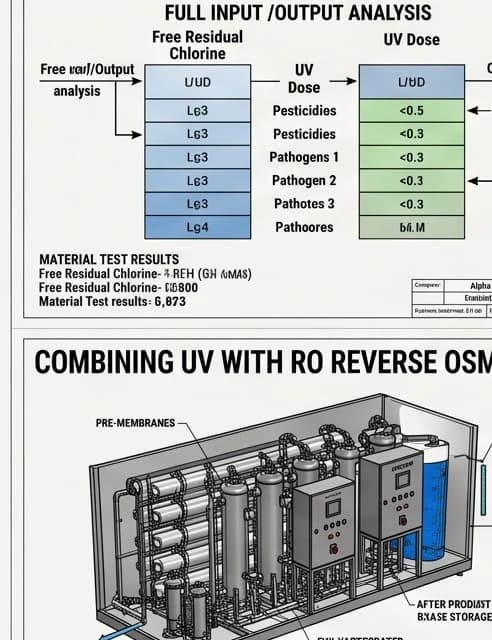
Combining UV with RO (reverse osmosis) is the appropriate system where water contains dissolved chemical contaminants that no other technology addresses: high TDS, arsenic, fluoride, nitrates, or heavy metals. RO and UV handle completely different contaminant classes, and combining UV with other water treatment methods — specifically RO — gives you a system that addresses both chemical and biological safety.
When RO is required:
- TDS above 500 ppm — common in Rajasthan, Gujarat, coastal South India, and parts of UP
- Arsenic contamination — endemic in West Bengal (Ganga delta) and Bihar
- Fluoride above 1.5 mg/L — widespread in Rajasthan, Gujarat, AP, Telangana, Karnataka
- Nitrates above 45 mg/L — Punjab and Haryana agricultural areas
- Heavy metals from industrial discharge
Critical placement rule: UV goes after RO — always. UV before an RO membrane degrades the polyamide membrane material over time. UV-C radiation attacks the polymer structure of the membrane, reducing its rejection performance and shortening membrane life significantly.
Why UV is still needed after RO: RO membranes remove bacteria by size exclusion — bacteria are too large to pass through the membrane pores. However, a membrane with microscopic defects, a compromised o-ring, or bypass seal failure allows biological breakthrough. More importantly, RO systems have a storage tank where treated water sits before use. In Indian ambient temperatures of 30–40°C, bacteria proliferate rapidly in stored RO water. UV at the outlet of the storage tank — the last stage before the tap — inactivates any bacteria that grew in the tank or passed through the membrane. This is why the Philips TUV lamp at the post-tank position is standard in all properly designed RO+UV systems.
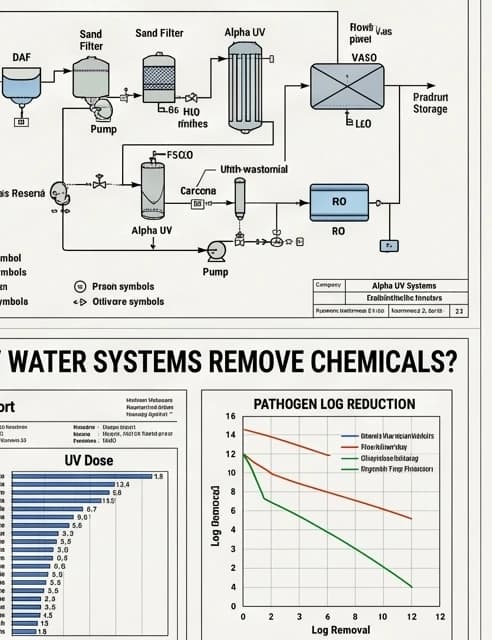
Correct stage order: Sediment filter → RO membrane → Storage tank → UV → Tap
Cost implication: RO adds Rs. 8,000–25,000 for the system plus Rs. 2,500–6,000 per year in membrane and filter maintenance. UV adds Rs. 1,200–3,000 per year for the Philips UV-C lamp replacement. For areas where RO is necessary, this is the complete solution — there is no lower-cost substitute that achieves both chemical and biological safety.
Combination 5 — UV + Water Softener
Combining UV with a water softener addresses very hard water — hardness above 300 mg/L as CaCO3 — which is common in Rajasthan, Gujarat, Haryana, and parts of UP. Hard water causes scale deposits in pipes, geysers, washing machines, and kitchen appliances. It also affects the UV system directly.
How hard water affects UV: Calcium carbonate scale deposits on the quartz sleeve of the Philips UV-C lamp exactly as it deposits on geyser heating elements. The scale builds up progressively and reduces UV-C transmission through the sleeve. In areas with very hard water, a UV system without softening upstream may require quartz sleeve cleaning every four to six weeks.
What a water softener does: Ion exchange softeners replace calcium and magnesium ions with sodium ions. The treated water no longer causes scale. UV-C transmission through the quartz sleeve is maintained, and sleeve cleaning intervals extend significantly.
Critical point: Softening does not disinfect. Ion exchange resin beds can harbour bacteria — the resin provides surface area for biofilm formation. UV after the softener inactivates any bacteria from the resin bed before the water reaches the tap. Combining UV with a water softener protects against both the scale problem and the biological risk from the softener itself.
Correct stage order: Softener → Sediment filter → UV
Maintenance: Softener regeneration with NaCl (common salt) every one to three weeks depending on hardness level and water consumption. Replace the sediment cartridge every three months. Replace the Philips UV-C lamp annually.
Complete Treatment Train Guide for Indian Water Sources
The right approach to combining UV with other water treatment methods depends on your source water. The table below maps common Indian water sources to their typical problems and the recommended treatment train for each.
| Water Source | Common Problems | Recommended Treatment Train | Priority Note |
|---|---|---|---|
| Delhi NCR municipal supply | Chlorine taste, occasional bacteria from distribution | Sediment → Carbon → UV | UV for safety; carbon for taste |
| UP / Bihar / Jharkhand borewell | Iron, bacteria, moderate TDS | Iron filter → Sediment → UV | Iron filter essential — UV fails without it |
| Rajasthan / Gujarat groundwater | High TDS, fluoride, hardness, bacteria | Sediment → RO → UV | RO essential for TDS and fluoride |
| West Bengal arsenic belt | Arsenic, iron, bacteria | Sediment → RO → UV | RO essential for arsenic removal |
| Punjab / Haryana agricultural area | Nitrates, pesticide residues, bacteria | Sediment → Carbon → RO → UV | Full train for nitrates + pesticides + pathogens |
| South India coastal areas | High TDS, salinity, bacteria | Sediment → RO → UV | RO for TDS and salinity reduction |
| Northeast India (humic acid in groundwater) | Colour from humic acids, bacteria | Coagulation → Sediment → Carbon → UV | Coagulation stage needed for humic colour removal |
| Apartment water tanker (unknown source) | Unknown chemical and biological quality | Sediment → Carbon → UV (minimum) | Test water first; add RO if TDS above 500 ppm |
What NOT to Combine with UV
Understanding what to avoid is as important as knowing the right combinations. These are the most common errors when combining UV with other water treatment methods — each one results in either reduced UV performance or re-contamination of treated water.
Activated carbon filter after UV: Exhausted carbon beds are dense bacterial growth media. Placing carbon after UV re-contaminates disinfected water before it reaches the tap. Carbon must always be upstream of UV — never downstream.
Storage tank between UV and tap without UV on the outlet: Bacteria grow in stored water, particularly in Indian summer temperatures. If there is a tank after UV, UV must be placed at the tank outlet, not the inlet. Water sitting in the tank after passing through UV will be re-contaminated by the time it is used.
UV before an RO membrane: UV-C radiation degrades the polyamide polymer in RO membranes over time. UV before RO shortens membrane life and increases rejection failure risk. UV always goes after RO.
Chlorine dosing after UV: Chlorine dosed into already UV-treated water reacts with any residual organic compounds to form trihalomethanes (THMs) — disinfection byproducts that are themselves harmful. UV-treated water does not need additional chlorination; if a residual disinfectant is needed for distribution (in large systems), this is a separate engineering decision requiring careful design.
Frequently Asked Questions
What is the correct order of filters with UV?
The universal rule for combining UV with other water treatment methods is: all pre-treatment stages come before UV, and UV is always the final stage before the tap. A typical order is: Iron removal filter (if needed) → Sediment filter → Carbon filter (if needed) → RO (if needed) → UV → Tap. Nothing goes after UV except the tap itself. If there is a storage tank, UV must be positioned at the tank outlet, not the inlet.
Do I need all these filters or just UV?
It depends entirely on your water quality. The sediment pre-filter is mandatory for every UV installation — there are no exceptions. Beyond that, the filters you need depend on what contaminants your water contains. Municipal water in Delhi NCR typically needs sediment and carbon before UV. Borewell water in UP or Bihar with high iron needs an iron removal filter before sediment and UV. Water with high TDS in Rajasthan or Gujarat needs RO before UV. Get your water tested — the test result determines which combination is right for your situation.
Can I combine UV with a water softener?
Yes, and for hard water areas — Rajasthan, Gujarat, Haryana, parts of UP — this is the recommended approach. Place the softener before the sediment filter and UV. The softener prevents calcium scale on the Philips UV-C lamp quartz sleeve, maintaining UV-C transmission. The UV inactivates any bacteria from the softener resin bed. The combination provides both scale protection and biological safety that neither technology provides alone.
Is it safe to have a storage tank after UV?
Only if UV is placed at the outlet of the tank, not the inlet. Water stored in a tank after UV treatment will be re-contaminated by bacteria that enter the tank through the air vent or grow from surface biofilm — particularly in Indian heat. The correct design is: UV treats water at the point of use, just before the tap. If a storage tank is required in the system, UV must be positioned at the tank outlet. This is one of the most important placement rules when combining UV with other water treatment methods.
Does UV work with an RO system already installed?
Yes — and if you have an RO system, adding a Philips TUV UV unit at the outlet is strongly recommended. RO removes bacteria by size exclusion, but membrane defects and storage tank bacterial regrowth in Indian ambient temperatures (30–40°C) mean RO output is not reliably safe from biological contamination. UV at the RO tank outlet, as the final stage before the tap, closes this gap. Ensure the UV is positioned after the storage tank, not between the membrane and the tank.
How many pre-filters do I actually need before UV?
At minimum, one: a 5-micron sediment cartridge filter. This is non-negotiable. Beyond that, you need only the filters that match your actual water quality problems. Municipal water usually needs sediment plus carbon — two pre-filters. Borewell water with iron needs an iron filter plus sediment — two stages. High-TDS water needs sediment plus RO — two stages. There is no benefit to adding filtration stages that address contaminants not present in your water. The right number of pre-filters is determined by a water test, not by a general rule.
Need Help Designing the Right Treatment Train?
Combining UV with other water treatment methods correctly requires knowing your source water quality. Share your water test report or describe your water source — we will recommend the right treatment train for your home or business within 24–48 hours.
WhatsApp Us for a Free Treatment Train RecommendationStandards, authorities & further reading
External references used to inform this guide. Regulations evolve — check the latest revision on each authority's site before compliance decisions.
Recommended UV Systems
Alpha UV System products for this application — powered by genuine Philips UV-C lamps.
Commercial UV Water Purification System
500 – 5,000 LPH
HACCP-compliant UV water purification for hotels, restaurants, and offices
Industrial UV Water Treatment System
5,000 – 50,000 LPH
Schedule M 2025 and HACCP compliant UV for pharma, food & beverage, and process water
Not sure which system suits your application? WhatsApp our engineers for a free recommendation →
Related solutions
See how Alpha UV System applies this to your industry or city.
Need a UV system?
Talk to our UV engineers — WhatsApp for a quote in 2 hours, or browse the full catalog on IndiaMART.