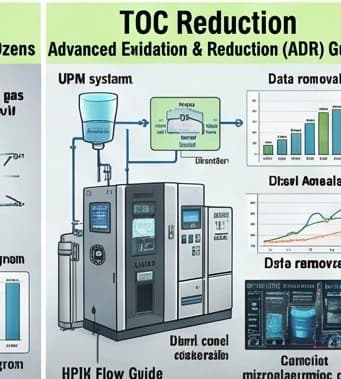
TOC (Total Oxidizable Carbon) is a measure of all organic carbon compounds dissolved in water, expressed in parts per billion (ppb) or mg/L. In pharmaceutical purified water, TOC must be below 500 ppb (0.5 mg/L) per USP <643> and Schedule M 2025. UV at 185 nm — not the standard 254 nm used for disinfection — photo-oxidises organic molecules and reduces TOC to ultra-low levels required for pharmaceutical WFI and semiconductor ultrapure water.
Total Oxidizable Carbon is a parameter most water engineers encounter in pharmaceutical, food and beverage, and semiconductor manufacturing contexts — but it matters increasingly for any application where organic contamination fuels microbial regrowth downstream of treatment. Understanding TOC, its sources, its regulatory limits, and how UV-based TOC reduction works is essential for specifying correct water treatment systems for these applications in India.
What Is TOC and Why Does It Matter?
TOC stands for Total Oxidizable Carbon — the total quantity of carbon present in organic compounds dissolved in a water sample. The "oxidizable" qualifier distinguishes it from inorganic carbon forms (bicarbonate, carbonate, dissolved CO₂) that are also present in water but are not considered pollutants in the same sense. TOC is measured in parts per billion (ppb) or milligrams per litre (mg/L), where 1 mg/L = 1,000 ppb.
In practical water treatment terms, TOC represents everything from simple molecules like acetone and acetic acid to complex humic and fulvic acids derived from decaying organic matter. Each of these carbon-containing compounds is a potential substrate for microbial growth. In a water system with no disinfectant residual — pharmaceutical purified water loops, semiconductor ultrapure water (UPW) systems, beverage ingredient water — even trace TOC levels of 100–500 ppb can sustain biofilm colonies that then produce endotoxins, particulate contamination, and further organic breakdown products.
High TOC also indicates that the water treatment train is not removing organic contamination effectively — a signal that upstream processes (multimedia filtration, activated carbon, RO membranes) may be degrading or bypassing.
TOC Regulatory Limits by Application
Different industries and regulatory frameworks set TOC limits appropriate to their product quality and contamination risk profiles:
| Application | TOC Limit | Regulatory Standard | Consequence of Exceedance |
|---|---|---|---|
| Pharmaceutical Purified Water (PW) | <500 ppb (0.5 mg/L) | USP <643>, Ph. Eur. 2.2.44, Schedule M 2025 | Batch failure, CDSCO audit finding |
| Pharmaceutical Water for Injection (WFI) | <500 ppb (0.5 mg/L) | USP <643>, Schedule M 2025 | Batch rejection, product recall risk |
| Semiconductor Ultrapure Water (UPW) — 28nm node and above | <5 ppb | SEMI F63, ITRS/IRDS roadmap | Wafer yield loss, oxide defects |
| Semiconductor UPW — advanced nodes (<10nm) | <1 ppb | SEMI F63-2019 | Critical pattern defects, fab shutdown risk |
| Food and Beverage Ingredient Water | <2,000 ppb (2.0 mg/L) | FSSAI, internal OEM specifications | Off-flavour, shelf-life reduction |
| Boiler Feed Water (high-pressure) | <200 ppb | ASME BPV Code Section I, OEM specs | Organic deposition, corrosion under deposit |
Sources of TOC in Water Treatment Systems
TOC enters water systems from several categories of source, each requiring a different control strategy:
| TOC Source | Typical Compounds | Where It Enters | Primary Control |
|---|---|---|---|
| Natural Organic Matter (NOM) | Humic acid, fulvic acid, tannins | Source water (surface, groundwater) | Coagulation, activated carbon, NF |
| Disinfection By-Products (DBPs) | Trihalomethanes, haloacetic acids, chloramines | Chlorinated municipal supply | Activated carbon adsorption |
| Leachables from system materials | Plasticisers, antioxidants, oligomers | PVC piping, hose connections, tank liners | Use of USP Class VI / food-grade materials |
| Biofilm breakdown products | Exopolymers, cellular debris, metabolites | Distribution loops, dead legs | UV disinfection, loop design, sanitisation |
| RO membrane ageing products | Polyamide degradation fragments | RO permeate after oxidant exposure | Membrane replacement, oxidant control |
| Ion exchange resin leachables | Divinylbenzene oligomers, sulphonates | DI water after new or aged resin | Resin rinsing, resin quality specification |
How UV at 185 nm Reduces TOC — The Photo-Oxidation Mechanism
Standard UV disinfection operates at 254 nm and is highly effective at inactivating bacteria, viruses, and protozoa by damaging their DNA. However, 254 nm UV does not significantly reduce TOC because most dissolved organic molecules do not absorb strongly at this wavelength.
TOC reduction by UV requires 185 nm radiation — a shorter wavelength generated only by low-pressure mercury lamps with fused silica (quartz) sleeves and lamp envelopes. Standard lamp glass (borosilicate) is opaque to 185 nm. Fused silica is transparent to it.
The 185 nm UV photo-oxidation mechanism proceeds in two parallel pathways:
Pathway 1 — Direct photolysis of organic molecules:
Organic molecule + hν (185 nm) → fragmented intermediates → CO₂ + H₂O
At 185 nm, most dissolved organic molecules absorb UV radiation and undergo direct bond-breaking. This is the direct photo-oxidation route — no intermediate reagent is required.
Pathway 2 — Hydroxyl radical generation from water:
H₂O + hν (185 nm) → ·OH + H·
·OH + organic molecule → oxidised intermediates → CO₂ + H₂O
185 nm radiation splits water molecules into hydroxyl radicals (·OH, E° = 2.80 V) and hydrogen radicals. The hydroxyl radical is the strongest oxidant in water chemistry and attacks virtually all organic molecules non-selectively, producing progressively smaller fragments until complete mineralisation to CO₂ and H₂O.
| Parameter | 254 nm UV (Disinfection) | 185 nm UV (TOC Reduction) |
|---|---|---|
| Primary function | Microbial DNA damage → inactivation | Photo-oxidation of dissolved organics → TOC reduction |
| Lamp type | Low-pressure or medium-pressure mercury, or UV LED | Low-pressure mercury with fused silica envelope only |
| Sleeve material | Borosilicate or quartz | Fused silica (synthetic quartz) — mandatory |
| Required UV dose | 16–40 mJ/cm² (drinking water), 40–80 mJ/cm² (STP) | 500–3,000 mJ/cm² (depending on inlet TOC and target) |
| Reduces TOC? | No (minimal effect) | Yes — reduces TOC by 60–95% in UPW range (<200 ppb inlet) |
| Typical application | Drinking water, STP, pharma disinfection | Pharma WFI/PW polish, semiconductor UPW, boiler feed |
| Energy consumption | 0.02–0.1 kWh/m³ | 0.2–1.5 kWh/m³ (higher dose needed) |
TOC Reduction in Pharmaceutical Water Systems
In pharmaceutical purified water systems designed to Schedule M 2025 (CDSCO Revised GMP Guidelines) compliance, the TOC treatment train typically operates as follows:
Pharmaceutical PW Treatment Train with 185 nm UV TOC Reduction:
Mains water supply → Multimedia filtration → Softening (IX) → Activated carbon adsorption (chlorine and NOM removal) → 5 µm cartridge pre-filter → RO (primary) → RO (second pass or EDI) → 185 nm UV (TOC reduction) → Mixed-bed DI or EDI polishing → 254 nm UV (final disinfection) → Purified water distribution loop
The 185 nm UV reactor is placed after the RO stage — at this point, TOC is typically in the 50–200 ppb range from RO permeate. The reactor reduces TOC to <100 ppb, often <50 ppb. The 254 nm UV at the loop return provides ongoing microbial disinfection to prevent biofilm-derived TOC from accumulating in the distribution system.
| Application | Inlet TOC (Post-RO) | Target TOC | UV Dose Required (185 nm) | Flow Rate |
|---|---|---|---|---|
| Small pharma PW system (formulation) | 50–150 ppb | <500 ppb (Schedule M) | 200–400 mJ/cm² | 0.5–2 m³/h |
| Medium pharma PW system | 100–200 ppb | <500 ppb | 400–800 mJ/cm² | 2–10 m³/h |
| WFI still feed (pre-distillation polishing) | 50–100 ppb | <100 ppb (pre-still) | 200–500 mJ/cm² | 1–5 m³/h |
| Semiconductor UPW (<5 ppb target) | 20–100 ppb | <5 ppb | 1,000–2,000 mJ/cm² | 5–50 m³/h |
| Semiconductor UPW (<1 ppb target) | 5–20 ppb | <1 ppb | 2,000–4,000 mJ/cm² | 5–50 m³/h |
TOC Measurement Methods
Accurate TOC measurement is essential both for system design (knowing the inlet TOC to size the UV reactor) and for ongoing compliance monitoring. Three principal analytical methods are used in Indian pharmaceutical and semiconductor facilities:
| Method | Principle | Detection Limit | Best For | Notes |
|---|---|---|---|---|
| Combustion / High-temperature oxidation | Sample combusted at 680–1,000°C; CO₂ measured by NDIR | 10–50 ppb | General pharma QC, municipal water | USP <643> reference method |
| UV/persulfate oxidation | UV + persulfate generates ·OH; CO₂ measured conductometrically | 1–10 ppb | Online pharmaceutical loop monitoring | Compact, low reagent use |
| Photo-catalytic oxidation | TiO₂ + UV → ·OH oxidation; CO₂ measured by NDIR or conductometry | 0.1–1 ppb | Semiconductor UPW (<5 ppb applications) | Highest sensitivity, highest cost |
For Schedule M 2025 pharmaceutical compliance, USP <643> mandates the use of a validated TOC analyser with a system suitability test using sucrose (500 ppb) and 1,4-benzoquinone (500 ppb) reference standards. Alpha UV System provides guidance on TOC analyser selection and system suitability testing as part of commissioning support.
Schedule M 2025 Water Quality Requirements
The CDSCO Revised Schedule M (2025) mandates the following water quality parameters for pharmaceutical manufacturing in India. TOC is a critical element of the purified water and WFI specifications:
| Parameter | Purified Water (PW) Limit | Water for Injection (WFI) Limit | Test Method Reference |
|---|---|---|---|
| Total Organic Carbon (TOC) | <500 ppb (0.5 mg/L) | <500 ppb (0.5 mg/L) | USP <643> / Ph. Eur. 2.2.44 |
| Conductivity | Stage 1: <4.3 µS/cm at 20°C | <1.3 µS/cm at 25°C | USP <645> |
| pH | 5.0–7.0 (Stage 2 conductivity confirms) | 5.0–7.0 | Ph. Eur. 2.2.3 |
| Total Viable Count (TVC) | <100 CFU/mL (alert: 50) | <10 CFU/100 mL | Ph. Eur. 2.6.12 |
| Endotoxins (Bacterial) | Not applicable to PW | <0.25 EU/mL | USP <85> LAL test |
| Nitrates | <0.2 ppm | <0.2 ppm | Ph. Eur. 2.4.8 |
TOC vs COD vs BOD — What Is the Difference?
These three parameters all measure organic contamination in water, but in different ways and for different applications. TOC is preferred in pharmaceutical and high-purity water because it is the most precise and does not require harsh oxidising reagents or multi-day incubation:
TOC (Total Oxidizable Carbon): Measures the total carbon content of organic molecules. Direct, accurate, fast (online measurement in seconds to minutes). Does not measure inorganic carbon. Standard in pharma and semiconductor water quality.
COD (Chemical Oxygen Demand): Measures the oxygen required to chemically oxidise organic matter using potassium dichromate. Includes both biodegradable and non-biodegradable organics. Used in industrial effluent treatment and CPCB compliance. Approximate TOC conversion: COD ≈ 2.67 × TOC (for simple organics; varies by compound).
BOD (Biochemical Oxygen Demand): Measures the oxygen consumed by bacteria to biodegrade organic matter over 5 days (BOD₅) at 20°C. Used for wastewater treatment and river quality assessment. BOD ≤ COD always; ratio BOD/COD indicates biodegradability.
Does standard 254 nm UV disinfection reduce TOC?
No. Standard 254 nm UV disinfection is effective at inactivating bacteria and viruses by damaging their DNA, but it does not significantly reduce dissolved TOC. Most dissolved organic molecules do not absorb 254 nm radiation efficiently. TOC reduction requires 185 nm UV, which is only generated by low-pressure mercury lamps with fused silica envelopes — a different lamp specification from standard disinfection lamps. Systems claiming "UV TOC reduction" using borosilicate-sleeve lamps at 254 nm will not achieve meaningful TOC reduction.
What TOC level can 185 nm UV reduce from, and what can it achieve?
185 nm UV TOC reduction is most efficient when inlet TOC is below 500 ppb — the range typical of RO permeate in pharmaceutical water systems. At inlet TOC of 50–200 ppb, a correctly sized 185 nm reactor achieves outlet TOC of <50 ppb in a single pass. For higher inlet TOC (500 ppb to 2 mg/L), the reactor must be larger or operated at lower flow rates to achieve the same outlet target. For inlet TOC above 5 mg/L, activated carbon pre-treatment or UV-AOP is required before 185 nm UV polishing. Alpha UV System engineers specify the correct reactor size based on measured inlet TOC from your system.
Why must 185 nm UV reactors use fused silica sleeves?
Standard borosilicate glass (the most common sleeve material in disinfection UV systems) blocks 185 nm radiation entirely — its UV cutoff is around 300 nm. Fused silica (synthetic quartz) transmits 185 nm with >90% efficiency. A reactor fitted with borosilicate sleeves around a 185 nm lamp will output only 254 nm radiation and will function as a standard disinfection reactor — it will not reduce TOC. Always confirm sleeve material in writing when specifying a 185 nm TOC-reduction UV system. Alpha UV System 185 nm reactors use certified fused silica sleeves with transmission verification at commissioning.
How frequently must TOC be tested under Schedule M 2025?
Schedule M 2025 does not prescribe a fixed TOC testing frequency — it requires that the pharmaceutical manufacturer maintain a validated water quality monitoring programme with alert and action limits. Industry practice (aligned with WHO TRS 970 Annex 2 and FDA guidance) is to test TOC daily from the distribution loop return at a minimum, with online continuous TOC monitoring strongly preferred for WFI systems. CDSCO inspectors typically ask for 12 months of TOC trend data during GMP audits. Alpha UV System provides guidance on online TOC monitor selection and calibration as part of pharmaceutical water system commissioning support.
Is 185 nm UV radiation safe to work around?
185 nm UV generates ozone from atmospheric oxygen when the beam is exposed to air. Enclosed UV reactors (closed-vessel flow-through design) contain the radiation entirely — no ozone is generated outside the reactor. However, if the reactor is opened for maintenance while the lamp is energised, or if the reactor is used in an open configuration, ozone generation is possible. Alpha UV System 185 nm reactors are fully enclosed with interlocked lamp shutdown on door/port opening, and include an optional ozone concentration sensor for installation in enclosed plant rooms where ventilation is limited.
Does installing 185 nm UV reduce the need for RO?
No. 185 nm UV reduces dissolved organic carbon but does not remove dissolved inorganic salts, heavy metals, endotoxins, or particles. RO is still required upstream of 185 nm UV in pharmaceutical and semiconductor water systems for conductivity, endotoxin, and dissolved solid reduction. The role of 185 nm UV is to polish RO permeate by removing the residual TOC that RO cannot eliminate — typically 50–200 ppb even after double-pass RO. The two technologies are complementary, not interchangeable.
Alpha UV System designs and supplies 185 nm UV TOC reduction reactors for pharmaceutical purified water, WFI systems, and semiconductor ultrapure water applications across India. We specify fused silica sleeve reactors, size them to your measured inlet TOC, and provide Schedule M 2025 commissioning documentation.
WhatsApp Us for TOC Reduction UV SizingStandards, authorities & further reading
External references used to inform this guide. Regulations evolve — check the latest revision on each authority's site before compliance decisions.
Recommended UV Systems
Alpha UV System products for this application — powered by genuine Philips UV-C lamps.
Commercial UV Water Purification System
500 – 5,000 LPH
HACCP-compliant UV water purification for hotels, restaurants, and offices
Industrial UV Water Treatment System
5,000 – 50,000 LPH
Schedule M 2025 and HACCP compliant UV for pharma, food & beverage, and process water
Not sure which system suits your application? WhatsApp our engineers for a free recommendation →
Related solutions
See how Alpha UV System applies this to your industry or city.
Need a UV system?
Talk to our UV engineers — WhatsApp for a quote in 2 hours, or browse the full catalog on IndiaMART.