Quick Answer
RO removes dissolved chemicals, TDS, heavy metals, and fluoride but does not kill pathogens — bacteria can grow on RO membranes and in storage tanks. UV kills all waterborne bacteria, viruses, and protozoa but does not remove dissolved chemicals. UV after RO gives you both: chemical safety from RO and biological safety from UV. This combination is recommended for high-TDS water in Rajasthan, Gujarat, Delhi, and coastal India.
Combining UV with reverse osmosis RO water treatment is the single most effective point-of-use water purification strategy available for Indian homes and businesses. RO and UV address entirely different contamination categories, and understanding what each technology does — and cannot do — is essential before choosing the right system for your water source.
What RO Does (and Cannot Do)
Reverse osmosis pushes water through a semi-permeable membrane at high pressure. The membrane has an effective pore size of approximately 0.0001 microns — small enough to reject dissolved ions, molecules, and most microorganisms by physical size exclusion.
RO is highly effective at removing dissolved chemical contaminants. It reduces TDS by 85–97%, removes heavy metals including arsenic and lead, reduces fluoride by 85–95%, reduces nitrates by 85–95%, and removes pesticides and industrial organic chemicals. For high-TDS groundwater in Rajasthan, Gujarat, and West Bengal's arsenic belt, RO is irreplaceable for chemical safety.
However, combining UV with reverse osmosis RO water treatment is necessary precisely because of what RO cannot do. RO does not kill pathogens — it excludes them by size, which is fundamentally different from inactivation. A membrane that develops a micropinhole, a bypass seal failure, or pressure-induced breakthrough allows bacteria to pass through at concentrations too low to detect by taste or smell. Additionally, bacteria do not merely pass through membranes — they colonise post-membrane tubing and storage tanks, growing in warm Indian ambient conditions of 25–40°C where they were never present in the source water at all.
RO also wastes significant water. For every 1 litre of treated water produced, 3–4 litres are discharged as reject stream. RO removes beneficial minerals — calcium, magnesium, potassium — along with contaminants, producing flat-tasting, slightly acidic water. These are the practical trade-offs of RO-only treatment.
| Contaminant | RO removes? | UV kills? | Solution |
|---|---|---|---|
| TDS / dissolved salts | Yes | No | RO alone |
| Heavy metals (arsenic, lead) | Yes | No | RO alone |
| Fluoride | Yes (85–95%) | No | RO alone |
| Nitrates | Yes (85–95%) | No | RO alone |
| Pesticides / herbicides | Yes | No | RO alone |
| E. coli / bacteria | Partially | Yes | UV after RO |
| Viruses | Partially (very small may pass) | Yes | UV after RO |
| Cryptosporidium | Yes (too large for membrane) | Yes | Both work |
| Biofilm bacteria (from membrane / tank) | No — can add these | Yes | UV after RO essential |
What UV Does (and Cannot Do)
UV-C radiation at 254 nm disrupts the DNA and RNA of microorganisms, preventing replication. At a validated dose of 40 mJ/cm², a properly designed UV system inactivates all waterborne bacteria, viruses, and protozoa — including pathogens such as E. coli, Salmonella, Vibrio cholerae, Hepatitis A virus, Rotavirus, and Cryptosporidium parvum. No pathogen known to be waterborne is resistant to UV-C at this dose.
Critically, UV adds nothing to water. There are no chemical by-products, no taste or odour change, no residual, and no alteration to mineral content. For combining UV with reverse osmosis RO water treatment, this matters because RO output water has very high UV transmittance (UVT typically above 95%) — meaning UV-C penetrates the water column exceptionally well and delivers maximum effective dose with minimum lamp power.
What UV cannot do is equally important to understand. UV does not reduce TDS, does not remove dissolved chemicals, heavy metals, fluoride, nitrates, or hardness. Water that tastes of minerals before UV treatment tastes identical after UV treatment. UV is a disinfection technology, not a filtration or chemical-removal technology. This is precisely why combining UV with reverse osmosis RO water treatment — rather than relying on either alone — is the technically correct approach for Indian water sources with both chemical and biological contamination.
Why UV After RO Is Essential
Many Indian households rely on RO alone and assume the output is microbiologically safe. This assumption carries a significant risk that is not widely understood.
RO membranes are not absolute barriers. Even well-maintained polyamide thin-film composite membranes develop micropinholes over their service life of 2–3 years. Pressure variations, chlorine breakthrough from a depleted carbon pre-filter, and manufacturing defects in lower-quality membranes all create pathways for biological breakthrough. Very small viruses — norovirus (27–32 nm), for example — are at the threshold of RO rejection and can pass through intact membranes at low concentrations. These concentrations are sufficient to cause illness but are undetectable by any household-level monitoring.
The more significant risk is post-membrane contamination. After water passes through the RO membrane, it enters a storage tank — typically a 5–10 litre bladder tank in household systems. This tank, in Indian ambient temperatures of 25–40°C, is an ideal bacterial growth environment. Bacteria that entered via tiny membrane breaches, or that were introduced during installation or tank cleaning, proliferate in stored water. Post-membrane tubing — flexible plastic tubing connecting the tank to the product tap — harbours biofilm. These bacteria leach into treated water between draw cycles.
UV installed after the RO storage tank, immediately before the product tap, destroys bacteria regardless of whether they passed through a compromised membrane or grew in the post-RO storage system. Without UV, RO-treated water sitting in a storage tank in Indian conditions is not guaranteed to be pathogen-free — regardless of how well the RO membrane is performing. Combining UV with reverse osmosis RO water treatment eliminates this risk category entirely.
System Design: Where to Position UV in an RO System
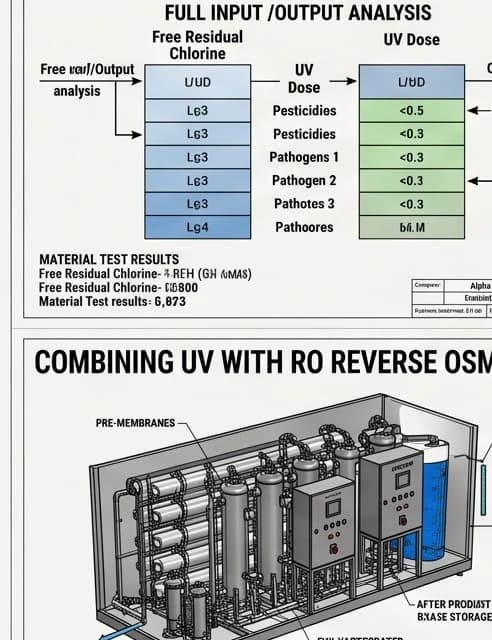
The correct position for UV in any RO system is always after the RO membrane and after the storage tank — immediately before the product tap. The flow sequence that all properly designed combined systems follow is: Raw water inlet to pre-filter (5 micron sediment), then to activated carbon filter (chlorine removal), then through the RO membrane, then to the storage tank, then through the UV chamber, and finally to the product tap.
UV must never be installed before the RO membrane. UV-C radiation at 254 nm degrades polyamide — the polymer used in all standard thin-film composite RO membranes — over time. Pre-RO UV also provides no protection against post-membrane bacterial growth, which is the primary biological risk in RO systems. Pre-RO UV is technically incorrect for both reasons.
| Setup | UV position | Why | Risk if wrong |
|---|---|---|---|
| Home under-counter RO | After RO membrane, before tap | Kills post-membrane bacteria | Biofilm in tank without UV |
| Apartment central RO plant | After RO membrane, at distribution manifold | Protects distribution pipes | Re-contamination in pipe runs |
| Commercial RO (restaurant) | After RO storage tank, before service | Tank bacteria controlled | FSSAI non-compliance risk |
| Pharma WFI loop | UV in recirculation loop after RO | Loop bioburden control | Schedule M 2025 non-compliance |
Indian Water Sources That Need RO + UV
Combining UV with reverse osmosis RO water treatment is the recommended solution across most Indian groundwater and surface water sources because Indian water quality problems are almost always dual — both chemical and biological contamination are present simultaneously. The table below maps the most common Indian water source profiles to their treatment requirements.
| Region / Source | Main Chemical Problem | Main Biological Problem | Best Solution |
|---|---|---|---|
| Rajasthan, Gujarat groundwater | Fluoride, high TDS 1,000–5,000 ppm | E. coli, bacteria | RO then UV |
| West Bengal, Bihar (arsenic belt) | Arsenic above 10 ppb | Waterborne bacteria | RO then UV |
| Coastal areas (Tamil Nadu, Kerala, Andhra) | High TDS, salinity | Bacteria, Vibrio | RO then UV |
| Delhi NCR municipal | Moderate TDS, lead from old pipes | E. coli | RO then UV, or UV alone if TDS acceptable |
| Industrial corridors (Vapi, Kanpur) | Heavy metals, industrial organics | Bacteria | RO then UV + carbon pre-filter |
| Punjab, Haryana (nitrate belt) | Nitrates above 45 mg/L | Bacteria | RO then UV |
When UV Alone Is Sufficient (Without RO)
Not every situation requires combining UV with reverse osmosis RO water treatment. If your source water TDS is below 500 ppm (the BIS IS 10500 preferred limit for drinking water) and a water quality test confirms no heavy metal or fluoride concern, UV alone provides complete microbiological protection without the trade-offs of RO.
UV without RO has meaningful advantages: it preserves beneficial minerals — calcium and magnesium that RO removes; produces zero water wastage compared to RO's 3–4 litres of reject per litre treated; operates at lower capital and annual maintenance cost; and delivers faster flow rates since there is no membrane pressure drop. For municipal water supplies in cities like Pune, Bengaluru, or Chennai where TDS is generally acceptable and the primary risk is biological contamination in the distribution network, UV alone is technically adequate and practically superior to RO.
The decision rule is straightforward: get a water quality test. If TDS is acceptable and no heavy metals or fluoride are confirmed, UV alone is the recommended solution. If TDS is elevated or chemical contaminants are present, combining UV with reverse osmosis RO water treatment becomes necessary.
Cost Comparison
| System | Purchase cost (INR) | Annual maintenance | Water waste | Minerals preserved |
|---|---|---|---|---|
| UV alone | Rs 8,000–25,000 | Rs 1,200–3,000 | None | Yes |
| RO alone | Rs 8,000–25,000 | Rs 2,500–6,000 | 3L per 1L | No |
| RO + UV | Rs 15,000–50,000 | Rs 3,700–9,000 | 3L per 1L | No (RO removed) |
| UV + Carbon pre-filter | Rs 10,000–30,000 | Rs 1,800–4,500 | None | Yes |
The cost premium for combining UV with reverse osmosis RO water treatment over RO alone is relatively modest — typically Rs 7,000–25,000 in additional capital cost depending on system size — and the operational cost addition is largely the annual Philips UV-C lamp replacement at Rs 1,200–3,000. Given that UV provides the one protection category that RO cannot (guaranteed pathogen inactivation even with membrane degradation), the addition of UV to any RO system represents strong value.
Maintenance for RO + UV Combined Systems
A combined system has more serviceable components than either technology alone, and each component has a specific service interval. Neglecting any one component undermines the protection provided by the whole system.
- Sediment pre-filter (5 micron): Replace every 3 months. A clogged sediment filter reduces RO membrane pressure and flow rate, and can allow particulates that increase turbidity of RO output and reduce UV dose.
- Activated carbon filter: Replace every 6 months. Carbon exhaustion allows chlorine through to the RO membrane, accelerating membrane degradation.
- RO membrane: Replace every 12–24 months depending on source water TDS and usage. Check TDS rejection rate quarterly — if rejection drops below 85%, membrane replacement is overdue.
- Philips UV-C lamp: Replace every 12 months (rated at 9,000 hours). UV-C output degrades progressively even when the lamp appears to be on. A lamp that has not been replaced in 18–24 months is delivering materially less than rated dose, and may provide no effective disinfection. Only genuine Philips TUV lamps should be used as replacements to maintain rated output.
- Quartz sleeve: Inspect every 3 months for scaling or fouling. Foul quartz reduces UV-C transmission to water. Replace every 2–3 years or when cleaning does not restore transmission.
- Storage tank: Clean and sanitise every 6 months. Tank biofilm is the primary post-RO contamination source that combining UV with reverse osmosis RO water treatment is designed to address — a fouled tank produces higher bacterial load that UV must inactivate.
- Water quality test: Annual. Test for TDS (to confirm RO membrane performance), E. coli (to confirm UV performance), and the specific contaminants relevant to your source water.
Frequently Asked Questions
Does my RO system already have UV built in?
Many branded household RO systems sold in India include a UV stage as a final treatment step before the product tap — this is the correct configuration. To confirm whether your system has UV, look for a UV indicator light on the unit or a separate UV lamp housing in the product water line after the storage tank. If the system has UV, check when the lamp was last replaced — most UV lamps in RO systems are replaced far less frequently than the required annual interval, making the UV stage ineffective even when the lamp appears to be on. A Philips TUV lamp replacement once a year is the minimum requirement for guaranteed performance.
Can I add UV to an existing RO system?
Yes. If your existing RO system does not have a UV stage, a compact UV unit can be installed inline on the product water line between the storage tank and the tap. The installation requires no modification to the RO membrane or pre-filter stages — only a connection into the product water tubing before the tap. Alpha UV System supplies UV units sized for household RO output flow rates (typically 100–250 LPH for a 5–10 LPH RO system). WhatsApp us with your RO system's rated product flow rate for the correct UV unit recommendation. Response within 24–48 hours.
Should UV go before or after the RO membrane?
Always after. UV must be installed after the RO membrane and after the storage tank — as the final treatment stage before the product tap. This is the only position where UV addresses the actual biological risk in an RO system: pathogens that passed through a compromised membrane and bacteria that grew in post-RO storage. UV before RO provides no meaningful benefit and may degrade the RO membrane over time.
Does UV-C damage the RO membrane?
UV-C at 254 nm does degrade polyamide, the polymer used in standard thin-film composite RO membranes, if directly exposed at high doses over time. This is exactly why the correct configuration places UV after the RO membrane — UV-C never contacts the membrane in a properly designed system. If a supplier or installer suggests placing UV before the RO membrane, this is technically incorrect and should be rejected. In combining UV with reverse osmosis RO water treatment correctly, the UV chamber is always downstream of both the membrane and the storage tank.
Is RO + UV necessary or is RO alone safe?
RO alone is not reliably microbiologically safe for the following reason: bacteria that grow in post-RO storage tanks and post-membrane tubing are not removed by the RO membrane because they were never in the feed water — they grew after the membrane, in the product water system itself. RO does not address this contamination pathway. UV after RO is the only treatment stage that eliminates bacteria in stored RO-treated water before it reaches the tap. For households in India where ambient temperatures are 25–40°C and stored water sits in tanks between draw cycles, combining UV with reverse osmosis RO water treatment is the technically correct approach. RO alone should be considered incomplete biological protection.
Does the combination of RO + UV remove Cryptosporidium?
Yes, through two independent mechanisms. Cryptosporidium oocysts are 4–6 microns in diameter — far larger than the 0.0001-micron effective pore size of RO membranes — and are physically removed by size exclusion in the RO stage. UV-C at 40 mJ/cm² also inactivates Cryptosporidium; it is one of the pathogens most effectively controlled by UV because Cryptosporidium is highly resistant to chlorine but highly susceptible to UV. In combining UV with reverse osmosis RO water treatment, Cryptosporidium is addressed by both stages independently, providing redundant protection — the standard for critical water safety applications.
Add UV to Your Existing RO System — or Get a Combined RO + UV Solution
Whether you need to add a UV stage to an existing RO unit or want a complete combined system designed for your water source in Rajasthan, Gujarat, West Bengal, Delhi NCR, or coastal India, Alpha UV System can help. We supply Philips TUV lamps and design RO + UV systems for homes, apartments, restaurants, and pharmaceutical facilities across India.
WhatsApp Us for RO + UV AdviceResponse within 24–48 hours. MSME Udyam registered. ISO 9001 certified manufacturer.
Standards, authorities & further reading
External references used to inform this guide. Regulations evolve — check the latest revision on each authority's site before compliance decisions.
Recommended UV Systems
Alpha UV System products for this application — powered by genuine Philips UV-C lamps.
Commercial UV Water Purification System
500 – 5,000 LPH
HACCP-compliant UV water purification for hotels, restaurants, and offices
Industrial UV Water Treatment System
5,000 – 50,000 LPH
Schedule M 2025 and HACCP compliant UV for pharma, food & beverage, and process water
Not sure which system suits your application? WhatsApp our engineers for a free recommendation →
Related solutions
See how Alpha UV System applies this to your industry or city.
Need a UV system?
Talk to our UV engineers — WhatsApp for a quote in 2 hours, or browse the full catalog on IndiaMART.