Quick Answer
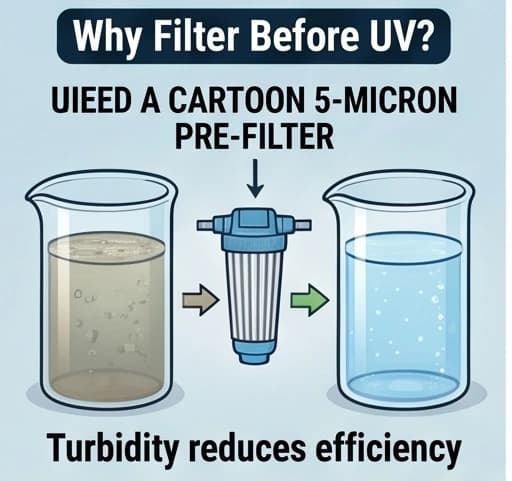
Yes. A 5-micron sediment pre-filter before UV is always required for effective disinfection. UV-C light cannot penetrate turbid water or pass through iron deposits on the quartz sleeve. Without pre-filtration, pathogens can survive behind particle shields, and the quartz sleeve fouls prematurely. For borewell water with iron above 0.3 mg/L, an iron removal filter is also needed.
If you are asking do I need a filter before UV water treatment, the short answer is yes — always. The longer answer depends on your water source, location, and the specific contaminants in your supply. This guide explains the science behind why UV needs pre-filtered water, which pre-filters Indian water sources require, the correct installation order, and what happens when pre-filtration is skipped. The guide covers municipal water in Delhi and Mumbai, iron-rich borewell water common in UP and Bihar, high-TDS groundwater in Rajasthan and Gujarat, and humic-acid-laden surface water sources in Northeast India.
Why UV Needs Clear Water
UV disinfection works by exposing pathogens — bacteria, viruses, and protozoa — to UV-C light at 254 nm. This wavelength damages their DNA and RNA, preventing replication and rendering them harmless. The critical requirement is that UV-C photons must physically reach each pathogen in the water column. Any substance that absorbs or scatters UV-C light reduces the dose delivered to the water.
The standard measure of how well water transmits UV-C is UV Transmittance (UVT), expressed as a percentage. A UVT of 100% means UV-C passes through the water with no absorption; 0% means it is completely blocked. For a UV system to deliver the standard disinfection dose of 40 mJ/cm2 at its rated flow rate, the incoming water must have UVT above 75%. This is why the question of whether you need a filter before UV water treatment is inseparable from the UVT of your specific water source.
Municipal tap water in cities like Delhi and Mumbai typically has UVT between 85% and 95% — adequate for UV disinfection with only a sediment pre-filter. Turbid borewell water common across UP and Bihar, without any pre-treatment, often measures 40–60% UVT. At that level, UV alone cannot deliver a safe dose.
| UVT Level | Water Condition | UV Dose Delivered | Disinfection Status |
|---|---|---|---|
| Above 90% | Clear municipal water | 40+ mJ/cm2 | Fully effective |
| 75–90% | Lightly turbid | 30–40 mJ/cm2 | Adequate with rated flow |
| 60–75% | Moderately turbid | 20–30 mJ/cm2 | Marginal — some pathogens may survive |
| Below 60% | Turbid or iron-rich | Below 20 mJ/cm2 | Inadequate — unsafe |
What Reduces UV Transmittance in Indian Water
Understanding what lowers UVT in your supply is the first step to specifying the correct pre-treatment. Indian water sources span a wide range of contamination profiles, and the answer to do I need a filter before UV water treatment changes significantly depending on whether you are in a major city, a North India borewell zone, or a Northeast surface water region.
- Turbid particles (sand, silt, organics): Physically shield pathogens within particle aggregates, preventing UV-C exposure. Common in surface water, monsoon-affected supplies, and shallow borewells across UP and Bihar.
- Dissolved iron and manganese: Iron(III) absorbs UV-C directly and — more critically — deposits on the quartz sleeve over time, forming a scale layer that progressively blocks UV-C from entering the water. Borewell iron above 0.3 mg/L requires an iron removal filter before UV.
- Humic acids and dissolved organic matter: Natural organic compounds from soil and decaying vegetation absorb UV-C strongly. This is especially prevalent in Northeast India, Assam, West Bengal, and areas with high surface water influence.
- Colour (yellow or brown water): Strongly coloured water indicates high humic acid content. UVT in heavily coloured water can fall below 40%, making UV treatment ineffective without coagulation and carbon pre-treatment.
- High TDS above 500 ppm: Concentrated dissolved minerals cause moderate UVT reduction. At extreme levels — above 1,500 ppm, common in Rajasthan and Gujarat groundwater — TDS can reduce UVT meaningfully and points toward RO as part of the pre-treatment train.
| Water Source | Typical UVT | Main UV Absorbers | Pre-treatment Needed |
|---|---|---|---|
| Delhi / Mumbai municipal | 85–95% | Chlorine byproducts | 5-micron sediment |
| North India borewell (iron) | 55–70% | Iron, manganese | Iron filter + sediment |
| Rajasthan / Gujarat groundwater | 70–80% | High TDS, calcium | Sediment + possible softener |
| Northeast India surface water | 40–65% | Humic acids, TSS | Coagulation + carbon + sediment |
| South India coastal groundwater | 65–80% | Salinity, organics | Sediment + carbon |
| Industrial area groundwater | 50–75% | Organics, metals | Sediment + carbon |
The Quartz Sleeve Fouling Problem
The UV lamp in any UV water treatment system sits inside a quartz sleeve — a transparent glass tube that keeps the lamp dry while allowing UV-C to pass through into the water. For the system to function correctly, this sleeve must remain optically clear. When untreated water flows directly into the UV chamber, dissolved iron, calcium, and manganese deposit on the outer surface of the sleeve over time.
Iron-fouled sleeves can reduce UV-C transmission by 30–60%, depending on iron concentration and how long the sleeve has been operating without cleaning. This is one of the most common causes of UV system failure in North India borewell installations — the lamp is running, the indicator light is on, but actual UV dose in the water has fallen well below the required 40 mJ/cm2. The system appears to be working while providing inadequate disinfection.
Fouling deposits are easy to identify visually when the sleeve is removed for inspection:
- Yellow-orange deposits: Iron scale — most common in borewell water across UP, Bihar, Haryana, and Punjab
- White chalky deposits: Calcium carbonate from hard water — common in Rajasthan and Gujarat
- Dark brown or black deposits: Manganese oxide scale — often accompanies iron in deep borewells
With proper pre-filtration, the quartz sleeve typically needs cleaning every 6–12 months. Without pre-filtration in iron-rich borewell water, the sleeve can foul within 2–3 weeks, requiring frequent manual cleaning with dilute acid — a maintenance burden that proper pre-treatment eliminates entirely. This is one of the most concrete and immediate reasons to install a filter before UV water treatment in any borewell application.
What Pre-Filters Do I Need?
The pre-treatment train required before UV depends entirely on what your water source contains. The table below and the tiered guide that follows answer the question of what filter before UV water treatment is appropriate for each Indian water type.
Always Required: 5-Micron Sediment Cartridge Filter
Every UV system installation — without exception — requires a 5-micron sediment cartridge filter immediately upstream of the UV chamber. This applies to municipal water in Delhi and Mumbai, borewell water, and any other source. The sediment filter removes sand, silt, rust particles from pipes, and suspended solids that would otherwise accumulate on the quartz sleeve. For clear municipal water, this is often the only pre-treatment needed.
For Iron Above 0.3 mg/L: Iron Removal Filter
BIS IS 10500 sets the permissible limit for iron in drinking water at 0.3 mg/L. Borewell water in UP, Bihar, West Bengal, and parts of Haryana frequently has iron concentrations of 1–5 mg/L or higher. At these levels, an iron removal filter using birm media or manganese greensand must be installed before the sediment filter. The sequence is: iron filter first, then sediment filter, then UV.
For High TDS or Fluoride (Rajasthan, Gujarat, Coastal South India): RO Before UV
Where TDS exceeds 500 ppm, or where fluoride, nitrates, or arsenic are elevated, a reverse osmosis (RO) system should precede the UV unit. RO removes dissolved salts and chemical contaminants; UV then provides microbiological safety assurance for the RO permeate. RO output typically has UVT above 90%, making UV highly effective in this position. This combination is the correct answer when people ask whether they need a filter before UV water treatment in Rajasthan groundwater conditions.
For Coloured or Humic-Rich Water (Northeast India, Surface Water): Activated Carbon
Surface water and river-influenced supplies in Northeast India — Assam, Meghalaya, Mizoram, Tripura — often carry high humic acid loads that produce yellow or brown colour and dramatically reduce UVT. For these sources, an activated carbon filter after the sediment filter removes humic acids and dissolved organic matter, raising UVT to a level where UV can deliver adequate dose. In very turbid or highly coloured sources, a coagulation step before the carbon and sediment filters may also be required.
For Very Hard Water (Above 500 mg/L Hardness): Water Softener
Hard water areas — common in parts of Maharashtra, Rajasthan, and Gujarat — produce calcium carbonate scale on the quartz sleeve. If hardness exceeds 500 mg/L, a water softener before the UV system prevents sleeve scaling and extends the interval between cleanings significantly.
| Water Type | Iron | Turbidity | TDS | Recommended Pre-treatment Train |
|---|---|---|---|---|
| Municipal (clear) | Low | Low | Moderate | 5-micron sediment filter |
| Municipal (high chlorine) | Low | Low | Moderate | Sediment + activated carbon |
| North India borewell | High | Moderate | Moderate | Iron filter → sediment → UV |
| Rajasthan / Gujarat groundwater | Moderate | Low | High | Sediment → RO → UV |
| Northeast surface / river water | Low | High | Low | Coagulation → sediment → carbon → UV |
| South India coastal | Low | Moderate | High | Sediment → RO → UV |
| Hard water areas | Low | Low | Moderate | Sediment → softener → UV |
Installation Order and Flow Direction
Getting the installation sequence right matters as much as selecting the correct pre-filters. The correct flow sequence for any UV water treatment installation is:
Water source → Sediment filter → [Iron filter / RO if required] → UV system → Distribution point
UV must always be the last treatment step before use. Any treatment stage installed after the UV system creates a risk of re-contamination, which completely undoes the disinfection. There are two specific wrong installations that are particularly common:
- Carbon filter after UV: Activated carbon filter media harbours bacteria when it is exhausted or when flow is intermittent. Installing a carbon filter downstream of UV will re-contaminate the treated water. Carbon must always go before UV — never after.
- Storage tank between UV and tap: Bacteria regrow in unpressurised storage tanks, even if the water entering the tank was UV-treated. If a storage tank is part of the system, the UV unit should be positioned on the tank outlet — treating water as it leaves the tank for use, not as it enters.
| Wrong Setup | Why It Fails | Correct Alternative |
|---|---|---|
| No pre-filter before UV | Sleeve fouls within weeks; UVT drops below safe threshold | Add 5-micron sediment pre-filter |
| Carbon filter after UV | Bacteria from carbon re-contaminate UV-treated water | Carbon before UV, not after |
| UV before storage tank | Bacteria regrow in tank; UV-treated water becomes unsafe | UV on tank outlet (last point before tap) |
| Iron-rich borewell water direct to UV | Quartz sleeve coats with iron scale within 2–3 weeks | Iron removal filter installed before UV |
Maintenance Schedule for Pre-Filters
Installing the right pre-filters is only half the answer to whether you need a filter before UV water treatment — maintaining them is equally critical. An exhausted or clogged pre-filter stops protecting the UV system. A blocked sediment cartridge causes pressure drop and reduced flow; an exhausted carbon filter releases adsorbed contaminants back into the water; a clogged iron filter allows iron breakthrough that rapidly fouls the quartz sleeve.
| Filter Type | Replacement / Service Interval | Signs Replacement Is Due |
|---|---|---|
| 5-micron sediment cartridge | Every 3–6 months (municipal); every 1–3 months (borewell) | Reduced flow at tap; cartridge visibly dark |
| Activated carbon cartridge | Every 6 months | Chlorine taste / odour returns; turbid water entering UV |
| Iron removal filter media | Backwash monthly; replace media every 3–5 years | Yellow-orange water returning; iron taste |
| RO membrane | Every 12–24 months | TDS of permeate rising; reduced output flow |
| Water softener resin | Salt refill every 2–6 weeks; resin every 8–12 years | Hard water symptoms returning; scale on fixtures |
Warning signs that your pre-filter needs replacement and is no longer protecting your UV system: reduced water pressure or flow rate at the tap downstream; turbid or discoloured water that suggests breakthrough past a spent cartridge; rapid quartz sleeve fouling that was not present before; and — in UV systems with intensity monitors — a declining UV sensor reading despite the lamp operating normally.
Cost of Pre-Filtration in India 2026
Pre-filtration is a modest investment relative to the cost of UV system downtime, premature quartz sleeve replacement, or — most importantly — waterborne illness from inadequate disinfection. The following costs reflect 2026 Indian market pricing for standard residential and small commercial pre-filter components.
| Pre-filter Type | Purchase Cost (INR) | Cartridge / Media Cost | Replacement Interval | Annual Cost (INR) |
|---|---|---|---|---|
| 5-micron sediment | 500–1,500 | 100–300 per cartridge | Every 3 months | 400–1,200 |
| Activated carbon | 800–2,500 | 200–500 per cartridge | Every 6 months | 400–1,000 |
| Iron removal filter | 2,000–8,000 | 500–1,500 media | Every 3–5 years | 300–800 |
| RO membrane | 6,000–20,000 | 2,000–5,000 membrane | Every 12–24 months | 2,000–5,000 |
For a typical North India borewell installation, the annual running cost of a properly specified pre-treatment train — iron filter plus sediment cartridge — is approximately ₹700–2,000 per year. Skipping pre-filtration and cleaning or replacing a fouled quartz sleeve costs more, and provides none of the safety assurance that proper pre-treatment delivers.
Frequently Asked Questions
My municipal water looks completely clear — do I still need a pre-filter?
Yes. Water that appears clear to the eye can still contain particles smaller than 5 microns — rust flakes from building plumbing, fine silt, and organic debris — that accumulate on the quartz sleeve over time. Additionally, municipal water quality varies seasonally. Clear winter supply in Delhi or Mumbai can become noticeably more turbid during monsoon. A 5-micron sediment filter provides consistent pre-treatment year-round and is always the minimum requirement when asking whether you need a filter before UV water treatment, regardless of how clear the water looks.
Can I use UV directly on borewell water without any pre-filter?
No. Borewell water across most of North India — UP, Bihar, Haryana, Punjab — contains elevated iron, suspended silt, and turbidity that places UVT well below the 75% minimum required for safe UV disinfection. Running borewell water directly into a UV chamber will foul the quartz sleeve within weeks, drop UV dose below 40 mJ/cm2, and create a false sense of safety where the system appears to be running but is not disinfecting adequately. An iron removal filter and sediment filter are required before UV on any iron-bearing borewell source.
What happens if I skip the pre-filter and use UV directly?
Two failure modes occur simultaneously. First, high-turbidity or high-iron water entering the UV chamber has UVT below the required threshold — some pathogens survive behind particle shields and reach the tap. Second, iron and calcium in the water deposit on the quartz sleeve, progressively reducing UV-C transmission week by week. The system continues to appear operational — the lamp is on, no alarm triggers — but actual delivered dose falls below the required 40 mJ/cm2. Both failures are invisible without a UV intensity monitor and water quality testing. This is why every UV system specification begins with the question of what filter before UV water treatment is appropriate for the source.
How do I know when my pre-filter cartridge needs replacing?
The most reliable indicator is reduced flow or pressure at the tap — a clogged sediment cartridge creates measurable resistance. Other signs include turbid or discoloured water appearing downstream of the filter (breakthrough), rapid quartz sleeve fouling that was not occurring before, or a declining reading on a UV intensity monitor. In practice, the most cost-effective approach is scheduled replacement — every 3 months for sediment cartridges in borewell installations, every 6 months for municipal water — rather than waiting for performance degradation to become visible.
Should the carbon filter go before or after the UV system?
Always before UV — never after. This is one of the most important installation rules for any UV water treatment setup. Activated carbon filter media can harbour bacteria, particularly when the carbon is exhausted or when water sits in the filter between uses. If a carbon filter is installed after UV, bacteria from the carbon will re-contaminate the UV-treated water before it reaches the tap. The correct sequence is: sediment filter first, then carbon filter, then UV as the final treatment stage before the distribution point.
Does my pre-filter need to be the same brand as my UV system?
No. Pre-filters are standardised components — a 10-inch standard cartridge housing from any reputable manufacturer accepts standard replacement cartridges. The critical specification is the micron rating (5-micron for the sediment filter immediately before UV) and the flow rate capacity (the pre-filter must handle your system's rated flow without excessive pressure drop). Brand matching between the pre-filter and the UV unit is not required. What matters is that the pre-filter is correctly sized for the flow rate, installed in the correct sequence, and maintained on schedule.
Not sure which pre-filtration setup is right for your water source?
Tell us your water source type (municipal, borewell, open well), your location, and any known water quality issues — iron, turbidity, TDS, colour. Our team will specify the complete pre-treatment train and UV system for your situation, with a written recommendation within 24–48 hours.
WhatsApp for Pre-filter AdviceStandards, authorities & further reading
External references used to inform this guide. Regulations evolve — check the latest revision on each authority's site before compliance decisions.
Recommended UV Systems
Alpha UV System products for this application — powered by genuine Philips UV-C lamps.
Commercial UV Water Purification System
500 – 5,000 LPH
HACCP-compliant UV water purification for hotels, restaurants, and offices
Industrial UV Water Treatment System
5,000 – 50,000 LPH
Schedule M 2025 and HACCP compliant UV for pharma, food & beverage, and process water
Not sure which system suits your application? WhatsApp our engineers for a free recommendation →
Related solutions
See how Alpha UV System applies this to your industry or city.
Need a UV system?
Talk to our UV engineers — WhatsApp for a quote in 2 hours, or browse the full catalog on IndiaMART.