Quick Answer: What to Know Before Buying a UV Water System
Before buying a UV water system, verify: (1) flow rate matches your peak demand in LPH, (2) the system uses a genuine Philips UV-C lamp with BIS IS 14962 certification, (3) chamber is SS 304 or SS 316 stainless steel, (4) UV dose is guaranteed at 40 mJ/cm² at rated flow, (5) a 5-micron sediment pre-filter is included or available.
Price alone is the worst guide — a Rs 4,000 system with a generic Chinese lamp may deliver less than 15 mJ/cm², providing no meaningful disinfection.
Knowing what to know before buying a UV water system is not about reading specifications — it is about knowing which specifications actually predict whether the system will keep your water safe. In the Indian market, where dozens of brands compete mostly on price and marketing language, understanding six technical factors separates a system that reliably disinfects from one that merely looks like it does.
This guide covers every factor that determines real-world performance: flow rate sizing, lamp brand and certification, chamber material, UV dose verification, pre-filtration, and after-sales support. If you are evaluating a UV system for a home in Delhi NCR, a borewell installation in a borewell-dependent region, a coastal property with high-TDS water, or a restaurant or institution, the principles are the same — only the sizing changes.
Why Most UV Buyers Get It Wrong
Most buyers approach a UV water system purchase the same way they approach most appliance purchases: compare three prices, pick the middle option, and trust the seller's assurance of "genuine" lamps. This approach works reasonably well for appliances where performance is visible. It does not work for UV disinfection.
The fundamental problem is that UV disinfection efficacy is invisible. A UV lamp that is illuminated is not the same as a UV lamp that is delivering 40 mJ/cm² of germicidal dose at your actual flow rate. Many sub-Rs 5,000 systems use counterfeit or misrepresented lamps that produce UV-C output 30–60% below their labelled rating. The system appears to work — water flows, the lamp glows — but the dose delivered is inadequate for safe disinfection.
This is not a fringe problem. Third-party testing of budget UV systems sold on Indian e-commerce platforms has repeatedly found systems claiming "40 mJ/cm² at 1,000 LPH" delivering less than 15 mJ/cm² at that flow. At 15 mJ/cm², pathogens including certain protozoa and viruses are not reliably inactivated. You cannot tell by looking at the water, smelling it, or tasting it.
Understanding what to know before buying a UV water system means understanding that the critical quality signals are in the documentation and specifications — not in the physical appearance of the unit or the price point.
Factor 1 — Flow Rate (LPH) Sizing
Flow rate is the single most critical sizing parameter when you are deciding what to know before buying a UV water system. UV dose is the product of lamp intensity and exposure time. At flow rates above the system's rated capacity, water moves through the chamber faster, exposure time drops, and dose falls below the safe threshold. The system does not warn you — it simply under-disinfects.
How to calculate your required flow rate:
- Bucket test: Time how long it takes to fill a 10-litre bucket from the tap or pump outlet. Calculate litres per minute, then multiply by 60 for LPH.
- Add 20% safety margin: Your UV system should be rated for at least 20% above your measured peak flow to account for pressure variations and future demand increases.
- For borewell installations: Match the system rating to the borewell pump's maximum output — not the average consumption. The pump can deliver full flow even when demand is lower.
| Application | Peak Demand | Recommended UV Size | Safety Note |
|---|---|---|---|
| 1–2 person flat | 250–400 LPH | 500 LPH system | One tap at a time |
| 3–5 person family (municipal water) | 400–800 LPH | 1,000 LPH system | Standard family, India |
| 5–8 person family (borewell) | 800–1,500 LPH | 2,000 LPH system | Match borewell pump output |
| Small restaurant / canteen | 1,500–3,000 LPH | 3,000 LPH system | Peak service demand, not average |
| Hotel / apartment complex | 3,000–10,000 LPH | Industrial series | Multi-point simultaneous demand |
Undersizing is the most common mistake Indian buyers make. A 500 LPH system is genuinely adequate for a single-tap kitchen filter — but installed on a borewell pump that delivers 1,200 LPH, it is delivering unsafe water at every flow above its rated capacity, with no indication that anything is wrong.
Factor 2 — Lamp Brand and Certification
If there is one factor that separates a genuine UV water system from a product that merely looks like one, it is the UV-C lamp installed inside. The lamp brand is the single most important quality indicator when you are assessing what to know before buying a UV water system.
The Philips UV-C lamp — specifically the Philips TUV series — is the most widely validated UV-C lamp in the world. Philips TUV lamps carry a 9,000-hour rated life at 80% output, meaning the lamp is certified to deliver at least 80% of its original UV-C output after 9,000 hours of operation. Reactors built around Philips TUV lamps have been validated by USEPA and DVGW (the German technical standards body). This is why reputable Indian UV manufacturers, including Alpha UV System, build around Philips UV-C lamps rather than alternatives.
Generic or Chinese OEM lamps are a different category entirely. These lamps are designed to fit the same socket dimensions as Philips lamps and are often described as "equivalent" or "compatible." In practice, third-party measurements show actual UV-C output 30–60% below the manufacturer's claimed rating, and rated life figures of 4,000–6,000 hours are regularly overstated. A lamp that delivers 60% of claimed output in a system sized for 40 mJ/cm² is delivering approximately 24 mJ/cm² — which provides inadequate pathogen inactivation for many organisms.
BIS IS 14962 is the Indian standard for UV water treatment systems. A system certified under IS 14962 has been tested to confirm it delivers its claimed UV dose. Look for this certification mark when evaluating any system for Indian domestic or commercial use.
Red flags on lamp brand:
- Lamp brand is not named in the product specification — described only as "UV lamp" or "UV-C lamp"
- Lamp described as "Philips compatible" — this means it is not a Philips lamp
- System priced below Rs 5,000 for a claimed 1,000 LPH rating — genuine Philips lamp cost alone makes this price impossible at real margins
| Feature | Philips UV-C / Philips TUV | Generic / Chinese OEM |
|---|---|---|
| Rated life (hours) | 9,000 hours at 80% output | 4,000–6,000 hours (often overstated) |
| UV-C output accuracy | ±5% from rated | ±20–40% from claimed |
| Mercury content (controlled) | Compliant with EU RoHS | Often non-compliant |
| Third-party validation | USEPA, DVGW validated reactors | Typically none |
| 5-year lamp spend (replacement cost) | Rs 4,000–12,500 | Rs 2,000–8,000 per lamp, more replacements |
| Actual 5-year total lamp spend | Rs 4,000–12,500 | Rs 6,000–20,000+ (shorter life = more replacements) |
The cost-of-ownership calculation consistently favours genuine Philips UV-C lamps over generic alternatives, even before accounting for the disinfection performance gap. Knowing this is a core part of understanding what to know before buying a UV water system in India.
Factor 3 — Chamber Material
The UV chamber is the stainless steel body that houses the lamp and through which water flows. For a UV water system to be food-grade and safe for long-term use, the chamber must be stainless steel — not plastic, not painted steel, not chrome-plated mild steel.
UV-C radiation at 254 nm degrades most plastics over time. A plastic inner liner in a UV chamber will develop micro-cracks, harbour biofilm, and may leach chemical compounds into the water stream. This is not acceptable for any drinking water application, regardless of flow rate or price point.
SS 304 is the standard specification for residential and most commercial UV chambers in India. It is corrosion-resistant under normal municipal and borewell water conditions, food-safe, and robust over the system's service life.
SS 316 is the specification for aggressive water conditions: coastal India where water has elevated chloride content, high-TDS borewell water with mineral concentrations that accelerate corrosion, and pharmaceutical or food-manufacturing applications requiring full Schedule M or HACCP compliance. SS 316 contains molybdenum, which gives it superior resistance to pitting corrosion in chloride-rich environments.
| Material | Suitable For | Not Suitable For |
|---|---|---|
| SS 304 | Residential, municipal water, standard borewell, most commercial use | Coastal high-chloride water, pharma Grade A |
| SS 316 | Coastal India, high-TDS borewell, food/pharma manufacturing, HACCP/Schedule M | No meaningful disadvantage; higher cost |
| ABS Plastic | Very low-flow under-sink residential units only | Any commercial, food, borewell, or institutional application |
| Painted / chrome-plated steel | Not suitable for any water application | Avoid regardless of seller claims |
When purchasing online, always confirm the chamber grade — not just "stainless steel." SS 304 and SS 316 are the only acceptable specifications. If a seller cannot confirm the stainless grade, treat the chamber as unspecified.
Factor 4 — UV Dose Guarantee
The UV dose is the measure of germicidal energy delivered to the water — expressed in mJ/cm² (millijoules per square centimetre). This is the performance specification that determines whether your UV system actually disinfects. It is also the specification most commonly misrepresented by budget systems.
The WHO-recognised minimum for 4-log (99.99%) pathogen inactivation in clear drinking water is 40 mJ/cm² at the rated flow rate, measured at end-of-lamp-life output (80% of initial). A system that delivers 40 mJ/cm² with a new lamp but only 25 mJ/cm² at end-of-lamp-life is under-performing for most of its service interval.
Many budget systems print "40 mJ/cm²" on the label or listing without any supporting test data. The figure is a marketing claim, not a validated performance specification. When you know what to know before buying a UV water system, you know to ask for the third-party test report or manufacturer validation document that confirms this figure at the rated flow.
How to verify UV dose claims:
- Ask for the third-party validated dose data or manufacturer test report specifying mJ/cm² at rated flow
- Ask whether the dose is specified at new-lamp or end-of-lamp-life output — the latter is the honest figure
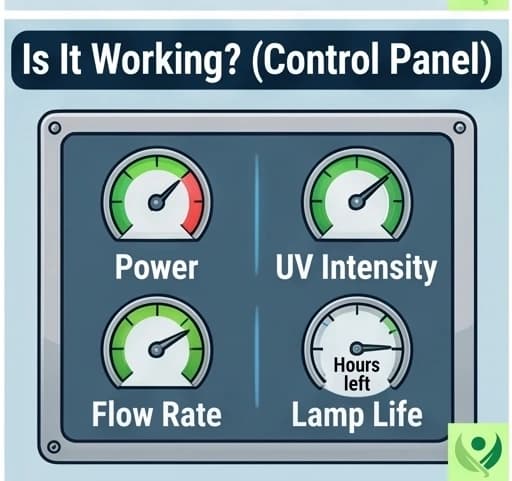
- For commercial systems: a UV intensity monitor with alarm is the only real-time way to confirm the system is delivering adequate dose throughout its service life
- BIS IS 14962 certification is the most accessible independent verification that the system delivers its claimed dose — look for this mark
A well-designed UV system from a reputable manufacturer will specify dose at end-of-lamp-life and will be happy to provide test documentation. Resistance to providing this documentation is itself a signal about product quality.
Factor 5 — Pre-Filtration Included or Required
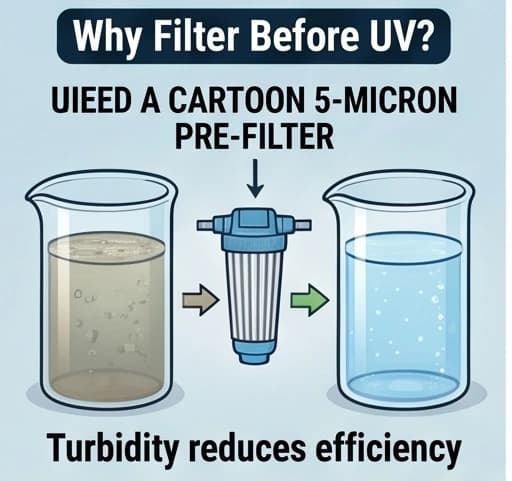
Every UV water system requires a sediment pre-filter — without exception. This is not optional equipment. Suspended particles in water can shield microorganisms from UV-C radiation, allowing pathogens to pass through even a correctly dosed UV chamber. BIS IS 14962 requires a pre-filter as part of a compliant UV water treatment system for this reason.
The minimum specification is a 5-micron sediment filter upstream of the UV chamber. For most municipal water supplies in Indian homes and Delhi NCR apartments, this is sufficient pre-treatment before UV. For borewell water, additional pre-treatment may be needed:
- Iron above 0.3 mg/L: An iron removal filter is required before the sediment filter. Iron precipitates on the quartz sleeve inside the UV chamber, coating it and reducing UV-C transmission — with no visible indication that the system's performance has degraded.
- High turbidity (NTU above 1): A sand filter or multi-media filter may be needed upstream of the sediment filter.
- High TDS borewell: Consider RO upstream of UV — RO removes dissolved solids that UV cannot address.
A significant fraction of UV systems sold online at sub-Rs 5,000 prices are listed without a pre-filter, or with a pre-filter housing but no cartridge. Many buyers do not know to add one, particularly if the seller does not mention it. When calculating the actual cost of a UV water system, the complete cost is:
Total effective purchase cost = UV system + pre-filter housing + cartridge + installation
A system sold at Rs 4,500 without a pre-filter and a system sold at Rs 7,000 with a pre-filter included may cost the same once the buyer purchases the missing pre-filter separately. Always ask: does the package include a pre-filter housing and cartridge?
Factor 6 — Warranty and After-Sales Support
A UV water system is not a one-time purchase — it requires annual lamp replacement and periodic quartz sleeve cleaning to maintain performance. The quality of after-sales support is therefore a functional part of the product, not just a commercial nicety.
The minimum acceptable warranty for any UV system is one year on the chamber and ballast (power supply / controller). The lamp itself is a consumable and is not typically covered under warranty, but the replacement lamp must be readily obtainable. If you cannot source a genuine Philips UV-C replacement lamp within 24–48 hours in your city, the system will lapse in protection when the lamp reaches end-of-life.
Questions to ask about after-sales support:
- Can I get a genuine Philips UV-C replacement lamp from a local distributor or courier within 24–48 hours?
- Is there a WhatsApp or phone support channel for troubleshooting — not just an email ticket system?
- For online-only brands: check whether spare lamps and quartz sleeves are stocked by the seller or require 5–7 day shipping from a warehouse
- Is an annual maintenance contract (AMC) available? For institutional or commercial installations, an AMC that includes scheduled lamp replacement and inspection simplifies compliance
Alpha UV System offers 24–48 hour WhatsApp support for troubleshooting across all installations, with Philips UV-C replacement lamps and spare parts available nationally through its distributor network. For commercial installations in Delhi NCR and surrounding regions, on-site support is available through the same network.
Red Flags When Buying UV Systems Online
| Red Flag | What It Signals | What to Do Instead |
|---|---|---|
| Price below Rs 4,000 for a 1,000 LPH system | Almost certainly uses a generic lamp — genuine Philips lamp cost makes this margin impossible | Budget Rs 8,000 minimum for a genuine Philips UV-C lamp system at this flow rate |
| "UV lamp" without brand name in specs | Generic or counterfeit lamp; seller cannot name the brand | Ask specifically: "Is this a Philips TUV lamp? Can you provide the lamp datasheet?" |
| No BIS IS 14962 certificate | System has not been independently tested for dose delivery | Request the certificate or choose a BIS IS 14962 certified system |
| Plastic chamber | UV-C degrades plastic; not food-grade for most applications | Insist on SS 304 minimum; SS 316 for coastal or commercial use |
| "99.9% bacteria killed" without dose spec | Marketing claim without a performance specification — meaningless without mJ/cm² figure | Ask for the UV dose in mJ/cm² at the rated flow rate |
| No pre-filter in the package for borewell use | Buyer typically does not know they need one; system will under-perform immediately | Budget separately for a 5-micron pre-filter; add iron filter if iron is above 0.3 mg/L |
What to Ask the Seller Before Buying
Armed with an understanding of what to know before buying a UV water system, here are the seven questions every buyer should get answered before placing an order — whether buying from a local dealer, an e-commerce platform, or directly from a manufacturer:
- What lamp brand is installed — Philips TUV or another brand? If the seller cannot name the brand, treat it as a generic lamp.
- What is the UV dose in mJ/cm² at the rated flow? The answer must be a number — not "40 mJ/cm²" as a brand claim, but supported by a test document.
- Is this system BIS IS 14962 certified? Request the certificate number if the seller claims certification.
- What is the chamber material — SS 304, SS 316, or plastic? "Stainless steel" without a grade is not a specification.
- Does the package include a pre-filter? What micron rating? If not, factor in the additional cost of a 5-micron housing and cartridge.
- How do I get a replacement lamp in my city, and how long does delivery take? Confirm availability before purchase, not at lamp replacement time.
- What is the warranty period and what does it cover? Confirm whether chamber, ballast, and quartz sleeve are covered — and what the process is for a warranty claim.
A seller who can answer all seven questions with documentation has a product worth evaluating. A seller who deflects, changes the subject, or provides only verbal assurances on two or more of these questions is a signal to look elsewhere.
Frequently Asked Questions
How do I know if the UV lamp is a genuine Philips lamp?
A genuine Philips UV-C lamp (Philips TUV series) will have the Philips logo printed on the lamp tube itself, a lamp code matching Philips product documentation, and a country of manufacture of the Netherlands or Poland. The seller should be able to provide the Philips lamp datasheet or Certificate of Analysis on request. If the lamp is described as "Philips compatible," "equivalent," or "OEM," it is not a genuine Philips lamp. If the lamp has no visible brand marking, it is a generic lamp regardless of what the seller says. Always ask for the lamp to be photographed with the markings visible before purchase if buying online.
Is a more expensive UV system always better?
Not automatically — but below a certain price point, a system cannot contain genuine Philips UV-C lamps and SS 304 or SS 316 chambers and still be profitable for the seller. For a 1,000 LPH system with genuine Philips UV-C lamp, the minimum realistic retail price is approximately Rs 7,000–9,000. Systems priced significantly below this are making compromises on lamp quality, chamber material, or both. Above that floor, higher price should buy better features — UV intensity monitoring, better build quality, longer warranty, and stronger after-sales support — not simply a more expensive lamp that performs the same function.
What flow rate UV system do I need for a 3-BHK apartment?
A 3-BHK apartment in India with 4–6 occupants on municipal water supply typically needs a 1,000 LPH system at minimum. If the apartment has simultaneous demand from kitchen and bathroom taps, or if the building uses a booster pump that can deliver above 700–800 LPH at a single point, a 2,000 LPH system is the more appropriate choice. Use the bucket test: fill a 10-litre bucket at your main inlet or storage tank outlet, time it, and calculate the LPH. Add 20% for the safety margin, then select the next standard system size above that figure.
Should I buy a UV system online or from a local dealer?
For residential units where the specifications are straightforward — flow rate and lamp brand — purchasing online from the manufacturer's official website or an authorised distributor is practical, provided you can verify the seven questions listed above. For borewell installations with pre-treatment requirements, commercial applications, or any use case requiring documentation (FSSAI, HACCP, pharmaceutical), purchasing through a local representative who can provide installation, commissioning, and compliance documentation is strongly preferable. Online-only sellers typically cannot provide the commissioning support that commercial installations require. The key risk with online purchase is receiving a unit that differs from the specification shown in the listing — which is why asking for lamp documentation before purchase matters.
Can I buy a UV system without a pre-filter if my water looks clear?
No. Water clarity is not an indicator of particulate content at the 5-micron level that matters for UV disinfection. Municipal water that appears clear can contain fine suspended particles, rust fragments from old pipework, and sediment that is invisible to the naked eye. Borewell water that looks clear at the tap may contain iron in dissolved form that precipitates on the quartz sleeve inside the UV chamber. A 5-micron pre-filter is not optional — it is part of the minimum system specification, required by BIS IS 14962, and essential for maintaining UV-C transmission through the chamber over the system's service life. Always include a pre-filter, regardless of what the water looks like.
How long will an Alpha UV system last before I need to replace it?
The stainless steel chamber and ballast of an Alpha UV system are designed for a service life exceeding 10 years with normal use. The UV-C lamp requires annual replacement at approximately 8,000–9,000 hours of continuous operation. The quartz sleeve protecting the lamp should be inspected annually and replaced when fouling is visible or every 2–3 years. The pre-filter cartridge is replaced every 3–6 months depending on water quality and flow volume. The effective system life is therefore determined by maintenance discipline rather than hardware durability — a system that receives annual lamp changes, sleeve inspections, and pre-filter cartridge replacements will perform reliably for over a decade. Alpha UV's 24–48 hour WhatsApp support is available for lamp replacement guidance, troubleshooting, and spare parts ordering throughout this period.
Not sure which UV system is right for your home or business?
Tell us your flow rate, water source, and application — we will recommend the right system size, pre-filtration setup, and chamber specification, with transparent pricing and no obligation. Our team responds within 24–48 hours.
WhatsApp Us for Free Buying Advice
Standards, authorities & further reading
External references used to inform this guide. Regulations evolve — check the latest revision on each authority's site before compliance decisions.
Recommended UV Systems
Alpha UV System products for this application — powered by genuine Philips UV-C lamps.
Commercial UV Water Purification System
500 – 5,000 LPH
HACCP-compliant UV water purification for hotels, restaurants, and offices
Industrial UV Water Treatment System
5,000 – 50,000 LPH
Schedule M 2025 and HACCP compliant UV for pharma, food & beverage, and process water
Not sure which system suits your application? WhatsApp our engineers for a free recommendation →
Need a UV system?
Talk to our UV engineers — WhatsApp for a quote in 2 hours, or browse the full catalog on IndiaMART.