Quick Answer
The most reliable way to know if your UV water system is working is a UV intensity monitor — a sensor that measures actual UV-C output in real time. Without one, check the lamp indicator light, verify lamp hours are within 9,000 hours, inspect the quartz sleeve for fouling, confirm flow rate is within rated capacity, and run an annual water quality coliform test.
How do I know if UV water system is working? It is one of the most important questions any household or facility relying on UV disinfection should be able to answer. This guide covers every reliable verification method in order of accuracy — from the gold-standard UV intensity monitor to a once-a-year laboratory coliform test. Whether you are running a UV system in a Delhi NCR apartment on municipal supply or treating borewell water for a family in rural Haryana, the six methods below apply equally.
Why UV Failure Is Invisible
A burst pipe announces itself immediately. A UV system that has stopped disinfecting gives no warning at all. Water continues to flow at the same pressure, appearance, taste, and smell — even if the lamp has completely failed, the quartz sleeve is blocked with iron scale, or the system is running at twice its rated flow rate. This invisibility is what makes understanding how do I know if UV water system is working an essential — not optional — question for every UV system owner.
There are four silent failure modes that account for the vast majority of cases where a UV system appears to be running but is not delivering adequate disinfection dose:
- Expired lamp: A Philips UV-C lamp loses output gradually. At 9,000 hours it drops below 80% of initial UV-C output — still lit, still appearing to function, but no longer delivering adequate germicidal dose at rated flow.
- Fouled quartz sleeve: Iron deposits, calcium scale, or biofilm on the quartz sleeve block UV-C transmission from lamp to water. A heavily fouled sleeve can reduce UV-C reaching the water by 40–60%, without any visible change to the system's exterior behaviour.
- Excessive flow rate: UV dose depends on both intensity and exposure time. If water demand temporarily or permanently exceeds the system's rated capacity, contact time drops and delivered dose falls below safe levels — even with a brand-new lamp.
- Power supply issue: Voltage fluctuations common in Indian borewell pump circuits, particularly in states like UP, Bihar, and Rajasthan, can cause the electronic ballast to operate the lamp at reduced power — reducing UV-C output without triggering any visible alarm.
Each of these failure modes produces water that looks, smells, and tastes completely normal. That is precisely why every UV system owner needs a structured, repeatable answer to the question: how do I know if UV water system is working right now — and how do I know it was working yesterday?
Method 1 — UV Intensity Monitor
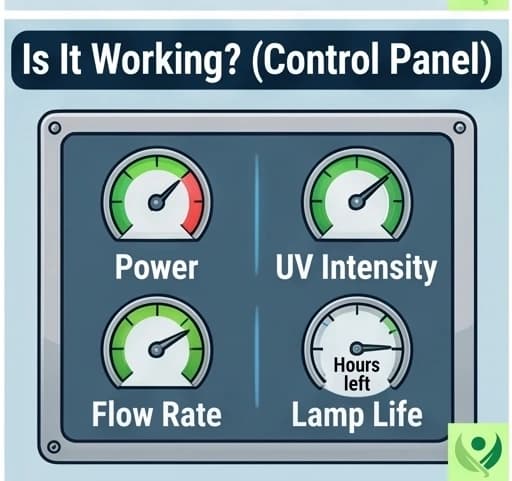
The definitive answer to how do I know if UV water system is working in real time is a UV intensity monitor. This is a calibrated UV-C photodiode sensor mounted through the reactor chamber wall, positioned to measure actual UV-C irradiance at a representative point inside the chamber. The reading is displayed continuously in mW/cm² on a panel-mounted digital display, and an alarm relay triggers automatically if output drops below a configured safe threshold — typically 20 mW/cm².
A UV intensity monitor answers all four silent failure modes simultaneously: a failed lamp produces zero output, a fouled sleeve drops the reading below threshold, a power supply problem reduces the displayed value. The monitor catches every scenario automatically without requiring any manual check.
UV intensity monitors are standard on all commercial and industrial Alpha UV systems and available as an add-on for residential systems. They are strongly recommended for Indian households using borewell water or open well water — sources with variable iron and turbidity common across Delhi NCR, western UP, and Punjab.
The table below explains how to interpret UV intensity monitor readings:
| Reading | Meaning | Action Required |
|---|---|---|
| Above 20 mW/cm² | Safe — adequate UV dose | No action needed |
| 15–20 mW/cm² | Warning zone — lamp degrading | Plan lamp replacement within 4 weeks |
| Below 15 mW/cm² | Insufficient dose — unsafe | Replace lamp immediately; do not use water for drinking |
| Zero reading | Lamp failure or sensor fault | Stop use; replace lamp; check sensor connection |
Method 2 — Lamp Indicator Light
Nearly every residential UV system sold in India includes a lamp indicator LED on the control panel or mounted directly on the system body. A green light indicates the lamp circuit has electrical continuity — the lamp is powered and illuminating. This is the first check most users make when asking how do I know if UV water system is working, and it is a reasonable starting point — but with a critical limitation that is frequently misunderstood.
The lamp indicator light tells you the lamp is electrically on. It does not tell you the lamp is producing adequate UV-C output.
A Philips UV-C lamp that has operated for 10,000 hours — more than 400 days of continuous use — will still illuminate. The visible light output (which is mostly in the visible violet range) changes very little as the lamp ages. But UV-C output in the germicidal 254 nm band degrades significantly after 9,000 hours. A lamp that has run for 14,000 hours may still show a green indicator light while delivering less than 50% of its rated UV-C dose.
Use the lamp indicator as a first-line check only. A dark indicator means the lamp has completely failed — an urgent problem requiring immediate action. A green indicator means the lamp is powered but tells you nothing about whether adequate germicidal dose is being delivered. To answer how do I know if UV water system is working properly, combine the indicator check with one or more of the methods below.
Method 3 — Lamp Hours Tracking
The Philips UV-C lamp has a rated life of 9,000 hours at 80% UV-C output. This is not a manufacturer's caution — it is the engineering basis for UV system dose calculations. At 9,000 hours, UV-C output drops below 80% of initial rated output, which means at the system's rated flow rate, the water no longer receives the full design dose of 40 mJ/cm².
Tracking lamp hours is a precise and reliable way to know how do I know if UV water system is working over its operational life. Commercial Alpha UV systems include a lamp-hours counter in the control panel. For residential systems without a counter, log the lamp installation date and calculate hours based on daily usage.
| Daily Hours of Use | Hours to Reach 9,000 h | Replacement Interval |
|---|---|---|
| 24 hours/day (continuous) | 375 days | Annual (every 12 months) |
| 12 hours/day | 750 days | Every 25 months |
| 8 hours/day | 1,125 days | Every 37 months |
| 4 hours/day | 2,250 days | Every 75 months |
For any UV system used for drinking water — regardless of calculated hours — the practical recommendation is to replace the Philips UV-C lamp annually. Indian households frequently have variable power supply, which can stress the electronic ballast and accelerate lamp degradation beyond the rated curve. Annual replacement at a predictable calendar date eliminates uncertainty and ensures you always know how do I know if UV water system is working: the answer is always "lamp is within first-year operation."
Method 4 — Quartz Sleeve Inspection
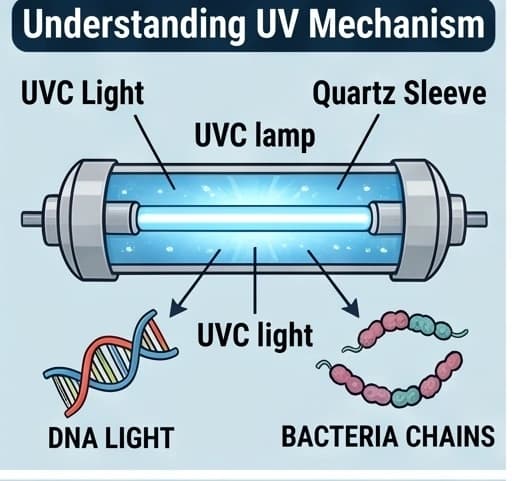
The quartz sleeve is the transparent tube surrounding the UV lamp inside the reactor chamber. It keeps water away from the electrical lamp assembly and transmits UV-C radiation from the lamp into the water stream. UV-C transmission through clean quartz is typically 90–95%. Fouling reduces this dramatically — and a fouled sleeve is one of the most common reasons how do I know if UV water system is working remains unanswered even after a lamp replacement.
In Indian borewell water contexts — particularly in Delhi NCR, Haryana, and western UP where groundwater commonly contains iron at 1–5 mg/L and hardness above 300 mg/L as CaCO3 — quartz sleeves can foul significantly within three to six months without any pre-treatment. A sleeve with visible orange-brown iron staining may transmit as little as 40–50% of UV-C, cutting effective dose in half even with a brand-new lamp. This is one of the most common reasons Indian UV system users ask how do I know if UV water system is working — they have replaced the lamp but not cleaned the sleeve.
To inspect the quartz sleeve: shut off the water supply to the UV system, depressurise by opening a downstream tap, remove the lamp end cap, slide out the lamp carefully, then remove the sleeve. Hold it up to a light source and look through it lengthwise.
| Sleeve Appearance | Problem | Action |
|---|---|---|
| Clear, transparent | Good condition | No action needed |
| Light haze | Minor fouling | Clean with citric acid solution |
| Orange or yellow staining | Iron deposits | Soak in citric acid (30 g/L) for 30 minutes |
| White scale | Calcium buildup | Soak in citric acid (30 g/L) for 1 hour |
| Cracked or chipped | Physical damage | Replace sleeve immediately — do not operate |
After cleaning, dry the sleeve thoroughly and inspect again before reinstalling. Do not use abrasive cloths or steel wool — only non-abrasive wipes. If citric acid soaking does not restore clarity, replace the sleeve.
Method 5 — Flow Rate Verification
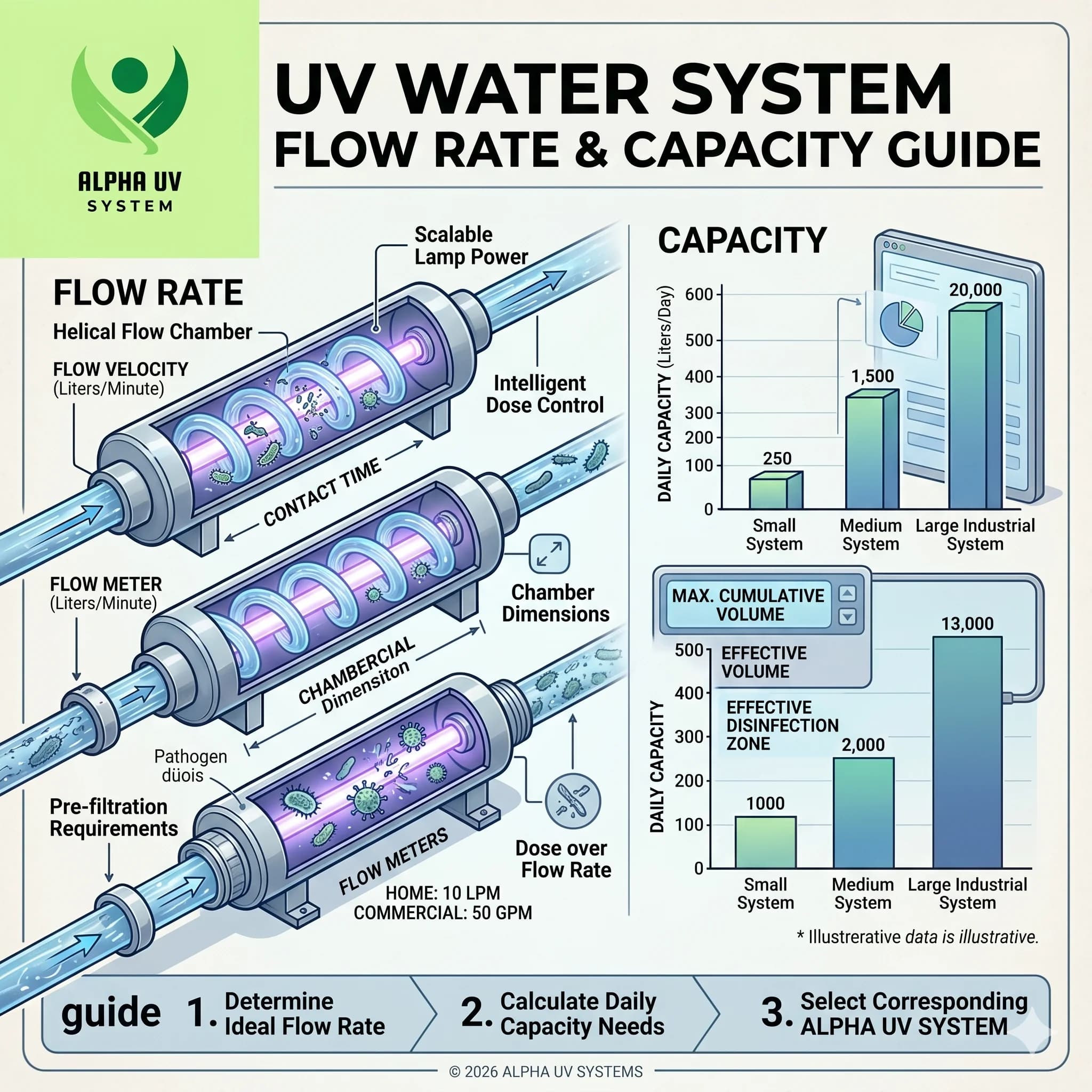
UV disinfection dose is the product of UV intensity and exposure time: Dose (mJ/cm²) = Intensity (mW/cm²) × Time (seconds). When water flows through the reactor faster than the rated design flow, exposure time drops proportionally and so does delivered dose. This is a frequently overlooked answer to how do I know if UV water system is working — the lamp may be new, the sleeve clean, and the monitor reading fine at low flow, but during peak demand the system is under-dosing.
Common peak demand situations in Indian households include multiple taps running simultaneously during morning hours, connection to an extended joint-family or multi-floor setup after original sizing, and addition of new fixtures post-installation.
To measure your peak flow rate: use a clean 10-litre bucket and a stopwatch. Open the tap fully during a period of high demand, fill the bucket, and time it. Flow rate in LPH = (10 litres ÷ seconds to fill) × 3,600.
| Flow as % of Rated | UV Dose Delivered | Disinfection Status |
|---|---|---|
| Up to 100% | 40 mJ/cm² (rated dose) | Safe |
| 125% | 32 mJ/cm² | Borderline — marginal for some viruses |
| 150% | 27 mJ/cm² | Insufficient for full 4-log kill |
| 200% | 20 mJ/cm² | Unsafe — significant pathogen risk |
If measured peak flow exceeds the rated system capacity, the UV system is structurally under-sized for your current demand. The correct resolution is to upgrade to a higher-capacity system — not to reduce water use or operate the existing system with the expectation that it is protecting you.
Method 6 — Water Quality Coliform Test
When someone asks how do I know if UV water system is working at the biological level — not just instrumentally — the definitive answer is a laboratory microbiological water quality test. No sensor reading can substitute for evidence of actual pathogen elimination in the treated water itself. An annual coliform test should be part of every drinking water UV system's maintenance routine — particularly for Indian households on borewell or open well sources where seasonal contamination events are common.
Request a test for Total Coliform and E. coli in the treated water (post-UV). These are the standard indicator organisms used to confirm microbiological safety of drinking water under BIS IS 10500:2012 and WHO Guidelines for Drinking Water Quality.
How to collect the sample: Use the sterile bottle provided by the laboratory. Collect from a tap directly downstream of the UV system — not from a storage tank, which can introduce recontamination. Run the tap at full flow for two minutes first, fill the bottle without touching the rim or interior.
Where to test in India: NABL-accredited private labs (search "NABL lab water testing" + your city), state Public Health Engineering (PHE) department labs, BIS-approved labs, or FSSAI-accredited labs for food service applications. Cost is approximately Rs 300–800 for a Total Coliform and E. coli panel.
Interpreting results: A correctly functioning UV system at rated flow should produce Total Coliform absent in 100 mL and E. coli absent in 100 mL. A negative coliform result directly answers how do I know if UV water system is working — it confirms biological safety at the source. A positive coliform result in post-UV water is a definitive indicator of system failure; proceed immediately to lamp replacement, sleeve cleaning, flow rate verification, and re-testing.
Verification Schedule
The six methods above each answer how do I know if UV water system is working at a different time horizon and level of certainty. Together they form a complete maintenance calendar. The table below integrates all six into a practical schedule for Indian residential and light commercial UV systems.
| Check | Frequency | Method | If Problem Found |
|---|---|---|---|
| UV intensity monitor reading | Daily (automatic) | Monitor display | Replace lamp / clean sleeve |
| Lamp indicator light | Weekly | Visual check | Investigate if light is dark |
| Lamp hours | Monthly | Log or calendar | Replace at 9,000 hours |
| Quartz sleeve inspection | Every 3 months | Visual + citric acid test | Clean or replace sleeve |
| Flow rate check | Every 6 months | 10-litre bucket test | Upgrade system if flow exceeds rating |
| Water quality coliform test | Annual | NABL lab submission | Immediate lamp and sleeve investigation |
What to Do When Your UV System Fails
If any of the checks above indicate your UV system is not performing correctly — or if you simply cannot answer how do I know if UV water system is working with confidence — the immediate priority is to protect the people drinking the water before diagnosing the system.
Step 1 — Stop using the water for drinking immediately. Switch all drinking and cooking water to boiled water (rolling boil for at least one minute) or sealed bottled water. Do not wait for the diagnosis to be complete before taking this step.
Step 2 — Identify the failure mode. The three most common causes are lamp failure or end-of-life, fouled quartz sleeve, and power supply instability causing the ballast to run at reduced power — a more common issue in Indian borewell pump circuits with voltage fluctuations than in stable municipal supply scenarios.
Step 3 — Replace the lamp. Lamp replacement is a 15-minute DIY task requiring no plumber and no specialised tools — shut off water, remove the end cap, slide out the old lamp, insert the new Philips UV-C lamp, replace end cap, restore supply. The lamp is the most common failure point and the most cost-effective first resolution to try.
Step 4 — Clean or replace the sleeve simultaneously with the lamp replacement. If the sleeve is visibly fouled, clean with citric acid as described above. If it is damaged, replace it before restarting.
Step 5 — Confirm resolution. After repair, run the system for 24 hours and submit a post-UV water sample to an NABL lab before resuming normal use. A negative coliform result is the only way to be fully certain — and is the most authoritative answer to how do I know if UV water system is working correctly again.
For remote diagnostic support on Alpha UV systems, contact our technical team via WhatsApp with the system model, lamp installation date, and a description of the symptom. We provide diagnostic guidance with a 24–48 hour response.
Frequently Asked Questions
The questions below address specific scenarios that come up most often when Indian UV system owners ask how do I know if UV water system is working in their particular situation.
My lamp indicator is green — does that mean my UV system is working?
Not necessarily. A green lamp indicator confirms the lamp has electrical continuity — not that it is producing adequate UV-C output at 254 nm. A Philips UV-C lamp beyond 9,000 hours will typically still illuminate while delivering less than 80% of its rated germicidal dose. The green light is a necessary condition (a dark light means definite failure) but not a sufficient answer to how do I know if UV water system is working. Combine it with lamp-hours tracking and a UV intensity monitor reading.
How often should I test my water after UV treatment?
At minimum once a year for residential systems on municipal supply — annual coliform testing is part of how do I know if UV water system is working at the biological level. For borewell or open well sources — common across Delhi NCR, UP, Haryana, Bihar, and Rajasthan — test every six months, since groundwater quality shifts seasonally with monsoon infiltration and nearby agricultural activity. For food service, healthcare, or institutional UV systems, quarterly testing is the appropriate minimum.
Can I test UV-C output myself at home?
Not with meaningful accuracy. Consumer UV detection cards are calibrated to UV-A (315–400 nm), not UV-C (200–280 nm), and give false-positive responses to sunlight. A properly calibrated UV-C photodiode meter costs Rs 15,000–50,000 and requires periodic recalibration — not a practical home tool. The reliable home answer to how do I know if UV water system is working is lamp-hours tracking, quartz sleeve inspection, and annual coliform testing, with a UV intensity monitor if you want continuous real-time confirmation.
What happens if I ignore a UV intensity alarm?
Ignoring a UV intensity alarm means using water your own system is telling you is inadequately disinfected — it is the clearest possible negative answer to how do I know if UV water system is working. On borewell water with detectable coliform in the source — the normal situation for millions of Indian households — an unaddressed alarm means drinking water that may contain E. coli or waterborne viruses at unsafe levels. Children, elderly individuals, and immunocompromised persons face substantially higher risk. There is no safe duration for ignoring a UV intensity alarm.
My lamp is only 6 months old — do I still need to check it?
Yes. A 6-month-old lamp is unlikely to have end-of-life degradation, but the other three silent failure modes still apply: the quartz sleeve may have fouled on high-iron borewell water, peak flow may have increased with added fixtures, and a power supply event may have damaged the ballast. A 6-month-old lamp does not fully answer how do I know if UV water system is working — only the complete check set does. The inspection takes under 10 minutes.
Can I use a UV system without a UV intensity monitor?
Yes — most residential UV systems in India operate without one, relying on lamp-hours tracking, annual lamp replacement, sleeve inspection, and periodic water quality testing. This is adequate for clean municipal supply and healthy adults when the schedule is followed consistently. For borewell or well water, households with infants, elderly, or immunocompromised members, or any commercial application, a UV intensity monitor is strongly recommended. It converts the question "how do I know if UV water system is working?" from a periodic uncertainty into a continuously alarmed fact.
Need Help Checking Your UV System?
If you are unsure how do I know if UV water system is working for your specific installation, our technical team can guide you through a diagnostic checklist remotely. We support Alpha UV systems across India with 24–48 hour response via WhatsApp.
WhatsApp Us for UV System DiagnosticsStandards, authorities & further reading
External references used to inform this guide. Regulations evolve — check the latest revision on each authority's site before compliance decisions.
Recommended UV Systems
Alpha UV System products for this application — powered by genuine Philips UV-C lamps.
Commercial UV Water Purification System
500 – 5,000 LPH
HACCP-compliant UV water purification for hotels, restaurants, and offices
Industrial UV Water Treatment System
5,000 – 50,000 LPH
Schedule M 2025 and HACCP compliant UV for pharma, food & beverage, and process water
Not sure which system suits your application? WhatsApp our engineers for a free recommendation →
Need a UV system?
Talk to our UV engineers — WhatsApp for a quote in 2 hours, or browse the full catalog on IndiaMART.