Quick Answer
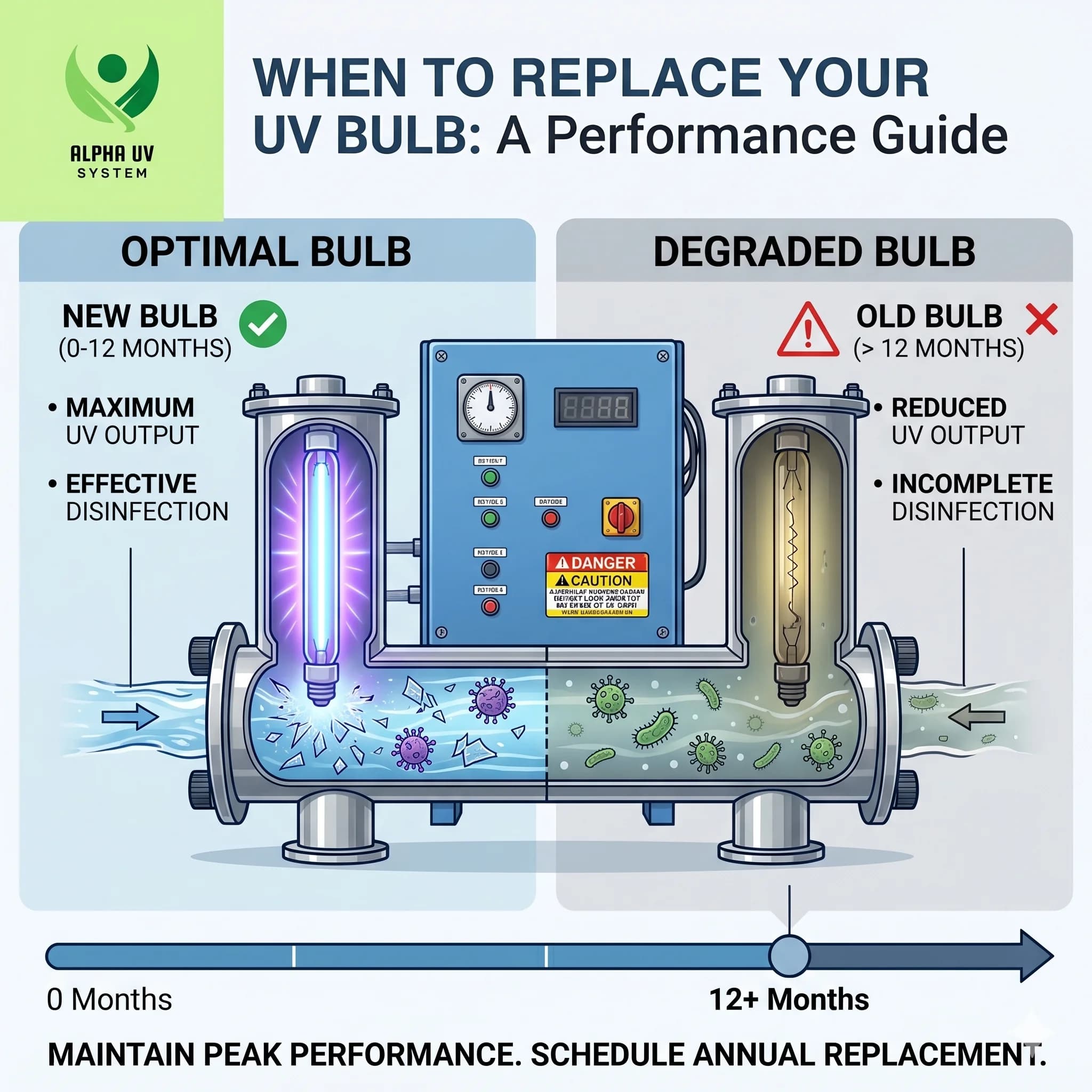
Replace your UV lamp annually or at 9,000 operating hours — whichever comes first. Philips UV-C lamps degrade to 80% output at 9,000 hours; beyond this, the UV dose drops below the safe 40 mJ/cm² threshold. The lamp will still glow, but it is no longer disinfecting your water reliably. For drinking water safety, annual replacement is the standard — the lamp cost (₹800–2,500) is minimal compared to health risk.
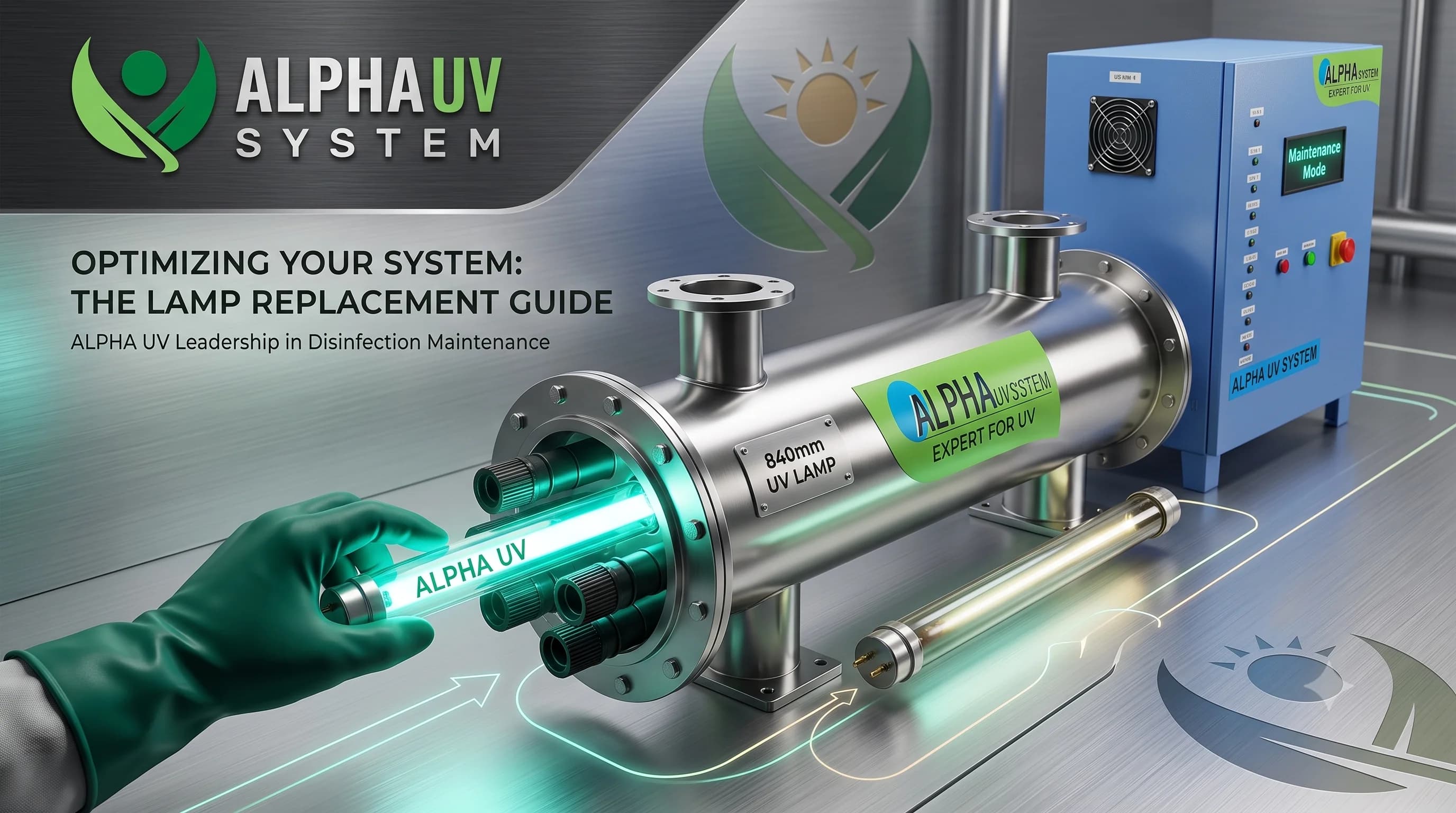
Knowing when to replace a UV bulb lamp in a water system is the single most important maintenance decision for any UV disinfection setup — residential or industrial. Unlike a conventional light bulb that fails visibly, UV-C lamps continue to emit visible purple-blue light long after their germicidal output has degraded to unsafe levels. This guide covers every scenario: how UV lamp degradation works, the 9,000-hour rule, a full decision table, replacement timing by daily usage, and a step-by-step replacement procedure tailored to Indian home and business contexts.
Why UV Lamps Need Replacement Even When Still Glowing
The most dangerous misconception about UV water treatment is that a glowing lamp is a working lamp. UV lamp output is not constant — it degrades gradually and invisibly over the lamp's rated life. Understanding this degradation is the foundation of knowing when to replace your UV bulb lamp in a water system.
The Mechanism of UV-C Output Degradation
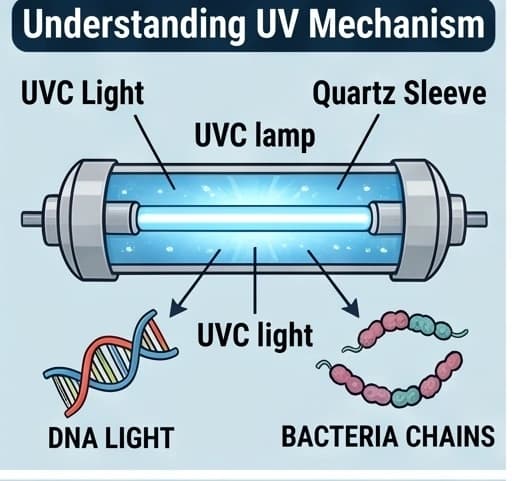
Low-pressure mercury vapour lamps — the standard lamp type in drinking water UV systems — produce germicidal UV-C at 254 nm by exciting mercury vapour inside a fused quartz envelope. Three processes cause output to decline over time:
- Mercury vapour pressure change: Mercury atoms bind to the inner glass wall over time, reducing the vapour pressure available for UV-C emission. Less mercury vapour means less UV-C output, even though the plasma discharge continues to glow.
- Electrode sputtering: Tungsten from the electrodes is deposited on the inner lamp wall with each on-off cycle and continuously during operation. These tungsten deposits absorb UV-C radiation before it exits the lamp.
- Quartz solarisation: Prolonged UV-C exposure causes the fused quartz glass to darken slightly — a process called solarisation — which reduces UV-C transmission through the lamp wall itself.
The result: the visible plasma discharge (the blue-purple glow) continues well past the point where UV-C output has dropped below the safe threshold. The lamp indicator LED on your controller confirms only that the lamp is powered and conducting — not that UV-C output is at adequate germicidal levels.
This is silent failure: water flows normally, the lamp glows, and the controller shows no alarm — but disinfection is inadequate. Understanding when to replace your UV bulb lamp in a water system means accepting that the glow tells you nothing about dose.
UV-C Output Degradation Over Lamp Life
| Operating Hours | UV-C Output % | UV Dose at Rated Flow | Disinfection Status | Action |
|---|---|---|---|---|
| 0–3,000 hours | 100–95% | 40–38 mJ/cm² | Safe | No action required |
| 3,000–6,000 hours | 95–88% | 38–35 mJ/cm² | Safe | Monitor intensity reading |
| 6,000–9,000 hours | 88–80% | 35–32 mJ/cm² | Safe — approaching limit | Plan replacement now |
| 9,000 hours | 80% | ~32 mJ/cm² | Borderline — replace now | Replace immediately |
| 9,000–12,000 hours | 80–60% | 32–24 mJ/cm² | Insufficient dose | Unsafe — must replace |
| Above 12,000 hours | Below 60% | Below 24 mJ/cm² | Dangerous | Replace urgently |
The 9,000-Hour Rule: Why This Number
When manufacturers and water treatment engineers specify when to replace a UV bulb lamp in a water system, the threshold is consistently 9,000 operating hours. This is not an arbitrary figure — it is grounded in lamp physics and safety margin engineering.
Philips UV-C lamps are rated under IEC 62471 (photobiological safety) and lamp manufacturer specification to maintain above 80% of initial UV-C output for 9,000 hours of continuous operation. This is the rated life for Philips TUV low-pressure lamps used in water treatment.
The 80% threshold is a conservative safety boundary, not a failure point. Here is why the specific number matters:
- Why 80%, not 70% or 60%: UV systems are designed and validated at rated flow to deliver 40 mJ/cm² when the lamp is at 100% output. At 80% output, the actual dose delivered is approximately 32 mJ/cm². This remains above the minimum required dose for most water-borne pathogens, but the margin is narrow. Operating beyond 80% output decline means the safety margin disappears entirely.
- Annual replacement for drinking water: Even if a specific lamp reaches 9,500 hours before hitting the 80% threshold, annual replacement removes uncertainty. For drinking water, the consequence of under-dosed UV is a health risk — not a process inconvenience. The cost of one replacement lamp is far lower than the cost of one waterborne illness episode.
- Philips TUV lamp reliability: The 9,000-hour rated life is well-documented and reproducible for genuine Philips TUV lamps. Generic or OEM lamps do not carry this validated specification — actual life for generic lamps is typically 3,000–5,000 hours, with UV-C output accuracy of ±20–40% even when new. This is why lamp brand matters when deciding when to replace a UV bulb lamp in a water system.
When to Replace: Decision Guide for Every Situation
The table below covers every common scenario a homeowner or facility manager faces when deciding whether to replace a UV lamp. Use this as your primary reference for when to replace a UV bulb lamp in a water system.
| Situation | Should You Replace? | Reason |
|---|---|---|
| 12 months since last replacement (continuous use) | Yes — replace now | Annual schedule standard for drinking water systems |
| UV intensity monitor reading below 20 mW/cm² | Yes — replace immediately | UV dose is insufficient regardless of hours on lamp |
| Lamp indicator is OFF (lamp not lighting) | Yes — replace immediately | Lamp has failed; no UV-C output whatsoever |
| Lamp hours counter above 9,000 | Yes — replace now | Rated life exceeded; safety margin is gone |
| Purple/dark discolouration at lamp ends | Yes — replace soon | Electrode sputtering visible — end of life approaching |
| New lamp but intensity monitor still reads low | No — check quartz sleeve | Fouled or scaled quartz sleeve blocks UV-C; lamp itself is fine |
| 6 months old, 24-hour continuous operation | Monitor now; plan ahead | ~4,380 hours — halfway through rated life. Check intensity; order replacement lamp |
| 12 months old, 8 hours/day operation | Not yet | Only ~2,920 hours used. Check monitor; next replacement at approximately 37 months |
Replacement Timing by Daily Usage
The exact interval for replacing a UV bulb lamp in a water system depends on how many hours per day the system operates. This table gives you the precise replacement schedule for your usage pattern.
| Daily Hours of Operation | Hours Per Year | Years to Reach 9,000 h | Recommended Replacement Interval |
|---|---|---|---|
| 24 hours/day (continuous) | 8,760 | 1.03 years | Annual — every 12 months |
| 18 hours/day | 6,570 | 1.37 years | Every 16–17 months |
| 12 hours/day | 4,380 | 2.05 years | Every 25 months |
| 8 hours/day | 2,920 | 3.08 years | Every 37 months |
| 6 hours/day | 2,190 | 4.11 years | Every 49 months |
Important note for low-use drinking water systems: Even if your UV system operates only 6–8 hours per day, replace the Philips UV-C lamp every 24 months regardless of calculated hours. UV-C emission efficiency can also decline due to mercury redistribution within the lamp even when the lamp is not powered — this is an additional degradation pathway independent of operating hours.
Signs Your UV Lamp Needs Immediate Replacement
In addition to scheduled replacement timing, watch for these indicators that your UV bulb lamp in a water system needs to be changed right away:
- UV intensity monitor alarm: The most reliable real-time indicator. If the intensity reading has dropped below the low-alarm setpoint (typically 20 mW/cm² for drinking water systems), replace the lamp immediately regardless of how many hours it has run.
- Lamp indicator OFF: The lamp has failed to strike — electrode failure, ballast fault, or broken lamp. No UV-C output at all. Do not operate the system until the lamp is replaced.
- Black or purple discolouration at lamp ends: Visible tungsten deposits from electrode sputtering. This is a clear visual sign that the lamp is approaching or past end of life.
- Visible darkening of the lamp tube: Solarisation of the quartz glass envelope — UV-C transmission has been degraded. The lamp may still glow, but UV-C output is severely reduced.
- Water quality test failure: Coliform detection in post-UV treated water, combined with a lamp over 9,000 hours or 12 months old, confirms the UV dose is insufficient. Replace the lamp and retest.
- Ozone-like smell near the UV chamber: If present, check lamp type immediately. Drinking water UV systems must use ozone-free lamps (UV-C at 254 nm only). A UV-C lamp producing ozone indicates a lamp type mismatch — this is both a health hazard and a performance issue.
What Happens If You Do Not Replace the Lamp
The consequences of not knowing when to replace a UV bulb lamp in a water system — or knowing and delaying — extend well beyond the UV system itself.
The health risk is real and invisible. Pathogens pass through the UV chamber without adequate inactivation. There is no visible change to the water: no colour difference, no taste change, no flow reduction. Households and businesses believe they have UV-treated water when they effectively have biologically untreated water.
In the Indian context, the specific pathogens of concern in under-dosed UV water are:
- Escherichia coli — gastroenteritis, diarrhoeal disease; endemic in many Indian municipal and borewell water sources
- Salmonella typhi — typhoid fever; requires UV dose of 25–40 mJ/cm² for 4-log inactivation
- Giardia lamblia — giardiasis (highly sensitive to UV; but even Giardia survives below 10 mJ/cm²)
- Cryptosporidium parvum — highly UV-sensitive protozoan, but requires adequate dose at rated flow
The cost arithmetic is straightforward:
- Annual Philips UV-C lamp replacement: ₹800–2,500 (depending on system size)
- One typhoid hospitalisation episode: ₹15,000–50,000 (excluding lost income)
- One typhoid episode costs 6–60 times the annual lamp replacement cost
For FSSAI-regulated food businesses: Operating a UV water system with an expired lamp can result in inspection failure. FSSAI food safety audits for water treatment systems expect documented maintenance records including lamp replacement dates. A lamp operating beyond its rated life with no replacement log is a compliance failure under Schedule 4 of the Food Safety and Standards (Licensing and Registration of Food Businesses) Regulations.
Choosing the Right Replacement Lamp
Once you have determined when to replace the UV bulb lamp in your water system, lamp selection is equally important. The wrong lamp compromises the disinfection that the system was designed to deliver.
Always use a Philips UV-C lamp (Philips TUV series). The 9,000-hour rated life is validated and reproducible for genuine Philips TUV lamps. Generic or OEM replacement lamps carry significant risks:
- Actual operating life of generic lamps is typically 3,000–5,000 hours — meaning you may be at risk well before the expected replacement date
- UV-C output accuracy for generic lamps is ±20–40% even when new — a lamp labelled "25W" may deliver UV-C equivalent to a 15W Philips lamp
- No independent third-party validation of rated output or rated life
How to identify a genuine Philips lamp: The lamp envelope inscription should clearly show "Philips TUV" followed by the wattage and part number. If this inscription is absent, faded, or shows a different brand name with a Philips-like appearance, the lamp is not genuine.
Match wattage exactly: Do not substitute a different wattage lamp than the original system specification. A lower-wattage lamp delivers less UV-C output and will fail to meet the required dose. A higher-wattage lamp may overheat the quartz sleeve and ballast.
Where to buy in India: Order through Alpha UV (WhatsApp order — see CTA below), authorised Philips distributors, or FSSAI-compliant water treatment suppliers. Delivery is available across India within 24–48 hours for most locations.
Common Philips UV-C Lamp Models and Indian Pricing (2026)
| Wattage | System Size | Approximate Price (India 2026) | Annual Cost |
|---|---|---|---|
| 5W | 250–500 LPH residential | ₹600–900 | ₹600–900/year |
| 11W | 750–1,000 LPH residential | ₹900–1,500 | ₹900–1,500/year |
| 25W | 2,000 LPH commercial | ₹1,500–2,500 | ₹1,500–2,500/year |
| 55W | 4,000 LPH industrial | ₹2,500–4,000 | ₹2,500–4,000/year |
| 110W | 8,000 LPH industrial | ₹4,000–7,000 | ₹4,000–7,000/year |
How to Replace a UV Lamp
Replacing a UV bulb lamp in a water system is a straightforward task that requires no plumber and no specialist tools. Time required: 15–20 minutes.
Tools needed: None (standard twist-lock or screw cap access). Clean cloth or latex gloves for handling the new lamp.
Step 1: Switch off the UV system at the power controller. Close the inlet valve to prevent water flow through the chamber. Wait 10 minutes for the lamp to cool — UV-C lamps operate at elevated temperature and must be allowed to cool before handling.
Step 2: Remove the lamp access cap. On most Alpha UV systems this is a twist counter-clockwise motion; some models use a screw cap. Do not force the cap — if it resists, check for a locking ring or retaining screw.
Step 3: Carefully slide out the old lamp. Hold the lamp only at the ceramic end caps — never touch the glass envelope with bare fingers. Skin oils contaminate the quartz surface and can cause localised heating when the lamp is powered.
Step 4: Before installing the new lamp, inspect the quartz sleeve inside the chamber. If the sleeve shows mineral scale, yellowish discolouration, or visible fouling, clean it with a citric acid solution (1 tablespoon citric acid in 500 ml warm water) on a soft cloth. A fouled sleeve reduces UV-C transmission and will cause low intensity readings even with a new lamp — this is the most common reason a new lamp appears not to solve a low-intensity problem.
Step 5: Slide in the new Philips UV-C lamp. Handle it only at the ceramic ends. Ensure it seats fully into the lamp socket at the far end of the chamber.
Step 6: Reseat the access cap. Restore the water supply by opening the inlet valve. Switch on power to the UV system.
Step 7: Verify the lamp indicator light is on. Check for leaks at the cap seal — if any moisture is present, power off immediately, dry thoroughly, and reseat the cap O-ring before powering on again.
Step 8: Record the replacement date in your maintenance log. Write the date on the ceramic end cap of the old lamp for reference, and note the new lamp installation date on the new lamp's ceramic end cap. For FSSAI-regulated businesses, this record is a required maintenance document.
Frequently Asked Questions
My UV lamp still glows after 2 years of use — does it still need replacing?
Yes, absolutely. If your system has been running continuously (24 hours/day), a 2-year-old lamp has accumulated approximately 17,520 operating hours — nearly double the 9,000-hour rated life. At this stage the UV-C output has declined to an unknown level, potentially below 50% of initial output. The lamp will be delivering a UV dose far below the 40 mJ/cm² required for reliable disinfection. The continued glow is produced by the plasma discharge in the lamp, which continues independently of UV-C germicidal output. Replace immediately and check the quartz sleeve while the system is open.
How do I track how many hours my UV lamp has run?
Commercial and industrial Alpha UV systems include a lamp-hours counter on the controller panel — read this directly. For residential systems without a counter, calculate from the installation date: multiply the number of days since installation by the average hours of operation per day. If you run the system continuously, simply count the days since installation — at 9,000 hours the lamp reaches its 375-day mark. Mark the installation date on the lamp's ceramic end cap with a permanent marker, and set a calendar reminder 30 days before the expected replacement date to order a new lamp in advance.
Can I use a non-Philips replacement lamp in my Alpha UV system?
Not recommended. Alpha UV systems are designed, flow-rated, and validated using Philips UV-C lamps with a 9,000-hour rated life and defined UV-C output specifications. A generic OEM lamp installed in place of a Philips UV-C lamp may have a rated life of 3,000–5,000 hours and UV-C output accuracy of ±20–40%. This means the system may fail to deliver adequate UV dose even when the generic lamp appears new and operational. The chamber design, flow rate, and dose calculation all assume the Philips lamp specification. Substituting a different lamp invalidates the dose calculation and the disinfection guarantee.
What happens to water quality if I am 2 months late on lamp replacement?
For a system running 24 hours/day, being 2 months late means the lamp has been operating for approximately 14 months — around 10,200 hours. At this stage, UV-C output has declined beyond the 80% threshold and the safety margin in the dose calculation has been exceeded. Water may still be largely safe depending on the incoming pathogen load, but there is no longer a reliable safety margin. The risk is proportional to the pathogen concentration in your source water. Borewell water users face higher risk than those on municipal supply, as borewell water typically has higher and more variable microbial counts. Replace the lamp within the same week, not at the next convenient opportunity.
Does lamp replacement cost differ between residential and industrial UV systems?
Yes — the cost scales with lamp wattage and system size. Residential systems (5W–11W lamps) cost ₹600–1,500 per annual replacement. Commercial systems (25W lamps) cost ₹1,500–2,500 per replacement. Industrial systems (55W–110W and above) cost ₹2,500–7,000 per lamp, but many industrial facilities under Annual Maintenance Contracts have lamp replacement included in the AMC fee. For large industrial installations with multiple UV chambers, AMC agreements are the most cost-effective way to ensure timely lamp replacement across the entire system without tracking individual lamp hours manually. Contact Alpha UV for AMC pricing for your specific system configuration.
How do I safely dispose of old UV lamps in India?
UV-C lamps contain mercury — typically 5–15 mg per low-pressure lamp — and are classified as hazardous waste under India's E-Waste (Management) Rules 2022 and the Hazardous and Other Wastes (Management and Transboundary Movement) Rules 2016. Do not dispose of used UV lamps in regular household or municipal waste. Correct disposal options in India include: returning the lamp to the supplier or manufacturer for Extended Producer Responsibility (EPR) collection; depositing at an authorised e-waste collection point (available in most Indian cities through the state Pollution Control Board); or arranging collection through an authorised hazardous waste recycler. Alpha UV customers can return used Philips UV-C lamps through our collection process — mention this when ordering your replacement lamp.
Order a Replacement Philips UV-C Lamp
To order a genuine Philips UV-C replacement lamp for your water system, WhatsApp the Alpha UV team. Mention your system model or wattage and we will confirm the correct lamp and arrange delivery within 24–48 hours across India.
WhatsApp to Order LampStandards, authorities & further reading
External references used to inform this guide. Regulations evolve — check the latest revision on each authority's site before compliance decisions.
Recommended UV Systems
Alpha UV System products for this application — powered by genuine Philips UV-C lamps.
Commercial UV Water Purification System
500 – 5,000 LPH
HACCP-compliant UV water purification for hotels, restaurants, and offices
Industrial UV Water Treatment System
5,000 – 50,000 LPH
Schedule M 2025 and HACCP compliant UV for pharma, food & beverage, and process water
Not sure which system suits your application? WhatsApp our engineers for a free recommendation →
Need a UV system?
Talk to our UV engineers — WhatsApp for a quote in 2 hours, or browse the full catalog on IndiaMART.