Quick Answer
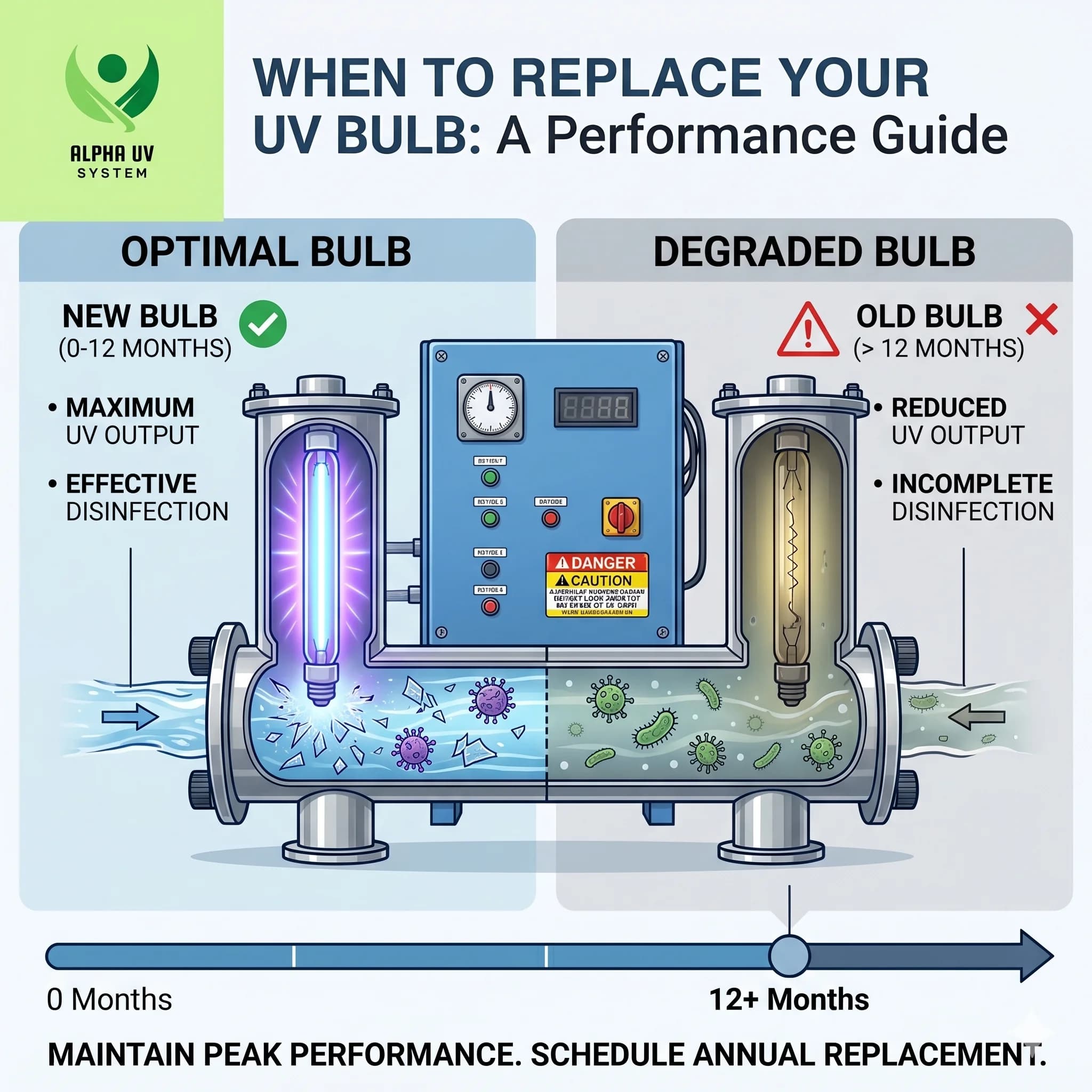
A UV disinfection lamp must be replaced at 9,000–12,000 operating hours (approximately 12–16 months of 24/7 operation) regardless of whether it continues to illuminate — because lamp UV output degrades continuously from the first hour of operation, and a lamp at 9,000 hours delivers approximately 70% of its initial UV output. A UV system designed to deliver 40 mJ/cm² at 100% lamp output is delivering only 28 mJ/cm² when the lamp has degraded to 70% — insufficient for the 4-log E. coli inactivation required by BIS IS 10500, FSSAI, and NABH. There are two principal types of UV disinfection lamps in water treatment: low-pressure (LP) lamps, which emit 85–95% of their UV output at 254 nm (the germicidal peak) and are the standard choice for drinking water, food process water, and pharmaceutical applications; and medium-pressure (MP) polychromatic lamps, which emit across the 200–400 nm UV-C/UV-B spectrum and are used in swimming pool chloramine destruction and high-flow applications where footprint matters. In both categories, Philips UV-C is the specified lamp make for compliance-critical applications in India — its published output-versus-hours degradation curve is the basis for end-of-lamp-life dose calculation and replacement interval determination.
Low-Pressure vs Medium-Pressure UV Disinfection Lamps
The choice between low-pressure and medium-pressure UV disinfection lamps is the most fundamental design decision in UV water treatment system specification. They differ in output wavelength distribution, efficiency, power density, footprint, and cost.
| Parameter | Low-Pressure (LP) Lamp | Low-Pressure High-Output (LPHO) Amalgam | Medium-Pressure (MP) Lamp |
|---|---|---|---|
| UV-C output wavelength | Single wavelength — 253.7 nm | Single wavelength — 253.7 nm | Polychromatic — 200–400 nm continuum |
| UV electrical efficiency | 35–40% (UV output / electrical input) | 35–40% | 12–15% |
| Power rating (per lamp) | 15–90W | 100–500W (amalgam technology) | 1–30 kW (per lamp) |
| UV output per lamp | 5–35W UV | 35–200W UV | 200W–3kW UV per lamp |
| Operating temperature (lamp wall) | 40°C (ambient water temperature sensitive) | 70°C (amalgam buffer against water temp variation) | 600–900°C |
| Water temperature sensitivity | High — output drops in cold water (<15°C) or hot water (>35°C) | Low — amalgam technology buffers temperature effect | Very low — high operating temp insensitive to water temp |
| Warm-up time to stable output | 5–10 minutes | 5–10 minutes | 30–60 seconds |
| Chloramine destruction capability | Limited — single wavelength less effective | Limited | Excellent — polychromatic spectrum destroys all chloramine species |
| Lamp life | 8,000–12,000 hours | 9,000–16,000 hours (amalgam extends life) | 4,000–8,000 hours |
| Reactor footprint | Large (multiple lamps needed for high flows) | Medium | Compact (fewer lamps for same output) |
| Lamp cost | Low (₹2,500–5,000 per lamp) | Medium (₹5,000–12,000 per lamp) | High (₹25,000–1,00,000 per lamp) |
| Primary application | Drinking water, food/beverage, pharmaceutical, STP up to 5 MLD | Industrial, aquaculture, STP 2–50 MLD | Swimming pools (chloramine), large municipal WTP/STP |
UV Lamp Output Degradation — Why This Determines Replacement Interval
UV lamp output declines continuously from the moment of first ignition. The degradation rate is not linear — output falls faster in the first 1,000 hours as the lamp stabilises, then declines more slowly through mid-life, and accelerates again approaching end-of-life as electrode degradation becomes significant. The industry-standard replacement criterion is when lamp output has degraded to 70% of its initial output — the point at which the design UV dose (calculated at 100% initial lamp output) can no longer be guaranteed.
For a UV system designed to deliver 40 mJ/cm² at 100% lamp output:
| Operating hours | Typical LP lamp output (% of initial) | Effective dose delivered | BIS IS 10500 compliance status |
|---|---|---|---|
| 0 hours (new lamp) | 100% | 40 mJ/cm² | ✅ Compliant |
| 2,000 hours | ~92% | ~37 mJ/cm² | ✅ Compliant (dose margin) |
| 5,000 hours | ~83% | ~33 mJ/cm² | ✅ Compliant (reduced margin) |
| 9,000 hours | ~70% | ~28 mJ/cm² | ⚠️ Replace now — approaching failure |
| 12,000 hours (if not replaced) | ~55% | ~22 mJ/cm² | ❌ Non-compliant — dose failure |
| 15,000 hours (severely overdue) | ~35% | ~14 mJ/cm² | ❌ Severe dose failure — system producing untreated water |
The table illustrates why UV lamp replacement at 9,000 hours is not a conservative recommendation but a performance requirement. A lamp running beyond 12,000 hours in a system without UV intensity monitoring — common in Indian installations where scheduled maintenance is deferred — is producing water that appears treated but is not meeting the BIS IS 10500 zero-coliform standard.
Philips UV-C Lamps — Why Lamp Make Matters for Compliance
Philips UV-C (now marketed under the Signify brand for lamps) publishes the UV output-versus-operating-hours degradation curve for its lamp range. This published data is the basis for:
- Calculating the lamp replacement interval (when output falls to 70% of initial)
- Adjusting the UV dose calculation at mid-life and end-of-life (to account for actual output, not assumed initial output)
- Generating the compliance documentation for FSSAI, CPCB, NABH, and Schedule M audits — which requires evidence that the UV dose was maintained throughout the reporting period, not just at commissioning
Generic OEM UV lamps sourced from India or China without published degradation curves create an audit problem: the compliance record cannot show that the dose was maintained through the lamp life because there is no manufacturer data on how the lamp output changed between initial commissioning and replacement. For compliance-critical applications — pharmaceutical GMP, FSSAI HACCP, NABH WSP, CPCB OCEM — specifying Philips UV-C lamps is the only defensible position.
For non-compliance-critical applications (e.g., basic turbid groundwater pre-treatment where dose validation is not required), OEM lamps may be acceptable on cost grounds — but the trade-off must be understood and accepted explicitly.
When to Replace a UV Disinfection Lamp
Replace the UV disinfection lamp when any of the following conditions are met — whichever comes first:
- Hour meter reading reaches 9,000 hours: This is the unconditional primary replacement criterion. Replace regardless of whether the lamp visually appears to be functioning normally.
- UV intensity sensor reading has declined 15% or more from initial commissioning value: This indicates sleeve fouling, lamp degradation, or sensor drift — investigate and replace if lamp hours are above 5,000.
- UV intensity alarm activates: The alarm setpoint is typically set at 80% of the dose-delivery threshold intensity. An alarm is an immediate replacement or remediation trigger.
- Lamp fails to ignite: A UV lamp that fails to ignite (no UV output) is an immediate replacement requirement — the system is producing unprotected water.
- Visual inspection shows blackening at electrode ends: End-blackening indicates electrode erosion and imminent failure. Replace before the lamp fails in service.
UV Lamp Replacement Procedure
- Isolation: Close inlet and outlet isolation valves. Open bypass line if fitted to maintain water supply during maintenance.
- Electrical lockout: De-energise the UV control panel and lock out the electrical supply. UV lamp power supplies maintain residual voltage — do not touch the lamp or its connections until power is locked out.
- Cool-down: Wait minimum 15 minutes for the lamp to cool to safe handling temperature. UV lamps operate at 40–80°C (LP lamps) to 600–900°C (MP lamp wall) — contact with a hot lamp causes burns.
- Reactor drain: Open drain valve and drain the reactor chamber. Do not attempt to remove the lamp with water in the reactor.
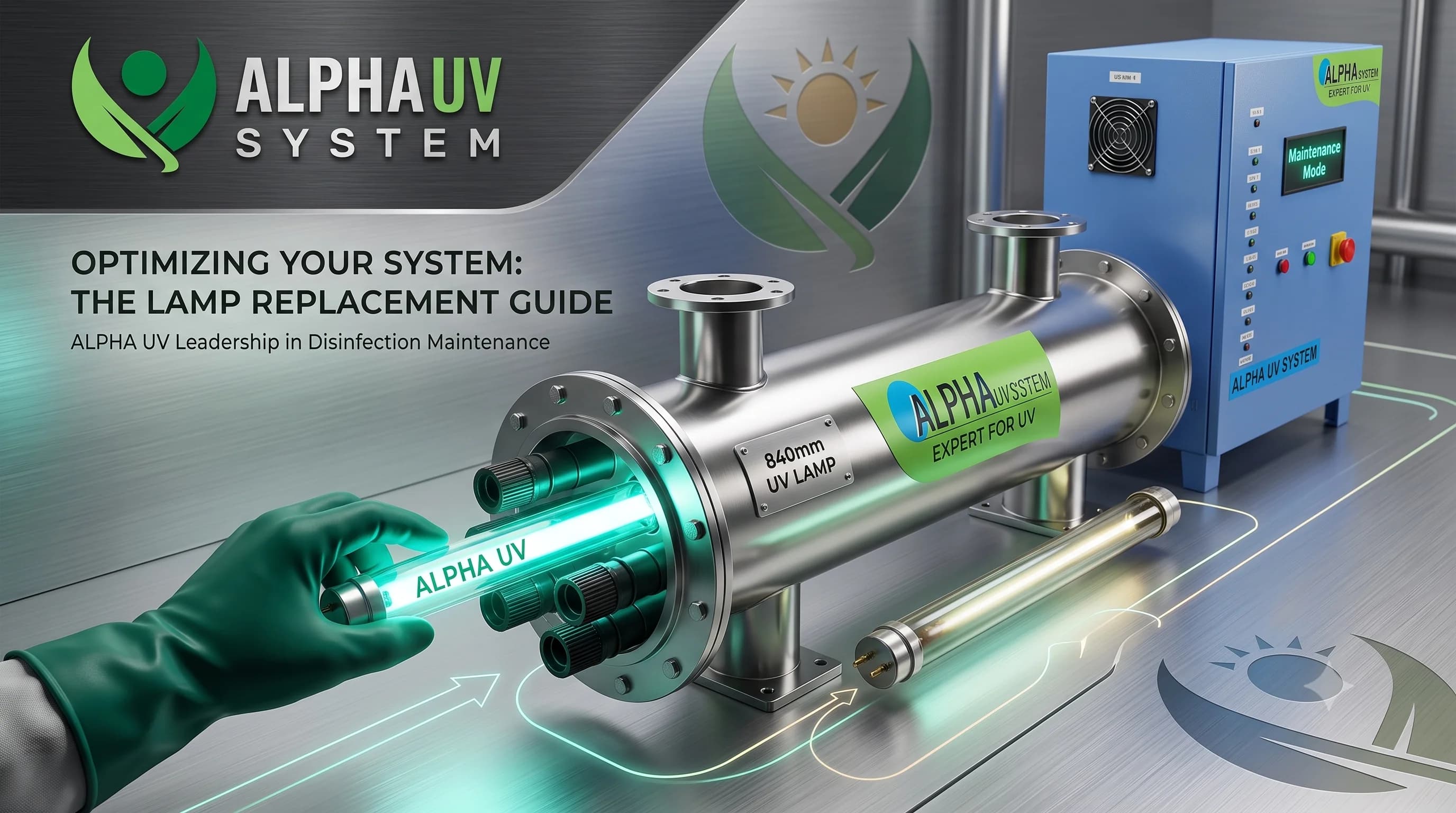
- Lamp removal: Disconnect the lamp electrical connections. Grip the lamp only at the ceramic end caps — do not grip the glass envelope, as pressure can crack the lamp. Slide the lamp out of the quartz sleeve carefully.
- Quartz sleeve inspection: With the lamp removed, inspect the quartz sleeve for scale deposits, iron fouling (brown discolouration), or physical cracks. Clean if fouled (citric acid 5% solution soak for 30 minutes, then rinse thoroughly). Replace if cracked.
- New lamp installation: Wear clean nitrile gloves — finger oils on the quartz sleeve (or on the lamp envelope if it contacts the sleeve) absorb UV and cause hot spots that crack the quartz. Slide the new lamp into the sleeve, ensuring pins seat fully into lamp holder contacts. Record new lamp serial number, manufacturer, and installation date.
- Reassembly and pressure test: Replace O-rings if due (at each sleeve cleaning). Reassemble reactor. Perform a 5-minute hydrostatic pressure test at operating pressure before re-energising.
- Commissioning check: Energise the lamp. Allow 5-minute warm-up to stable output. Read UV intensity from the control panel and compare to the design value from the system's IOM manual. Record new baseline UV intensity alongside the lamp serial number and installation date. Reset the hour meter to zero.
UV Lamp Procurement in India — Availability and Lead Times
A critical but overlooked aspect of UV lamp specification is ensuring spare lamp availability when replacement is due. In India, UV lamp supply chains have historically been a weakness — generic OEM lamps are widely available but lack the performance data needed for compliance documentation, while Philips UV-C lamps require planning for procurement lead times of 2–4 weeks for non-stocked items.
Best practice for Indian UV system owners:
- Keep one spare lamp in stock at all times — never let the installed lamp approach its replacement interval without a confirmed spare on hand
- Confirm lamp model number and replacement cost at the time of UV system purchase — ask for the ex-stock availability from your supplier
- Include UV lamp replacement as a budget line item in the annual O&M budget — it is a predictable, scheduled cost, not a surprise expense
- For large installations with multiple lamps, coordinate lamp replacement schedules to consolidate lamp purchases and service visits
UV Lamps and Replacement Service from Alpha UV System
Alpha UV System specifies Philips UV-C lamps in all our UV water disinfection systems. We maintain ex-stock inventory of replacement Philips UV-C lamps for the reactor range we supply, with 24–48 hour NCR delivery and courier supply nationwide. Our preventive maintenance contracts include annual lamp replacement, quartz sleeve cleaning, O-ring replacement, and UV intensity sensor calibration — with maintenance documentation formatted for FSSAI, NABH, and Schedule M audit requirements.
IIT-trained engineers perform lamp replacement visits with on-site commissioning verification (UV intensity measurement at rated flow and UVT) and updated compliance documentation after each lamp change. MSME Udyam registered manufacturer, Greater Noida.
Contact us for UV lamp replacement supply or service: WhatsApp +91 93183 05878 or call +91 95995 00580.
Related guides: When to replace a UV bulb — complete guide | UV system installation and commissioning | How to clean UV system parts | How to know if your UV system is working
Recommended UV Systems
Alpha UV System products for this application — powered by genuine Philips UV-C lamps.
Commercial UV Water Purification System
500 – 5,000 LPH
HACCP-compliant UV water purification for hotels, restaurants, and offices
Industrial UV Water Treatment System
5,000 – 50,000 LPH
Schedule M 2025 and HACCP compliant UV for pharma, food & beverage, and process water
Not sure which system suits your application? WhatsApp our engineers for a free recommendation →
Need a UV system?
Talk to our UV engineers — WhatsApp for a quote in 2 hours, or browse the full catalog on IndiaMART.