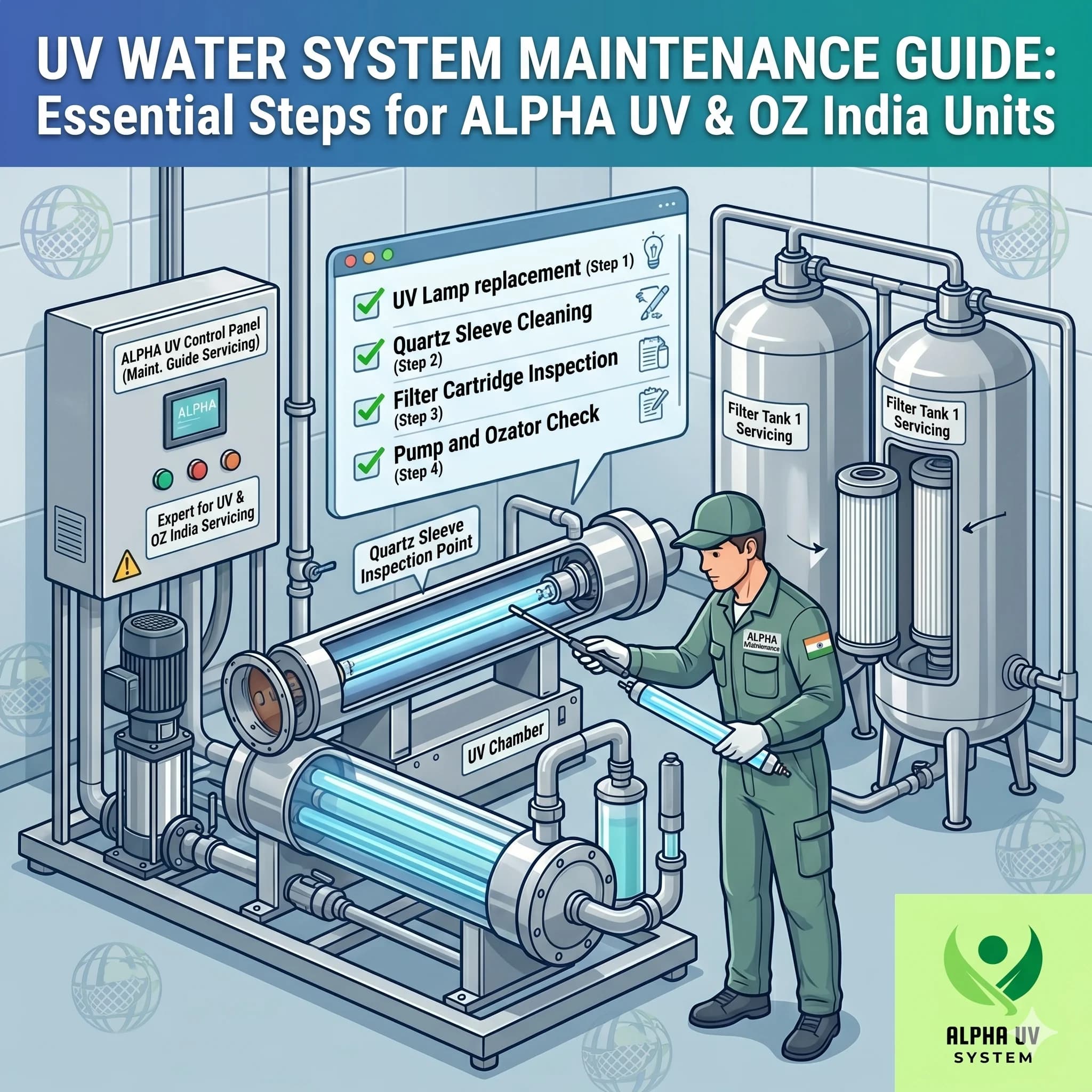
UV water system maintenance involves three tasks: (1) replace the Philips UV-C lamp annually or every 9,000 hours, (2) clean the quartz sleeve every 3–6 months using citric acid solution, and (3) replace the sediment pre-filter cartridge every 3 months. Total time: under 30 minutes per task. No plumber required — all tasks are homeowner DIY.
Knowing how to clean maintain UV water system parts is one of the most important things a homeowner or facility manager can do to protect their water supply. UV disinfection is passive and chemical-free, but the hardware that delivers the UV dose — the lamp, the quartz sleeve, and the sediment pre-filter — degrades on a predictable schedule. Skipping maintenance does not cause a visible change in your water. The water will still flow, still look clear, and still taste normal. The only thing that changes is the disinfection dose, and that change is invisible until a health problem surfaces.
This guide covers exactly how to clean maintain UV water system parts across all three maintenance tasks: lamp replacement, quartz sleeve cleaning, and sediment filter cartridge replacement. It includes step-by-step procedures, a lamp replacement schedule table by daily operating hours, a quartz sleeve condition guide, an annual cost reference for India (2026), maintenance log requirements, and a full FAQ section.
Why Maintenance Cannot Be Skipped
UV water systems are sometimes described as maintenance-free because they require no chemicals and no operator intervention during normal operation. This is misleading. The system requires no daily maintenance, but it does require scheduled maintenance at 3-month, 6-month, and 12-month intervals. Here is why each component matters.
UV Lamp Output Degrades Over Time
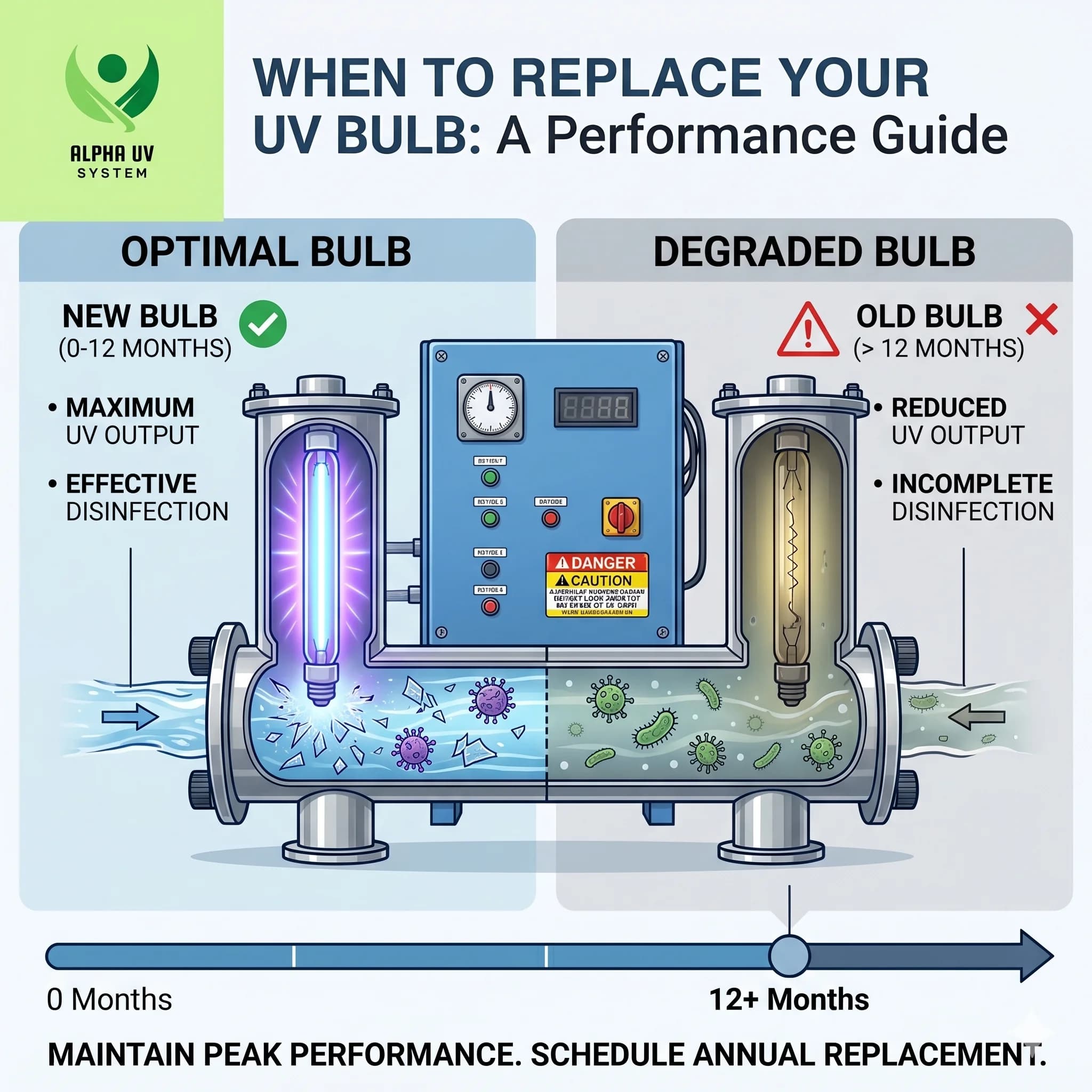
The Philips UV-C lamp used in certified UV water systems is rated at 9,000 hours at 80% output. This means that at the 9,000-hour mark, the lamp is still producing 80% of its initial UV-C emission — but this is the minimum acceptable threshold. Beyond 9,000 hours, output continues to fall below 80%, and the delivered UV dose drops below the 40 mJ/cm² standard required to inactivate waterborne pathogens including E. coli, Giardia, and Cryptosporidium. The lamp will still glow and the system will appear to be working. There is no visible sign of failure.
Quartz Sleeve Fouling Blocks UV-C Transmission
The quartz sleeve surrounds the UV lamp and separates the lamp from the water. It must remain optically transparent to UV-C wavelengths (primarily 253.7 nm). In Indian water conditions — particularly borewell water in UP, Bihar, and Rajasthan with high iron content, and hard water in Gujarat and Haryana with calcium above 300 mg/L — mineral deposits form on the outer surface of the quartz sleeve within weeks. Iron deposits appear as orange-yellow staining; calcium deposits appear as white scale; manganese deposits appear as dark brown or black crusts. Studies on UV reactor performance show that sleeve fouling can cause 20–60% dose loss even with a functioning lamp. Learning how to clean maintain UV water system parts starts with understanding that the quartz sleeve is your highest-impact maintenance point in Indian water conditions.
Sediment Pre-Filter: The First Line of Protection
The sediment pre-filter (typically a 5-micron polypropylene spun cartridge) removes suspended particles from water before it enters the UV chamber. A clogged filter restricts flow, increases the time water spends in the UV chamber (which is actually beneficial for dose delivery), but in extreme clog conditions can harbour bacteria in the accumulated debris. More critically, a bypassed or absent sediment filter allows turbid water to enter the UV chamber, where suspended particles shield pathogens from UV-C exposure — a phenomenon known as particle shielding. UV dose cannot penetrate particles; microorganisms attached to sediment can pass through a UV chamber completely unaffected.
Silent Failure: The Core Risk
None of these three failure modes is visible. Water flows normally. Water looks clear. Water tastes normal. The UV system's power light stays on. The only reliable protection against silent failure is a documented maintenance schedule — and, for systems with UV intensity monitors, monitoring the output reading over time. Maintenance ensures the 40 mJ/cm² dose is always delivered to every cubic centimetre of water passing through the chamber.
Part 1 — UV Lamp Replacement
Lamp replacement is the most critical maintenance task in any UV water system. The Philips UV-C lamp (Philips TUV series) is the standard lamp used in certified UV water treatment systems for drinking water applications. Do not substitute with generic OEM lamps — lamp output at 253.7 nm, arc length, and electrical characteristics must match the system design for the system to deliver its validated UV dose.
When to replace: Every 9,000 operating hours, or once per year — whichever comes first. For systems in continuous operation (24 hours/day), 9,000 hours is reached in approximately 375 days, making annual replacement the practical rule. For drinking water applications, replace annually regardless of calculated hours — the cost of a replacement Philips UV-C lamp is far less than the health risk of under-dosed water.
Time required: 15–20 minutes for a first-time replacement; 10–15 minutes once you are familiar with the procedure.
Step-by-Step UV Lamp Replacement Procedure
Step 1: Switch off the UV system at the wall switch or circuit breaker, and close the inlet valve. Wait 10 minutes for the lamp to cool — UV-C lamps run at high temperature and thermal shock from residual cool water can crack a hot lamp if the chamber is opened immediately.
Step 2: Open the lamp access cap or end cap at the end of the UV chamber. This is typically a twist-unlock quarter-turn fitting or a threaded screw-off cap. Some models have a compression fitting secured with a locking ring. Refer to your system's installation manual for the specific mechanism.
Step 3: Carefully slide out the old lamp from the quartz sleeve. Hold the lamp only by its ceramic end caps — do not grip the quartz glass envelope directly. Even after the lamp has cooled, skin oils deposited on the quartz glass cause localised hot spots during the next operating cycle, which can crack the lamp prematurely.
Step 4: Slide in the new Philips TUV lamp, again holding only the ceramic end caps. Ensure the electrical pins at the lamp's base seat correctly into the lamp holder connectors. Do not force the lamp — if resistance is felt, check pin alignment before applying pressure.
Step 5: Reseat the end cap, ensuring the O-ring seal is correctly positioned in its groove. A misaligned or pinched O-ring is the most common cause of leaks after lamp replacement. Restore water flow by opening the inlet valve, then check the end cap seal for leaks before restoring power.
Step 6: Restore power. Verify the lamp indicator light is on and, if your system has a UV intensity monitor, verify the output reading returns to its normal operating range.
Step 7: Record the replacement date, the new lamp's batch number, and the cumulative operating hours (if your system displays this) in your maintenance log. Keep the original packaging of the Philips TUV lamp as documentation of genuine lamp use — this is required for FSSAI and Schedule M compliance records in commercial installations.
Safety note on disposal: UV-C lamps contain a sealed quantity of mercury (typically 5–15 mg per lamp). Do not dispose of in regular household waste. Under India's E-Waste Management Rules 2022, UV lamps qualify as e-waste and must be deposited at an authorised e-waste collection facility. Alpha UV System assists commercial customers with lamp collection and proper disposal.
Lamp Replacement Schedule by Daily Operating Hours
The table below shows how daily operating hours determine the calendar interval at which 9,000 hours is reached. Use this to set your replacement reminder, and note the recommendation for drinking water applications.
| Daily Operating Hours | Days to Reach 9,000 Hours | Replacement Frequency |
|---|---|---|
| 24 hours/day (continuous) | 375 days | Annual — every 12 months |
| 18 hours/day | 500 days | Every 16–17 months |
| 12 hours/day | 750 days | Every 25 months |
| 8 hours/day | 1,125 days | Every 37 months |
| 4 hours/day | 2,250 days | Every 75 months (replace annually regardless for drinking water safety) |
Recommendation for drinking water applications: Replace the Philips UV-C lamp annually regardless of calculated operating hours. UV-C lamp output degradation is not linear and is affected by voltage fluctuations, ambient temperature, and start-stop cycling — all common in Indian power supply conditions. The cost of a replacement lamp is far less than the health risk of under-dosed water delivered over months before the next scheduled change.
Part 2 — Quartz Sleeve Cleaning
The quartz sleeve is the second critical element when learning how to clean maintain UV water system parts. It is a precision optical component — fused quartz selected specifically for its high UV-C transmittance — and it must remain clear to perform its function. In Indian water conditions, quartz sleeve fouling is often the most frequent maintenance task required, particularly for borewell users in UP, Bihar, Rajasthan, and Gujarat.
Cleaning frequency:
- Every 6 months for municipal water supply (hardness below 200 mg/L, low iron)
- Every 3 months for borewell water with elevated iron or hardness (Rajasthan, Gujarat, UP, Haryana)
- Every 2 months for very high-iron or very hard water (iron above 1 mg/L or hardness above 400 mg/L CaCO₃)
Signs that the sleeve needs cleaning: Yellow-orange staining indicates iron deposits; white chalky scale indicates calcium/magnesium deposits; dark brown or black deposits indicate manganese. If your system has a UV intensity monitor and the output reading has dropped without a lamp fault, sleeve fouling is the first thing to investigate.
Cleaning solution: Citric acid dissolved in warm water — 30g of food-grade citric acid per 1 litre of warm water. Citric acid is available at most pharmacies, grocery stores, and online marketplaces in India for approximately ₹50–100 per 100g packet. It is non-toxic, safe to handle with bare hands, and safe for contact with food-grade water systems after rinsing. Do not use hydrochloric or other mineral acids — these can etch quartz surfaces and damage O-rings.
Step-by-Step Quartz Sleeve Cleaning Procedure
Step 1: Switch off the UV system and close the inlet valve. Open a downstream tap or outlet valve to drain water pressure from the chamber before opening any fittings.
Step 2: Remove the quartz sleeve end cap and carefully slide the sleeve out of the UV chamber. The sleeve is fragile — handle it with both hands and set it down on a soft surface (a clean folded cloth works well).
Step 3: Prepare the citric acid cleaning solution: dissolve 30g of food-grade citric acid in 1 litre of warm water in a container long enough to fully submerge the sleeve. A clean PVC pipe section or a tall kitchen jug works well.
Step 4: Submerge the quartz sleeve fully in the citric acid solution. Soak for 20–30 minutes for light mineral haze or early-stage fouling. For heavy iron scale, extend the soak to 45–60 minutes. For severe iron or manganese deposits, soak for 60–90 minutes with gentle agitation every 15 minutes.
Step 5: After soaking, gently wipe the outer surface with a soft, lint-free cloth. Do not use abrasive scrubbing pads, steel wool, or rough cloths — quartz scratches easily, and surface scratches scatter UV-C light and permanently reduce sleeve transmittance.
Step 6: Rinse the sleeve thoroughly under clean running water to remove all citric acid residue. If RO water or distilled water is available, use it for the final rinse — this prevents new mineral spotting as the sleeve dries.
Step 7: Inspect the sleeve. Hold it up to a window or light source and look through it lengthwise. It should be completely clear and transparent with no remaining haze, staining, or deposits. Also inspect the outer surface carefully for cracks or chips. Even a hairline crack is grounds for immediate replacement — a cracked sleeve allows water to contact the lamp directly, which will cause immediate lamp failure.
Step 8: Before reinstalling, inspect the O-rings at the sleeve end caps. O-rings that appear flattened, cracked, or brittle should be replaced. In Indian summer conditions (ambient temperatures of 40°C or above), O-ring degradation is accelerated — check them at every sleeve cleaning. Replace with EPDM or silicone O-rings of the correct size.
Step 9: Reinstall the sleeve, restore water flow by opening the inlet valve, and inspect the sleeve seal fittings for leaks before switching the system back on.
| Sleeve Appearance | Problem | Action | Citric Acid Soak Time |
|---|---|---|---|
| Fully clear and transparent | Good condition | No action required | N/A |
| Light haze or cloudiness | Early mineral fouling | Clean with citric acid | 20 minutes |
| Yellow-orange staining | Iron deposits | Citric acid soak | 30–60 minutes |
| White chalky scale | Calcium/magnesium deposits | Citric acid soak | 45–60 minutes |
| Dark brown or black deposits | Manganese deposits | Citric acid soak with gentle agitation | 60–90 minutes |
| Cracked or chipped | Physical damage | Replace sleeve immediately | Do not soak — replace |
Part 3 — Sediment Pre-Filter Cartridge Replacement
The sediment pre-filter cartridge is the lowest-cost component in a UV water system and the one that needs to be changed most frequently. For most Indian borewell users, cartridge replacement every 3 months is the correct interval. This is a fully DIY task that takes 10–15 minutes and requires no tools beyond a filter housing wrench (which often ships with the system).
Replacement interval:
- Every 3 months for borewell water or water with visible turbidity
- Every 4–6 months for clear municipal supply water
- Replace immediately if water flow drops noticeably or if the cartridge is visibly brown or black when removed
Cartridge type: 5-micron polypropylene spun cartridge (standard 10-inch or 20-inch, depending on your housing size). These are widely available at hardware stores, plumbing suppliers, and online across India for ₹100–300 per cartridge.
Step-by-Step Sediment Pre-Filter Cartridge Replacement
Step 1: Close the inlet valve immediately upstream of the filter housing. This is typically a ball valve on the feed water pipe before the filter.
Step 2: Open a downstream tap to relieve residual water pressure from the filter housing. You will hear a brief rush of air and water — wait until the flow stops before proceeding.
Step 3: Unscrew the filter housing by turning it counter-clockwise. Most filter housings can be opened by hand once pressure is relieved, but if the housing is stuck, use the filter housing wrench. Do not use a pipe wrench or pliers — these can crack plastic housings.
Step 4: Remove the old cartridge and set it aside for disposal. Inspect the cartridge — note whether it is uniformly dirty (normal loading pattern) or whether one end is significantly dirtier (indicates flow channelling, which means you may need to reduce the replacement interval).
Step 5: Wipe the inside of the filter housing with a clean damp cloth to remove any accumulated sediment or biofilm from the housing walls.
Step 6: Insert the new 5-micron polypropylene cartridge, ensuring it seats centrally in the housing and the top of the cartridge fits into the housing head's centre post.
Step 7: Inspect the O-ring on the filter housing lid. If it appears flattened, cracked, or dried out, replace it before reassembling — a failed housing O-ring will cause the filter to bypass and leak at the housing joint.
Step 8: Screw the housing closed (clockwise) and hand-tighten firmly. Reopen the inlet valve slowly and check the housing for leaks at the O-ring joint. Flush the downstream tap for 30 seconds to clear any loose fibres from the new cartridge before returning the system to normal service.
Part 4 — O-Ring and Seal Inspection
O-rings are the most overlooked component in a UV water system, and also one of the most common causes of maintenance-related problems. Every joint in the system — the quartz sleeve end caps, the lamp access cap, the filter housing lid, and the inlet/outlet connections — is sealed with an O-ring. When an O-ring fails, the consequence is a water leak, not a disinfection failure, but leaks can cause water damage to walls, cabinets, and flooring in the systems most commonly installed under kitchen sinks or in utility cupboards.
Inspection frequency: Inspect all O-rings at each annual lamp replacement and at each sleeve cleaning service. This adds less than 5 minutes to the procedure and prevents the most common cause of post-maintenance leaks.
What to look for: O-rings that are flattened (compressed beyond their recovery point), cracked, or brittle need replacement. Healthy O-rings are round in cross-section, flexible, and slightly tacky to the touch. Hard, shiny, or cracked O-rings will not seal reliably.
Indian climate consideration: In North India's summer months (May–June), ambient temperatures frequently exceed 40°C in utility areas. High heat accelerates O-ring degradation, particularly in systems exposed to direct sunlight or installed in unventilated cupboards. Annual O-ring replacement is a worthwhile precaution for systems in these conditions.
O-ring material: Most UV system O-rings are EPDM (ethylene propylene diene monomer) or silicone. Both materials are suitable for drinking water contact and are resistant to UV-C exposure. Do not substitute with natural rubber O-rings — natural rubber degrades rapidly in contact with water and UV-C radiation. Replacement O-ring sets are available from Alpha UV System or local plumbing hardware suppliers at ₹20–100 per set.
Annual Maintenance Cost Reference — India 2026
One of the most common questions when learning how to clean maintain UV water system parts is how much the annual running cost amounts to. The table below provides a realistic cost reference for a single-lamp residential or light-commercial UV system in India in 2026.
| Maintenance Item | Frequency | Unit Cost (INR) | Annual Cost (INR) |
|---|---|---|---|
| Philips UV-C lamp (TUV series) | Annual | ₹800–2,500 | ₹800–2,500 |
| Sediment cartridge (5-micron, PP spun) | Every 3 months (4 per year) | ₹100–300 | ₹400–1,200 |
| Citric acid (cleaning solution) | Every 3–6 months | ₹50–100 | ₹100–400 |
| O-ring set (sleeve + filter housing) | Annual | ₹50–200 | ₹50–200 |
| Quartz sleeve (if replacement needed) | Every 2–3 years | ₹400–1,200 | ₹150–600 (annualised) |
| Total annual running cost | ₹1,500–4,900 |
To put this in context: a residential UV system with a daily water consumption of 100 litres treats approximately 36,500 litres per year at an annual running cost of ₹1,500–4,900 — less than ₹0.15 per litre of treated drinking water. This is the core economic argument for UV disinfection over bottled water or repeated water testing.
Maintenance Log for Regulatory Compliance
For household users, a maintenance log is simply good practice — a WhatsApp reminder, a calendar alarm, or a sticky note on the UV system with the last service date are all sufficient. For commercial and industrial users, however, a documented maintenance log is a compliance requirement.
The following regulations and standards require documented UV system maintenance records:
- FSSAI (Food Safety and Standards Authority of India): Food and beverage manufacturers using UV water treatment as a CCP (Critical Control Point) must maintain records of all CCP monitoring, verification, and corrective actions, including UV lamp replacement dates, output readings, and sleeve cleaning records.
- Schedule M (Good Manufacturing Practices for Pharmaceutical Manufacturing): Pharmaceutical water systems using UV treatment must maintain equipment maintenance logs as part of equipment qualification records.
- CPCB (Central Pollution Control Board): Effluent treatment installations incorporating UV disinfection are subject to maintenance documentation requirements for regulatory inspection.
Minimum log entries for compliance:
- Date of each lamp replacement
- Cumulative lamp hours at the time of replacement (from system hour counter or calculated)
- Batch number and make of replacement lamp (Philips TUV — retain original packaging)
- UV intensity reading before and after lamp replacement (for systems with UV monitors)
- Quartz sleeve cleaning date and result (pass — fully transparent, or fail — replaced)
- Sediment filter cartridge replacement date and cartridge condition at removal
- Any alarm events: UV intensity low, lamp failure, flow alarm
- Any corrective actions taken in response to alarm events
Alpha UV System provides maintenance log templates meeting FSSAI HACCP CCP documentation requirements and Schedule M maintenance record formats for pharmaceutical and food industry customers. Contact us for documentation templates suited to your regulatory environment.
Frequently Asked Questions
How do I know when my UV lamp needs replacing?
The most reliable indicator is elapsed time: if 12 months have passed since the last lamp replacement, replace the lamp regardless of other indicators. If your system has a UV intensity monitor, a declining output reading over months (rather than a sudden drop, which indicates lamp failure) signals that the lamp is ageing and approaching its end-of-life output. If your system has an hour counter, replace the Philips UV-C lamp when it reaches 9,000 hours. For systems without any monitoring, annual replacement is the only reliable protocol — there is no visual or sensory sign that a UV lamp needs replacing.
Can I use household vinegar instead of citric acid to clean the quartz sleeve?
White vinegar (5% acetic acid) can be used for light mineral haze and early calcium scale, but it is significantly less effective than citric acid for iron deposits and manganese, which are the most common fouling agents in Indian borewell water. Citric acid is the correct cleaning agent for UV quartz sleeves because it is a stronger chelating agent for iron and manganese than acetic acid, and it is available in concentrated solid form, allowing a controlled 30g/litre solution to be prepared. If white vinegar is the only option available, soak for twice as long and use undiluted (do not further dilute with water). For regular maintenance, invest in a packet of food-grade citric acid — at ₹50–100 per 100g, it represents very low cost for the cleaning performance it delivers.
What happens if I do not clean the quartz sleeve?
In soft or low-iron municipal water, a neglected quartz sleeve may still perform adequately for 12–18 months before fouling becomes performance-critical. In borewell water with iron above 0.5 mg/L — conditions that apply to large parts of UP, Bihar, West Bengal, and eastern Rajasthan — a quartz sleeve can accumulate enough iron deposit in 6–8 weeks to cause a measurable drop in UV dose. The consequence is water that passes through the UV system but does not receive the full 40 mJ/cm² dose required to inactivate all waterborne pathogens. The water still looks clear. The system still appears operational. Microbiological contamination would only be detected by independent water testing. Regular quartz sleeve cleaning at 3-month intervals for borewell users is not optional — it is the maintenance task most directly linked to water safety in Indian conditions.
How do I dispose of old UV lamps safely in India?
UV-C lamps fall under India's E-Waste Management Rules 2022 (E-Waste Rules) as they contain mercury, a scheduled hazardous substance. Do not dispose of UV lamps in regular household waste, municipal solid waste bins, or rag-picker collection streams. Correct disposal options in India include: depositing the lamp at an authorised e-waste collection facility (most major cities have these; check the MoEFCC e-waste portal for the nearest authorised facility), returning the lamp to the equipment supplier or lamp manufacturer's collection programme, or contacting Alpha UV System for commercial customers, who assist with lamp collection and handover to authorised recyclers as part of extended producer responsibility under the E-Waste Rules.
Can I do all UV system maintenance myself, or do I need a technician?
All three core maintenance tasks — lamp replacement, quartz sleeve cleaning, and sediment filter cartridge replacement — are designed to be homeowner DIY tasks for residential UV systems. The procedures involve no special tools, no plumbing modifications, and no electrical work beyond switching a wall switch. The total time commitment is under 30 minutes per task. The only exceptions are: (1) if the lamp access cap or filter housing is seized and requires tools beyond hand tightening, (2) if you discover a cracked quartz sleeve that needs replacement and you are not confident in sleeve removal and reinstallation, or (3) if your system is a multi-lamp or high-flow industrial unit where the lamp configuration differs from a standard single-lamp residential system. For commercial and industrial systems, or where regulatory documentation is required, scheduling a 24–48 hour response service visit from Alpha UV System is advisable for at least the annual lamp replacement.
My UV system has an intensity monitor alarm — what should I check first?
A UV intensity monitor alarm means the sensor has detected UV output below the system's minimum setpoint. Work through the following checks in order: (1) Verify that the lamp is lit — a lamp-off condition (lamp failure or loose connection) will trigger the intensity alarm; (2) If the lamp is lit, inspect the quartz sleeve — sleeve fouling is the most common cause of a UV intensity alarm in a system with a functioning lamp; (3) Clean the quartz sleeve using citric acid solution as described above and recheck the intensity reading after reinstallation; (4) If the intensity reading remains low after sleeve cleaning, check the lamp age — if the lamp is more than 9 months into its operating year, replace the Philips UV-C lamp and recheck; (5) If intensity remains low after both sleeve cleaning and lamp replacement, check the UV sensor itself — the sensor window can also foul with mineral deposits and may need cleaning; (6) If all of the above have been addressed and the alarm persists, contact Alpha UV System via WhatsApp for technical support — response time is 24–48 hours.
Alpha UV System supplies genuine Philips UV-C replacement lamps, quartz sleeves, sediment filter cartridges, and O-ring sets. We also provide Annual Maintenance Contracts (AMC) for commercial and industrial UV systems with documentation meeting FSSAI, Schedule M, and CPCB requirements. Response time: 24–48 hours.
WhatsApp Us for Maintenance SupportStandards, authorities & further reading
External references used to inform this guide. Regulations evolve — check the latest revision on each authority's site before compliance decisions.
Recommended UV Systems
Alpha UV System products for this application — powered by genuine Philips UV-C lamps.
Commercial UV Water Purification System
500 – 5,000 LPH
HACCP-compliant UV water purification for hotels, restaurants, and offices
Industrial UV Water Treatment System
5,000 – 50,000 LPH
Schedule M 2025 and HACCP compliant UV for pharma, food & beverage, and process water
Not sure which system suits your application? WhatsApp our engineers for a free recommendation →
Need a UV system?
Talk to our UV engineers — WhatsApp for a quote in 2 hours, or browse the full catalog on IndiaMART.