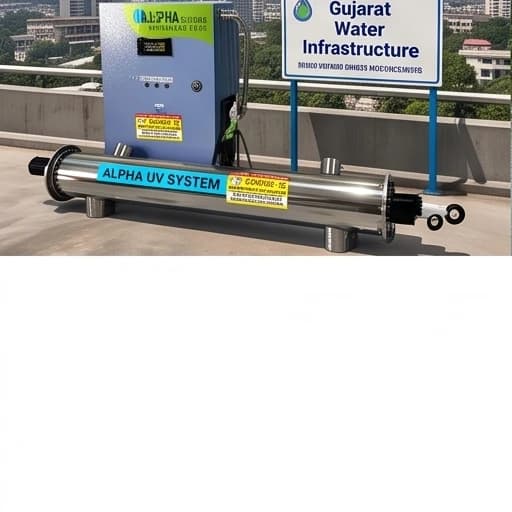
UV water treatment in Ahmedabad and Gujarat is driven by three factors: (1) AMC-supplied Narmada water with seasonal quality variation and overhead tank bacterial regrowth, particularly in Ahmedabad's rapidly growing south and west zones; (2) chemical, pharma, and textile industries requiring UV disinfection for process water and UV-AOP for effluent treatment at GIDC estates across Ankleshwar, Vapi, Vatva, and Naroda; and (3) GPCB's stringent ZLD mandate for industrial units in Gujarat — including mandatory UV disinfection of ZLD RO permeate before process water reuse. Alpha UV System supplies UV systems across Gujarat with Philips UV-C lamps, GPCB documentation, and 5–7 day delivery to Ahmedabad, Surat, Vadodara, Rajkot, Ankleshwar, and Vapi.
Gujarat is India's most industrialised state by manufacturing output — the GIDC (Gujarat Industrial Development Corporation) manages 196 industrial estates across the state, many of which are among the world's most concentrated chemical manufacturing zones. Ankleshwar (chemicals and APIs), Vapi (chemicals, dyes, plastics — one of Asia's largest chemical industrial estates), Vatva (Ahmedabad — chemicals and pharma), Naroda (textiles, chemicals), and Sachin GIDC (Surat — textiles and chemicals) are all designated as CPCB Critically Polluted Areas due to their effluent discharge history.
This industrial intensity makes Gujarat one of the most demanding markets for industrial UV water treatment in India — both for process water quality (chemical and pharma plants requiring high-purity input water) and for effluent treatment compliance with GPCB's historically strict enforcement posture.
Gujarat's Water Supply Landscape and UV Relevance
Gujarat receives its water from three primary sources: the Narmada Main Canal (Sardar Sarovar Project) now supplies water to most major cities via the GWSSB (Gujarat Water Supply and Sewerage Board) grid; the Mahi, Sabarmati, and Tapi rivers supply industrial estates and smaller towns; and groundwater from alluvial aquifers provides backup supply for areas not yet covered by the Narmada grid.
| City / Zone | Water Source | Key Water Quality Issue | UV Solution |
|---|---|---|---|
| Ahmedabad (AMC areas) | AMC piped supply — Narmada + Sabarmati | Bacterial regrowth in overhead tanks; seasonal turbidity spike during monsoon in Sabarmati supply | Post-tank UV at 40 mJ/cm², 1–5 m³/h |
| Surat (SMC areas) | SMC piped supply — Tapi River | Tapi industrial discharge affects raw water quality; post-storage bacterial regrowth | Post-tank UV at 40 mJ/cm²; pre-filter for turbid supply |
| Vadodara (VMC areas) | Mahi River supply + groundwater | Iron in groundwater (some areas 1–5 mg/L); hardness; E. coli in older ward plumbing | Iron removal + UV; post-tank UV for piped supply |
| Ankleshwar GIDC | GWSSB Narmada supply + borewell backup | Industrial estate groundwater contamination; chemical spills; high TDS in some areas | NABL test mandatory first; full pre-treatment + UV for potable use |
| Vapi GIDC | GWSSB supply + borewell | Extremely high groundwater contamination from legacy chemical industry discharge; some areas not suitable for potable use even after treatment | External water supply + UV; RO + UV for process water |
| Rajkot | Aji and Nyari rivers + borewell | High TDS (600–1,500 mg/L), hardness, fluoride in some areas; E. coli in older parts of city | RO + UV for drinking; UV-only for process water pre-treatment |
UV Water Treatment for Gujarat's Chemical Industry
Gujarat's chemical manufacturing sector — dyes and intermediates, agrochemicals, specialty chemicals, bulk drugs, and petrochemical derivatives — is concentrated in GIDC estates at Ankleshwar, Vapi, Vatva, Baroda (Vadodara), Panoli, and Jhagadia. Chemical manufacturing process water requirements vary by product type but typically include:
Purified water for API synthesis: Pharmaceutical API manufacturers in Ankleshwar and Vadodara require Schedule M 2025-compliant purified water. UV systems at 185 nm (TOC reduction) and 254 nm (loop disinfection) are mandatory components of the pharmaceutical water system. Ankleshwar alone has 200+ pharma and fine chemical units requiring pharmaceutical-grade water UV systems.
Process water disinfection for chemical reactors: Some chemical synthesis processes use water as a reaction medium or solvent. Microbial contamination in reactor feed water can compromise product purity and generate by-products. UV disinfection at 40 mJ/cm² on process water feeds provides microbiological control without chemical contamination of the reaction.
Effluent treatment UV-AOP: Chemical plant effluent — containing solvents, intermediates, dyes, and agrochemical residues — often contains compounds resistant to biological degradation. UV-AOP (UV + H₂O₂) converts recalcitrant organics to biodegradable fragments for downstream biological treatment, reducing COD by 30–60% in a single pass.
GPCB ZLD Requirements and UV Integration
The Gujarat Pollution Control Board (GPCB) mandates ZLD for all industries in designated Critically Polluted Areas and for specific Red category industries across the state. Under GPCB's ZLD policy:
Industrial effluent must be treated to a high quality, concentrated by RO/MF/NF membranes, and the reject brine sent to Multiple Effect Evaporation (MEE) for crystallisation. The RO permeate — the cleaned water recovered from the ZLD system — must meet quality specifications for process water reuse before being returned to the industrial process.
UV disinfection of ZLD RO permeate is a standard requirement in GPCB-compliant ZLD systems for two reasons: (a) RO membranes remove most but not all bacteria — UV at 40 mJ/cm² on the permeate provides the final pathogen barrier before the water re-enters the process; and (b) the recovered process water stored in RO permeate tanks can develop microbial growth without UV treatment, contaminating subsequent batches and increasing biofouling on downstream membranes.
For chemical and pharma plants in Ankleshwar and Vapi that have installed ZLD systems under GPCB consent conditions, UV disinfection is a mandatory component of the permeate polishing train — typically at 40 mJ/cm² on the permeate flow (5–50 m³/h depending on plant scale).
UV-AOP for Surat's Textile Industry
Surat is India's largest synthetic textile manufacturing centre, producing 40% of India's man-made fabric. The Surat textile cluster — concentrated in Katargam, Udhna, Pandesara, and the SURAT TEXTILE MARKET area — uses disperse dyes (for polyester), acid dyes (for nylon), and reactive dyes (for blended fabrics). Surat textile effluent has historically been discharged to the Tapi River — a major source of Tapi River pollution that GPCB and NGT have addressed through consent conditions requiring colour treatment.
GPCB consent conditions for Surat textile units specify colour discharge limits of <400 ADMI. For disperse and polyester dye effluent, UV-AOP at 2,000–5,000 mJ/cm² with H₂O₂ is required to achieve this target. Surat's CETP operators (SEAG CETP at Udhna, Pandesara CETP) have integrated UV-AOP into their treatment trains following GPCB enforcement notices.
UV Water Treatment for Dholera SIR and New Industrial Zones
The Dholera Special Investment Region (SIR) — India's largest greenfield industrial city being developed under the Delhi Mumbai Industrial Corridor (DMIC) — will host a Tata Electronics/PSMC 28nm semiconductor fab as its anchor industrial investment, along with chemical, pharmaceutical, and electronics manufacturing. Dholera's UPW (ultrapure water) requirements for the semiconductor fab will be the most demanding in any new Indian industrial zone — 185 nm UV TOC reduction and 254 nm disinfection at SEMI F63 Grade 1 specifications.
Alpha UV System is positioned to supply UV reactors for Dholera semiconductor and industrial facility water treatment systems as the zone comes online through 2026–2028, including UV systems compatible with SEMI F63, FSSAI, and GPCB regulatory requirements across the diversified industrial mix planned for the SIR.
UV System Sizing Reference for Gujarat
| Application | Flow Rate | UV Dose | Notes |
|---|---|---|---|
| Residential apartment — Ahmedabad / Surat | 1–5 m³/h | 40 mJ/cm² | Post-overhead-tank; 5 µm pre-filter for borewell |
| Pharma / API plant purified water (Ankleshwar) | 2–20 m³/h | 80 mJ/cm² | 185 nm + 254 nm; Schedule M 2025 IQ/OQ/PQ documentation |
| Chemical plant process water (Vapi/Vatva GIDC) | 5–30 m³/h | 40 mJ/cm² | 316L SS body; confirm UVT of process water before sizing |
| ZLD RO permeate disinfection | 5–50 m³/h | 40 mJ/cm² | High UVT (95%+); compact reactor; GPCB ZLD documentation |
| Surat textile CETP UV-AOP | 20–100 m³/h | 2,000–4,000 mJ/cm² | Medium-pressure lamps; H₂O₂ 50–80 mg/L; GPCB colour compliance 400 ADMI |
| STP outlet — 300 KLD (Ahmedabad township) | 20–30 m³/h | 40 mJ/cm² | Philips TUV 95W for STP UVT 55–65%; GPCB documentation |
| Semiconductor UPW (Dholera SIR) | 10–100 m³/h | 500–3,000 mJ/cm² (TOC); 80 mJ/cm² (loop) | 185 nm fused silica reactor; SEMI F63 specification; 316L electropolished SS |
Does GPCB require UV as part of the ZLD system documentation?
GPCB does not specify UV disinfection explicitly in ZLD consent conditions — but it specifies that the ZLD treated water reused as process water must meet the quality specifications required for that process. For pharmaceutical and food processing facilities, the process water quality standard requires microbiological compliance that UV disinfection of ZLD permeate achieves. For chemical plants where the process water quality specification includes a total bacteria limit, UV is the control measure that meets that specification. In practice, GPCB environmental officers reviewing ZLD system designs for Critically Polluted Area facilities expect to see UV disinfection as a standard component of the permeate polishing train alongside multimedia filtration and cartridge filtration. Alpha UV System provides GPCB-formatted ZLD system documentation packages including UV system commissioning reports, UV intensity monitoring records, and Philips lamp COA documentation.
Is it safe to use Vapi groundwater even with UV treatment?
No. CPCB and GPCB have documented severe groundwater contamination in Vapi GIDC — including chlorinated solvents, heavy metals, and dissolved organics from decades of industrial chemical discharge. UV disinfection eliminates biological contamination (bacteria and viruses) but does not remove dissolved chemicals, heavy metals, or solvents. Vapi groundwater for potable use requires detailed chemical analysis by an NABL-accredited laboratory, and depending on what is found, may require multi-stage treatment (activated carbon for organics, ion exchange for metals, RO for dissolved solids) before UV provides meaningful value. For industrial process water in Vapi, external Narmada Canal supply (from GWSSB pipelines that now reach Vapi) is strongly recommended over groundwater. Contact Alpha UV System for a water treatment recommendation after sharing your NABL analysis report.
Alpha UV System supplies UV disinfection and UV-AOP systems across Gujarat — Ahmedabad, Surat, Vadodara, Rajkot, Ankleshwar, Vapi, and Dholera. Pharmaceutical purified water UV, chemical plant process water UV, textile UV-AOP, and ZLD permeate UV. GPCB documentation as standard. Philips UV-C lamps. 5–7 day delivery to Gujarat.
WhatsApp Us for Gujarat UV System SupplyRecommended UV Systems
Alpha UV System products for this application — powered by genuine Philips UV-C lamps.
Commercial UV Water Purification System
500 – 5,000 LPH
HACCP-compliant UV water purification for hotels, restaurants, and offices
Industrial UV Water Treatment System
5,000 – 50,000 LPH
Schedule M 2025 and HACCP compliant UV for pharma, food & beverage, and process water
Not sure which system suits your application? WhatsApp our engineers for a free recommendation →
Related solutions
See how Alpha UV System applies this to your industry or city.
Need a UV system?
Talk to our UV engineers — WhatsApp for a quote in 2 hours, or browse the full catalog on IndiaMART.