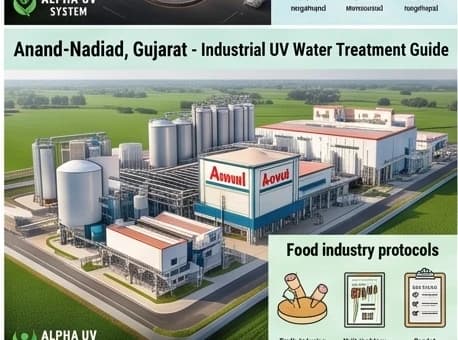
UV water treatment in Anand and Nadiad addresses four key needs: (1) post-overhead-tank disinfection for residential areas — Anand and Nadiad Municipal Corporation supply from the Mahi River loses residual chlorine in overhead tanks during Gujarat's summer heat (temperatures reach 42–45°C in May–June); (2) dairy and food processing UV for GCMMF (Gujarat Cooperative Milk Marketing Federation) Amul operations and the dairy cooperative ecosystem in Anand district — FSSAI food contact water compliance requiring UV-treated process water for milk processing, ice cream manufacturing, and cheese production; (3) pharmaceutical manufacturing UV for Anand GIDC's pharmaceutical sector (Zydus Cadila is headquartered in Ahmedabad but has significant manufacturing in the Anand-Nadiad belt), including Schedule M 2025 compliance; and (4) GPCB STP compliance for the Anand-Nadiad-Vallabh Vidyanagar urban cluster's residential and institutional complexes. Alpha UV System supplies Philips UV-C lamp UV systems to Anand and Nadiad with 5–7 day delivery and GPCB documentation support.
Anand — "The Milk Capital of India" — is the birthplace of India's White Revolution and the home of Amul (the Anand Milk Union Limited), which Dr. Verghese Kurien built into India's most successful cooperative brand. The district of Anand is the original collection zone of Gujarat's milk cooperative model: farmer-owned village-level dairy cooperatives feeding into district unions (AMUL) that process and market under the GCMMF national umbrella. The Anand model has been replicated across India, but the Anand-Kheda district remains the geographic and spiritual heart of India's cooperative dairy movement.
Beyond dairy, Anand and Nadiad have developed into significant educational (Anand Agricultural University, Sardar Vallabhbhai Patel National Police Academy), pharmaceutical, and food processing hubs in central Gujarat. The Mahi River supply — shared with Vadodara's agricultural and residential needs — provides a surface water source that is treated by GWSSB and municipal corporations before distribution.
Anand-Nadiad Water Quality by Zone
| Zone / Area | Supply Type | Key Water Issue | UV Solution |
|---|---|---|---|
| Anand city (Mota Bazar, Vallabh Vidyanagar) | AMC piped supply (Mahi River) + borewell | Bacterial regrowth in summer (45°C peak); Mahi monsoon turbidity spikes; borewell TDS 400–900 mg/L in parts | Post-tank UV at 40 mJ/cm²; 5 µm pre-filter; RO + UV for borewell if TDS >500 mg/L |
| AMUL Anand dairy complex | AMC supply + GCMMF borewell | India's iconic dairy brand — FSSAI food contact water; milk pasteurisation; ice cream and cheese manufacturing; EU/US export dairy standards | UV at 40 mJ/cm² on all food contact water; FSSAI compliance; 316L SS food-grade body; no chlorine in dairy contact water |
| Anand GIDC (pharmaceutical/industrial) | GIDC industrial supply + borewell | Pharmaceutical manufacturers; chemical units; GPCB industrial STP compliance | Pharma UV (185 nm + 254 nm); industrial STP UV; Schedule M 2025; GPCB documentation |
| Nadiad city (Kheda district HQ) | NMC piped supply (Mahi/GWSSB) + borewell | Dense residential; hospital (GMERS Medical College Nadiad); STP compliance; borewell TDS 400–800 mg/L | Post-tank UV; hospital UV; STP UV; RO + UV for elevated TDS borewell |
| Petlad / Borsad (satellite towns) | GWSSB supply + borewell | Agricultural towns; dairy cooperative collection; borewell TDS 500–1,200 mg/L in southern Anand district | NABL test first; RO + UV for high-TDS borewell; post-tank UV for GWSSB supply |
UV for AMUL and Gujarat's Dairy Cooperative Sector
GCMMF (Amul's parent cooperative federation) processes approximately 26–30 million litres of milk daily at its processing facilities across Gujarat — the Anand milk processing plant, Anand ice cream plant, Gandhinagar cheese plant, and various district dairy plants in NDDB's cooperative network. UV water treatment in dairy processing:
Why UV — not chlorine — in dairy processing water: Dairy product quality is acutely sensitive to chlorine residual in water used in milk contact applications (equipment cleaning, CIP final rinse, condensate make-up water). Even trace chlorine (0.1–0.2 mg/L) in dairy CIP rinse water can cause chlorophenol off-flavours in milk and milk products — a disaster for quality-conscious brands like Amul. UV at 40 mJ/cm² provides the microbiological safety required for FSSAI food contact water compliance without any chemical residual in the product-contact water.
FSSAI export compliance: Amul's cheese, butter, and anhydrous milk fat (AMF) exports to the EU and the USA are governed by EU Regulation 853/2004 and US FDA's Grade A pasteurised milk ordinance (PMO). Both require dairy plant water quality documentation — UV system commissioning reports and intensity monitoring logs form part of the plant's water safety documentation reviewed during EU and US Dairy Grading Branch inspections of Indian dairy exporters.
| Application | Flow Rate | UV Dose | Notes |
|---|---|---|---|
| Residential apartment (Anand / Nadiad) | 1–3 m³/h | 40 mJ/cm² | Post-overhead-tank UV; 5 µm pre-filter; summer peak May–June critical |
| AMUL dairy plant food contact water | 5–30 m³/h | 40 mJ/cm² | FSSAI food contact water; no chlorine in dairy product contact; 316L SS food-grade body; EU export audit |
| Village dairy cooperative collection point | 1–3 m³/h | 40 mJ/cm² | Village dairy BMC cleaning water UV; FSSAI milk handling water; compact UV for rural cooperative |
| Pharma purified water (Anand GIDC) | 2–10 m³/h | 80 mJ/cm² | 185 nm + 254 nm; Schedule M 2025 IQ/OQ/PQ; GPCB documentation |
| GMERS Medical College hospital (Nadiad) | 5–20 m³/h | 40–80 mJ/cm² | NABH hospital water safety; dialysis UV; ICU 80 mJ/cm² |
| STP outlet — 300 KLD (Anand residential) | 20–30 m³/h | 40 mJ/cm² | Philips TUV 95W; GPCB consent documentation; Mahi River basin compliance |
Does Amul and the cooperative dairy sector use UV for all water in the plant?
In a well-run dairy plant meeting FSSAI and EU/US dairy standards, UV should be installed on the water supply for all product-contact applications: CIP final rinse water supply, boiler feed water (steam used for sterilisation), ice cream hardening tunnel air wash water, packaging machine wash water, and container rinse water. UV is not typically needed for: cooling tower water (chlorine-based biocides are acceptable for non-product-contact cooling water in dairy plants), floor washing water, or non-contact cleaning applications.
The practical implementation in a large dairy plant like Amul Anand: a main UV system at the plant water supply header (treating all incoming water from the GWSSB supply or borewell backup) followed by a UV polishing unit specifically on the CIP final rinse water circuit (because the CIP circuit has specific microbiological sensitivity). For smaller village-level dairy cooperative collection centres (BMC — Bulk Milk Cooler centres): a single compact UV system at 1–3 m³/h on the BMC cleaning water supply covers all FSSAI-required food contact water applications. Alpha UV System supplies dairy-grade 316L stainless steel UV reactors specifically for the dairy sector — suitable for Amul and affiliated cooperative plants and for private dairy processors in the Anand-Nadiad district.
Alpha UV System supplies UV disinfection systems to dairy cooperatives, pharmaceutical manufacturers, residential complexes, hospitals, and STP operators across Anand, Nadiad, Vallabh Vidyanagar, Karamsad, Petlad, and the Kheda district. GPCB STP documentation. FSSAI dairy and food safety UV. Philips UV-C lamps. 5–7 day delivery to Anand-Nadiad.
WhatsApp Us for Anand-Nadiad UV System SupplyStandards, authorities & further reading
External references used to inform this guide. Regulations evolve — check the latest revision on each authority's site before compliance decisions.
Recommended UV Systems
Alpha UV System products for this application — powered by genuine Philips UV-C lamps.
Commercial UV Water Purification System
500 – 5,000 LPH
HACCP-compliant UV water purification for hotels, restaurants, and offices
Industrial UV Water Treatment System
5,000 – 50,000 LPH
Schedule M 2025 and HACCP compliant UV for pharma, food & beverage, and process water
Not sure which system suits your application? WhatsApp our engineers for a free recommendation →
Related solutions
See how Alpha UV System applies this to your industry or city.
Need a UV system?
Talk to our UV engineers — WhatsApp for a quote in 2 hours, or browse the full catalog on IndiaMART.