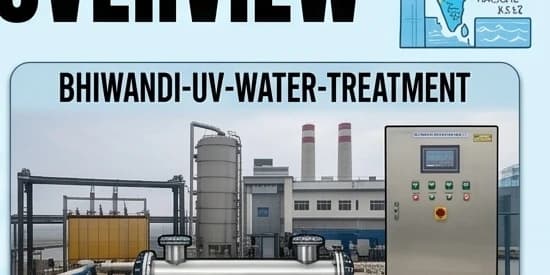
UV water treatment in Bhiwandi addresses 5 key needs: (1) logistics and warehousing complexes (e-commerce, 3PL, FMCG) requiring FSSAI-compliant process water and worker welfare drinking water; (2) power loom textile cluster (1.5 lakh+ power looms) ETP final-stage UV for MPCB compliance before Ulhas River discharge; (3) Ulhas River surface water (high TOC, industrial contamination, seasonal turbidity) requiring robust pre-treatment before UV; (4) pharmaceutical and FMCG cold chain facilities needing Schedule M or FSSAI-grade water; (5) Bhiwandi-Nizampur City Municipal Corporation (BNCMC) distributed supply with aging network coliform risk. Philips TUV 16W–95W at 40 mJ/cm² standard; power loom ETP needs auto-wiper on UV chambers due to textile dye pigment contamination.
Bhiwandi: From Power Looms to Logistics Parks — A Water Treatment Story
Bhiwandi — 50 km northeast of Mumbai in Thane district — has undergone a dramatic economic transformation: from Asia's largest power loom textile cluster (1.5 lakh+ decentralized looms) to India's leading logistics and warehousing hub (hosting distribution centers of Amazon, Flipkart, Reliance, Mahindra Logistics, DHL, and 500+ other 3PL operators). UV water treatment in Bhiwandi must serve both these identities simultaneously — the old textile industry's ETP compliance challenges and the new logistics economy's food safety and worker welfare water requirements.
Bhiwandi's water quality situation is complex: the city draws on Ulhas River supply (treated at Kalyan-Dombivali-Thane intake, with KDMC/BNCMC distribution), supplemented by borewells that show elevated iron and coliform from the Ulhas basin alluvial geology. The Ulhas River itself is heavily polluted by Ambarnath and Dombivali MIDC textile and chemical effluent upstream — even after treatment, TOC (total organic carbon) in Bhiwandi municipal supply is higher than ideal (>3 mg/L), which reduces UVT and increases pre-treatment requirements for UV systems.
Ulhas River Water Quality: Bhiwandi's Contaminated Source
The Ulhas River upstream of Bhiwandi receives effluent from Ambarnath MIDC (textile dyes, reactive dyes, acid dyes) and Dombivali MIDC (pharmaceutical, chemical, dye intermediates). Even after KDMC treatment, Bhiwandi distributed water can carry elevated color (ADMI 50–150 units), TOC (3–8 mg/L), and trace chlorinated organics. These organic compounds reduce UVT to 70–80% and are NOT removed by UV alone. Activated carbon pre-filtration before UV is mandatory in Bhiwandi to remove color-forming organics, improve UVT to >90%, and prevent DBP (disinfection by-product) formation. Never install UV on Bhiwandi water without upstream activated carbon filtration.
Table 1: Bhiwandi Water Quality by Zone and Source
| Zone / Area | Source | TDS (mg/L) | Key Issue | Treatment Required |
|---|---|---|---|---|
| BNCMC municipal supply | Ulhas River treated | 200–400 | TOC 3–8 mg/L, color | AC filter + 5-micron + UV |
| Power loom cluster (old Bhiwandi) | BNCMC + borewell mix | 250–500 | Iron 0.3–1.0 mg/L, color | Iron filter + AC + UV |
| Logistics parks (NH-48 corridor) | BNCMC / private tanker | 200–400 | Tanker contamination risk | 5-micron + AC + UV (STP for large parks) |
| Kulgaon-Badlapur industrial area | MIDC supply | 300–600 | Industrial contamination | Full pre-treatment + UV |
| Rural Bhiwandi tehsil | Borewell (lateritic) | 200–500 | Iron 0.5–2.0 mg/L | Iron filter + 5-micron + UV |
Logistics and E-Commerce Warehouses: Water for India's Supply Chain Hub
Bhiwandi's logistics parks — NH-48 corridor, Amne, Mankoli, Sonale, and Padgha nodes — host distribution centers for Amazon (3 large FCs), Flipkart, Reliance Retail, Bigbasket, and 500+ 3PL operators. UV water treatment in Bhiwandi's logistics sector addresses: (1) worker canteen and drinking water for 2–15 lakh daily workers across all parks; (2) food storage and cold chain facility process water (FSSAI FBO compliance for temperature-controlled warehouses); (3) firefighting water reserve quality (coliform-free systems to prevent contamination of fire suppression mist if food product exposure occurs).
Large logistics parks (Amazon FC Bhiwandi, 1.5 million sq ft+) house 5,000–20,000 workers per shift — requiring canteen water supply at 5,000–50,000 LPH. FSSAI Central License (for large food storage and distribution operators) requires documented potable water quality for all water contact with food products — including ice used in produce storage, cleaning water for conveyor belts and picking stations, and drinking water. Philips TUV 55W or 95W UV systems (5,000–9,000 LPH per unit, multiple units in parallel for large canteens) with 5-micron sediment + activated carbon pre-filtration handle logistics park water effectively.
Private water tanker supply — common in Bhiwandi during BNCMC supply interruptions — is a specific risk: tanker water is often untested and may carry coliform contamination from storage and transport. UV installed at the tanker filling point for the building's underground sump provides a critical safety barrier against tanker-borne microbiological contamination. For Amazon FC-scale operations with certified food storage requirements, on-site water testing kits (coliform test strips) at tanker receiving point + UV at storage tank outlet provides a two-stage verification system.
Power Loom Textile ETP: MPCB Compliance UV in Bhiwandi's Traditional Industry
Bhiwandi's 1.5 lakh+ power looms (primarily producing grey fabric — synthetic-cotton blends, polyester fabric, saree warp weaving) generate textile ETP wastewater with BOD 200–800 mg/L and characteristic color from sizing agents, fabric finishers, and occasional dye sizing. UV water treatment in Bhiwandi's power loom sector is the critical final stage before ETP discharge to Ulhas River under MPCB consent.
Power loom ETP effluent (after biological treatment and clarification) often retains residual color from sizing agents (starch, PVA) and trace dyes — UVT typically 55–70%. This color deposits on quartz UV sleeves within 1–2 weeks, dramatically reducing UV output and causing compliance failure without visible alarm. UV chambers for Bhiwandi textile ETP must be equipped with automatic mechanical sleeve wipers (auto-wipers) that continuously clean the quartz surface during operation. Do NOT install standard UV systems without auto-wipers for power loom ETP application in Bhiwandi — standard lamp designs will fail to meet MPCB's 1,000 MPN/100 mL coliform discharge limit within weeks of installation.
MPCB's Orange and Red category CTO for power loom ETPs in Bhiwandi requires third-party ETP audit (annually) where UV system commissioning certificates, auto-wiper maintenance logs, lamp certificates (Philips factory test certificates), and online monitoring integration are checked. MPCB Maharashtra has implemented real-time OEM (Online Effluent Monitoring) for medium and large CTO holders — UV intensity 4–20 mA output transmitted to MPCB servers is increasingly required for Bhiwandi cluster units above 50 KLD ETP capacity.
Pharmaceutical and FMCG Cold Chain Facilities: Schedule M and FSSAI Grade UV
Bhiwandi's logistics infrastructure increasingly hosts pharmaceutical third-party logistics (3PL) with cold chain — Mahindra Logistics, Snowman, TCI Coldex, and others operate temperature-controlled (2–8°C for pharma, -18°C for frozen food) warehouses that require FSSAI Central License (food) or GDP (Good Distribution Practice) compliance (pharma). UV water treatment in Bhiwandi's pharmaceutical cold chain addresses purified water (PW) requirements for cleaning-in-place (CIP) systems used to sterilize pharmaceutical storage containers and packaging lines.
For pharma GDP-compliant facilities, water used in container washing and CIP must meet Schedule M 2025 PW grade: TOC <500 µg/L, conductivity <1.3 µS/cm, bacteria <100 CFU/mL. The treatment train: BNCMC/tanker supply → activated carbon filter (removes chlorine, TOC) → water softener (removes hardness) → RO (reduces TDS, TOC) → UV (254 nm + 185 nm dual-wavelength — 185 nm photooxidizes residual TOC) → PW storage. The 185+254 nm dual-wavelength Philips TUV lamp is essential for TOC reduction in Bhiwandi water where upstream Ulhas River contamination keeps TOC elevated even after RO.
Table 2: UV System Sizing for Bhiwandi Applications
| Application | Flow | UV Dose | Model | Pre-treatment |
|---|---|---|---|---|
| Home / small office (BNCMC supply) | 200–500 LPH | 40 mJ/cm² | TUV 16W | 5-micron + AC + UV |
| Logistics park canteen (5,000 workers) | 10,000–30,000 LPH | 40 mJ/cm² | TUV 95W × multi-bank | 5-micron + AC + UV |
| Power loom ETP discharge | 10,000–1,00,000 LPH | 40 mJ/cm² | TUV 95W × bank (auto-wiper) | Full ETP + clarifier + UV (auto-wiper) |
| Pharma 3PL PW (CIP) | 1,000–5,000 LPH | 40 mJ/cm² | TUV 36W (185+254 nm) | AC → softener → RO → UV (TOC oxidation) |
| Hospital / clinic point-of-use | 300–3,000 LPH | 40–80 mJ/cm² | TUV 36W | AC + 5-micron + UV (NABH docs) |
BNCMC Infrastructure Gaps: Post-Treatment Contamination Risk
Bhiwandi-Nizampur City Municipal Corporation (BNCMC) serves a rapidly growing city — population over 8 lakh — with water infrastructure that has not kept pace with growth. Intermittent supply (4–8 hours/day in many wards), aging distribution pipes in the old textile town core (Naka areas, Kapad Bazar), and illegal tap connections cause negative pressure events that allow groundwater infiltration into the distribution network. UV water treatment in Bhiwandi at the point of use is especially important given this infrastructure gap — even treated BNCMC supply may carry coliform contamination at the tap from distribution system issues.
For residential buildings and commercial establishments in Bhiwandi drawing on BNCMC supply, a simple and reliable treatment train is: overhead tank (OHT) outlet → 5-micron sediment filter → activated carbon filter (removes chlorine, organic color from Ulhas contamination) → Philips TUV 16W UV → drinking water tap. This OHT-to-tap system is effective even with intermittent supply — the OHT provides storage buffer, and the UV treats the outflow continuously when water is being drawn.
Table 3: Philips TUV Product Recommendations for Bhiwandi UV Water Treatment
| Application | Philips TUV Model | Capacity | UV Dose | Key Feature |
|---|---|---|---|---|
| Household (BNCMC supply) | TUV 16W (PL-L) | ~1,500 LPH | 40 mJ/cm² | AC upstream mandatory, compact |
| Logistics park large canteen | TUV 95W (amalgam) | ~9,000 LPH | 40 mJ/cm² | High output, 12,000h life, FSSAI docs |
| Power loom ETP (auto-wiper) | TUV 95W × bank (with auto-wiper) | 10,000–1,00,000 LPH | 40 mJ/cm² | Auto-wiper on quartz sleeve — mandatory |
| Pharma 3PL PW generation | TUV 36W (185+254 nm) | ~3,000 LPH | 40 mJ/cm² + TOC | Dual-wavelength, Schedule M IQ/OQ/PQ |
Table 4: Regulatory Compliance for UV Water Treatment in Bhiwandi
| Regulation | Sector | Requirement | UV Role |
|---|---|---|---|
| IS 10500:2012 | All drinking water | Zero coliform, turbidity <1 NTU | UV final barrier after AC + 5-micron |
| MPCB ETP Discharge Norms | Power loom clusters, industrial ETP | <1,000 MPN/100 mL coliform | ETP UV with auto-wiper, OEM monitoring |
| FSSAI Central License | Food cold chain, FMCG warehouses | Zero E. coli in contact water, process water | UV at 40 mJ/cm², FSSAI inspection records |
| Schedule M 2025 (CDSCO) | Pharma 3PL / CIP / PW generation | PW TOC <500 µg/L, IQ/OQ/PQ | 185+254 nm dual-wavelength UV in PW loop |
| MPCB OEM / Real-Time Monitoring | Red/Orange CTO holders (>50 KLD ETP) | Continuous OEM data to MPCB | UV 4-20 mA intensity on OEM panel |
Frequently Asked Questions — UV Water Treatment in Bhiwandi
Q1: Why does Bhiwandi water have an unusual color/smell even after BNCMC treatment?
Bhiwandi's BNCMC supply draws on the Ulhas River, which receives effluent from Ambarnath MIDC (textile dyes, chemicals) and Dombivali MIDC (pharmaceutical intermediates, dye chemicals) upstream. Even after BNCMC's treatment with coagulation, sedimentation, rapid sand filtration, and chlorination, residual color-causing organic compounds (humic acids, dye metabolites, organic acids) pass through into the distribution network. These organics cause the slightly yellowish tinge and faint chemical odor often noticed in Bhiwandi tap water. They also react with chlorine to form disinfection by-products (DBPs — trihalomethanes, haloacetic acids). An activated carbon filter upstream of UV removes these organics — improving taste, color, odor, and UVT (improving UV disinfection efficacy) simultaneously. This is why AC pre-filtration is mandatory for Bhiwandi UV installations, not just optional.
Q2: Why do power loom ETPs in Bhiwandi need auto-wipers on UV systems while other industries don't?
Power loom textile ETP effluent, even after biological treatment and secondary clarification, retains residual color from sizing agents (PVA, starch, CMC), fabric finishers (acrylic softeners, silicone), and trace reactive dye contamination from yarn dyeing batches. These colored compounds absorb UV at 254 nm and deposit a colored film on quartz UV sleeves over time — unlike clean water applications where quartz remains clear for months. The film deposition rate in textile ETP is fast — in Bhiwandi's power loom ETPs, untreated UV sleeves show visible discoloration within 1–2 weeks of operation, with UV output dropping 20–40% within a month. Auto-wiper mechanisms (rotating silicone wiper or PTFE ring driven by a motor with 15-second duty cycle) continuously clean the quartz surface, maintaining UV output and MPCB coliform compliance. Standard UV systems without auto-wipers will fail textile ETP applications in Bhiwandi within weeks.
Q3: Amazon and Flipkart have large warehouses in Bhiwandi — what water treatment do they require?
Amazon, Flipkart, and other large e-commerce operators with FSSAI Central License (for food storage) or FSSAI State License (for non-food warehouse with canteen) require: (1) Documented potable water quality at all drinking and food-contact water points — zero coliform, zero E. coli (monthly test reports); (2) UV or other WHO-approved treatment at drinking water dispensers for workers; (3) For food fulfilment centers handling fresh produce, dairy, or beverages — process water (conveyor washing, produce misting, cleaning) must be FSSAI-grade. The practical implementation for a 500,000 sq ft Amazon FC: Philips TUV 95W systems (9,000 LPH each) with 5-micron + AC pre-filtration at all water supply points (canteen, drinking water kiosks, clean room washing stations). Monthly microbiological test reports are maintained for FSSAI state audit (typically annual) and Amazon/Flipkart internal auditor review (semi-annual). Alpha UV Systems provides FSSAI-aligned documentation for warehouse installations.
Q4: Is there a risk of dye contamination in residential drinking water near Bhiwandi power loom areas?
Yes — this is a real and documented concern in older Bhiwandi residential areas adjacent to power loom clusters (Naka areas, Anand Nagar, Khambalpada, Kashimira border zones). Power loom ETP overflow during monsoon, combined with inadequate sewer separation in older areas, can contaminate shallow borewells with reactive dye metabolites and trace azo dyes. MPCB surveys have detected trace dye contamination in groundwater samples from residential borewells near non-compliant power loom cluster ETPs. For residents in these areas: (1) Do NOT use shallow borewell water for drinking without comprehensive testing; (2) If using borewell water, test for BOD, color (ADMI), and azo aromatic amines before system design; (3) If contamination is found, RO (not just UV) is required — UV does not remove dissolved dyes or dye metabolites; (4) For municipal BNCMC supply in these areas, activated carbon + UV provides adequate protection from distribution-level organic contamination.
Q5: How should logistics park developers include UV in Bhiwandi RERA/MIDC specifications?
Bhiwandi logistics park projects under MIDC-Bhiwandi Node infrastructure are not strictly RERA-governed (commercial/industrial, not residential) but must comply with MIDC infrastructure specifications and MPCB consent conditions. Key UV specification elements for logistics park MEP drawings: (1) Drinking water UV system — Philips TUV 55W or 95W (sized per canteen headcount at 8 LPH per person for 3 meals/day), with 5-micron + AC pre-filtration, UV intensity monitor, alarm output to BMS; (2) FSSAI inspection documentation package (commissioning report, factory test certificate, monthly water quality records); (3) ETP UV system (if ETP is on-site) — auto-wiper equipped if any textile or food processing is co-located; (4) Emergency power backup (UPS or DG set tie-in) for UV systems in food-grade storage areas (UV must continue during grid outages). Alpha UV Systems provides complete MEP specification support for Bhiwandi logistics park developers.
Bhiwandi's Ulhas River contamination and textile ETP challenges require specialized UV system design — with mandatory AC pre-filtration and auto-wipers for ETP applications. Alpha UV Systems provides complete UV solutions for Amazon/Flipkart logistics warehouses, power loom cluster ETPs, FSSAI pharma cold chain, and BNCMC municipal supply households in Bhiwandi, Mankoli, Amne, Padgha, and Sonale.
WhatsApp Us for Bhiwandi UV Water TreatmentStandards, authorities & further reading
External references used to inform this guide. Regulations evolve — check the latest revision on each authority's site before compliance decisions.
Recommended UV Systems
Alpha UV System products for this application — powered by genuine Philips UV-C lamps.
Commercial UV Water Purification System
500 – 5,000 LPH
HACCP-compliant UV water purification for hotels, restaurants, and offices
Industrial UV Water Treatment System
5,000 – 50,000 LPH
Schedule M 2025 and HACCP compliant UV for pharma, food & beverage, and process water
Not sure which system suits your application? WhatsApp our engineers for a free recommendation →
Related solutions
See how Alpha UV System applies this to your industry or city.
Need a UV system?
Talk to our UV engineers — WhatsApp for a quote in 2 hours, or browse the full catalog on IndiaMART.