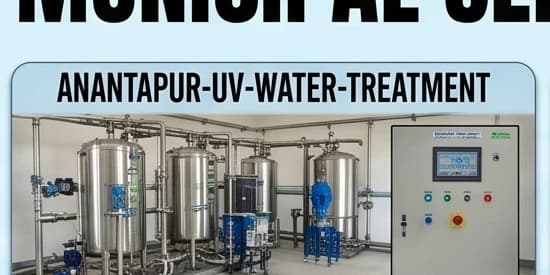
UV water treatment in Anantapur addresses 5 key needs: (1) fluoride endemic groundwater (1.5–6.0 mg/L across Rayalaseema Deccan trap) where RO is mandatory before UV to reduce fluoride below 1.0 mg/L; (2) solar energy project O&M camps and worker housing needing microbiologically safe water in remote semi-arid locations; (3) cement plant (Zuari, India Cements) cooling tower and process water UV disinfection; (4) JN Medical College and Govt General Hospital NABH compliance for ICU, OT, dialysis; (5) APEPC-compliant ETP final-stage UV for groundnut oil mills and textile units. Philips TUV 16W–95W at 40 mJ/cm² (drinking) and 80 mJ/cm² (ICU/OT) cover all applications; RO mandatory before UV for all groundwater sources in Anantapur district.
Why Anantapur Requires Mandatory RO Before UV Water Treatment
Anantapur district in Andhra Pradesh's Rayalaseema region sits atop Deccan trap basalt and granite — geology that concentrates fluoride in groundwater through natural leaching. Unlike iron or coliform, which UV can address indirectly through pre-filtration + UV, fluoride is a dissolved ion that UV cannot touch. UV water treatment in Anantapur without RO pre-treatment is an incomplete solution that leaves the district's most critical water quality problem unresolved.
The Andhra Pradesh Department of Health has categorized Anantapur as a "Grade A" fluoride-endemic district — mean groundwater fluoride 2.5–4.5 mg/L across most mandals, with peak values up to 6.0 mg/L in Tadipatri, Kanekal, and Guntakal areas. Chronic fluoride exposure above 1.5 mg/L causes dental fluorosis; above 4.0 mg/L, skeletal fluorosis. IS 10500:2012 permissible limit is 1.0 mg/L. No amount of UV treatment reduces fluoride — RO (which rejects fluoride at 95–99% efficiency) is the only practical solution at community and household scale. Only after RO brings fluoride to acceptable levels does UV serve its essential role as the final microbiological barrier against bacteria and viruses in the RO permeate line.
Anantapur district groundwater fluoride averages 2.5–4.5 mg/L. UV CANNOT remove fluoride. Installing UV-only water treatment in Anantapur (without RO) gives water that is microbiologically safe but chemically dangerous — skeletal fluorosis develops within years of consuming water at 4.0–6.0 mg/L fluoride. Every UV installation in Anantapur must be preceded by RO (reverse osmosis, 75 GPD–1,000 GPD depending on application) to reduce fluoride below 1.0 mg/L before UV final disinfection.
Anantapur District Water Quality: Zone-Wise Profile
UV water treatment in Anantapur requires understanding the district's water quality variation — both the endemic fluoride and the additional challenges of high TDS (semi-arid zone, Tungabhadra basin) and seasonal coliform contamination during the sparse rainy season (Anantapur receives only 550–600 mm average annual rainfall, lowest in peninsular India).
Table 1: Anantapur District Water Quality by Zone and Source
| Mandal / Area | TDS (mg/L) | Fluoride (mg/L) | Coliform Risk | Treatment Required |
|---|---|---|---|---|
| Anantapur City (municipal) | 450–800 | 1.5–3.0 | Moderate | RO mandatory + UV final |
| Tadipatri (cement belt) | 600–1,200 | 3.0–6.0 | Moderate | RO mandatory + UV final |
| Guntakal (railway junction zone) | 500–900 | 2.5–5.0 | Moderate | RO mandatory + UV final |
| Dharmavaram (textile) | 400–700 | 1.5–3.5 | Moderate | RO mandatory + UV final |
| Solar farm corridors (Pavagada side) | 300–600 | 1.5–4.0 | Low–Moderate | RO mandatory + UV final |
| Kanekal / Uravakonda | 500–1,000 | 3.5–6.0 | Low | RO mandatory + UV final |
Solar Energy Sector: UV Water Treatment for Remote O&M Camps
Anantapur district — India's "Solar Capital" — hosts some of the country's largest solar photovoltaic parks: NTPC Anantapur Solar (250 MW), SECI Anantapur (200 MW+), and multiple smaller IPP (Independent Power Producer) projects across Kanaganapalle, Kadiri, and Kadapa border taluks. These solar parks employ 200–500 O&M staff in remote camp housing, far from municipal water supply. UV water treatment in Anantapur's solar sector addresses water supply for remote worker camps drawing on local borewells with fluoride 2.0–4.5 mg/L.
The treatment train for solar camp water is: borewell → RO (75 GPD or 1,000 LPH commercial, depending on camp size) → RO permeate storage tank → UV (Philips TUV 16W or 36W) → drinking water distribution. RO reduces fluoride to <0.3 mg/L and TDS to <150 mg/L; UV provides the final microbiological safety barrier on the clean permeate. Without UV, RO permeate — while chemically clean — can harbor bacteria entering through the storage tank. The RO+UV combination ensures both chemical and microbiological safety for workers spending 6–12 months in remote camp conditions.
Solar EPC contractors (L&T, Tata Power Solar, Adani Solar) increasingly specify RO+UV water systems as a mandatory welfare facility in their camp construction BOQ (Bill of Quantities) under Factories Act 1948 Section 18 (drinking water provision) and Andhra Pradesh Factories Rules. APEDC (Andhra Pradesh Energy Development Corporation) also requires O&M camp welfare documentation in project commissioning reports.
Cement Industry: Tadipatri Cluster UV Applications
Tadipatri taluk hosts Zuari Cement, India Cements, and Orient Cement — large integrated clinker plants drawing on local limestone deposits. UV water treatment in Anantapur's cement industry focuses on three applications: cooling tower water (Legionella ASHRAE 188 compliance), quarry worker and plant staff drinking water (RO+UV for fluoride-endemic borewell sources), and ETP final-stage disinfection for cement plant washdown water before discharge to APEPC (now APPCB) norms.
Cement plant cooling towers are Legionella risk environments — warm water (30–40°C), drift aerosols, stagnant zones in tower packing. ASHRAE 188-2018 requires a Water Management Plan (WMP) with biological control. UV sidestream treatment at 10–25% recirculation volume (Philips TUV 95W × multiple lamps at 40 mJ/cm², 50,000–2,00,000 LPH depending on tower capacity) reduces Legionella to non-detectable without the biocide chemical costs and handling hazards of traditional chlorine/bromine treatment. This is especially relevant for cement plants in water-scarce Anantapur where recirculating cooling tower water is reused to maximum extent.
Quarry workers and plant staff drinking water: the contractor canteen and colony water supply must meet IS 10500:2012. With borewell fluoride at 3.0–6.0 mg/L in Tadipatri, RO (to reduce fluoride <1.0 mg/L) + UV (to eliminate microbial contamination from storage) is mandatory. Factories Act compliance (Section 18) requires documented water quality testing for all factories with 250+ workers — a requirement cement plants with 500–2,000 workers must meet during DISH (Department of Industrial Safety and Health, AP) inspections.
Table 2: UV System Sizing for Anantapur Applications
| Application | Flow Requirement | UV Dose | Lamp Model | Pre-treatment |
|---|---|---|---|---|
| Household / artisan RO+UV | 50–200 LPH | 40 mJ/cm² | TUV 16W | RO (75 GPD) → UV |
| Solar camp worker (50–100 pax) | 500–1,500 LPH | 40 mJ/cm² | TUV 16W / 36W | RO (1,000 LPH) → UV |
| Cement plant canteen | 2,000–5,000 LPH | 40 mJ/cm² | TUV 36W / 55W | RO → 5-micron → UV |
| JN Medical ICU/OT | 300–800 LPH | 80 mJ/cm² | TUV 36W | RO → 5-micron → UV |
| Cement cooling tower sidestream | 50,000–2,00,000 LPH | 40 mJ/cm² | TUV 95W × multi-bank | Strainer + 100-micron filter |
| Groundnut oil mill ETP | 10,000–50,000 LPH | 40 mJ/cm² | TUV 95W × multi-bank | ETP → clarifloculator → UV |
JN Medical College and Government General Hospital: NABH Healthcare Water
Jawaharlal Nehru Medical College (JNMC) Anantapur — part of Sri Krishnadevaraya University's medical campus — serves as the district's apex referral hospital. UV water treatment in Anantapur's healthcare sector centers on JNMC's growing NABH accreditation requirements and the city's expanding private hospital sector (Srinivasa Hospitals, Prasad Hospitals, Rainbow Hospitals).
The critical challenge for JNMC is that the campus draws on borewell water with fluoride 2.0–3.5 mg/L — completely unacceptable for patient drinking water, dialysis water, and food preparation. The mandatory treatment train is: borewell → RO (to reduce fluoride <0.5 mg/L and TDS <150 mg/L) → RO permeate storage → UV at 40 mJ/cm² (drinking/kitchen) or 80 mJ/cm² (ICU/OT) → point-of-use. Dialysis water requires the additional UF step: RO → UV → UF → hemodialysis machine (AAMI ISO 13959 bacteria <50 CFU/mL, endotoxin <2 EU/mL).
For NABH IPSG-8 compliance, all critical water points (ICU, OT, NICU, dialysis, CSSD, blood bank) must have documented monthly microbiological testing, lamp life records (replace at 9,000 hours or earlier if UV intensity drops below 70% of initial), quartz sleeve cleaning logs (quarterly minimum), and service engineer visit records. Alpha UV Systems provides the full NABH documentation package — factory test certificates, commissioning reports, and AMC with quarterly service visits — with every hospital installation.
Groundnut Oil Mills: Anantapur's Agricultural Processing Sector UV Needs
Anantapur is India's largest groundnut (peanut) producing district — the "Groundnut Capital of India" — with hundreds of oil expeller mills, solvent extraction plants, and groundnut processing units concentrated around Anantapur city, Rayadurgam, and Gooty. UV water treatment in Anantapur's agro-processing sector addresses process water quality for food-grade oil production and ETP discharge compliance under APEPC (Andhra Pradesh Pollution Control Board) norms.
Groundnut oil mills use water for washing raw groundnuts, cooling presses, and steam generation. FSSAI Food Business Operator (FBO) licenses for oil mills require process water to meet IS 10500:2012 microbiological standards. More critically, groundnut processing wastewater (ETP) contains high BOD (2,000–8,000 mg/L raw), oils/fats, and coliform from hull decomposition. APEPC discharge norms mandate <1,000 MPN/100 mL coliform in treated effluent before inland surface water discharge. UV at 40 mJ/cm² on ETP final effluent (after biological treatment, clarification, and filtration) achieves APEPC compliance without chlorine-contact chemical costs.
For solvent extraction plants (hexane-based extraction), water quality in the steam generation circuit is critical — boiler feed water must be very low TDS to prevent scale. A softener + RO + UV train provides boiler quality water and simultaneously ensures drinking/canteen water safety for plant workers. This shared infrastructure investment is financially efficient for large solvent extraction plants (50–500 MT/day capacity) in Anantapur's oil milling belt.
Dharmavaram Textile Industry: UV for Loom Industry Process Water
Dharmavaram — an Anantapur taluk city known for silk and silk-blend saree weaving — hosts over 15,000 power loom and handloom units. While textile dyeing is not prominent in Dharmavaram (unlike Tiruppur or Panipat), the sizing and finishing processes use water that must be free of iron and coliform. Iron in process water causes rust staining on silk fabric — a major quality defect in premium saree production. UV water treatment in Anantapur's textile cluster at Dharmavaram focuses on: (1) iron-free, coliform-free water for sizing and finishing, and (2) RO+UV for artisan welfare drinking water.
Dharmavaram groundwater (TDS 400–700 mg/L, fluoride 1.5–3.5 mg/L, iron 0.1–0.3 mg/L) requires RO to address fluoride and reduce TDS. Post-RO, UV provides the final microbiological barrier. For loom units using borewell water for silk washing, an iron removal filter + 5-micron + UV sequence (without RO) may be adequate if fluoride is below 1.5 mg/L — test your specific borewell before deciding whether RO is needed for the process water circuit (separate from drinking water, where RO is mandatory regardless).
Table 3: Philips TUV Product Recommendations for Anantapur UV Water Treatment
| Application | Philips TUV Model | Capacity | UV Dose | Key Feature |
|---|---|---|---|---|
| Home RO+UV (fluoride zone) | TUV 16W (PL-L) | ~1,500 LPH | 40 mJ/cm² | Post-RO UV stage, compact housing |
| Solar camp / MSME office | TUV 36W (PL-L) | ~3,000 LPH | 40 mJ/cm² | Intensity alarm, SS316 chamber |
| Hospital ICU/dialysis (JNMC) | TUV 36W (PL-L) | ~3,000 LPH | 80 mJ/cm² | Reduced flow for high dose, NABH docs |
| Groundnut oil mill / food plant | TUV 55W (PL-L) | ~5,000 LPH | 40 mJ/cm² | Food-grade SS316, FSSAI documentation |
| Cement cooling tower sidestream | TUV 95W (amalgam) | ~9,000 LPH (×multi-bank) | 40 mJ/cm² | ASHRAE 188 Legionella control, high output |
APEPC/APPCB Compliance: ETP UV for Anantapur Industries
UV water treatment in Anantapur's compliance context is governed by the Andhra Pradesh Pollution Control Board (APPCB, formerly APEPC). For all industries with APEPC "Red" category Consent to Operate (CTO), the ETP must meet discharge standards before treated effluent is released. For coliform and pathogenic bacteria in effluent from food processing, agro-processing, and slaughterhouses, APPCB requires <1,000 MPN/100 mL — achievable with UV at 40 mJ/cm² on biologically treated effluent with UVT >65%.
APPCB has begun requiring online OEM (Online Effluent Monitoring) for medium and large CTO units — continuous pH, BOD, COD, TSS, and coliform sensors with data transmitted to APPCB servers. UV systems with 4-20 mA intensity output can be integrated into OEM panels to demonstrate continuous disinfection compliance in real-time — a critical feature for industries facing APPCB third-party audit.
Table 4: Regulatory Compliance for UV Water Treatment in Anantapur
| Regulation | Sector | Requirement | UV Role |
|---|---|---|---|
| IS 10500:2012 (BIS) | All drinking water (home, office, hospital) | Zero coliform, F⁻ <1.0 mg/L | UV post-RO (RO mandatory for fluoride) |
| NABH IPSG-8 | JNMC hospital, private hospitals | Monthly water testing, ICU/OT/dialysis docs | Point-of-use UV 40–80 mJ/cm² |
| ASHRAE 188 | Cement plant cooling towers | Legionella WMP, biological control | Sidestream UV 40 mJ/cm² |
| APPCB / APEPC Discharge Norms | Groundnut mills, textiles, food processing ETP | <1,000 MPN/100 mL coliform | ETP final-stage UV, OEM integration |
| Factories Act 1948 (S.18) | Solar EPC camps, cement plants | Documented drinking water quality | RO+UV with test records for DISH inspection |
| FSSAI FBO License | Groundnut oil mills, food processors | Zero E. coli in process water | UV at 40 mJ/cm² in process water line |
Frequently Asked Questions — UV Water Treatment in Anantapur
Q1: Can I install UV alone in Anantapur without RO for drinking water?
No. Anantapur groundwater fluoride (1.5–6.0 mg/L) exceeds IS 10500:2012 permissible limit (1.0 mg/L) throughout the district. UV is an ultraviolet disinfection technology — it kills bacteria and viruses by damaging their DNA using 254 nm light. UV does NOT remove dissolved ions including fluoride, nitrate, arsenic, or TDS. Installing UV-only in Anantapur gives water that is microbiologically safe but chemically dangerous — long-term consumption of 3–6 mg/L fluoride causes skeletal fluorosis, joint deformities, and neurological effects. RO (which rejects 95–99% of fluoride) is mandatory before UV for all drinking water applications in Anantapur. After RO, UV protects the clean permeate from bacterial regrowth in storage. Neither technology alone is sufficient — both are required.
Q2: What is the correct treatment train for Anantapur borewell water in a solar camp?
The recommended treatment train for solar O&M camp borewell water in Anantapur district: (1) Borewell pump → multi-media pre-filter (removes turbidity, sediment) → (2) Activated carbon filter (removes chlorine if present, chloramines, organic odour) → (3) RO system sized for camp population (1,000 LPH for 50 workers, 3,000 LPH for 150 workers) → (4) RO permeate storage tank (SS304 or food-grade PE) → (5) Philips TUV 16W or 36W UV system → drinking water tap. The RO reduces fluoride from ~3 mg/L to <0.3 mg/L; UV eliminates any bacteria entering through the storage tank; together they meet IS 10500:2012 for drinking water. Monthly water quality tests (coliform + fluoride) should be kept for DISH inspection records.
Q3: Does JN Medical College hospital in Anantapur need UV for all water points or just ICU?
NABH IPSG-8 requires documented water quality controls for specific high-risk areas: ICU (both MICU and SICU), NICU, PICU, OT/operating rooms, dialysis unit, CSSD (instrument sterilization), and hospital kitchen. These are the mandatory UV points. General ward drinking water and patient bathroom water do not have an explicit UV mandate under NABH — but given Anantapur's fluoride and microbiological risks, installing UV (with RO upstream) at general ward drinking points is strongly recommended as a patient safety measure. Dialysis water specifically requires RO → UV → UF (ultrafiltration) in sequence to meet AAMI ISO 13959 endotoxin limits — RO alone is not sufficient for dialysis grade water. Alpha UV Systems can design a tiered UV specification covering all NABH critical points plus general wards.
Q4: Is UV suitable for cooling tower water at Anantapur cement plants?
Yes — sidestream UV is the preferred biological control method for cooling tower Legionella management under ASHRAE 188-2018. At cement plants (Zuari, India Cements at Tadipatri), cooling tower water is circulated at 50,000–2,00,000 LPH. A sidestream UV bypass (treating 10–25% of recirculation volume through a bank of Philips TUV 95W lamps) continuously eliminates Legionella pneumophila, Pseudomonas, and biofilm-forming organisms without chemical biocide addition. This is important in arid Anantapur where cooling tower water is recirculated at high concentration cycles (8–12×) to minimize blowdown and save scarce water — high concentration increases biocide demand, whereas UV efficacy is independent of water concentration cycles. APPCB also prefers UV over chlorine biocide for cooling tower blowdown discharge, as it eliminates chlorinated DBP formation.
Q5: How often do Philips TUV UV lamps need replacement in Anantapur's harsh climate?
Philips TUV lamps (16W, 36W, 55W, 95W) are rated for 9,000 hours (TUV 16W/36W/55W) to 12,000 hours (TUV 95W amalgam). At continuous operation (24 hours/day), replacement is needed every 12–16 months. In Anantapur's extreme summer heat (ambient 40–48°C, May–June), UV system enclosures should be in shaded, ventilated locations — not exposed to direct sun — to prevent lamp overheating and premature aging. A UV intensity monitor (photocell measuring 254 nm output, with alarm when output drops below 70% of initial) is mandatory for any hospital, food plant, or industrial installation to detect early lamp degradation and schedule preventive replacement before failure. Alpha UV Systems supplies intensity monitoring controllers with all TUV lamp series. Spare lamps should be stocked on-site (1 spare lamp per UV unit) to allow immediate replacement without extended downtime.
Anantapur's fluoride crisis requires RO+UV — not UV alone. Alpha UV Systems designs complete RO+UV water treatment systems for Anantapur households, solar camps, cement plants, hospitals, and groundnut oil mills. We provide fluoride test kit, system sizing, APPCB/NABH documentation, and AMC service for Anantapur, Tadipatri, Guntakal, Dharmavaram, and Kanekal.
WhatsApp Us for Anantapur RO+UV ConsultationStandards, authorities & further reading
External references used to inform this guide. Regulations evolve — check the latest revision on each authority's site before compliance decisions.
Recommended UV Systems
Alpha UV System products for this application — powered by genuine Philips UV-C lamps.
Commercial UV Water Purification System
500 – 5,000 LPH
HACCP-compliant UV water purification for hotels, restaurants, and offices
Industrial UV Water Treatment System
5,000 – 50,000 LPH
Schedule M 2025 and HACCP compliant UV for pharma, food & beverage, and process water
Not sure which system suits your application? WhatsApp our engineers for a free recommendation →
Related solutions
See how Alpha UV System applies this to your industry or city.
Need a UV system?
Talk to our UV engineers — WhatsApp for a quote in 2 hours, or browse the full catalog on IndiaMART.