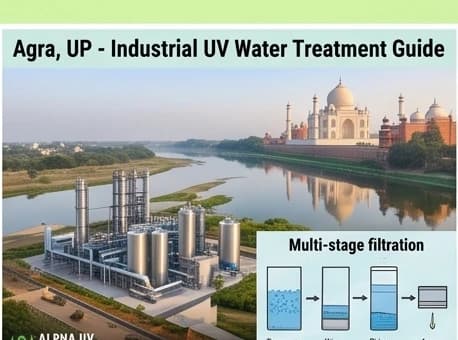
UV water treatment in Agra addresses four key needs: (1) post-overhead-tank disinfection for Agra's residential areas — Agra Jal Kal supply from the Yamuna River (treated at the WTP on the Yamuna) loses residual chlorine in overhead tanks during Agra's extreme summer heat (temperatures reach 44–47°C in May–June); (2) heritage hotel and tourism complex water safety — Agra's 5-star international hotels (Oberoi Amarvilas, ITC Mughal, Radisson Blu, Courtyard Marriott) serving international tourists near the Taj Mahal require documented water safety programmes that include UV as the primary disinfection step, with Legionella management for cooling towers and pools; (3) leather goods processing water for Agra's leather goods export industry (Agra is India's largest leather footwear manufacturing centre, a key supplier to international brands); and (4) UPPCB and NMCG STP compliance for Agra's residential complexes in the Yamuna basin. Alpha UV System supplies Philips UV-C lamp UV systems to Agra with 5–7 day delivery and UPPCB/NMCG documentation support.
Agra — the city of the Taj Mahal, the Agra Fort, and the Fatehpur Sikri — is India's most visited tourist city by international visitor count. The city's economy is dominated by tourism and the leather goods manufacturing industry (Agra produces 65%+ of India's leather footwear exports). The Yamuna River at Agra — the same river that flows past the Taj Mahal's northern face in the iconic view — is one of India's most polluted rivers, heavily contaminated by industrial and sewage discharge from Delhi and Mathura's refinery upstream, and from Agra's own untreated sewage discharge.
Agra's water supply from the Yamuna requires more intensive treatment than most Indian cities due to the river's high BOD, COD, and coliform levels. The Agra Jal Kal WTP treats Yamuna water with coagulation, sedimentation, filtration, and chlorination, but the treated water's residual chlorine depletes rapidly in Agra's extreme summer heat, and the old city's distribution infrastructure (including the Taj Ganj zone adjacent to the Taj Mahal) has very old pipework with long residence times.
Agra Water Quality by Zone
| Zone / Area | Supply Type | Key Water Issue | UV Solution |
|---|---|---|---|
| Taj Ganj / Shilpgram (heritage hotel zone) | Jal Kal piped supply + borewell | 5-star international hotels — Oberoi Amarvilas, ITC Mughal — international guest Legionella WMP; pool water; cooling tower; very high UV dose standards | UV at 40–80 mJ/cm²; Legionella WMP; cooling tower UV; pool UV; international chain standards |
| Central Agra (Sadar Bazar, Civil Lines) | Jal Kal piped supply | Dense residential — bacterial regrowth in summer (47°C peak); intermittent supply; old distribution in commercial core | Post-tank UV at 40 mJ/cm²; 5 µm pre-filter |
| Bodla industrial area | Jal Kal supply + borewell | Leather goods manufacturing; footwear export for EU and US brands — REACH compliance; FSSAI food industry adjacent; UPPCB STP | Leather processing UV; FSSAI food UV; industrial STP UV; UPPCB documentation |
| Sikandra / Dayal Bagh (residential) | Jal Kal piped supply + borewell | New apartment growth zone; STP compliance; borewell TDS 400–800 mg/L in some areas; seasonal supply pressure issues | Post-tank UV; STP UV; RO + UV for high-TDS borewell |
| Mathura (religious city) | Jal Kal / PHED supply (Yamuna) + borewell | Mathura Refinery water; pilgrimage hotels and ashrams; Krishna Janmabhoomi zone; NMCG Yamuna compliance | Post-tank UV; pilgrimage hotel UV; refinery process water UV; UPPCB STP UV |
UV and Legionella Management for Agra's Heritage Hotels
Agra's 5-star international hotels — positioned directly adjacent to the Taj Mahal, Agra Fort, and UNESCO heritage sites — cater to some of India's most affluent international tourists and represent a hospitality investment that requires international water safety standards. The Oberoi Amarvilas (rated one of Asia's top hotels), ITC Mughal Resort and Spa (a Grande collection ITC property), Radisson Blu Agra, Trident Agra, and The Coral Tree all follow their respective international chain Legionella Water Management Plan (WMP) requirements.
Agra's climate creates year-round Legionella risk in hotel cooling towers: the city's 47°C summer peak means cooling tower basins run at 30–38°C even in the hottest months, and hotel air conditioning demand is year-round. UV at 40–80 mJ/cm² on cooling tower make-up water is specified in IHG, Marriott, Radisson Hotel Group, and ITC Hotels' India Legionella WMP templates. Additionally, Agra's heritage hotels have complex spa and pool systems that require UV for pool water disinfection supplement to chlorine.
UV for Agra's Leather Goods Industry
Agra is India's largest leather footwear manufacturing city — producing shoes, sandals, and leather goods for export to European and American brands. The Bodla industrial area and distributed leather goods workshops across Agra produce approximately 100 million pairs of shoes annually, with major international buyers including Clarks, Ecco, Bata India, and dozens of private-label European brands. Leather goods manufacturing uses water in several critical stages: hide soaking, liming, tanning, dyeing, and finishing.
UPPCB effluent treatment compliance for leather tanning (chrome tanning) wastewater is mandatory — Agra leather ETPs must achieve chromium and COD limits before Yamuna discharge. UV on final ETP treated water provides UPPCB coliform compliance before Yamuna discharge. For food-adjacent leather (food handling gloves, food processing plant safety boots), FSSAI water quality standards apply to the leather surface treatment process — UV at 40 mJ/cm² on food-contact leather washing water provides FSSAI compliance.
| Application | Flow Rate | UV Dose | Notes |
|---|---|---|---|
| Residential apartment (Sikandra / Civil Lines) | 1–3 m³/h | 40 mJ/cm² | Post-overhead-tank UV; 5 µm pre-filter; summer months (April–June) critical |
| Heritage hotel (Oberoi / ITC / Radisson type) | 10–50 m³/h | 40–80 mJ/cm² | Legionella WMP; international chain standards; cooling tower UV; spa/pool UV; monthly Legionella testing |
| Mid-scale tourism hotel (Taj Ganj area) | 2–10 m³/h | 40 mJ/cm² | International tourist water safety; TripAdvisor compliance; post-tank UV on kitchen supply |
| Leather ETP final effluent (Bodla) | 10–50 m³/h | 40 mJ/cm² | UPPCB coliform limit before Yamuna discharge; NMCG Yamuna compliance |
| STP outlet — 300 KLD (residential township) | 20–30 m³/h | 40 mJ/cm² | Philips TUV 95W; UPPCB/NMCG consent documentation; Yamuna basin compliance |
Do international hotels near the Taj Mahal have specific UV water treatment requirements?
Yes — international hotel chains operating near the Taj Mahal follow their corporate global water safety standards, which are stricter than Indian regulatory minimums. The key UV requirements for Agra's international hotels: (a) Legionella WMP requiring UV at 40–80 mJ/cm² on all cooling tower make-up water — documented in the hotel's Legionella Water Management Plan reviewed by the chain's global safety team; (b) monthly Legionella culture testing from cooling tower basin, hot water calorifier, and domestic hot water return points; (c) UV intensity monitoring logs maintained for 2 years for audit purposes; (d) pool water UV supplement to reduce chlorine demand in the spa and outdoor pool (important for large pools in Agra's dusty, organic-load-heavy environment). For guestrooms, post-overhead-tank UV at 40 mJ/cm² on the potable water distribution is specified in Marriott, IHG, and Radisson India food safety and water safety audit checklists. Alpha UV System provides complete Legionella WMP UV packages for Agra international hotels, including documentation support for chain-level safety audits.
Alpha UV System supplies UV disinfection systems to international hotels, residential complexes, leather ETPs, and STP operators across Agra, Taj Ganj, Bodla industrial area, Sikandra, and Mathura. UPPCB/NMCG STP documentation. International hotel chain Legionella WMP UV support. Philips UV-C lamps. 5–7 day delivery to Agra.
WhatsApp Us for Agra UV System SupplyStandards, authorities & further reading
External references used to inform this guide. Regulations evolve — check the latest revision on each authority's site before compliance decisions.
Recommended UV Systems
Alpha UV System products for this application — powered by genuine Philips UV-C lamps.
Commercial UV Water Purification System
500 – 5,000 LPH
HACCP-compliant UV water purification for hotels, restaurants, and offices
Industrial UV Water Treatment System
5,000 – 50,000 LPH
Schedule M 2025 and HACCP compliant UV for pharma, food & beverage, and process water
Not sure which system suits your application? WhatsApp our engineers for a free recommendation →
Related solutions
See how Alpha UV System applies this to your industry or city.
Need a UV system?
Talk to our UV engineers — WhatsApp for a quote in 2 hours, or browse the full catalog on IndiaMART.