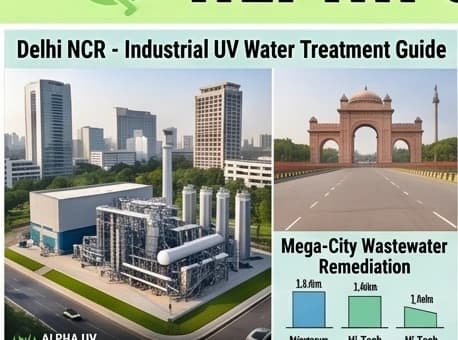
UV water treatment in Delhi NCR addresses three overlapping problems: (1) DJB-supplied water in Delhi loses its chlorine residual in overhead tanks within hours due to summer temperatures — UV at the tank outlet provides a reliable final disinfection barrier; (2) groundwater in Gurgaon, Faridabad, and Ghaziabad has high TDS, iron, and bacterial contamination requiring pre-filtration plus UV; and (3) UPPCB (Noida/Ghaziabad) and HSPCB (Gurgaon/Faridabad) STP enforcement has intensified, with UV disinfection at STP outlets now effectively mandatory for commercial complexes and industrial units. Alpha UV System supplies UV systems across the NCR with Philips UV-C lamps and state-specific PCB documentation.
The Delhi National Capital Region is India's largest urban agglomeration — spanning Delhi (UT), Gurgaon and Faridabad (Haryana), Noida and Ghaziabad (Uttar Pradesh), and rapidly developing areas like Greater Noida, Manesar, and Kundli. With a combined population of over 30 million and water demand that consistently outstrips supply, the NCR faces some of India's most acute water quality challenges.
Delhi Jal Board (DJB) draws from the Yamuna — a river that carries significant industrial and domestic effluent loads in the stretch from Haryana to Delhi — and treats it at water treatment plants in Haiderpur, Sonia Vihar, Wazirabad, and Okhla. Despite treatment, DJB supply shows seasonal quality deterioration during the monsoon (turbidity spikes) and summer (lower flow → higher concentration). The NCR's piped supply reliability also varies enormously by zone — while South Delhi and Lutyens Delhi receive relatively good piped supply, outer zones like Dwarka, Rohini, and East Delhi depend substantially on groundwater and tanker supply.
Water Quality Issues Across the NCR
| Location | Primary Supply | Key Water Quality Problem | UV Solution |
|---|---|---|---|
| South Delhi (GK, Defence Colony, Vasant Vihar) | DJB piped supply (Yamuna-derived) | Bacterial regrowth in summer overhead tanks; chlorine loss in high-temperature storage | Post-tank UV at 40 mJ/cm², 1–3 m³/h |
| Gurgaon (DLF, Sector 56–70, Sohna Road) | GMDA piped supply + borewell (mixed) | High TDS (600–1,500 mg/L), high hardness, E. coli in borewell near older septic systems | RO + UV for drinking; UV-only for process/flushing; STP UV for condominiums |
| Noida and Greater Noida | DJB / Noida Authority piped supply | Lead contamination from old pipes (Noida Sector 15-20 areas); seasonal coliform spikes | RO + UV for drinking; UV at 40 mJ/cm² for building supply |
| Faridabad (NIT, Sector 37-49) | HSVP piped supply + borewell | Industrial area groundwater contamination; fluoride in some pockets; E. coli in shallow wells | Pre-filter + UV; RO + UV for drinking water in high-TDS zones |
| Ghaziabad (Indirapuram, Vaishali, Vasundhara) | DJB piped supply + borewell backup | Heavy bacterial contamination — studies show >90% of Ghaziabad water samples fail BIS 10500 coliform test | UV at 40 mJ/cm² essential; confirmed by NABL monthly test |
| Manesar (Industrial area) | HSVP supply + borewell | Industrial area water supply quality; Legionella risk in auto plant cooling towers | UV for process water; cooling tower UV; HSPCB ETP compliance UV |
Delhi's Yamuna-Derived Water and Seasonal UV Relevance
The Yamuna in Delhi is one of the most polluted urban rivers in India. Despite DJB treating Yamuna water at multiple WTPs, the treatment efficiency varies with raw water quality. During the monsoon (July–September), the Yamuna carries high turbidity (200–2,000 NTU raw water), elevated coliform loads, and dissolved organic matter from upstream drain discharges. DJB's conventional treatment (coagulation, flocculation, sedimentation, filtration, chlorination) experiences reduced efficiency at high turbidity — and the post-treatment water may have higher coliform counts than during dry season.
During peak summer (April–June), Delhi temperatures reach 44–46°C. Water stored in overhead tanks at 40–45°C loses its chlorine residual 3–5 times faster than at 25°C — the effective disinfectant lifetime in a Delhi summer overhead tank may be as short as 2–4 hours rather than the 24–48 hours typical in cooler months. Bacteria multiply more rapidly in warm storage tanks as well. UV disinfection at the tank outlet is particularly valuable in Delhi summer precisely because the piped supply's residual protection is least effective during the hottest months.
UV Water Treatment for Gurgaon's IT and Corporate Sector
Gurgaon (Gurugram) — home to Cyber City, DLF Cyberhub, Udyog Vihar, Golf Course Road, and Sohna Road corporate parks — hosts the Indian offices of hundreds of multinational companies. Corporate real estate in Gurgaon typically operates to higher water quality standards than standard residential or commercial buildings — driven by occupational health requirements, LEED green building certifications, and the safety expectations of global occupants.
UV water treatment for Gurgaon IT campuses includes:
Cooling tower Legionella management: Gurgaon's large corporate towers (DLF Cyber Hub, Unitech InfoSpace, Signature Tower) have substantial cooling tower capacity. Under ASHRAE 188 (adopted by most multinational tenants), a Water Management Plan is required — UV disinfection at 40–80 mJ/cm² on cooling tower make-up water is the standard primary Legionella control measure.
Drinking water for employee pantries: RO + UV systems at pantry points ensure drinking water quality consistent with US and European potable water standards — a requirement of many multinational companies' global health and safety programmes.
STP compliance: Office campus STPs in Gurgaon discharge under HSPCB consent conditions. UV at the STP outlet at 40 mJ/cm² provides HSPCB coliform compliance, and the UV intensity log is a key document during HSPCB STP inspections.
UV Water Treatment for NCR Pharmaceutical and Manufacturing
The NCR's pharmaceutical and manufacturing belt spans Noida Special Economic Zone (NSEZ), the Manesar auto cluster, Faridabad industrial estates, and Ghaziabad's UPSIDC zones. Key UV water treatment applications:
| Industry / Location | UV Application | Flow Rate | Regulatory Driver |
|---|---|---|---|
| Pharmaceutical plants (Noida, Haridwar feeder area) | Purified water: 185 nm TOC + 254 nm disinfection | 2–20 m³/h | Schedule M 2025 / CDSCO |
| Auto components (Manesar, Gurgaon) | Process water UV, cooling tower UV, ETP UV-AOP | 5–50 m³/h | HSPCB ETP consent conditions; ZLD for some units |
| Food processing (Ghaziabad, Hapur) | Process water disinfection, FSSAI compliance water | 2–20 m³/h | FSSAI Food Hygiene Regulations 2020 |
| Textiles / garment (Faridabad, Gurgaon) | UV-AOP for dye effluent colour removal | 5–30 m³/h | HSPCB ETP consent — colour <400 ADMI |
| Data centres (Gurgaon, Noida) | Cooling tower Legionella control UV | 10–50 m³/h | ASHRAE 188 / uptime tier requirements |
UPPCB and HSPCB STP Compliance in the NCR
Two state pollution control boards govern STP compliance in the NCR:
UPPCB (Uttar Pradesh PCB): Governs Noida, Greater Noida, and Ghaziabad. UPPCB has been under sustained NGT pressure since 2019 orders directing Yamuna river basin STP compliance enforcement. UPPCB STP inspections now include spot sampling and UV system operational verification. Non-compliant residential societies in Noida have received closure notices in 2023 and 2024 for STP coliform non-compliance.
HSPCB (Haryana State PCB): Governs Gurgaon, Faridabad, and Manesar. HSPCB has been particularly active in enforcing STP compliance in Gurgaon's high-rise residential zones, where rapid construction has outpaced STP installation. Several large housing societies along Golf Course Road and Dwarka Expressway received HSPCB notices in 2024 for STP non-compliance related to absent or non-functional UV disinfection systems.
| PCB | Total Coliform Standard (Land Discharge) | Total Coliform Standard (Surface Water) | UV Dose Required |
|---|---|---|---|
| UPPCB (Uttar Pradesh) | <100 MPN/100mL | <10 MPN/100mL (Yamuna discharge: 2-log stricter than surface water) | 40 mJ/cm² (land); 80 mJ/cm² (Yamuna discharge) |
| HSPCB (Haryana) | <100 MPN/100mL | <10 MPN/100mL | 40 mJ/cm² (land); 80 mJ/cm² (river discharge) |
UV System Sizing Reference for Delhi NCR
| Application | Flow Rate | UV Dose | Notes |
|---|---|---|---|
| DDA / builder flat — individual unit | 0.5–1 m³/h | 40 mJ/cm² | Post-overhead-tank or under-sink installation |
| Residential society — 200–400 flats | 10–20 m³/h | 40 mJ/cm² | Twin UV reactors in parallel for 100% redundancy |
| Corporate office tower (Cyber City, Noida SEZ) | 10–50 m³/h | 40 mJ/cm² | UV intensity sensor essential for ASHRAE WMP documentation |
| STP outlet — 500 KLD (Noida / Gurgaon) | 40–60 m³/h | 40 mJ/cm² | UVT 55–65%; Philips TUV 95W lamps recommended |
| STP outlet — 1 MLD (large housing society) | 80–100 m³/h | 40 mJ/cm² | Multiple parallel reactors; UV intensity monitoring required by UPPCB/HSPCB |
| Hospital / nursing home (Delhi) | 5–30 m³/h | 80 mJ/cm² | MoEFCC 2016 hospital effluent; NABH water safety plan UV documentation |
| Cooling tower (Gurgaon data centre) | 20–100 m³/h | 40–80 mJ/cm² | Legionella risk particularly high in data centre cooling towers (high heat load) |
DJB water already has chlorine. Why is UV still needed at the building level?
DJB adds chlorine or chloramines at the treatment plant and distribution main. But the chlorine residual at the consumer's tap depends on residence time in the distribution system — in areas far from the WTP or with intermittent supply, residual at the tap can be near zero. Even in areas with adequate piped residual, the water enters an overhead storage tank at the building where the high summer temperature (40–50°C in Delhi rooftop tanks) degrades chloramine rapidly. Bacteria that were suppressed by the distribution residual can multiply significantly in tank storage. A UV system at the tank outlet eliminates these tank-regrowth bacteria at the point before they enter the building plumbing — providing a final barrier that is independent of supply residual variability and storage temperature.
I received an UPPCB/HSPCB notice for STP non-compliance. How quickly can UV be installed?
For standard STP UV installations (40 mJ/cm², flow rates up to 50 m³/h), Alpha UV System can typically dispatch within 3–5 working days from order confirmation. Delivery to Noida, Gurgaon, Delhi, and Faridabad takes 2–4 days by express logistics. Installation of an inline UV reactor on an existing STP pipeline — typically 2–4 hours for a qualified plumber — can be done with the STP in operation (UV is installed on the outlet line; no STP shutdown is required). UPPCB and HSPCB inspection notices typically allow 30–90 days for compliance — full UV installation, commissioning, and monthly NABL test confirmation can be completed within this window. WhatsApp our team immediately with the STP capacity (KLD), current secondary effluent UVT if available, and the PCB compliance deadline, and we will provide an emergency supply timeline within 2 hours.
Alpha UV System supplies UV disinfection systems to residential societies, IT campuses, pharmaceutical plants, auto manufacturers, hospitals, and STP operators across Delhi, Gurgaon, Noida, Faridabad, and Ghaziabad. UPPCB and HSPCB STP documentation provided. Philips UV-C lamps. 5–7 day delivery to NCR locations.
WhatsApp Us for Delhi NCR UV System SupplyStandards, authorities & further reading
External references used to inform this guide. Regulations evolve — check the latest revision on each authority's site before compliance decisions.
Recommended UV Systems
Alpha UV System products for this application — powered by genuine Philips UV-C lamps.
Commercial UV Water Purification System
500 – 5,000 LPH
HACCP-compliant UV water purification for hotels, restaurants, and offices
Industrial UV Water Treatment System
5,000 – 50,000 LPH
Schedule M 2025 and HACCP compliant UV for pharma, food & beverage, and process water
Not sure which system suits your application? WhatsApp our engineers for a free recommendation →
Related solutions
See how Alpha UV System applies this to your industry or city.
Application
Marine UV — UV Disinfection
IMO D-2 compliant UV ballast water treatment for commercial shipping. USCG ballast water rule, MARPOL Annex IV, ISO 8217. 50,000–50,00,000 LPH. IIT Patna-trained engineers. Alpha UV System India.
Local service
UV Systems in Delhi NCR
IIT Patna engineered UV systems — manufactured in Greater Noida, supplied and installed across Delhi NCR with fast local response.
Need a UV system?
Talk to our UV engineers — WhatsApp for a quote in 2 hours, or browse the full catalog on IndiaMART.