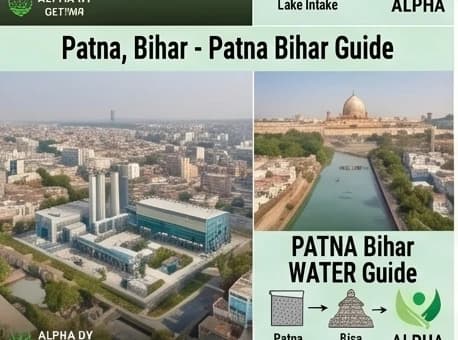
UV water treatment in Patna and Bihar requires important caveats: (1) in arsenic-affected zones of Bihar — particularly the Ganga alluvial plain districts including Bhojpur, Buxar, Patna, Vaishali, Saran, Samastipur, Begusarai, Khagaria, and Bhagalpur — groundwater arsenic exceeds IS 10500 limits (0.01 mg/L) in many shallow tube wells; UV disinfection does NOT remove arsenic and must be preceded by arsenic removal treatment for potable water use in affected zones; (2) for Patna and Bihar cities receiving PHED Ganga-derived piped supply, post-overhead-tank UV at 40 mJ/cm² addresses bacterial regrowth in storage tanks; (3) pharmaceutical manufacturers in Hajipur Vaishali and the emerging Patna pharmaceutical cluster require Schedule M 2025-compliant UV systems; and (4) BSPCB STP compliance for Patna's growing residential sector, and JSPCB compliance for Jharkhand industrial cities (Ranchi, Jamshedpur, Dhanbad). Alpha UV System supplies Philips UV-C lamp UV systems to Bihar and Jharkhand with 5–7 day delivery.
Bihar — one of India's most populous and fastest-growing states in economic terms — presents what may be the most complex UV water treatment advisory challenge in India. The state sits on the Ganga alluvial plain, where natural geochemical processes have deposited arsenic in reducing groundwater conditions at concentrations that exceed safe limits in hundreds of blocks across more than 15 districts. This makes Bihar's water treatment context fundamentally different from most other Indian states: the first question in Bihar is not "which UV system?" but "what are the chemical parameters of this water source?" — because UV is the last step in a multi-stage treatment train, not the first or only step.
Jharkhand — carved from Bihar in 2000 — has a very different water context: the Jharkhand plateau (Ranchi, Jamshedpur, Dhanbad) draws from granite aquifers and river systems that are geologically distinct from the Ganga alluvial plain, with different but significant water quality challenges: iron from weathered laterite (common in Jharkhand plateau groundwater), acid mine drainage from coal mines affecting some Dhanbad and Bokaro zone sources, and industrial heavy metal contamination near Jamshedpur and Bokaro steel town peripheries.
Bihar Groundwater Arsenic — Critical Context for UV Buyers
Bihar's arsenic problem is one of the world's most significant public health water quality crises. WHO (World Health Organization) and Government of India surveys have identified that districts along the Ganga floodplain — including Bhojpur, Buxar, Patna, Vaishali, Saran, Siwan, Chapra (Saran), Samastipur, Begusarai, Khagaria, Bhagalpur, Katihar, and Purnia — have tube well water with arsenic concentrations ranging from 0.01 mg/L to over 1.0 mg/L in some blocks. Chronic arsenic exposure at concentrations above 0.01 mg/L causes arsenicosis (skin lesions), peripheral neuropathy, and increases the risk of cancers of the skin, lung, and bladder with long-term consumption.
UV water treatment is not a solution for arsenic. UV at any dose (40 mJ/cm² or higher) does not remove dissolved arsenic from water. If your borewell water is in an arsenic-affected district, the mandatory first step is an NABL-accredited laboratory test for arsenic. If arsenic exceeds 0.01 mg/L, the treatment required before UV is either coagulation-filtration with ferric chloride (for community systems), iron-based adsorptive media filters (granular ferric hydroxide — widely available in Bihar for point-of-use use), or RO. After arsenic reduction to below 0.01 mg/L, UV at 40 mJ/cm² provides microbiological safety.
Bihar Water Quality by City and UV Application
| City / Zone | Supply Type | Key Water Issue | UV Solution |
|---|---|---|---|
| Patna (PHED piped supply) | PHED piped supply — Ganga river-derived (Saidpur, Beur WTPs) | Ganga seasonal turbidity; old distribution network in older wards; post-storage bacterial regrowth; some low-lying areas — PHED supply intermittent | Post-tank UV at 40 mJ/cm²; 5 µm pre-filter during monsoon; borewell test mandatory before UV-only use |
| Hajipur (Vaishali) — pharma EPIP zone | PHED supply + borewell | Pharmaceutical manufacturing — Schedule M 2025; EPIP Hajipur zone — pharma companies require full pharmaceutical water trains | Full pharma water UV (185 nm + 254 nm); BSPCB documentation |
| Muzaffarpur, Bhagalpur (Ganga floodplain) | PHED piped + borewell | Arsenic risk in borewell in affected blocks; Ganga supply turbid; post-storage bacterial regrowth | Borewell NABL test first; arsenic removal before UV if needed; post-tank UV for piped supply |
| Gaya, Bodh Gaya (tourism zone) | PHED piped + borewell | Religious tourism — high-season water demand; hotel and dharamshala water safety for international Buddhist pilgrims; E. coli risk in borewell | Hotel UV at 40 mJ/cm²; RO + UV for borewell if TDS high; post-tank UV for piped supply |
| Ranchi (JSPCB zone — Jharkhand) | JUIDCO piped supply (Kanke dam) + borewell | Iron in plateau borewell (1–5 mg/L common); E. coli contamination near dense peri-urban areas; institutional and residential STP compliance | Iron removal + UV; post-tank UV for piped supply; JSPCB STP UV |
| Jamshedpur (Jharkhand — Tata Steel city) | JUSCO (Jamshedpur Utilities) piped supply + borewell | JUSCO supply quality generally good (Tata-managed utility); industrial periphery — groundwater affected by steel plant; STP compliance for residential colonies | Post-tank UV; industrial ETP UV; JSPCB STP UV |
| Dhanbad (coal belt — Jharkhand) | JUIDCO supply + borewell | Coal mine drainage — iron, manganese, sulfate in some borewell sources; colliery area groundwater affected; post-storage bacterial regrowth | Iron/manganese removal + UV; RO for high TDS mine-affected borewell; JSPCB STP UV |
UV for Hajipur EPIP Pharmaceutical Zone
Hajipur — just across the Ganga from Patna in Vaishali district — hosts the Export Promotion Industrial Park (EPIP) Hajipur, which is one of Bihar's primary pharmaceutical manufacturing zones. Pharmaceutical companies including Lupin, Cipla, Elder Pharmaceuticals, and multiple mid-size formulation and API manufacturers have established units in Hajipur EPIP. These plants manufacture for domestic and export markets and are subject to WHO-GMP, USFDA, and CDSCO Schedule M 2025 regulatory compliance.
Hajipur EPIP's water supply depends on PHED piped supply supplemented by borewell. Given Bihar's arsenic risk, pharmaceutical plants in Hajipur test their water supply comprehensively before designing the pharmaceutical water treatment train — in most cases, the multi-stage pre-treatment (multimedia filtration, activated carbon, softening, RO) renders the arsenic risk moot for the pharmaceutical water system, as RO removes >95% of arsenic in addition to TDS and TOC. The UV system in Hajipur pharmaceutical water trains:
185 nm UV (TOC reduction): Post double-pass RO, TOC from Ganga-derived supply (which may have organic compounds from upstream discharge) is reduced from post-RO values of 50–200 ppb to below 100 ppb. Fused silica sleeve reactor, 2–20 m³/h, electropolished 316L SS body.
254 nm UV (loop disinfection): 40–80 mJ/cm² on purified water distribution loop return. Continuous operation with 4–20 mA UV intensity output for SCADA integration. BSPCB industrial environmental compliance runs alongside CDSCO pharmaceutical compliance for Bihar pharma manufacturers.
UV for Jharkhand Plateau Borewell Iron Treatment
Jharkhand's plateau geology produces groundwater with elevated iron concentrations — a common characteristic of laterite and granite weathered aquifers found across the Chotanagpur plateau. Iron concentrations of 1–5 mg/L are common in Ranchi, Hazaribagh, Ramgarh, and the tribal district groundwater, with some boreholes showing iron above 10 mg/L. IS 10500 maximum permissible limit for iron is 0.3 mg/L — most Jharkhand borewell water exceeds this without treatment.
High iron in groundwater is important for UV system selection because iron fouls quartz sleeves rapidly: iron deposits on the quartz surface reduce UV transmission, decreasing the effective UV dose delivered to the water. For Jharkhand borewell water with iron above 0.3 mg/L, iron removal must be completed before the UV system — either through aeration + media filtration (iron oxidation and filtration) or through greensand filter — to prevent quartz sleeve fouling and to protect the UV lamp from iron scaling.
The correct treatment sequence for high-iron Jharkhand borewell water: aeration → settling → media filter (greensand or birm media) → 5 µm cartridge filter → UV at 40 mJ/cm².
| Application | Flow Rate | UV Dose | Notes |
|---|---|---|---|
| Residential apartment (Patna, PHED supply) | 1–3 m³/h | 40 mJ/cm² | Post-tank UV; 5 µm pre-filter; borewell test mandatory before UV-only decision |
| Pharma purified water (Hajipur EPIP) | 2–20 m³/h | 80 mJ/cm² | 185 nm + 254 nm; Schedule M 2025 IQ/OQ/PQ; BSPCB documentation |
| Hotel (Gaya / Bodh Gaya — pilgrimage tourism) | 3–15 m³/h | 40 mJ/cm² | International Buddhist pilgrim clientele; post-tank UV; RO + UV for borewell |
| Borewell (iron-affected — Jharkhand plateau) | 1–5 m³/h (after iron removal) | 40 mJ/cm² | Iron removal mandatory before UV; greensand filter + UV configuration |
| Jamshedpur industrial (JUSCO / TISCO area) | 5–50 m³/h | 40 mJ/cm² | JUSCO supply quality generally good; steel plant periphery areas — confirm water analysis |
| STP outlet — 100 KLD (Patna / Ranchi residential) | 8–12 m³/h | 40 mJ/cm² | Philips TUV 55W; BSPCB/JSPCB documentation; monthly NABL test |
| STP outlet — 300 KLD | 20–30 m³/h | 40 mJ/cm² | Philips TUV 95W; NMCG Ganga basin compliance in Bihar; quarterly BSPCB inspection |
I have a tubewell in Patna district — is UV sufficient for safe drinking water?
Not without testing first. Patna district is in the arsenic-affected zone of the Ganga alluvial plain. Before installing any water treatment system for a Patna district tubewell, you must get an NABL-accredited laboratory test for arsenic (As), along with TDS, fluoride, nitrate, iron, and coliform. If the test shows arsenic above 0.01 mg/L (IS 10500 limit), UV alone is not sufficient — arsenic removal treatment is required first. The recommended treatment for arsenic-affected Bihar tubewell water: iron-based adsorptive media filter (granular ferric hydroxide) for arsenic reduction followed by 5 µm cartridge filter followed by UV at 40 mJ/cm². For water with high TDS (>500 mg/L) in addition to arsenic, RO is the better choice as it removes both arsenic and excess TDS in one step, followed by UV on the RO permeate. Alpha UV System will not recommend UV-only treatment for Bihar district tubewell water without seeing the NABL test report — WhatsApp us your test report for a free recommendation on the complete treatment system.
How quickly does iron foul a UV quartz sleeve in Ranchi?
Iron fouling rate on UV quartz sleeves depends on iron concentration in the feed water and the flow velocity past the sleeve. At 2 mg/L iron (a common Jharkhand plateau borewell level), without any iron pre-treatment, visible yellow-orange iron scale can begin depositing on the quartz sleeve within 2–4 weeks of system operation, reducing UV intensity readings by 15–30% in the first month. At 5 mg/L iron, quartz fouling occurs within days of operation. This is why iron removal BEFORE the UV reactor is not optional but mandatory for Jharkhand plateau borewell applications — it protects the UV system from rapid performance degradation and prevents false-safe operation where the system appears to be running but is delivering sub-threshold UV dose due to fouled sleeves.
Alpha UV System supplies UV disinfection systems to residential complexes, pharmaceutical manufacturers, hotels, and STP operators across Patna, Hajipur, Muzaffarpur, Gaya, Ranchi, Jamshedpur, and Dhanbad. We provide complete water treatment system recommendations — including arsenic and iron pre-treatment configurations — based on your NABL water test report. Philips UV-C lamps. 5–7 day delivery to Bihar and Jharkhand.
WhatsApp Us for Bihar/Jharkhand UV System SupplyStandards, authorities & further reading
External references used to inform this guide. Regulations evolve — check the latest revision on each authority's site before compliance decisions.
Recommended UV Systems
Alpha UV System products for this application — powered by genuine Philips UV-C lamps.
Commercial UV Water Purification System
500 – 5,000 LPH
HACCP-compliant UV water purification for hotels, restaurants, and offices
Industrial UV Water Treatment System
5,000 – 50,000 LPH
Schedule M 2025 and HACCP compliant UV for pharma, food & beverage, and process water
Not sure which system suits your application? WhatsApp our engineers for a free recommendation →
Related solutions
See how Alpha UV System applies this to your industry or city.
Need a UV system?
Talk to our UV engineers — WhatsApp for a quote in 2 hours, or browse the full catalog on IndiaMART.