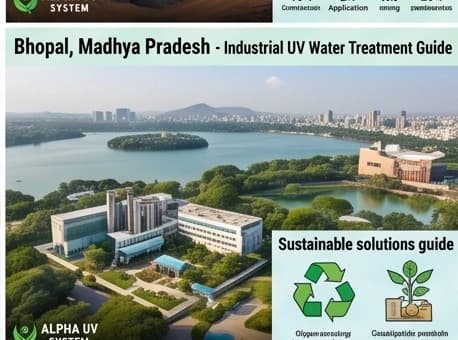
UV water treatment in Bhopal and Madhya Pradesh is shaped by the state's geographic diversity: (1) for Bhopal and western MP cities, Narmada river supply (via MPJNL — Madhya Pradesh Jal Nigam Limited) provides treated water of generally good quality — UV is needed for post-overhead-tank disinfection in the growing residential housing stock; (2) pharmaceutical manufacturers in Dewas, Pithampur (near Indore), and Malanpur (Gwalior) require Schedule M 2025-compliant purified water UV systems; (3) MPPCB STP compliance for Bhopal, Indore, Jabalpur, and Gwalior's rapidly developing residential corridors; and (4) in fluoride-affected districts of central MP (Shivpuri, Guna, Vidisha, Raisen) where groundwater fluoride exceeds 1.5–3 mg/L, RO pre-treatment is mandatory before UV for any potable water use. Alpha UV System supplies Philips UV-C lamp UV systems to Madhya Pradesh with 5–7 day delivery and MPPCB documentation support.
Madhya Pradesh — India's largest state by area — encompasses extreme water quality diversity within a single political boundary. The Narmada river valley (western MP) provides relatively clean, soft water to Bhopal, Jabalpur, and other western MP cities. The plateau districts of central MP (Vidarbha border zone, Bundelkhand in the northeast) have hard, high-TDS, and in some areas fluoride-contaminated groundwater. The Chambal river basin in northern MP feeds Gwalior and Morena. This diversity means UV water treatment recommendations in MP must be tailored by city and water source — a single generalisation across the state would be misleading.
Madhya Pradesh Water Quality by City
| City / Zone | Water Source | Key Water Quality Issue | UV Solution |
|---|---|---|---|
| Bhopal (BMC / MPJNL) | Kolar, Halali, and Bhadbhada reservoirs + Narmada (partial) | Generally good treated supply; bacterial regrowth in tanks in summer (temperatures reach 44°C); older distribution in old Bhopal wards | Post-tank UV at 40 mJ/cm², 1–5 m³/h |
| Indore (IMC supply) | Narmada supply (MPJNL) + Yashwant Sagar reservoir | Narmada supply high quality; summer bacterial regrowth in tanks; rapidly growing residential sector — STP compliance critical | Post-tank UV; STP UV; Dewas-Pithampur pharma UV |
| Jabalpur | Narmada supply (Bargi dam water) + Ken river in some zones | Soft Narmada water — good chemical quality; post-storage bacterial regrowth; STP compliance for new residential sectors | Post-tank UV; STP UV |
| Gwalior | Chambal river supply + Tigra reservoir + borewell | TDS in some borewell zones 600–1,500 mg/L; hardness; fluoride concern in Gwalior district periphery; malanpur pharma cluster | Post-tank UV for piped supply; RO + UV for high-TDS borewell; pharma UV |
| Dewas / Pithampur (pharma cluster) | Narmada supply (MPJNL) + borewell backup | Pharmaceutical manufacturing — Schedule M 2025 purified water; MPPCB industrial STP compliance | Full pharmaceutical water UV (185 nm + 254 nm); MPPCB documentation |
| Shivpuri, Guna, Vidisha (fluoride belt) | Borewell + seasonal piped supply | Groundwater fluoride 1.5–4.5 mg/L (IS 10500 limit 1.0 mg/L); TDS 500–2,000 mg/L; E. coli in some borewell sources | RO mandatory before UV; defluoridation or RO for fluoride removal + UV after |
| Rewa, Satna (eastern MP — cement belt) | Son River + borewell | Cement industry dust — silica in some water sources; borewell TDS 400–900 mg/L; seasonal Son River turbidity | Pre-filter + UV for river supply; RO + UV for high-TDS borewell |
UV for Dewas-Pithampur Pharmaceutical Industrial Cluster
The Dewas and Pithampur industrial areas, located 35–50 km from Indore respectively, constitute Madhya Pradesh's largest pharmaceutical manufacturing cluster. Dewas hosts pharmaceutical companies including Ipca Laboratories (one of its largest manufacturing sites), Sun Pharma's Dewas facility, and others. Pithampur — on the Agra-Mumbai highway — hosts Cipla, Lupin, and dozens of formulation manufacturers in the Pithampur SEZ and Industrial Area. These plants manufacture tablets, capsules, injectables, and APIs for domestic and international markets including USFDA and EU-regulated markets.
Pharmaceutical water UV at Dewas-Pithampur follows Schedule M 2025 requirements exactly. Key UV specifications for MP pharmaceutical plants:
185 nm UV (TOC reduction): After double-pass RO treating Narmada supply (which typically has low TOC), TOC values of 30–100 ppb in the permeate require 185 nm UV (fused silica sleeve) to reduce below the Schedule M 2025 limit of 500 ppb for Purified Water and 500 ppb for WFI. Flow rate 2–20 m³/h depending on plant water consumption.
254 nm UV (loop disinfection): On the purified water distribution loop return line at 40–80 mJ/cm². Continuous operation required during production and cleaning operations. UV intensity sensor with 4–20 mA output for integration into the plant SCADA/BMS alarm system.
CDSCO IQ/OQ/PQ validation: Installation Qualification, Operational Qualification, and Performance Qualification documents for each UV reactor are required for Schedule M 2025 compliance. Alpha UV System provides IQ/OQ/PQ documentation packages for pharmaceutical UV systems as standard for Dewas-Pithampur clients.
UV for Bhopal and Indore's Residential Growth Corridors
Bhopal — one of India's most liveable state capitals — has developed significant residential housing stock along the Hoshangabad Road (E-7, E-8, Arera Colony), Shahpura, and the newer Bhopal Metro corridor townships. Indore — consistently ranked India's cleanest city in the Swachh Bharat rankings — has grown through BRTS corridors (AB Road, Rau-Pithampur Road) and satellite townships in the Vijay Nagar, Vijay Nagar extension, and Scheme 78 zones.
In both cities, the residential UV market is driven by the standard overhead tank bacterial regrowth scenario. Bhopal's summer temperatures (maximum 43–45°C in May) and Indore's summer peak (43–46°C in May) create acute bacterial growth risk in uninsulated rooftop tanks during the April–June window. Post-tank UV at 40 mJ/cm² provides the standard protection for Bhopal and Indore residential buildings.
MPPCB STP Compliance for MP Residential Complexes
Madhya Pradesh Pollution Control Board (MPPCB) STP enforcement covers residential complexes, commercial buildings, and industrial estates across the state. MPPCB has increased STP inspection activity in Bhopal, Indore, Jabalpur, and Gwalior's newer development corridors since 2022, with particular focus on residential complexes built under RERA-compliant developer projects where STP systems were included in the building approval documentation but are not always maintained properly post-occupation.
MPPCB coliform discharge standards follow CPCB general standards: total coliforms <100 MPN/100 mL for surface water discharge and <200 MPN/100 mL for land irrigation. UV at 40 mJ/cm² on the STP outlet achieves <10 MPN/100 mL for secondary-treated effluent with adequate TSS (<30 mg/L) and UVT (>50%), providing comfortable compliance margin above the MPPCB standard.
| STP Capacity (KLD) | Peak Flow Rate (m³/h) | UV Dose | Lamp Specification | MPPCB Documentation |
|---|---|---|---|---|
| 50 KLD | 4–6 m³/h | 40 mJ/cm² | 1–2 × Philips TUV 36W | Commissioning report + UV intensity log |
| 100 KLD | 8–12 m³/h | 40 mJ/cm² | 2 × Philips TUV 55W | Monthly NABL coliform test + UV log |
| 300 KLD | 20–30 m³/h | 40 mJ/cm² | 4 × Philips TUV 95W | Commissioning report + quarterly MPPCB submission |
| 500 KLD | 35–50 m³/h | 40 mJ/cm² | 6 × Philips TUV 95W | MPPCB consent renewal with full UV performance record |
UV System Sizing Reference for MP
| Application | Flow Rate | UV Dose | Notes |
|---|---|---|---|
| Residential apartment (Bhopal / Indore) | 1–3 m³/h | 40 mJ/cm² | Post-overhead-tank UV; 5 µm pre-filter; summer months April–June critical |
| Gated community — 200 flats (Indore / Bhopal) | 8–15 m³/h | 40 mJ/cm² | Twin reactors for redundancy; MPPCB STP UV separate system |
| Pharma purified water (Dewas / Pithampur) | 2–20 m³/h | 80 mJ/cm² | 185 nm + 254 nm; Schedule M 2025 IQ/OQ/PQ documentation |
| Borewell (fluoride-affected zone — Shivpuri) | 1–3 m³/h after RO | 40 mJ/cm² | RO mandatory for fluoride removal; UV after RO permeate storage |
| Industrial process water (Malanpur GIDC / Gwalior) | 5–30 m³/h | 40 mJ/cm² | 316L SS body; confirm UVT before sizing; MPPCB industrial STP separate |
| STP outlet — 300 KLD (residential) | 20–30 m³/h | 40 mJ/cm² | Philips TUV 95W; MPPCB documentation; monthly NABL test |
Indore is India's cleanest city — does that mean water quality is also excellent?
Indore's Swachh Bharat "cleanest city" ranking reflects solid waste management — cleanliness of streets, waste collection efficiency, and open defecation-free status. It does not directly measure water quality at the tap. Indore's municipal water supply (Narmada water via MPJNL) is generally of good quality at the treatment plant outlet — the Narmada at the intake for Indore supply is relatively clean, and Indore's Yashwant Sagar reservoir provides additional storage capacity. However, the risk of bacterial regrowth in overhead tanks in Indore's summer heat (temperatures reach 45°C in May) is the same as in any other Indian city — it is a function of tank hygiene and ambient temperature, not of the city's cleanliness ranking. Post-tank UV at 40 mJ/cm² is the correct protection for Indore residential and commercial buildings regardless of the Swachh Bharat ranking. If your Indore building uses borewell backup supply (many new perimeter-zone buildings do during MPJNL supply gaps), check TDS and hardness before deciding whether UV alone or RO + UV is needed.
Is there any Union Carbide / Bhopal Gas tragedy legacy contamination that UV can address?
The Bhopal Gas Tragedy site (Union Carbide India Limited plant in JP Nagar) left legacy chemical contamination in the surrounding soil and shallow groundwater — ICMR and CSE studies have documented elevated chlorinated compounds, heavy metals, and pesticide residues in borewell water within approximately 2–3 km of the factory site. UV disinfection addresses biological contamination (bacteria, viruses) but does not remove dissolved chemicals — including the chlorinated organic compounds and heavy metals documented in the JP Nagar groundwater contamination zone. Residents using borewell water near the UCIL site should have their water tested by an NABL laboratory for chemical parameters first, and should rely on RO treatment (for chemical removal) followed by UV (for microbiological safety) rather than UV alone. Residents in other parts of Bhopal, far from the factory site, using MPJNL piped supply or borewell from unaffected zones, are not at risk from this specific contamination and can use standard post-tank UV disinfection without additional chemical treatment concern.
Alpha UV System supplies UV disinfection systems to residential complexes, pharmaceutical manufacturers, industrial units, and STP operators across Bhopal, Indore, Jabalpur, Gwalior, Dewas, Pithampur, and the wider Madhya Pradesh market. MPPCB STP documentation. Schedule M 2025 pharma water documentation. Philips UV-C lamps. 5–7 day delivery to Madhya Pradesh.
WhatsApp Us for Madhya Pradesh UV System SupplyStandards, authorities & further reading
External references used to inform this guide. Regulations evolve — check the latest revision on each authority's site before compliance decisions.
Recommended UV Systems
Alpha UV System products for this application — powered by genuine Philips UV-C lamps.
Commercial UV Water Purification System
500 – 5,000 LPH
HACCP-compliant UV water purification for hotels, restaurants, and offices
Industrial UV Water Treatment System
5,000 – 50,000 LPH
Schedule M 2025 and HACCP compliant UV for pharma, food & beverage, and process water
Not sure which system suits your application? WhatsApp our engineers for a free recommendation →
Related solutions
See how Alpha UV System applies this to your industry or city.
Need a UV system?
Talk to our UV engineers — WhatsApp for a quote in 2 hours, or browse the full catalog on IndiaMART.