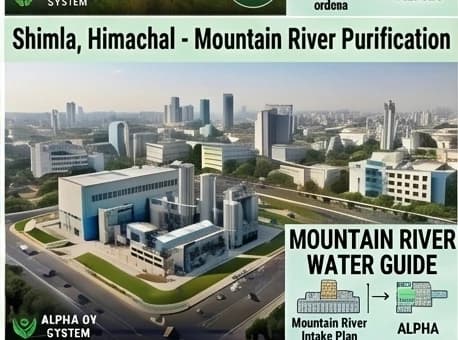
UV water treatment in Shimla and Himachal Pradesh addresses four distinct needs: (1) post-storage disinfection for Shimla's residential and hotel areas — MC Shimla supply from the Giri River and Ashwini Khad (seasonal streams) is highly seasonal, with significant monsoon turbidity spikes and winter low-flow periods; the city's extensive storage infrastructure (large underground and elevated tanks) creates bacterial regrowth risk, particularly in tanks that store water for days during supply scarcity; (2) heritage hotel and tourism resort water safety — Shimla's iconic hotels (Cecil by Oberoi, Wildflower Hall by Oberoi, Springfields, Radisson Shimla) serving international tourists require documented Legionella Water Management Plans for complex Victorian-era plumbing systems; (3) pharmaceutical-grade purified water for Himachal Pradesh's extraordinary pharmaceutical manufacturing cluster at Baddi-Barotiwala-Nalagarh (BBN) — one of India's most concentrated pharma production zones; and (4) HPPCB STP compliance for Shimla, Manali, Dharamshala, and Kullu's tourism-driven residential growth. Alpha UV System supplies Philips UV-C lamp UV systems to Himachal Pradesh with 5–7 day delivery and HPPCB documentation support.
Himachal Pradesh — the mountainous Himalayan state bordering Punjab and Uttarakhand — has a UV water treatment market that is disproportionately large relative to its 7.5 million population. Two factors make HP a major UV market: (a) the Baddi-Barotiwala-Nalagarh (BBN) pharmaceutical manufacturing cluster in Solan district — one of India's largest concentration of pharmaceutical factories, similar to Haridwar SIIDCUL in scale and regulatory environment; and (b) the Shimla-Manali-Dharamshala tourism corridor, where international and domestic tourism creates large UV demand in hotels, resorts, and hospitality infrastructure.
Shimla's water supply is Himachal Pradesh's most chronically challenging urban water system — the city sits on steep ridges at 2,000–2,500 metres altitude with no local perennial water sources. Supply depends on seasonal streams (Giri River, Ashwini Khad, Chaurabra) that have high flow during monsoon and very low flow in winter. Shimla's water crisis (first documented in the 1920s during British Raj, recurring during every summer) creates conditions where building-level water storage is not optional but mandatory — and extended storage is the enemy of microbiological water quality.
Himachal Pradesh Water Quality by Zone
| Zone / Area | Supply Type | Key Water Issue | UV Solution |
|---|---|---|---|
| Shimla city (Mall Road, Sanjauli) | MC Shimla piped supply (Giri, Ashwini Khad) | Monsoon turbidity spikes; winter low-flow scarcity; extended tank storage creating bacterial regrowth; Victorian-era distribution in Mall Road zone | Post-tank UV at 40 mJ/cm²; 5 µm pre-filter; monsoon monthly filter change; extended storage UV |
| Heritage hotel zone (Cecil, Wildflower Hall) | MC supply + dedicated hotel water system | Victorian-era hotel plumbing — complex dead-leg pipe runs; Legionella amplification in old hot water systems; international guest safety; hard water (calcium) | UV at 40–80 mJ/cm²; Legionella WMP; hot water loop UV; international chain standards |
| Baddi-Barotiwala-Nalagarh (BBN pharma cluster) | BBNIA supply + borewell | Pharmaceutical manufacturers — Schedule M 2025; US FDA 21 CFR; EU GMP Annex 11; validated UV IQ/OQ/PQ required | 185 nm + 254 nm; IQ/OQ/PQ; Schedule M 2025; US FDA 21 CFR Part 11 |
| Manali / Kullu (tourism zone) | HP Jal Shakti supply + borewell | International tourists — Israeli, European backpacker market; seasonal demand surge in May–June; monsoon turbidity in Beas River-sourced supply | Post-tank UV; hotel and guesthouse UV; monsoon pre-filter monthly |
| Dharamshala / McLeod Ganj | HPJAL supply + spring/borewell | Tibetan refugee settlement and international visitors; Dalai Lama residence zone; monastery water safety; backpacker tourism UV requirement | Post-tank UV; monastery and guesthouse UV; spring supply UV |
| Parwanoo (industrial zone) | HP Jal Shakti + SIDCUL Parwanoo | Apple juice and food processing; pharmaceutical units; HPPCB STP compliance | Apple juice FSSAI UV; pharmaceutical UV; HPPCB STP UV |
UV for Baddi-Barotiwala-Nalagarh (BBN) Pharmaceutical Cluster
The BBN industrial area in Solan district — lying in the Himalayan foothills along the Himachal-Punjab border — is one of India's most productive pharmaceutical manufacturing zones. Attracted by HP state tax incentives similar to those that built the Haridwar SIIDCUL cluster, BBN hosts companies including Sun Pharma's HP plants, Cipla's Baddi operation, Alkem Laboratories, Piramal Pharma, FDC Limited, and 500+ other pharmaceutical, nutraceutical, and FMCG companies. BBN's pharmaceutical cluster produces medicines for both domestic CDSCO markets and US FDA / EU GMP-regulated export markets.
UV specification for BBN pharmaceutical plants is identical to SIIDCUL Haridwar: 185 nm TOC reduction UV (fused silica sleeve, post double-pass RO) and 254 nm loop disinfection UV (40–80 mJ/cm², continuous operation on the purified water distribution loop return). IQ/OQ/PQ documentation for CDSCO Schedule M 2025 and export regulatory compliance. For US FDA-inspected plants at BBN, the 21 CFR Part 11 electronic records requirement means UV system intensity logs must be electronically stored and tamper-proof — Alpha UV System provides UV systems with data-logger outputs compatible with 21 CFR Part 11 compliant pharmaceutical data management systems.
UV for Himachal Pradesh's Apple Processing Industry
Himachal Pradesh produces 90%+ of India's apple crop (25–30 million boxes annually from the Kullu, Shimla, Kinnaur, and Lahaul-Spiti orchards). A growing apple juice, apple cider vinegar, and dried apple processing industry is emerging in the Parwanoo and Baddi industrial corridor, processing HP apples for domestic and export markets. Apple juice and cider processing water requires UV at 40 mJ/cm² for FSSAI compliance — UV provides the microbiological safety for apple juice processing water without the chlorine residual that can affect apple juice flavour profile in high-quality fresh-pressed juice products.
| Application | Flow Rate | UV Dose | Notes |
|---|---|---|---|
| Residential / guesthouse (Shimla city) | 1–3 m³/h | 40 mJ/cm² | Post-tank UV; 5 µm pre-filter; monsoon monthly filter change; extended winter storage management |
| Heritage hotel (Cecil / Wildflower Hall type) | 5–20 m³/h | 40–80 mJ/cm² | Legionella WMP for Victorian plumbing; Oberoi/international chain standards; hot water loop UV |
| Pharma purified water (BBN industrial area) | 2–20 m³/h | 80 mJ/cm² | 185 nm + 254 nm; Schedule M 2025; US FDA 21 CFR Part 11 electronic records; IQ/OQ/PQ |
| Manali hotel (international tourist) | 2–10 m³/h | 40 mJ/cm² | Israeli and European tourist water safety; WHO standard; monsoon Beas turbidity season monthly filter |
| Apple juice processing (Parwanoo) | 2–10 m³/h | 40 mJ/cm² | FSSAI food contact water; no chlorine in premium apple juice; 316L SS food-grade body |
| STP outlet — 200 KLD (Shimla / Manali township) | 15–20 m³/h | 40 mJ/cm² | Philips TUV 55W; HPPCB consent documentation; Himalayan river basin compliance |
During Shimla's summer water crisis, how do we manage UV system operation with extended tank storage?
Shimla's summer water crisis — when reservoir levels fall and the MC supply is rationed to a few hours per day or less — creates extended tank storage periods where water sits for 24–72+ hours in overhead tanks before use. The extended storage in Shimla's cool climate (temperatures rarely exceed 25–28°C even in summer) slows bacterial multiplication compared to plains cities, giving Shimla a marginal advantage. However, bacteria do multiply over 48–72 hours even at 25°C, and any contamination introduced during tank filling (overflow, unsealed access, pipe backflow) can proliferate during extended storage.
Management approach for Shimla UV systems during water scarcity: (a) run the UV system with a timed pump cycle — if your building has a booster pump, programme it to run 10–15 minutes every 4–6 hours during water scarcity periods to circulate tank water through the UV reactor, reducing the bacterial count that builds up during long storage; (b) ensure the tank access hatch is sealed with a gasket and padlocked — open overhead tanks in Shimla (common in older buildings) allow dust, insects, and bird droppings to contaminate stored water; (c) if your supply has been cut for 3+ days, draw and discard the first 30 litres from the kitchen tap before using UV-treated water for drinking — this flushes the distribution pipework. Alpha UV System provides UV system configuration guidance specific to Shimla's water scarcity management — WhatsApp us for your building's specific setup.
Alpha UV System supplies UV disinfection systems to pharmaceutical manufacturers, residential complexes, heritage hotels, apple processors, monasteries, and STP operators across Shimla, Baddi-Barotiwala-Nalagarh, Manali, Dharamshala, Parwanoo, and the wider Himachal Pradesh state. HPPCB STP documentation. Schedule M 2025 + US FDA IQ/OQ/PQ pharma water packages. Philips UV-C lamps. 5–7 day delivery to Himachal Pradesh.
WhatsApp Us for Himachal Pradesh UV System SupplyStandards, authorities & further reading
External references used to inform this guide. Regulations evolve — check the latest revision on each authority's site before compliance decisions.
Recommended UV Systems
Alpha UV System products for this application — powered by genuine Philips UV-C lamps.
Commercial UV Water Purification System
500 – 5,000 LPH
HACCP-compliant UV water purification for hotels, restaurants, and offices
Industrial UV Water Treatment System
5,000 – 50,000 LPH
Schedule M 2025 and HACCP compliant UV for pharma, food & beverage, and process water
Not sure which system suits your application? WhatsApp our engineers for a free recommendation →
Related solutions
See how Alpha UV System applies this to your industry or city.
Need a UV system?
Talk to our UV engineers — WhatsApp for a quote in 2 hours, or browse the full catalog on IndiaMART.