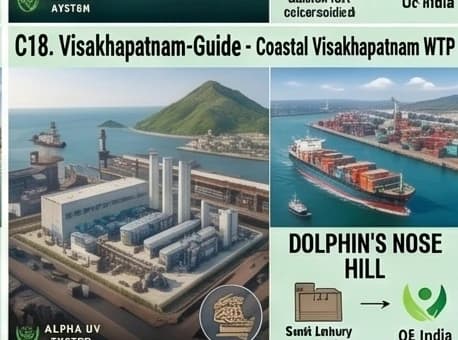
UV water treatment in Visakhapatnam and Andhra Pradesh addresses five sector-specific needs: (1) residential post-tank UV for Visakhapatnam, Vijayawada, Guntur, Tirupati, and Kakinada — where GWMC/municipal piped supply (derived from Godavari, Krishna, and Vamsadhara river sources) loses residual chlorine in overhead tank storage; (2) pharmaceutical-grade purified water for the Krishnapatnam-Nellore pharmaceutical SEZ and Parawada VSEZ pharma cluster near Visakhapatnam; (3) aquaculture shrimp and fish hatchery UV disinfection for the Krishna and Godavari delta zone — Andhra Pradesh is India's largest shrimp producer; (4) steel and heavy industry process water for the Vizag steel belt (RINL, HZL, Visakhapatnam Port zone); and (5) APPCB STP compliance UV for the dense residential and commercial development in the four new capital region cities around Amaravati. Alpha UV System supplies Philips UV-C lamp UV systems to Andhra Pradesh with 5–7 day delivery and APPCB documentation support.
Andhra Pradesh — India's eighth-largest state by area and one of its most agriculturally and industrially significant coastal states — presents a UV water treatment market defined by contrasts. The Visakhapatnam (Vizag) industrial cluster represents one of India's heaviest industrial concentrations: RINL (Rashtriya Ispat Nigam Limited — the Vizag Steel Plant), Hindustan Zinc, Hindustan Petroleum's Visakhapatnam Refinery, HPCL-Mittal Energy, GAIL, and dozens of chemical and fertiliser plants in the VSEZ and APIIC estates. Meanwhile, the Krishna-Godavari delta is India's shrimp export powerhouse, producing 60%+ of India's farmed shrimp for export to the EU, USA, and Japan.
The state's water supply is Godavari and Krishna river-derived for most urban areas, supplemented by groundwater in areas beyond piped supply reach. Coastal and deltaic groundwater in the Krishna delta (Guntur, Krishna, West Godavari districts) and near Visakhapatnam's refinery zone has variable quality — saline intrusion in coastal wells, industrial contamination in port industrial areas, and fluoride in inland groundwater in some Andhra districts.
Andhra Pradesh Water Quality by City and UV Need
| City / Zone | Supply Type | Key Water Issue | UV Solution |
|---|---|---|---|
| Visakhapatnam (GVMC supply) | GVMC piped supply (Vamsadhara + Godavari Canal) | Bacterial regrowth in overhead tanks; coastal area salinity risk in groundwater; VSEZ industrial area water quality variable | Post-tank UV at 40 mJ/cm²; industrial process water UV; APPCB STP UV |
| Vijayawada / Guntur (NTR district) | Krishna river supply (GWMC) + borewell | Krishna delta — seasonal variation; hard borewell in some zones; agricultural chemical runoff; dense residential STP compliance | Post-tank UV; STP UV; RO + UV for hard borewell |
| Tirupati, Chittoor (temple city) | TUDA piped supply (Swarnamukhi River + Kandaleru reservoir) + borewell | Religious tourism — millions of pilgrims annually; high seasonal demand; TTD (Tirumala Tirupati Devasthanams) campus water requirements | Post-tank UV for hotels and dharamshalas; TTD campus UV; STP UV |
| Krishnapatnam / Nellore (pharma SEZ) | APSPDCL industrial supply + borewell | Pharmaceutical SEZ — Schedule M 2025 purified water requirements; coastal industrial zone | Full pharmaceutical water UV (185 nm + 254 nm); APPCB documentation |
| Kakinada, Rajamahendravaram (East Godavari) | Godavari river supply + borewell | Aquaculture zone — hatchery UV; port industrial zone — process water UV; residential STP | Aquaculture hatchery UV; residential post-tank UV; STP UV |
| Amaravati capital region (Guntur-Krishna border) | New CRDA piped supply (Krishna diversion) + borewell | Greenfield capital city — new water infrastructure; planned townships; STP compliance from day one of occupation | Post-tank UV for new residential; STP UV; institutional UV |
UV for Andhra Pradesh's Shrimp and Aquaculture Industry
Andhra Pradesh produces approximately 60% of India's farmed shrimp — primarily Litopenaeus vannamei (whiteleg shrimp) — from ponds in the Krishna, Guntur, West Godavari, East Godavari, and Nellore coastal districts. AP shrimp is exported to the EU, USA, Japan, South Korea, and China, and is subject to MPEDA (Marine Products Export Development Authority) and EIC (Export Inspection Council) food safety certification. The EU and US impose strict Salmonella, Vibrio, antibiotic residue, and aquaculture chemical limits on AP shrimp imports.
UV disinfection in AP aquaculture operations serves multiple critical functions, as detailed in the dedicated aquaculture UV guide — but the key AP-specific applications are:
Shrimp hatchery water disinfection: Penaeus vannamei hatcheries in the Krishna delta and Nellore coast require UV disinfection of seawater and freshwater used for larval rearing (nauplii to post-larvae stages). WSSV (White Spot Syndrome Virus) — the most devastating shrimp pathogen — is carried in source seawater. UV at 40–120 mJ/cm² on seawater intake eliminates WSSV and other viral pathogens before they reach shrimp larvae. AP hatcheries operating under MPEDA certification are required to demonstrate pathogen control measures — UV disinfection with documented UV intensity monitoring is the standard compliance approach.
Pond water treatment for recirculating aquaculture: Semi-intensive and intensive shrimp pond operations using partial water recirculation systems disinfect recirculated water with UV at 40–80 mJ/cm² to control bacterial load and eliminate zooplankton that compete with shrimp larvae for feed.
Broodstock facility disinfection: High-value SPF (Specific Pathogen Free) broodstock facilities maintain certified shrimp broodstock for seed supply. These facilities require the highest biosecurity water treatment standards — UV at 80–120 mJ/cm² on all incoming water to maintain pathogen-free certification.
UV for Visakhapatnam's Steel and Heavy Industry
Visakhapatnam's industrial zone — concentrated in the VSEZ (Visakhapatnam Special Economic Zone), Gajuwaka industrial area, and the port industrial belt from Bheemunipatnam to Gangavaram — hosts RINL Vizag Steel, Hindustan Petroleum Visakhapatnam Refinery (HPCL-VR), GAIL, Coromandel International (fertilisers), and dozens of chemical and processing companies. Industrial water treatment needs in the Vizag belt are primarily:
Cooling tower and boiler water treatment: RINL Vizag Steel operates cooling towers consuming several million litres of water per day for blast furnace and converter cooling. Cooling tower water UV at 40–80 mJ/cm² controls biological fouling and manages Legionella risk in the cooling system. Boiler feed water UV at 40 mJ/cm² provides microbiological polishing after demineralisation.
Process water for refinery and chemical operations: HPCL-VR and chemical plant process water requires microbiological control at specific process stages. UV at 40 mJ/cm² provides chemical-free disinfection for process streams where residual biocides would interfere with catalyst or process chemistry.
UV for Tirupati's Religious Tourism Infrastructure
Tirupati and the Tirumala hills — home to the Sri Venkateswara Swamy Temple (Tirumala Temple), the world's most-visited religious site with 60,000–100,000 pilgrims daily — represent one of India's most concentrated institutional water treatment needs. The Tirumala Tirupati Devasthanams (TTD) manages the entire Tirumala hill complex including prasadam preparation kitchens (feeding 50,000+ pilgrims daily), free accommodation (cottages, dormitories), and the Tirumala water supply system.
TTD's prasadam preparation and pilgrim accommodation water requires UV disinfection at 40 mJ/cm² on all kitchen and drinking water supplies to protect the millions of pilgrims — including elderly, immunocompromised, and international visitors — who visit the temple annually. Hotels in Tirupati city (for pilgrims who stay below the hills before the climb) similarly require UV water treatment to meet the service expectations of the diverse pilgrim population.
| Application | Flow Rate | UV Dose | Notes |
|---|---|---|---|
| Residential apartment (Visakhapatnam / Vijayawada) | 1–3 m³/h | 40 mJ/cm² | Post-overhead-tank UV; 5 µm pre-filter |
| Shrimp hatchery (Krishna delta / Nellore) | 5–30 m³/h | 40–120 mJ/cm² | WSSV WSSV elimination; SPF broodstock: 80–120 mJ/cm²; seawater inlet UV |
| Pharma purified water (Krishnapatnam SEZ) | 2–20 m³/h | 80 mJ/cm² | 185 nm + 254 nm; Schedule M 2025 IQ/OQ/PQ; APPCB documentation |
| Steel plant cooling tower (Vizag RINL) | 20–100 m³/h | 40–80 mJ/cm² | Legionella WMP; biofouling control; 316L SS reactor body |
| Temple / institutional (Tirumala TTD) | 10–50 m³/h | 40 mJ/cm² | FSSAI food contact water; prasadam kitchen supply UV; pilgrim drinking water UV |
| Hotel (Tirupati) | 3–15 m³/h | 40 mJ/cm² | Cooling tower Legionella UV if cooling tower present; guest room potable UV |
| STP outlet — 300 KLD (Amaravati capital zone) | 20–30 m³/h | 40 mJ/cm² | Philips TUV 95W; APPCB new capital development compliance |
Do EU shrimp importers require documented UV disinfection in AP hatcheries?
EU importers of Indian shrimp require that exporting units comply with EC Regulation 854/2004 and 853/2004 for aquaculture products, which specify general pathogen control standards rather than mandating UV disinfection by name. However, EU buyers increasingly specify water disinfection methods as part of their Supplier Quality Assurance (SQA) requirements, and MPEDA's Hazard Analysis Critical Control Points (HACCP) certification (required for EU export approval) identifies hatchery water quality as a critical control point. UV disinfection with documented UV intensity monitoring (UV intensity sensor logs showing operation within the validated dose range) is the standard evidence MPEDA and EU inspectors accept as demonstration of effective hatchery water pathogen control. AP hatcheries without UV documentation have faced EU import suspensions — UV system commissioning reports and intensity logs are now effectively mandatory for MPEDA-certified export-quality AP hatcheries.
My coastal Andhra borewell water tastes salty — can UV fix this?
Salty-tasting water indicates high chloride and TDS — saline intrusion from coastal or backwater proximity. UV disinfection addresses biological contamination only; it cannot remove salt (chloride), sodium, or TDS. Saline coastal borewell water requires desalination — either through RO (most practical for residential use, reducing TDS from 1,000–5,000 mg/L to below 200 mg/L in one pass) or through Electrodialysis Reversal (EDR) for higher-volume applications. After RO desalination, UV at 40 mJ/cm² on the RO permeate provides the microbiological safety barrier. For coastal AP homes, the treatment train is: borewell → sediment filter → RO desalination → UV → treated water distribution. Contact Alpha UV System with your water test report for a complete system recommendation — the RO sizing and UV sizing must be matched to your specific water quality and flow demand.
Alpha UV System supplies UV disinfection systems to shrimp hatcheries, pharmaceutical manufacturers, steel and industrial facilities, residential complexes, temples and institutions, and STP operators across Visakhapatnam, Vijayawada, Guntur, Tirupati, Kakinada, Nellore, and Amaravati. APPCB STP documentation. Schedule M 2025 pharma water documentation. MPEDA aquaculture hatchery UV. Philips UV-C lamps. 5–7 day delivery to Andhra Pradesh.
WhatsApp Us for Andhra Pradesh UV System SupplyStandards, authorities & further reading
External references used to inform this guide. Regulations evolve — check the latest revision on each authority's site before compliance decisions.
Recommended UV Systems
Alpha UV System products for this application — powered by genuine Philips UV-C lamps.
Commercial UV Water Purification System
500 – 5,000 LPH
HACCP-compliant UV water purification for hotels, restaurants, and offices
Industrial UV Water Treatment System
5,000 – 50,000 LPH
Schedule M 2025 and HACCP compliant UV for pharma, food & beverage, and process water
Not sure which system suits your application? WhatsApp our engineers for a free recommendation →
Related solutions
See how Alpha UV System applies this to your industry or city.
Need a UV system?
Talk to our UV engineers — WhatsApp for a quote in 2 hours, or browse the full catalog on IndiaMART.