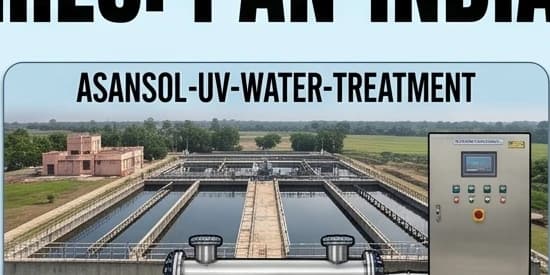
UV water treatment in Asansol addresses 5 critical needs: (1) SAIL IISCO Burnpur Steel Plant cooling tower Legionella risk — ASHRAE 188 sidestream UV for massive industrial cooling circuits; (2) ECL (Eastern Coalfields Limited) coalfield worker colonies in Raniganj–Jamuria–Salanpur with Gondwana sandstone iron (Fe 0.5–2.5 mg/L) and AMD risk in active mining zones; (3) Damodar River alluvial borewell iron (Fe 0.3–1.5 mg/L) across Asansol-Durgapur corridor requiring iron pre-treatment before UV; (4) WBPCB ETP polishing UV for engineering, chemical, and coke-oven industries; and (5) Asansol district hospital NABH water at 80 mJ/cm² for ICU/OT. Philips TUV 16W–95W systems serve all segments.
Asansol, headquarters of Paschim Bardhaman district and West Bengal's second-largest city, is the economic capital of the Raniganj coalfield — the largest coalfield in India by reserve extent. The ECL (Eastern Coalfields Limited, a Coal India subsidiary) operates 100+ mines in the Asansol-Raniganj belt, while the SAIL IISCO Burnpur Steel Plant (restarted in 2015 after modernization, 2.5 MMTPA crude steel capacity) anchors the heavy industry cluster. The Damodar River, flowing through the Asansol-Durgapur corridor, is simultaneously the primary water supply source and the primary water quality threat — receiving coal washery drainage, coke oven effluent, and mine drainage from dozens of upstream discharge points.
UV water treatment in Asansol operates in this challenging water context: raw Damodar River water that may carry coal particulates, iron, and bacterial contamination; ECL mine borewells with Gondwana sandstone iron and occasional acid mine drainage signatures; and massive SAIL Burnpur cooling tower circuits requiring ASHRAE 188 Legionella management at steel plant scale.
Asansol Water Quality: Zone-by-Zone Profile
| Zone / Area | Primary Water Source | Key Parameters | UV Treatment Need |
|---|---|---|---|
| Asansol municipal area | Damodar River (AMC WTP) | TDS 200–500 mg/L (varies with mining discharge), turbidity 5–30 NTU (monsoon), Fe 0.2–0.8 mg/L | UV 40 mJ/cm² at point-of-use after WTP |
| ECL Raniganj / Jamuria coalfield colonies | Gondwana sandstone borewell (60–120 m) | Fe 0.5–2.5 mg/L, Mn 0.1–1.2 mg/L, TDS 200–500 mg/L | Iron + Mn filter MANDATORY → UV 40 mJ/cm² |
| Active mining zones (Salanpur, Barabani AMD risk) | Mine sump / drainage-affected borewell | pH 4–6, Fe 2–15 mg/L, SO₄ 500–2,000 mg/L (AMD signature) | Full AMD pre-treatment MANDATORY before UV |
| SAIL Burnpur Steel Plant | Damodar River (IISCO WTP) | Cooling water TDS 400–2,000 mg/L (concentrated), T = 30–45°C, Legionella risk | ASHRAE 188 sidestream UV at 10–25% |
| Burnpur / Kulti residential | SAIL/IISCO township WTP (Damodar) | TDS 200–400 mg/L, Fe 0.1–0.4 mg/L post-WTP, turbidity <1 NTU | UV 40 mJ/cm² at point-of-use |
Acid Mine Drainage Warning: Salanpur and Barabani Active Mining Zones
In active and recently abandoned coal mine zones around Salanpur, Barabani, and parts of Raniganj, groundwater and surface drainage may be Acid Mine Drainage (AMD): pH 4–6, dissolved iron 2–15 mg/L (ferrous and ferric), sulfate 500–2,000 mg/L. UV water treatment is absolutely ineffective on AMD water — the extreme iron concentration will coat the quartz sleeve with iron deposits within hours, and the acid pH may damage system seals. AMD requires full chemical pre-treatment: lime neutralisation (to pH 8.0–8.5) → aeration (iron oxidation) → coagulation → settling pond (12–24 hours) → pressure sand filtration → pH adjustment (to 7.0–7.5) → activated carbon filtration → THEN UV as the final biological barrier. Do not install UV systems on AMD-affected water without this full pre-treatment chain. Test pH and Fe at the UV inlet — if pH <6.5 or Fe >0.3 mg/L, the pre-treatment is incomplete.
The Raniganj coalfield has been mined continuously since 1774 — making it one of the oldest coal mining regions in India. The legacy of 250+ years of mining includes thousands of abandoned shafts, underground voids, and surface mine drainage channels that have altered the hydrogeology of the entire Asansol basin. Newer active mines in Salanpur, Barabani, and Jamuria add fresh AMD to the system.
ECL's Mine Water Management (under MoEF Guidelines for Coal Mines 2017) requires treatment of all mine water before discharge. UV is a component of the terminal treatment chain — but only after the AMD neutralisation and iron removal steps are complete. ECL's larger mine complexes (Sonepur Bazari, Kajoragram, Muraidih) have established treatment plants where UV systems operate as the final biological barrier after full chemical-physical pre-treatment.
Iron Pre-Treatment: ECL Worker Colony Borewells
ECL worker colony borewells in the Raniganj-Jamuria-Salanpur area draw from Gondwana coal measure sandstone aquifers with dissolved iron 0.5–2.5 mg/L. This iron deposits on UV lamp quartz sleeves within 4–8 weeks, reducing effective UV dose by 30–60%. The UV lamp continues to glow normally — the failure is invisible without UV intensity measurement. A greensand or birm iron removal filter MUST precede every UV system on ECL coalfield borewell water. Manganese (0.1–1.2 mg/L co-occurring in these aquifers) causes dark deposits that are harder to remove — greensand also removes Mn. Confirm Fe <0.1 mg/L and Mn <0.05 mg/L at UV inlet before commissioning any system in ECL colony applications.
ECL operates 28+ worker colonies across the Asansol-Raniganj belt, each housing 500–5,000 mining families. Under DGMS (Directorate General of Mines Safety) welfare guidelines, these colonies must provide IS 10500-compliant drinking water. UV water treatment — specified as chemical-free, tamper-evident, and documentation-capable — is the DGMS preferred method for worker colony water supply.
The standard pre-treatment chain for ECL colony borewell water: dual-media pressure sand filter → greensand iron and manganese filter → 5-micron polypropylene sediment cartridge → Philips TUV 36W or TUV 55W UV chamber → SS304 overhead tank → low-dose chlorine dosing pump (0.2 mg/L residual for distribution pipe network protection).
SAIL IISCO Burnpur Steel Plant: ASHRAE 188 UV at Steel Plant Scale
SAIL's IISCO Burnpur Steel Plant (ISP) — recently modernised to 2.5 MMTPA crude steel capacity — operates electric arc furnaces, blast furnaces, sinter plant, coke ovens, and rolling mills, all with extensive cooling water requirements. The steel plant's cooling water system recirculates several million litres per hour through natural and mechanical draft cooling towers, at water temperatures of 35–45°C — the ideal temperature range for Legionella pneumophila growth.
SAIL's ISO 14001:2015 and OHSAS 18001 certification at Burnpur ISP requires documented Legionella Water Management Plans (WMP) per ASHRAE 188:2018 for all cooling tower systems. At ISP's scale:
- Blast furnace cooling circuit: 5,00,000–20,00,000 LPH recirculation; 25% sidestream UV = 1,25,000–5,00,000 LPH UV treatment capacity = 14–56 Philips TUV 95W lamps per circuit
- Coke oven cooling: 2,00,000–10,00,000 LPH; UV sidestream 50,000–2,50,000 LPH = 6–28 TUV 95W lamps
- Rolling mill cooling: 1,00,000–5,00,000 LPH; UV sidestream 25,000–1,25,000 LPH = 3–14 TUV 95W lamps
The total UV lamp bank across all SAIL ISP Burnpur cooling circuits potentially numbers 50–150+ Philips TUV 95W units — among the largest UV installations in eastern India.
SAIL procurement for UV systems follows SAIL's Central Purchase Organization (CPO) procedures with technical specifications aligned to ASHRAE 188 requirements: third-party validated UV dose, SS316 wetted materials, DCS-integratable alarm relay, and 5-year spare lamp availability guarantee.
Damodar River Alluvial Iron: Municipal and Residential UV
The Damodar River at Asansol carries iron loads from upstream mining drainage, with dissolved iron ranging from 0.3–1.5 mg/L in post-monsoon flows and higher spikes during active rainfall events mobilizing mine spoil. Asansol Municipal Corporation's WTP (drawing from Damodar at Maithon and Panchet reservoir releases) treats the river water through conventional coagulation-sedimentation-filtration, reducing iron to 0.1–0.4 mg/L in the output.
For AMC municipal supply recipients, UV at 40 mJ/cm² with a 5-micron sediment pre-filter and carbon block is generally sufficient without additional iron removal. For private borewell users in the Asansol municipal fringe and surrounding Raniganj block, where borewell iron is 0.5–2.5 mg/L, an iron removal filter is mandatory before UV.
UV System Sizing for Asansol Applications
| Application | Flow Rate Required | Philips TUV Model | UV Dose | Pre-Treatment |
|---|---|---|---|---|
| Household (AMC municipal supply) | 30–60 LPH | TUV 16W compact | 40 mJ/cm² | 5µ sediment + carbon |
| ECL colony borewell (500 families) | 3,000–5,000 LPH | TUV 36W–TUV 55W | 40 mJ/cm² | Iron+Mn filter MANDATORY + 5µ |
| ECL large colony (2,000 families) | 12,000–18,000 LPH | TUV 55W × 3–4 parallel | 40 mJ/cm² | Iron+Mn filter + 5µ sediment |
| District hospital ICU / OT | 500–1,000 LPH | TUV 16W (reduced flow) | 80 mJ/cm² | 5µ + 1µ microfiltration |
| SAIL Burnpur cooling tower sidestream | 1,25,000–5,00,000 LPH (per circuit) | TUV 95W × 14–56 per circuit | 40 mJ/cm² (ASHRAE 188) | 5µ SS strainer |
| Coke oven / industrial ETP polishing | 10,000–50,000 LPH | TUV 95W × 2–6 bank | 40 mJ/cm² | Biological + sand + 5µ |
Philips TUV Product Recommendations for Asansol
| Philips TUV Model | Rated Flow | UV Output | Best Fit in Asansol | Lamp Life |
|---|---|---|---|---|
| Philips TUV 16W | Up to 1,500 LPH | 16W, 254 nm | Household, SAIL township residence, clinic, hospital ICU loop | 9,000 hours |
| Philips TUV 36W | Up to 3,000 LPH | 36W, 254 nm | Small ECL colony, mine welfare kiosk, hospital outpatient | 9,000 hours |
| Philips TUV 55W | Up to 5,000 LPH | 55W, 254 nm | Large ECL colony, DHQ hospital, SAIL Burnpur township supply | 9,000 hours |
| Philips TUV 95W | Up to 9,000 LPH per lamp | 95W, 254 nm | SAIL cooling tower sidestream (50–150 lamp total), ECL ETP, Damodar WTP polishing | 12,000 hours |
Regulatory Compliance for Asansol
| Regulation | Applicable Sector | Key Requirement | UV Role |
|---|---|---|---|
| ASHRAE 188:2018 | SAIL IISCO Burnpur cooling towers | Legionella WMP sidestream UV documented at 10–25% | Massive sidestream UV bank per circuit |
| DGMS Welfare Guidelines | ECL coalfield worker colonies | IS 10500 coliform zero, documented UV treatment records | Primary disinfection with iron pre-treatment |
| MoEF Coal Mine Guidelines 2017 | ECL mine water treatment | Mine discharge coliform <1,000 MPN/100 mL, pH 6.5–8.5 | Terminal UV after AMD neutralisation chain |
| NABH IPSG-8 | Paschim Bardhaman DHQ hospital, IISCO Hospital | 80 mJ/cm² ICU/OT, monthly NABL water test reports | Dedicated critical-care UV loop |
| WBPCB CTO Conditions | Coke oven, engineering goods, chemical ETP | Coliform <1,000 MPN/100 mL at Damodar discharge | ETP polishing UV at terminal discharge stage |
Frequently Asked Questions
Q1: Can UV treat Acid Mine Drainage water from ECL coal mines in Raniganj?
No, UV cannot treat Acid Mine Drainage (AMD) directly. AMD from active coal mines in Salanpur, Barabani, and Raniganj has pH 4–6 and dissolved iron 2–15 mg/L — conditions that will destroy a UV system within hours. The extreme iron load coats the quartz sleeve almost immediately, reducing UV output to near-zero. The acid pH can also attack rubber seals and O-rings in the UV chamber. AMD requires full chemical treatment before UV: lime neutralization (calcium hydroxide or sodium hydroxide to raise pH to 8.0–8.5) → aeration and oxidation (iron oxidation from Fe²⁺ to Fe³⁺) → coagulation-flocculation (iron hydroxide floc formation) → settling pond (12–24 hour retention) → pressure sand filtration → pH re-adjustment (to 7.0–7.5) → activated carbon filtration (residual organic removal) → THEN UV at 40 mJ/cm² as the final biological barrier. This is the complete treatment train that ECL's mine water treatment plants use at their larger Raniganj and Salanpur operations before discharge to Damodar River tributaries.
Q2: How many Philips TUV 95W lamps does SAIL Burnpur steel plant cooling tower UV need?
SAIL IISCO Burnpur Steel Plant's total cooling water recirculation across blast furnace, coke oven, and rolling mill circuits is approximately 10,00,000–30,00,000 LPH. ASHRAE 188 requires sidestream UV at 10–25% of recirculation. At 25% sidestream: UV treatment flow = 2,50,000–7,50,000 LPH. Each Philips TUV 95W lamp handles approximately 9,000 LPH at 40 mJ/cm². Number of lamps required: 2,50,000 ÷ 9,000 ≈ 28 lamps (minimum estimate at 10 million LPH circuit, 25% sidestream) to 7,50,000 ÷ 9,000 ≈ 84 lamps (full circuit, 25% sidestream). In practice, SAIL engineers distribute the UV systems by individual cooling tower unit and cooling circuit, with separate UV banks for blast furnace, coke oven, and rolling mill circuits. The total across all circuits at full ASHRAE 188 compliance may reach 80–150 TUV 95W lamps — the largest UV installation in West Bengal outside of municipal WTPs.
Q3: What UV system is right for an ECL worker colony of 1,500 families in Jamuria?
For 1,500 mining families (approximately 6,000 persons), peak water demand during morning hours is 10,000–15,000 LPH. Three Philips TUV 55W units (5,000 LPH each) in parallel — providing 15,000 LPH total — is the recommended configuration, with a 4th unit as standby during lamp maintenance periods. The mandatory pre-treatment for Jamuria coalfield borewell water: dual-media pressure sand filter (anthracite + silica sand, 2.5 m/hour surface loading rate) → greensand iron and manganese filter (birm or manganese greensand media) → 5-micron polypropylene cartridge → UV manifold → SS304 overhead storage tank. Downstream of the tank: low-dose chlorine dosing (0.2 mg/L residual) for the colony distribution pipe network. The UV lamp-hours counter and monthly water test record (E. coli, coliform, Fe, Mn from NABL lab) are required for DGMS welfare compliance documentation during annual DGMS inspection of ECL collieries.
Q4: Does Damodar River water in Asansol require iron removal before UV?
Damodar River surface water, after treatment at Asansol Municipal Corporation's WTP (coagulation + sedimentation + sand filtration), typically emerges with dissolved iron 0.1–0.4 mg/L. At the WTP output, if iron is below 0.3 mg/L, UV can be used without additional iron pre-treatment — most AMC municipal supply recipients fall in this category. However, iron levels can spike during heavy rainfall monsoon periods when mine spoil runoff enters the Damodar, temporarily increasing iron in WTP output to 0.4–0.8 mg/L. A 5-micron pre-filter upstream of the UV system (changed every 3 months) provides basic particulate protection and marginal iron removal for moderate spikes. For private borewell users drawing from Gondwana sandstone aquifers in the Asansol-Raniganj fringe, iron is consistently 0.5–2.5 mg/L — these installations require dedicated greensand iron removal before UV, as described for ECL colony applications.
Q5: What NABH UV requirements apply to Paschim Bardhaman DHQ hospital?
NABH standard IPSG-8 requires documented water quality management for all clinical water points. For Paschim Bardhaman DHQ hospital (and SAIL IISCO Burnpur Hospital, which follows equivalent SAIL HSE standards): general ward and OPD water — UV at 40 mJ/cm², bacteria <100 CFU/100 mL, coliform zero; ICU, OT, NICU, CSSD, dialysis — UV at 80 mJ/cm², bacteria <10 CFU/100 mL, coliform zero; dialysis (if present) — RO → UV → UF chain, bacteria <50 CFU/mL, endotoxin <2 EU/mL per AAMI ISO 13959. Monthly water culture reports from NABL-accredited lab required for all clinical areas. ICU/OT must have a dedicated UV loop separate from general hospital distribution. NABH assessors verify: lamp replacement log, UV lamp model and serial number, water test certificate dates, and test parameters during accreditation visits. Lamp replacement at 9,000 hours or annually — whichever comes first — is mandatory documentation.
Asansol's UV water treatment market is shaped by 250 years of coal mining heritage and 70 years of steel production — creating water quality challenges that range from the harshest acid mine drainage to the most demanding ASHRAE 188 industrial cooling compliance. Whether you manage ECL's worker welfare, SAIL's environmental management, Asansol Municipal Corporation's distribution network, or the district hospital's NABH accreditation — UV water treatment configured around the Damodar basin's specific iron, AMD, and industrial water profile delivers compliant, sustainable, chemical-free disinfection.
Alpha UV System supplies Philips TUV-based UV water treatment systems for Asansol, Raniganj, and Paschim Bardhaman district — from SAIL IISCO Burnpur cooling tower ASHRAE 188 sidestream UV banks to ECL coalfield worker colony iron-pretreated systems, AMD post-treatment UV, NABH hospital compliance, and WBPCB ETP polishing. Full technical assessment and compliance documentation for SAIL, ECL, DGMS, WBPCB, and NABH requirements included.
WhatsApp Us for Asansol UV QuoteStandards, authorities & further reading
External references used to inform this guide. Regulations evolve — check the latest revision on each authority's site before compliance decisions.
Recommended UV Systems
Alpha UV System products for this application — powered by genuine Philips UV-C lamps.
Commercial UV Water Purification System
500 – 5,000 LPH
HACCP-compliant UV water purification for hotels, restaurants, and offices
Industrial UV Water Treatment System
5,000 – 50,000 LPH
Schedule M 2025 and HACCP compliant UV for pharma, food & beverage, and process water
Not sure which system suits your application? WhatsApp our engineers for a free recommendation →
Related solutions
See how Alpha UV System applies this to your industry or city.
Need a UV system?
Talk to our UV engineers — WhatsApp for a quote in 2 hours, or browse the full catalog on IndiaMART.