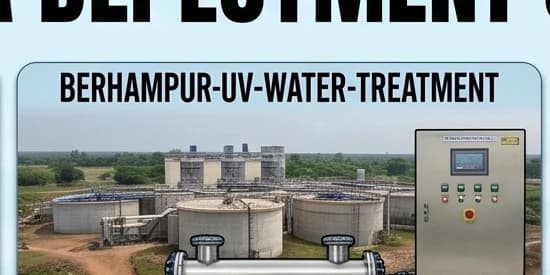
UV water treatment in Berhampur (Brahmapur) addresses 5 key needs: (1) MKCG Medical College and Hospital NABH compliance for ICU, OT, dialysis, and CSSD water quality; (2) Berhampuri tussar silk and patuasahi silk saree weaving — chemical-free UV for artisan welfare potable water and silk washing water; (3) coastal zone salinity intrusion (TDS 800–3,000 mg/L within 10 km of Bay of Bengal) where RO is mandatory before UV; (4) OSEPA-compliant ETP final-stage UV for Gopalpur Industrial Area and cashew processing clusters; (5) cyclone emergency mobile UV for Ganjam district coastal communities. Philips TUV 16W–95W at 40 mJ/cm² standard and 80 mJ/cm² ICU/OT.
Berhampur — Odisha's Southern Cultural Capital and Its Water Challenges
Berhampur (officially Brahmapur) is Odisha's third-largest city and the cultural and commercial capital of southern Odisha (Ganjam district). Known as "Silk City" for its famous Berhampuri silk sarees with patta and phoda kumbha designs, and home to MKCG Medical College — one of Odisha's premier government medical institutions — Berhampur presents a range of water treatment challenges unique to its coastal geography, textile heritage, and healthcare infrastructure.
UV water treatment in Berhampur must navigate three distinct water quality zones: (1) inland zones drawing on Rushikulya River basin groundwater (TDS 200–500 mg/L, relatively low iron, good UVT — UV without RO often adequate); (2) coastal zones within 10 km of Bay of Bengal (Chhatrapur, Gopalpur, Humma tehsils) where salinity intrusion brings TDS to 800–3,000 mg/L and chloride above IS 10500:2012 limits — RO mandatory; (3) tribal hinterland zones (Ganjam interior — Aska, Bhanjanagar, Phulbani border) with iron-rich lateritic groundwater (Fe 0.5–2.5 mg/L) requiring iron removal before UV.
Berhampur Water Quality: Zone-Wise Analysis
Table 1: Berhampur-Ganjam District Water Quality by Zone
| Zone / Area | Source | TDS (mg/L) | Iron (mg/L) | Treatment Required |
|---|---|---|---|---|
| Berhampur city (BeMC supply) | Rushikulya River treated | 150–350 | 0.1–0.3 | 5-micron + UV (iron filter if >0.3) |
| Gopalpur coastal zone | Shallow coastal borewell | 800–3,000 | 0.1–0.5 | RO mandatory + UV |
| Chhatrapur (Gopalpur SIA) | IDCO industrial supply + borewell | 400–1,000 | 0.1–0.4 | RO if TDS >500 + UV |
| Aska / tribal interior | Lateritic borewell | 200–400 | 0.5–2.5 | Iron filter mandatory + 5-micron + UV |
| Silk weaving clusters (Bada Bazar) | Municipal + borewell mix | 200–500 | 0.2–0.8 | Iron filter + UV (critical for silk quality) |
Gopalpur, Chhatrapur, and coastal Ganjam tehsil borewells within 10 km of Bay of Bengal show TDS 800–3,000 mg/L from saltwater intrusion. UV does NOT remove dissolved salts, chloride, or TDS. Installing UV alone in coastal Berhampur areas gives microbiologically safe but chemically unsafe water — high chloride and sulphate cause renal and cardiovascular stress with chronic consumption. RO is mandatory before UV for all coastal zone borewells. Cyclone events (Bay of Bengal cyclones affecting Ganjam coast) cause acute salinity pulses — coastal communities must use emergency UV+RO kits during cyclone recovery, not UV alone.
MKCG Medical College and Hospital: NABH Compliance for Southern Odisha's Apex Hospital
Maharaja Krushna Chandra Gajapati (MKCG) Medical College and Hospital is Odisha's second-largest government medical institution after SCB Cuttack, with over 1,200 beds serving Ganjam, Kandhamal, Gajapati, and Koraput districts. UV water treatment in Berhampur's healthcare sector is dominated by MKCG's expanding NABH accreditation requirements and the growing private hospital sector (Sriram Hospital, Vishal Hospital, and others in Tata Benz Square area).
MKCG draws on Berhampur Municipal Corporation (BeMC) supply — Rushikulya River treated water with TDS 150–350 mg/L, relatively low iron (0.1–0.3 mg/L from distribution). For NABH IPSG-8 compliance, critical water points require UV at 40–80 mJ/cm²:
ICU and OT areas (80 mJ/cm²): Philips TUV 36W chambers with intensity monitoring (4–20 mA output) and alarm at <70% initial output. Monthly microbiological testing (zero coliform, sterility requirement at OT scrub stations) with test reports kept in the NABH documentation folder. The MKCG oncology and transplant wards — which serve immunocompromised patients — require UV disinfection not just for drinking water but also for handwashing water stations.
Dialysis unit (AAMI ISO 13959): MKCG's renal medicine department (100+ hemodialysis seats) requires RO → UV at 40 mJ/cm² → UF → dialysis machine. AAMI limits: bacteria <50 CFU/mL, endotoxin <2 EU/mL. Quarterly endotoxin testing (LAL assay method) is required for NABH dialysis unit compliance — Alpha UV Systems provides the complete NABH documentation package for MKCG procurement teams.
Berhampuri Silk Industry: Chemical-Free UV for GI-Tagged Textile Heritage
Berhampur's iconic silk sarees — the double ikat Berhampuri silk, patta sarees with contrasting temple borders, and new fusion designs by cooperative weavers (Weavers Service Centre, SILK/Odisha) — are nationally GI-protected textiles. UV water treatment in Berhampur's silk weaving sector serves dual purposes: artisan welfare (drinking water for 15,000+ silk workers) and process water quality (silk yarn degumming and washing water).
Iron contamination in silk process water causes rust staining — a catastrophic quality defect on premium Berhampuri silk where a single orange spot can reject an entire saree costing ₹8,000–₹50,000. Silk degumming (removal of sericin protein using soda ash and soap) requires water with iron <0.05 mg/L to prevent iron-sericin complexes that stain the silk. Iron removal (birm or greensand filter) followed by UV (Philips TUV 16W, 1,500 LPH) provides iron-free, bacteria-free water for silk processing — critical for cooperatives exporting to Mumbai, Hyderabad, and international buyers requiring OEKO-TEX process water documentation.
For artisan drinking water, MSME Odisha cluster development guidelines for Berhampur silk cooperatives recommend potable water treatment at workshop level. Philips TUV 16W units with upstream iron filter and 5-micron sediment cartridge provide chemical-free drinking water for 15–20 artisans per shift — zero chlorine residual (important because silk artisans working with delicate fiber are sensitive to chlorine skin and eye irritation from water contact).
Gopalpur Special Economic Zone: Industrial UV at Coastal Location
Gopalpur Special Investment Area (Gopalpur SIA, formerly Gopalpur SEZ) — an IDCO-developed coastal industrial zone — hosts steel, aluminium downstream, and other industries. UV water treatment in Berhampur's industrial zone at Gopalpur focuses on: (1) drinking and canteen water for worker colonies (RO+UV mandatory given coastal TDS 400–1,000 mg/L); (2) ETP final-stage disinfection for OSEPA compliance before Rushikulya estuary discharge; (3) cooling tower Legionella management under ASHRAE 188 for large industrial plants.
For Gopalpur SIA factories drawing on IDCO piped industrial supply (blending treated river water with groundwater, TDS 400–1,000 mg/L), the drinking water treatment must be RO-first if TDS exceeds 500 mg/L. ETP UV for OSEPA compliance requires <1,000 MPN/100 mL coliform in discharge — achievable with Philips TUV 95W multi-bank at 40 mJ/cm² after biological treatment and clarification.
Cashew Processing Industry: Berhampur's Agro-Sector UV Needs
Ganjam district is Odisha's largest cashew nut production area — raw cashew sourced from Phulbani, Aska, and Berhampur hinterland is processed in cashew shelling, grading, and roasting units concentrated along Berhampur-Chhatrapur highway. UV water treatment in Berhampur's cashew sector addresses: FSSAI FBO process water quality (zero E. coli in washing water, steaming condensate, and packaging area potable supply) and OSEPA ETP discharge for cashew shell oil extraction effluent.
Cashew shell liquid (CNSL) extraction generates high-BOD wastewater with phenolic compounds. ETP for CNSL extraction requires biological treatment (activated sludge) + tertiary treatment before UV final disinfection. After treatment, UVT typically 60–70% — suitable for UV at 40 mJ/cm². OSEPA third-party audit for food processing units categorized as Orange checks ETP final effluent coliform quarterly — UV lamp certificates and intensity logs are reviewed as part of compliance evidence.
Table 2: UV System Sizing for Berhampur Applications
| Application | Flow | UV Dose | Model | Pre-treatment |
|---|---|---|---|---|
| Silk artisan workshop (drinking) | 200–500 LPH | 40 mJ/cm² | TUV 16W | Iron filter + 5-micron + UV |
| Silk process water (degumming) | 500–2,000 LPH | 40 mJ/cm² | TUV 16W / 36W | Iron filter mandatory (Fe <0.05 mg/L) |
| MKCG ICU / OT | 300–800 LPH | 80 mJ/cm² | TUV 36W | 5-micron + AC + UV, intensity monitor |
| MKCG dialysis (AAMI) | 500–3,000 LPH | 40 mJ/cm² | TUV 16W / 36W | RO → UV → UF → dialysis machine |
| Coastal household (Gopalpur RO+UV) | 50–200 LPH | 40 mJ/cm² | TUV 16W | RO (75 GPD) → UV |
| Gopalpur SIA ETP / cashew ETP | 10,000–50,000 LPH | 40 mJ/cm² | TUV 95W × multi-bank | Full ETP + clarification + UV |
Cyclone Emergency UV: Ganjam's Coastal Disaster Preparedness
Ganjam district is one of India's most cyclone-prone coastal districts — Phailin (2013), Titli (2018), and multiple other severe cyclones have hit the Berhampur-Gopalpur coast with devastating effect. Post-cyclone water contamination is a major public health crisis: saline surge contamination of wells, flooding of septic systems, and infrastructure breakdown cause extreme coliform spikes (10,000–1,00,000 MPN/100 mL in surface waters post-cyclone).
UV water treatment in Berhampur's disaster preparedness context requires mobile UV skids that can be pre-positioned before cyclone landfall and deployed within hours of the "all-clear." OSDMA (Odisha State Disaster Management Authority) maintains emergency water treatment inventory at Berhampur Civil Defence depot. Mobile UV skids (Philips TUV 55W, 5,000 LPH) with portable generators, 30-meter inlet hoses, and transportable sediment pre-filter kits can be deployed to cyclone relief camps and coastal habitations within 24 hours of event. Alpha UV Systems has supplied OSDMA-approved mobile UV emergency kits with IP65-rated controllers for coastal Odisha deployment.
Post-cyclone UV deployment note: salinity surge water (TDS 2,000–10,000 mg/L post-cyclone in coastal wells) cannot be treated by UV alone — mobile RO units are needed first. UV handles the biological safety after RO desalinates the salt-surge water. Emergency kits with both RO and UV stages are the standard for coastal Ganjam post-cyclone water supply.
Table 3: Philips TUV Product Recommendations for Berhampur UV Water Treatment
| Application | Philips TUV Model | Capacity | UV Dose | Key Feature |
|---|---|---|---|---|
| Silk workshop / home (inland BeMC) | TUV 16W (PL-L) | ~1,500 LPH | 40 mJ/cm² | Chemical-free, iron filter upstream |
| MKCG hospital / private hospital | TUV 36W (PL-L) | ~3,000 LPH | 40–80 mJ/cm² | SS316, intensity monitor, NABH docs |
| Coastal house (Gopalpur RO+UV) | TUV 16W (PL-L) | ~1,500 LPH | 40 mJ/cm² | Post-RO stage, compact |
| Cyclone emergency mobile kit | TUV 55W (PL-L) | ~5,000 LPH | 40 mJ/cm² | IP65, portable, OSDMA approved |
| Gopalpur SIA / cashew ETP | TUV 95W × multi-bank | 10,000–50,000 LPH | 40 mJ/cm² | OSPCB OEM monitoring, SCADA |
Table 4: Regulatory Compliance for UV Water Treatment in Berhampur
| Regulation | Sector | Requirement | UV Role |
|---|---|---|---|
| IS 10500:2012 | All drinking water | Zero coliform, TDS <500, Fe <0.3 | UV final barrier; RO mandatory coastal zones |
| NABH IPSG-8 | MKCG Medical College, private hospitals | Monthly water tests, critical area docs | 40–80 mJ/cm² point-of-use UV |
| AAMI ISO 13959 | MKCG dialysis, private dialysis centres | Bacteria <50 CFU/mL, endotoxin <2 EU/mL | RO → UV → UF dialysis train |
| OSEPA / OSPCB Discharge Norms | Gopalpur SIA, cashew processing ETP | <1,000 MPN/100 mL coliform in effluent | ETP final UV with OEM monitoring |
| FSSAI FBO License | Cashew processing, food industry | Zero E. coli in process water | UV at 40 mJ/cm² in process water line |
Frequently Asked Questions — UV Water Treatment in Berhampur
Q1: Is Berhampur Municipal Corporation water safe with just UV (no RO)?
For inland Berhampur areas on BeMC supply from Rushikulya River treatment plant — TDS 150–350 mg/L, fluoride typically 0.3–0.6 mg/L, iron 0.1–0.3 mg/L — UV without RO is generally adequate as a final microbiological barrier. A 5-micron sediment pre-filter + activated carbon filter (removes chlorine) + Philips TUV 16W UV handles BeMC supply well. However, BeMC distribution network has aging pipes in older wards (Station Bazar, Gandhi Nagar, Ramnagar) where post-treatment contamination and iron leaching from old CI pipes can occur — UV addresses the microbiological issue; if iron from pipes causes taste/staining problems, add an iron filter upstream. Coastal area residents (Gopalpur, Chhatrapur, Humma ward) must verify their TDS — if borewell backup is used, TDS may be 800–3,000 mg/L, in which case RO is mandatory.
Q2: What iron level is acceptable for Berhampuri silk process water?
Premium Berhampuri silk (tussar and mulberry) requires iron <0.05 mg/L in process water — far stricter than the IS 10500:2012 drinking water limit of 0.3 mg/L. Even 0.1–0.2 mg/L iron can cause subtle rust discoloration on white or pastel silk yarns during degumming. The standard pre-treatment for silk process water in Berhampur cooperatives: borewell/municipal water → greensand iron filter (birm media, removing iron to <0.05 mg/L) → 5-micron sediment filter → UV (Philips TUV 16W) → process water tank. Monthly iron testing of the filter outlet verifies that the greensand media is still effective — if outlet iron rises above 0.05 mg/L, the media needs KMnO₄ regeneration or replacement. UV does not remove iron — the iron filter step cannot be skipped.
Q3: What does MKCG Berhampur need for its dialysis unit versus ICU?
MKCG dialysis unit requires the full AAMI ISO 13959 treatment chain: RO (to reduce TDS and partially remove endotoxins) → UV at 40 mJ/cm² (primary biological kill step) → UF (10 kDa ultrafiltration membrane, removes endotoxin fragments) → hemodialysis machine feed. Quarterly culture tests (bacteria <50 CFU/mL) and LAL assay endotoxin tests (<2 EU/mL) are required for NABH dialysis unit compliance. MKCG ICU/NICU/PICU requires UV at 80 mJ/cm² — the higher dose (achieved by reducing flow rate through the same UV chamber) provides broader spectrum kill including Cryptosporidium and drug-resistant organisms that are critical threats in oncology/transplant ICU settings. Separate UV systems for dialysis and ICU/OT are recommended — each sized for its specific flow and dose requirement, with individual monitoring records for NABH audit.
Q4: Does Gopalpur SIA need ASHRAE 188 cooling tower UV like steel plants in other cities?
Gopalpur SIA's current tenants (as of 2026) include steel downstream, aluminium fabrication, and port-related industries — their cooling tower sizes vary. ASHRAE 188 is a standard adopted internationally for facilities with large cooling systems (typically >100 tons cooling capacity). For large Gopalpur SIA plants (steelmaking, large fabrication units) with recirculating cooling towers, ASHRAE 188 WMP compliance with UV sidestream treatment is applicable and increasingly expected by multinational industrial safety auditors. Smaller Gopalpur SIA units (light manufacturing, warehousing) with package cooling units or small evaporative coolers are typically below ASHRAE 188 formal application threshold. Alpha UV Systems can assess specific Gopalpur SIA facility cooling tower characteristics and advise on ASHRAE 188 applicability.
Q5: Can mobile UV skids be pre-positioned for cyclone preparedness in Berhampur?
Yes — and OSDMA strongly recommends pre-positioning for Ganjam coastal communities. The recommended kit for cyclone emergency water treatment in coastal Berhampur: a mobile UV skid (Philips TUV 55W, 5,000 LPH) with IP65 controller, portable generator (3.5 kVA petrol), sediment filter (20-micron bag filter), 30-meter inlet hose, and a parallel mobile RO unit (500–1,000 LPH, 12V DC solar-compatible) for post-storm saline surge conditions. The kit fits in a standard pickup truck for pre-cyclone evacuation transport. OSDMA registers certified emergency water treatment suppliers — Alpha UV Systems is listed under OSDMA's approved vendor panel for Odisha emergency UV skid procurement. BeMC and district civil administration Berhampur can procure through DGS&D GeM rate contract for immediate availability.
Whether you need NABH-compliant UV for MKCG Medical College, iron-free process water for Berhampuri silk cooperatives, RO+UV for Gopalpur coastal homes, OSEPA ETP compliance for Gopalpur SIA, or cyclone emergency UV skids for Ganjam coast — Alpha UV Systems provides complete solutions with OSDMA, OSPCB, and NABH documentation support.
WhatsApp Us for Berhampur UV ConsultationStandards, authorities & further reading
External references used to inform this guide. Regulations evolve — check the latest revision on each authority's site before compliance decisions.
Recommended UV Systems
Alpha UV System products for this application — powered by genuine Philips UV-C lamps.
Commercial UV Water Purification System
500 – 5,000 LPH
HACCP-compliant UV water purification for hotels, restaurants, and offices
Industrial UV Water Treatment System
5,000 – 50,000 LPH
Schedule M 2025 and HACCP compliant UV for pharma, food & beverage, and process water
Not sure which system suits your application? WhatsApp our engineers for a free recommendation →
Related solutions
See how Alpha UV System applies this to your industry or city.
Need a UV system?
Talk to our UV engineers — WhatsApp for a quote in 2 hours, or browse the full catalog on IndiaMART.