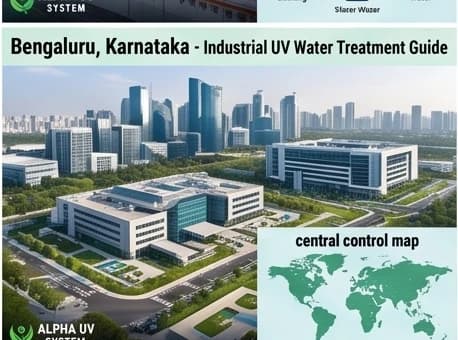
UV water treatment in Bengaluru is needed for two distinct reasons: (1) BWSSB-supplied water requires post-storage disinfection because overhead tanks lose chloramine residual within 24–48 hours, allowing bacterial regrowth — a UV system at 40 mJ/cm² on the tank outlet eliminates this without the taste issues that re-chlorination causes; (2) borehole water in Bengaluru's peri-urban areas (Whitefield, Sarjapur, Yelahanka) has consistently high TDS, iron, and E. coli contamination that require pre-filtration + UV. For industrial users — IT campuses, pharmaceutical plants, breweries, and residential townships — UV systems ranging from 0.5 m³/h (home) to 500+ m³/h (industrial) are available from Alpha UV System with Philips UV-C lamps and KSPCB-ready documentation.
Bengaluru is India's technology capital and one of its fastest-growing cities — but its water supply infrastructure has not kept pace with the population growth from 5 million in 2000 to over 12 million today. The Bruhat Bengaluru Mahanagara Palike (BBMP) and Bengaluru Water Supply and Sewerage Board (BWSSB) supply piped water to approximately 60% of the city's population. The remaining 40% — concentrated in the rapidly developing outer rings (Whitefield, Electronic City, Sarjapur, Hebbal, Yelahanka, Devanahalli) — depend on borehole water of variable quality.
Water quality problems in Bengaluru span both supply types. BWSSB-supplied water is treated to potable standards at the Cauvery water treatment plants but loses its chloramine disinfectant residual during storage in overhead tanks — creating a bacterial regrowth window between tank entry and tap delivery. Borehole water in Bengaluru's peripheral zones contains elevated TDS (500–2,000 mg/L), iron (0.5–5 mg/L), hardness, and in some areas E. coli contamination from septic tank proximity. UV water treatment addresses both problems.
BWSSB Water Quality and the UV Case
BWSSB draws from the Cauvery River at four stages (I through IV) and treats the water at the T.K. Halli, Torekadanahalli, and Hessarghatta treatment plants. The treated water is chloraminated (combined chlorine) to maintain a disinfectant residual throughout the distribution network. BIS 10500 allows up to 0.2 mg/L free residual chlorine at the consumer end.
However, Bengaluru's distribution network is old — significant portions date from the 1970s and 1980s — and distribution pressure varies significantly across the city. Many residential complexes and commercial buildings store BWSSB supply in underground sumps before pumping to overhead tanks, creating a multi-day residence time during which chloramine degrades and bacterial regrowth can occur. Water samples from Bengaluru overhead tanks routinely show coliform bacterial counts that exceed BIS 10500 limits, even though the BWSSB supply at the main is compliant.
A UV system installed on the outlet line from the overhead tank or on the building's internal distribution header eliminates any bacteria that regrew during storage — providing a reliable final disinfection barrier with zero chemical addition and no effect on taste or odour. For residential buildings, a flow rate of 0.5–2 m³/h (500–2,000 LPH) is typical; for apartment complexes of 50–200 flats, 2–5 m³/h.
Borehole Water in Bengaluru's Peripheral Zones
Whitefield, Electronic City Phase II, Sarjapur Road, Devanahalli, Yelahanka, and Tumkur Road areas outside BWSSB's current piped supply zone rely primarily on borehole (borewells) water. These boreholes tap the Peninsular Gneiss and Closepet Granite aquifer systems under Bengaluru, which has historically been a high-quality hard rock aquifer. However, decades of unregulated borewell drilling and urbanisation have created serious water quality problems:
| Area | Common Water Quality Issue | Likely Source | Treatment Required |
|---|---|---|---|
| Whitefield / Marathahalli | High TDS (800–1,800 mg/L), hardness, fluoride in some areas | Deep aquifer with naturally high mineral content; industrial area leachate | RO + UV disinfection |
| Sarjapur Road / Harlur | E. coli contamination, elevated nitrate, colour | Septic tank contamination of shallow aquifer; inadequate casing depth | Sand filter + 5 µm cartridge + UV at 40 mJ/cm² |
| Electronic City / Begur | Iron (0.5–3 mg/L), manganese, turbidity | Subsurface geology; industrial area groundwater | Iron removal filter + UV at 40 mJ/cm² |
| Yelahanka / Hebbal / Devanahalli | Hardness (300–600 mg/L as CaCO₃), high TDS | Agricultural land use, natural mineral content | Softener or RO + UV |
| Tumkur Road / Peenya | Industrial contamination, heavy metals, high COD | Industrial estate proximity; KSPCB has documented contamination in Peenya groundwater | Full treatment train; confirm potability by NABL test before use |
| Kanakapura Road / Bannerghatta | Bacterial contamination, turbidity during monsoon | Surface infiltration into shallow aquifer during heavy rain | Pre-filter + UV at 40 mJ/cm²; seasonal UVT monitoring |
UV Water Treatment for Bengaluru's Industrial Users
IT Parks and Technology Campuses
Bengaluru's IT sector — concentrated in Electronic City, Whitefield, Manyata Tech Park, Bagmane Tech Park, Embassy Golf Links, and RMZ Ecospace — operates large commercial campuses with food courts, gymnasiums, clinics, cooling towers, and fire suppression systems. Water quality requirements span potable water for employee consumption, cooling tower Legionella management, and BWSSB STP compliance for wastewater from campus toilets and kitchens.
UV disinfection for Bengaluru IT campuses is typically installed at three points: the main water supply header (potable water for the entire campus, sized for 5–50 m³/h depending on headcount); the cooling tower make-up water line (Legionella control, 2–20 m³/h); and the STP outlet for campus sewage (KSPCB consent compliance, 5–30 m³/h).
Pharmaceutical Manufacturers
Bengaluru's pharmaceutical manufacturing cluster — located in Peenya, Bommasandra, Jigani, and Doddaballapur — includes formulation plants, bulk drug manufacturers, and contract research organisations. Pharmaceutical water requirements under Schedule M 2025 are the most demanding in any industry sector — purified water with TOC <500 ppb, conductivity <4.3 µS/cm, and total viable count <100 CFU/mL.
Alpha UV System supplies pharmaceutical water UV systems to Bengaluru pharmaceutical manufacturers with: 185 nm fused silica UV reactors for TOC reduction in purified water loops; 254 nm UV disinfection on purified water distribution loop return lines; IQ/OQ/PQ commissioning documentation for CDSCO Schedule M 2025 audit readiness; and Philips UV-C lamp COA documentation for CGMP records.
Breweries and Beverage Manufacturers
Bengaluru is home to United Breweries (Kingfisher Beer — UB City headquarters), SOM Distilleries, and multiple craft breweries (Toit, Arbor, Windmills Craftworks). Brewery process water quality requirements are demanding: water hardness, mineral profile, and bacterial quality all affect beer flavour and shelf life. UV disinfection at 40–80 mJ/cm² on brewery process water provides microbiological quality without chlorine flavour contamination — critical for craft breweries where the flavour impact of any disinfectant residual is directly detectable in the product.
KSPCB STP Compliance Requirements for Bengaluru
The Karnataka State Pollution Control Board (KSPCB) has significantly increased enforcement of STP compliance requirements in Bengaluru since the NGT order in 2016 directing KSPCB to ensure all STPs in the BBMP area are functional and compliant. Key KSPCB requirements for STP discharge from Bengaluru residential, commercial, and industrial facilities:
| Parameter | KSPCB Standard (Land Discharge / Reuse) | KSPCB Standard (Surface Water) | UV Treatment Contribution |
|---|---|---|---|
| Total Coliform (MPN/100mL) | <100 | <10 | Primary — UV dose delivers required log reduction |
| BOD (mg/L) | <30 | <10 | None — secondary biological treatment |
| COD (mg/L) | <250 | <100 | None — biological treatment |
| TSS (mg/L) | <100 | <20 | Indirect — lower TSS improves UV efficiency |
| pH | 6.5–9.0 | 6.5–8.5 | None |
KSPCB STP inspections in Bengaluru have increased in frequency since 2022, particularly for residential townships in BBMP outer zones, commercial complexes, and industrial units. Non-compliant STPs face closure notices, consent withdrawal, and financial penalties. UV disinfection at the STP outlet — correctly sized for the STP peak flow rate and measured secondary effluent UVT — is the most reliable way to achieve KSPCB coliform compliance without the dosing variability problems of sodium hypochlorite.
UV System Sizing Reference for Bengaluru Applications
| Application | Typical Flow Rate | UV Dose | Notes |
|---|---|---|---|
| Individual villa / bungalow (BWSSB + borewell) | 0.5–1 m³/h | 40 mJ/cm² | Pre-filter (5 µm) essential for borewell iron |
| Apartment complex — 20–50 flats | 2–5 m³/h | 40 mJ/cm² | Post-overhead-tank installation preferred |
| Apartment complex — 100–200 flats | 5–15 m³/h | 40 mJ/cm² | Twin-reactor parallel installation for redundancy |
| IT campus (2,000–5,000 employees) | 20–50 m³/h | 40 mJ/cm² | Cooling tower UV separate from potable water UV |
| Pharmaceutical plant purified water | 2–10 m³/h | 80 mJ/cm² | 185 nm for TOC; 254 nm for loop — two reactors |
| STP outlet (100 KLD township STP) | 8–12 m³/h | 40 mJ/cm² | UVT of STP secondary effluent: 55–65% typical |
| STP outlet (500 KLD apartment STP) | 40–55 m³/h | 40 mJ/cm² | Philips TUV 95W lamps recommended for STP UVT |
| Hospital / nursing home (200 beds) | 10–20 m³/h | 80 mJ/cm² | Hot water loop UV separate; Legionella risk plan required for NABH |
Alpha UV System Services in Bengaluru and Karnataka
Alpha UV System supplies UV disinfection systems to customers across Bengaluru — residential complexes in Whitefield, Marathahalli, Sarjapur, and Yelahanka; pharmaceutical manufacturers in Peenya, Bommasandra, and Jigani; IT campuses in Electronic City and Manyata Tech Park; and industrial facilities along Tumkur Road, Hosur Road, and Doddaballapur. We also serve customers across Karnataka — Mysuru (food processing and hotels), Hubballi-Dharwad (textile and agro-processing), Mangaluru (coastal industries and hospitals), and Belagavi (sugar and food industry).
UV systems can be shipped to Bengaluru from our manufacturing facility within 5–7 working days for standard catalogue sizes. Installation support and commissioning can be arranged through our Bengaluru service network. KSPCB documentation packages for STP UV installations are provided as standard.
Is UV water treatment required if BWSSB supply is already treated?
BWSSB water is treated and meets BIS 10500 at the distribution main. However, once water enters a building's storage system — underground sump, pump, overhead tank — the chloramine residual degrades within 24–48 hours of storage, and bacteria can regrow in the tank. Studies of Bengaluru apartment complex water tanks have found E. coli and total coliform counts well above BIS 10500 limits in overhead tank samples, even from buildings connected to BWSSB supply. A UV system on the overhead tank outlet provides a reliable final disinfection step to address this tank regrowth problem, without the taste complaints that arise from adding more chlorine at the building level.
Iron in my Bengaluru borewell water is affecting the UV system — what do I do?
Iron in borehole water is the most common cause of UV system underperformance in Bengaluru peripheral areas. Iron at concentrations above 0.3 mg/L deposits as ferric oxide (orange-red scale) on quartz sleeves within days, absorbing UV radiation and reducing output by 20–50% or more. The UV system may appear to be operating (the lamp is on, the indicator light is green) but is not delivering the design UV dose. Pre-treatment with an iron removal filter (aeration + sand filtration, or greensand filter for dissolved iron) before the UV reactor is essential when borewell iron exceeds 0.3 mg/L. Alpha UV System checks iron content in your water analysis before specifying the UV system and recommends the appropriate pre-filter if required.
What happens during a KSPCB STP inspection in Bengaluru?
KSPCB STP inspections in Bengaluru typically include: (a) visual inspection of the STP plant and equipment condition; (b) review of the STP consent conditions and the plant's monitoring logbook; (c) spot sampling of inlet sewage and treated effluent for BOD, COD, TSS, pH, and total coliform analysis; (d) verification of the UV disinfection system operation — the inspector will check that the UV system is energised and that the UV intensity sensor is operational. During a 2024 inspection drive in Bengaluru's Outer Ring Road (ORR) tech park belt, KSPCB issued non-conformance notices to 14 out of 38 facilities inspected — primarily for non-functional UV systems (lamps expired but not replaced) and missing UV intensity monitoring logs. Alpha UV System provides a lamp replacement service contract with automatic lamp life tracking to prevent this type of compliance failure.
Why choose Alpha UV System for UV water treatment in Bengaluru?
Alpha UV System supplies Philips UV-C lamps — the same lamp brand specified by WHO, USEPA, and CPCB reference documents for drinking water and STP disinfection. Every UV system we supply includes a UV intensity sensor (not a simple lamp indicator light), a flow-proportional dose monitor, and alarm output for SCADA integration. Our UV systems come with KSPCB-compatible commissioning documentation. We offer stocking of replacement Philips UV-C lamps and replacement quartz sleeves for fast service response in Bengaluru. WhatsApp our engineering team at +91 95995 00580 for same-day quotation.
Alpha UV System supplies and commissions UV disinfection systems across Bengaluru — residential complexes, IT campuses, pharmaceutical plants, breweries, hospitals, and STP operators. KSPCB-compliant documentation provided as standard. Philips UV-C lamps, UV intensity monitoring, and 5–7 day delivery to Bengaluru.
WhatsApp Us for Bengaluru UV System SupplyStandards, authorities & further reading
External references used to inform this guide. Regulations evolve — check the latest revision on each authority's site before compliance decisions.
Recommended UV Systems
Alpha UV System products for this application — powered by genuine Philips UV-C lamps.
Commercial UV Water Purification System
500 – 5,000 LPH
HACCP-compliant UV water purification for hotels, restaurants, and offices
Industrial UV Water Treatment System
5,000 – 50,000 LPH
Schedule M 2025 and HACCP compliant UV for pharma, food & beverage, and process water
Not sure which system suits your application? WhatsApp our engineers for a free recommendation →
Related solutions
See how Alpha UV System applies this to your industry or city.
Need a UV system?
Talk to our UV engineers — WhatsApp for a quote in 2 hours, or browse the full catalog on IndiaMART.