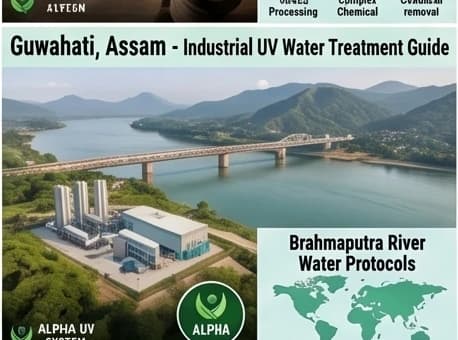
UV water treatment in Guwahati and Northeast India must account for two critical local factors not present in most other Indian regions: (1) arsenic contamination in Brahmaputra alluvial plain groundwater — Assam's lower Brahmaputra plain districts (Dhubri, Barpeta, Nalbari, Kamrup, Jorhat, Dibrugarh) have documented arsenic in shallow tube wells at concentrations exceeding the IS 10500 limit of 0.01 mg/L — UV alone does NOT remove arsenic; and (2) extreme seasonal turbidity in Brahmaputra and Barak river supply — during June–September monsoon, river turbidity can spike to thousands of NTU, requiring robust pre-filtration before UV. For treated municipal supply (GMC Guwahati) and areas with low-arsenic borewell water, post-tank UV at 40 mJ/cm² addresses bacterial regrowth in storage tanks. Tea industry process water, petroleum refinery process water (Guwahati refinery, Numaligarh refinery), and pharmaceutical plants in Guwahati all have additional UV water treatment needs. Alpha UV System supplies Philips UV-C lamp UV systems to Northeast India with 7–10 day delivery and APCB/MPCB/other state PCB documentation support.
Northeast India — the seven sister states and Sikkim — presents a UV water treatment market that differs from the rest of India in almost every dimension: geography (dramatic altitude ranges from Brahmaputra plains to Himalayan highlands), hydrology (the highest rainfall region in India, with Mawsynram and Cherrapunji in Meghalaya holding world records), geology (Brahmaputra alluvial arsenic, Barak valley arsenic, Shillong plateau granite groundwater), and industry (tea, petroleum refining, bamboo processing, and an emerging pharmaceutical sector rather than the chemical/pharma/textile clusters of western and southern India).
Guwahati — Assam's commercial capital and the gateway city of Northeast India — is the dominant urban UV water treatment market in the region. With a population exceeding 1.5 million and rapid residential development in Dispur, Narengi, Jalukbari, Beltola, and the Guwahati periphery, the city has a growing apartment sector requiring both potable water treatment and STP compliance.
Northeast India Water Quality by Zone
| City / Zone | Supply Type | Key Water Issue | UV Solution |
|---|---|---|---|
| Guwahati (GMC supply) | GMC piped supply (Brahmaputra intake — Panbazar, Jalukbari WTPs) + borewell | Extreme monsoon Brahmaputra turbidity; arsenic risk in some low-lying borewell zones; bacterial regrowth in tanks; new residential STP compliance | Post-tank UV; borewell test mandatory; pre-filter critical during monsoon; STP UV |
| Dibrugarh, Jorhat (Upper Assam) | PHED piped supply + borewell (shallow tube wells) | Brahmaputra alluvial arsenic risk in shallow tube wells; tea garden supply; petroleum refinery zone (Duliajan) — process water | NABL arsenic test first; arsenic removal + UV; tea processing UV; refinery UV |
| Silchar (Barak Valley, Assam) | Barak River supply + borewell | Barak valley arsenic — documented in Cachar, Karimganj, Hailakandi districts; Barak River seasonal turbidity | Arsenic test mandatory; arsenic removal + UV for borewell; pre-filter + UV for piped supply |
| Shillong (Meghalaya) | PHED supply (Umiam Lake + springs) + borewell | Generally good quality plateau spring and lake water; old pipes in Shillong city core; E. coli in peri-urban borewell in dense settlements | Post-tank UV at 40 mJ/cm²; MPCB STP compliance for new residential |
| Agartala (Tripura) | PHED supply (Haora River) + borewell | Bangladesh border proximity — some groundwater affected by Bengal delta arsenic; Haora river quality variable; STP compliance for apartments | Borewell arsenic test; post-tank UV for piped supply; STP UV; TPCB compliance |
| Imphal (Manipur) | PHED supply (Imphal River) + borewell | Plateau groundwater — generally lower arsenic risk than Brahmaputra plain; supply intermittent; post-storage bacterial regrowth | Post-tank UV at 40 mJ/cm²; MPCB (Manipur) STP compliance |
Assam Groundwater Arsenic — Critical Context
Assam's Brahmaputra and Barak river alluvial plains have documented groundwater arsenic — a natural geochemical phenomenon identical to the Bengal-Bihar arsenic belt. Research by the Geological Survey of India, CGWB, and international organizations has identified elevated arsenic in shallow tube wells (<50 metres) in districts including Dhubri, Barpeta, Nalbari, Kamrup Rural, Goalpara, Jorhat, Majuli, and parts of Dibrugarh, Tinsukia, and Lakhimpur. Arsenic concentrations in affected wells range from marginally above the IS 10500 limit (0.01 mg/L) to above 0.1 mg/L in severely affected blocks.
The arsenic mechanism is identical to the West Bengal / Bihar situation: reducing groundwater conditions in the alluvial sediments mobilise naturally occurring arsenic from iron oxide minerals into the groundwater. UV disinfection does not remove arsenic — the advisory for any Northeast India borewell user in an arsenic-affected district is: get an NABL laboratory arsenic test before installing any treatment system, and if arsenic exceeds 0.01 mg/L, install arsenic removal media (granular ferric hydroxide, or RO) before UV.
UV Water Treatment for Assam's Tea Industry
Assam produces 50–55% of India's tea — approximately 700 million kg annually — from gardens concentrated in the Upper Assam districts (Dibrugarh, Tinsukia, Sibsagar) and the Brahmaputra north bank (Darrang, Sonitpur). Tea manufacturing uses water at multiple critical stages: primary processing water, boiler steam for withering fans and drying, and final product tea liquor (water is 99% of a cup of tea — its quality directly determines tea flavour).
Water quality and tea flavour: Tea manufacturers — particularly those producing specialty teas for export — are sensitive to water quality effects on tea colour and flavour. Chlorine in water negatively affects tea flavour. UV disinfection at 40 mJ/cm² provides microbiological control without chlorine residual — making UV the preferred disinfection method for tea processing water at Assam tea estates and factories. Water TDS above 150 mg/L can also affect tea colour — many premium Assam tea factories use RO-reduced water (TDS 50–100 mg/L) with UV post-treatment.
Boiler feed water: Tea drying and withering use hot air from steam boilers. Boiler feed water UV at 40 mJ/cm² provides microbiological control of the demineralised boiler feed water before the deaerator — preventing microbial contamination of the condensate system.
Worker drinking water: Tea estates are large rural properties housing thousands of workers in tea lines (worker housing). The estate potable water supply — typically from estate boreholes or open wells — requires UV treatment to protect worker health. UV at 40 mJ/cm² on the estate water supply (with mandatory arsenic test first in Brahmaputra plain estates) provides safe drinking water for tea estate worker communities.
UV for Northeast India's Petroleum Industry
Assam has India's oldest petroleum producing region — the Digboi oilfield (producing since 1889) and the associated Duliajan and Nazira oilfield complex operated by Oil India Limited (OIL) and the Guwahati refinery, Bongaigaon refinery, and Numaligarh refinery constitute the petroleum industry cluster of the Northeast. Petroleum refinery process water requirements include boiler feed water, cooling tower water, and process water for various refinery operations.
UV water treatment at Northeast India petroleum facilities:
Cooling tower Legionella management: Refinery cooling towers operate at 28–35°C water temperature in Assam's warm climate — ideal for Legionella growth year-round. UV at 40–80 mJ/cm² on cooling tower make-up provides primary Legionella control. OISD (Oil Industry Safety Directorate) standards for Indian petroleum facilities reference ASHRAE 188 for cooling tower Legionella management.
Boiler feed water disinfection: Petroleum refinery boilers require high-purity feed water. After DM plant treatment, UV at 40 mJ/cm² on the deaerator inlet provides microbiological polishing before steam generation.
APCB STP Compliance for Guwahati Residential Complexes
Guwahati's residential development — concentrated in Dispur, Beltola, Narengi, Jalukbari, and Noonmati — has produced a growing stock of multi-storey apartment complexes that require STP systems under Assam Pollution Control Board (APCB) consent conditions. APCB's Guwahati office has increased STP compliance enforcement activity since 2022, following NGT directions on pollution of Bharalu and Deepor Beel (Ramsar wetland) from inadequately treated sewage from Guwahati's new residential zones.
| Application | Flow Rate | UV Dose | Notes |
|---|---|---|---|
| Residential apartment (Guwahati — GMC supply) | 1–3 m³/h | 40 mJ/cm² | Post-tank UV; monsoon season pre-filter critical; borewell arsenic test mandatory first |
| Gated community — 100 flats (Guwahati) | 4–8 m³/h | 40 mJ/cm² | APCB STP UV separate system; pre-filter maintenance during June–September |
| Tea estate worker supply (Upper Assam) | 2–10 m³/h | 40 mJ/cm² | Arsenic test mandatory for Brahmaputra plain estates; iron pre-filter often needed |
| Tea factory processing water | 2–10 m³/h | 40 mJ/cm² | No chlorine residual in tea processing water; UV preferred over chlorination for flavour preservation |
| Petroleum refinery cooling tower (Guwahati / Numaligarh) | 20–100 m³/h | 40–80 mJ/cm² | Legionella WMP; OISD compliance; ASHRAE 188 documentation |
| STP outlet — 100 KLD (Guwahati residential) | 8–12 m³/h | 40 mJ/cm² | Philips TUV 55W; APCB consent documentation; monthly NABL coliform test |
| Hospital (Guwahati — GNRC, GMCH) | 5–20 m³/h | 80 mJ/cm² | NABH accreditation water safety; Legionella WMP; dialysis water UV |
| Borewell (arsenic-cleared zone, iron present) | 1–5 m³/h (after treatment) | 40 mJ/cm² | Iron removal + UV; arsenic removal + UV; arsenic test mandatory before selecting treatment |
How does Guwahati's extreme monsoon affect UV water treatment?
Guwahati receives 1,600–2,000 mm of rainfall annually, with the Brahmaputra rising to flood stage nearly every year during June–September. During peak monsoon, Brahmaputra turbidity can exceed 5,000 NTU — far beyond what any UV system can handle without pre-treatment (UV requires turbidity below 1 NTU for full effectiveness, and performs optimally below 0.5 NTU). GMC's water treatment plants are designed for high-turbidity river water treatment (coagulation-flocculation-sedimentation) but during exceptional flood events, turbidity spikes can temporarily challenge treatment capacity. For UV system owners: (a) replace pre-filter cartridges at the start of monsoon season (May); (b) replace again mid-monsoon (August); (c) check UV intensity sensor readings more frequently during high-turbidity months — if readings drop, suspect pre-filter clogging; (d) after any flood event affecting municipal supply, replace the pre-filter before restoring household supply. For borewell users: test the borewell arsenic level every 2–3 years, as flood events can affect groundwater arsenic levels in the shallow aquifer.
Does Alpha UV System deliver to remote Northeast India locations?
Alpha UV System delivers UV systems to all major urban and semi-urban locations in Northeast India via express courier (typically 7–10 days from Delhi dispatch, compared to 5–7 days for other Indian metros). Delivery to Guwahati city is fastest (7 days typical). Delivery to district towns (Dibrugarh, Jorhat, Silchar, Tezpur, Nagaon) typically 8–10 days. Delivery to hill state capitals (Shillong, Imphal, Aizawl, Agartala, Kohima, Itanagar) typically 9–12 days depending on road conditions. For remote tea estate locations, delivery to the nearest railhead or ISD town with the estate collecting locally is standard. WhatsApp our team with your delivery pincode for a specific delivery time estimate for your location.
Alpha UV System supplies UV disinfection systems to residential complexes, tea estates, petroleum refineries, hospitals, and STP operators across Guwahati, Dibrugarh, Jorhat, Silchar, Shillong, Agartala, Imphal, and across Northeast India. We advise on arsenic pre-treatment requirements before UV system selection for Brahmaputra and Barak valley borewell users. Philips UV-C lamps. APCB and state PCB documentation. 7–10 day delivery to Northeast India.
WhatsApp Us for Northeast India UV System SupplyRecommended UV Systems
Alpha UV System products for this application — powered by genuine Philips UV-C lamps.
Commercial UV Water Purification System
500 – 5,000 LPH
HACCP-compliant UV water purification for hotels, restaurants, and offices
Industrial UV Water Treatment System
5,000 – 50,000 LPH
Schedule M 2025 and HACCP compliant UV for pharma, food & beverage, and process water
Not sure which system suits your application? WhatsApp our engineers for a free recommendation →
Related solutions
See how Alpha UV System applies this to your industry or city.
Need a UV system?
Talk to our UV engineers — WhatsApp for a quote in 2 hours, or browse the full catalog on IndiaMART.