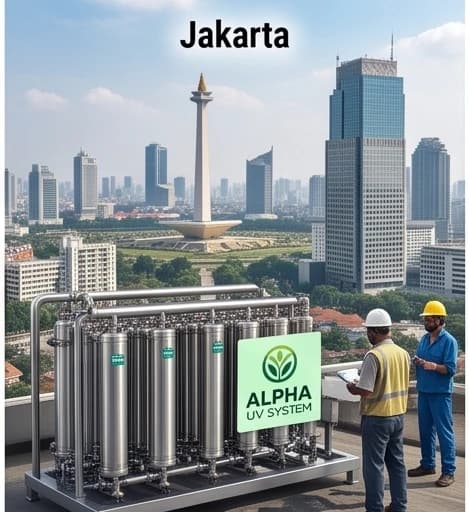
Quick Answer: UV water treatment system Jakarta market is driven by Indonesia's capital-region mega-city (10.6 million Jakarta + 35 million Jabodetabek metropolitan area — the world's 2nd largest urban agglomeration) where PAM Jaya (Perusahaan Daerah Air Minum Jakarta) and private concessionaires (Palyja, Aetra) supply Ciliwung River and West Tarum Canal-sourced treated water with UVT 55–70% at distribution — among Southeast Asia's lowest municipal UVT due to severe Ciliwung River contamination. Key UV demand drivers: Bekasi, Karawang, Cikarang, and Tangerang industrial estates (Jababeka, EJIP, MM2100 — hosting 6,000+ manufacturing companies including Toyota, Honda, Samsung, Unilever, Nestle); BPOM (Badan Pengawas Obat dan Makanan — National Agency of Drug and Food Control) food and pharmaceutical compliance; Jakarta's luxury hotel sector (Marriott, Hilton, Four Seasons, Shangri-La applying international brand water standards); and the growing domestic branded bottled water market (Aqua/Danone, Le Minerale, Club, Ades). Indonesia National Standard SNI 01-3553-2006 (drinking water) and BPOM Regulation 31/2018 (processed food HACCP) govern water quality. NSF/ANSI 55 Class A at 40 mJ/cm². Alpha UV ships to Soekarno-Hatta International Airport (CGK) within 48 hours or Tanjung Priok Port (25 days sea freight).
Jakarta's UV Water Treatment System Landscape
Jakarta's water supply crisis is one of Southeast Asia's most acute: only 60% of Jakarta formal households receive piped PAM Jaya/concessionaire supply; the remaining 40% rely on groundwater (rapidly depleting Jakarta aquifer, causing the city to sink 1–25 cm/year in some northern districts), private water trucks, or bottled water. PAM Jaya/concessionaires' supply comes from the Ciliwung River (one of Java's most polluted rivers — BOD 40–100 mg/L, total coliforms 100,000+ CFU/100 mL at raw water intake, heavy industrial and domestic sewage load), treated through conventional and advanced WTP processes (coagulation + sedimentation + filtration + chlorination + post-chlorination). Distribution UVT: 55–70% (wet season, November–March: 50–62%; dry season: 62–70%).
UV water treatment system Jakarta at 40 mJ/cm² is specified post-storage tank at virtually all commercial and industrial users — PAM Jaya supply degradation through building storage tanks (10,000–50,000 litre cisterns standard in Jakarta commercial buildings) means point-of-use biological quality cannot be guaranteed from distribution alone.
PAM Jaya Supply Quality and Industrial Zones
| Zone / Area | Water Source | UVT | Key Issue | Alpha UV System |
|---|---|---|---|---|
| Jakarta CBD (SCBD, Sudirman, Thamrin — financial/commercial) | PAM Jaya / Aetra WTP | 55–68% | High-rise building cistern re-contamination; international brand hotel water standards; post-softener Pseudomonas control in food and beverage premises | AU-M 25 post-tank, 5-micron pre-filter, 40 mJ/cm², NSF/ANSI 55 Class A |
| Bekasi Karawang industrial corridor (MM2100, Jababeka, EJIP) | Bekasi PDAM + private Cikarang water treatment | 58–72% | Japanese and South Korean manufacturing standards (Toyota, Honda, Daikin, LG, Samsung Electronics Indonesia); zero-Cl process water for electronics and automotive; BPOM food processing compliance | AU-M 25/30, zero Cl, 40 mJ/cm², MODBUS RS485 for Japanese quality management |
| Tangerang industrial area (Bitung, Cikupa, Pasar Kemis) | PDAM Tangerang + Cisadane River WTP | 60–72% | Unilever Indonesia, Indofood, food and FMCG manufacturing; BPOM compliance; zero-Cl requirement | AU-M 25/30, zero Cl, BPOM-compatible HACCP documentation, 40 mJ/cm² |
| Pulogadung industrial zone (East Jakarta) | PAM Jaya / Aetra supply | 55–66% | Oldest Jakarta industrial zone (heavy manufacturing); pharmaceutical manufacturers (Kalbe Farma, Sanbe Pharma); BPOM GMP inspection area | AU-M 25 tri-clamp 316L SS for pharma; AU-M 25 for food/industrial; BPOM GMP documentation |
Food, Beverage, and Pharmaceutical Manufacturing
| Company / Sector | Product | Water Standard | Alpha UV System |
|---|---|---|---|
| Indofood Sukses Makmur (Indonesia's largest food company — Indomie, Chitato, Pocari Sweat partnership) | Instant noodles, snack foods, beverages; Indonesia domestic + ASEAN export | BPOM Regulation 31/2018 (HACCP); SNI ISO 22000; zero Cl in noodle boiling water (chlorine affects instant noodle texture and flavour) | AU-M 30, zero Cl, 40 mJ/cm², BPOM HACCP documentation, MODBUS RS485 |
| Unilever Indonesia (Tangerang — Bango soy sauce, Blue Band, Royco, personal care) | Food and home care products; Indonesia's second largest listed company | Unilever global quality standards; FSSC 22000; BPOM compliance; ISO 14001 | AU-M 25/30, zero Cl, FSSC 22000-compatible MODBUS logging |
| Kalbe Farma (Jakarta — Indonesia's largest pharmaceutical company, USD 900 million revenue) | Generics, branded OTC, nutritionals; BPOM GMP; ASEAN export | BPOM GMP (Peraturan BPOM No. 34/2018 — aligned WHO TRS 986); WHO GMP prequalification target; USP Purified Water | AU-M 25 tri-clamp 316L SS, DQ/IQ/OQ for BPOM GMP inspection, MODBUS TCP 21 CFR Part 11-compatible |
| Aqua (Danone — Le Minerale competitor, Indonesia's largest bottled water brand) | Natural mineral water (Cianjur spring); packaged drinking water; BPOM bottled water license | BPOM Regulation 63/2021 (bottled water); SNI 3553:2015; Danone global quality; Codex STAN 108 NMW | AU-M 25 post-spring collection and post-filtration; UV mandatory in Danone AQUA global quality standard for spring water sources |
FAQ
What is BPOM and how does it regulate UV water treatment in Indonesian food and pharmaceutical facilities?
BPOM (Badan Pengawas Obat dan Makanan — National Agency of Drug and Food Control) is Indonesia's FDA equivalent — regulating food safety (Peraturan BPOM 31/2018 on HACCP) and pharmaceutical GMP (Peraturan BPOM 34/2018 — CPOB, aligned to WHO TRS 986). For food processing: BPOM HACCP regulation requires potable water at all food-contact points, with HACCP prerequisite programme (PRP) documentation for water treatment — UV at 40 mJ/cm² satisfies BPOM water treatment PRP requirements when documented with NSF/ANSI 55 Class A certification. For pharmaceuticals: BPOM CPOB (Cara Pembuatan Obat yang Baik / GMP) requires UV disinfection post-RO in Purified Water systems — DQ/IQ/OQ validation documentation required for BPOM pharmaceutical GMP inspection. BPOM inspectors check UV system calibration records, lamp replacement dates, and UVI monitoring logs during routine GMP inspections of Jakarta pharmaceutical facilities.
Why is Ciliwung River-sourced water so challenging for UV treatment in Jakarta?
The Ciliwung River — which flows through Bogor, Depok, and into Jakarta before reaching the sea — is one of Java's most polluted rivers. At PAM Jaya/Aetra intake points (Pejompongan, Pulogadung), Ciliwung raw water contains: BOD 40–100 mg/L (severe organic load from untreated sewage — Jakarta sewerage coverage <15%); total coliforms 100,000+ CFU/100 mL; turbidity 50–500 NTU in wet season; colour 200–400 HU from dissolved humic substances and industrial effluents. PAM Jaya's conventional WTP processes reduce turbidity and coliforms significantly but leave treated water with UVT 55–70% at distribution — the residual dissolved organics (humic and fulvic acids, chlorination by-products) reduce UV transmittance. Jakarta UV systems must be sized with 25–30% flow margin to maintain 40 mJ/cm² dose at the minimum dry-season UVT (55–60% in worst case). Alpha UV systems include automatic flow-based dose control — reducing throughput when UVI sensor detects low transmittance, maintaining 40 mJ/cm² dose continuously.
What is the UV specification for a Jakarta luxury hotel during Indonesian flooding season?
Jakarta's wet season (November–March) brings recurring urban flooding — impacting municipal water supply as PAM Jaya raw water quality deteriorates dramatically and distribution mains can be contaminated by floodwater ingress. Jakarta 5-star hotels (Grand Hyatt Jakarta, Shangri-La, Ritz-Carlton Pacific Place) have private UV systems that continue operating during flooding periods when PAM Jaya supply is suspended or quality-compromised. Typical specification for a 300-room Jakarta 5-star hotel: AU-M 30 at main potable supply post-cistern tank (operates continuously regardless of PAM Jaya supply quality, providing biological safety assurance during flood events); AU-M 25 MP at spa pool recirculation; AU-M 30 at cooling tower (Legionella — Jakarta tropical climate year-round). Hotels maintain emergency UV-treated drinking water buffer stock (cistern capacity typically 3–5 days at full occupancy) as part of Jakarta flood contingency plans.
How does Alpha UV ship to Jakarta and what are Indonesian import duties?
Air freight to Soekarno-Hatta International Airport (CGK, Tangerang — 30 km from Jakarta CBD): 48 hours from India. Sea freight to Tanjung Priok Port (Jakarta's primary container port): 20–25 days from Indian west coast. Indonesia Customs: HS 8421.21 (liquid purification equipment) — ASEAN-India FTA (AIFTA) 0% import duty for Indian-origin equipment. Indonesia VAT (PPN): 11% on declared value. Import Duty Registration (API-U or API-P for industrial goods) required for Indonesian importer — local Indonesian agent or PT handles this. Indonesian customs processing at CGK airport cargo: 5–10 working days (longer than ASEAN peers — local customs broker strongly recommended). PT (Indonesian limited liability company) import documentation required for commercial imports.
Standards, authorities & further reading
External references used to inform this guide. Regulations evolve — check the latest revision on each authority's site before compliance decisions.
Recommended UV Systems
Alpha UV System products for this application — powered by genuine Philips UV-C lamps.
Commercial UV Water Purification System
500 – 5,000 LPH
HACCP-compliant UV water purification for hotels, restaurants, and offices
Industrial UV Water Treatment System
5,000 – 50,000 LPH
Schedule M 2025 and HACCP compliant UV for pharma, food & beverage, and process water
Not sure which system suits your application? WhatsApp our engineers for a free recommendation →
Related solutions
See how Alpha UV System applies this to your industry or city.
Need a UV system?
Talk to our UV engineers — WhatsApp for a quote in 2 hours, or browse the full catalog on IndiaMART.