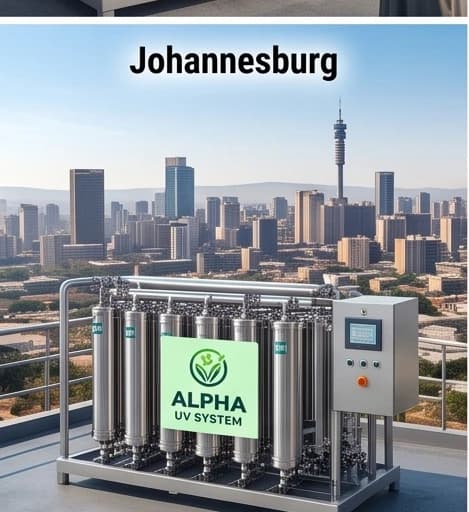
Quick Answer: Johannesburg — South Africa's economic capital (5.6 million city population, 15+ million Gauteng metropolitan area), Africa's financial centre, and the hub of the Witwatersrand gold mining arc — presents a UV water treatment system Johannesburg market driven by: Rand Water supply reliability and Vaal Dam water quality issues (UVT 72–82% post-treatment — Vaal River eutrophication from agricultural runoff and upstream municipalities), Gauteng manufacturing (AB InBev/SAB Miller brewery, Nestlé South Africa, Tiger Brands, Pioneer Foods, pharmaceutical — Aspen Pharmacare, Adcock Ingram), gold and platinum mining sector (Anglo American, Gold Fields, Harmony — mine water AMD management), and a large commercial and residential building sector. SANS 241:2015 (South African National Standard for Drinking Water Quality, WHO-aligned) governs all commercial applications. NSF/ANSI 55 Class A at 40 mJ/cm² is the standard specification. Alpha UV ships to Durban Port (18–22 days from India) then road to Johannesburg (570 km, 6 hours), or air freight to O.R. Tambo International Airport (JNB) in under 48 hours.
Johannesburg's UV Water Treatment System Landscape
Johannesburg — founded as a gold mining camp in 1886 following the discovery of the Witwatersrand gold reef, the world's largest gold deposit — remains anchored to its extractive industry legacy while hosting Africa's most sophisticated financial, commercial, and manufacturing infrastructure. Rand Water (South Africa's largest bulk water utility, serving 19 million people in Gauteng, Mpumalanga, and surrounding provinces) abstracts from Vaal Dam (Vaal River system) and treats water through six major treatment works (Zuikerbosch, Vereeniging, Palmiet, Calderbank, Claude Neon, Strandfontein — Vaal-area WTPs).
Post-Rand Water WTP treatment UVT: 72–82% — constrained by Vaal River eutrophication from upstream Lesotho Highlands water transfer system outflows, agricultural runoff (Highveld maize and sunflower farming), and upstream municipal wastewater discharge from Free State municipalities. Vaal Dam cyanobacterial (blue-green algae) blooms — increasingly frequent under climate-driven temperature increase — temporarily drop treated water UVT to 68–74% at Zuikerbosch WTP, activating auto de-rating UV control at downstream industrial installations.
The UV water treatment system Johannesburg market covers: (1) Gauteng food and beverage manufacturing (SAB Miller/AB InBev, Nestlé, Tiger Brands — process water CCPs), (2) pharmaceutical manufacturing (Aspen Pharmacare Sterile Division — AU-H 80 mJ/cm²), (3) gold and platinum mining (Witwatersrand, Bushveld Igneous Complex — mine AMD treatment, worker camp water), (4) commercial real estate (Sandton, Rosebank CBD — building water treatment), and (5) Soweto and East Rand township community water quality.
Rand Water Supply Zone and Water Quality
| Water Source / Zone | Post-WTP UVT | Key Issue | Alpha UV System |
|---|---|---|---|
| Rand Water Zuikerbosch WTP (Vaal River) | 72–82% (68–74% algae bloom events) | Eutrophication, cyanobacterial toxins, seasonal turbidity | Auto de-rating, AU-M 25–50, NSF/ANSI 55 |
| Rand Water Vereeniging WTP | 74–82% | AMD from West Rand mines affecting Vaal tributaries | AU-M 25, auto de-rating, MODBUS RS485 |
| Johannesburg borehole (Dolomite aquifer — East Rand) | 78–86% | Dolomite sinkhole risk areas — no deep boreholes; iron/manganese | AU-M 25, auto-wiper quartz sleeve (Fe/Mn) |
| Ekurhuleni East Rand supply | 72–80% | Aging distribution network, secondary contamination risk | AU-M 25, NSF/ANSI 55 Class A |
Johannesburg's Dolomite geology (extending across large parts of Soweto, West Rand, and East Rand) presents borehole abstraction risks — subsurface dissolution creates sinkhole risk zones where deep borehole drilling is restricted by City of Joburg regulations. This drives surface water (Rand Water) dependence for most Johannesburg users, with point-of-entry UV treatment as the final polish for process water applications.
Food and Beverage Manufacturing — SAB Miller and Major Processors
Gauteng hosts South Africa's largest food and beverage manufacturing cluster:
| Manufacturer / Sector | Location | Standard | Alpha UV System |
|---|---|---|---|
| AB InBev South Africa (Castle Lager, Carling Black Label — Alrode brewery) | Alrode, Alberton (East Rand) | AB InBev global HACCP, zero Cl, FSSC 22000 | AU-M 30, zero residual Cl, MODBUS TCP, duty/standby |
| Nestlé South Africa (Maggi, Nescafé, Kit Kat — Brakpan/Springs) | Brakpan, East Rand | Nestlé global HACCP, zero Cl, FSSC 22000 | AU-M 30, zero residual Cl, MODBUS RS485 |
| Tiger Brands (Purity, Jungle Oats, Ace maize — Johannesburg) | City Deep, Johannesburg | FSSC 22000, SANS 10330, HACCP, KEBS equivalent | AU-M 25, NSF/ANSI 55 Class A |
| Pioneer Foods (Sasko, Weet-Bix — Johannesburg) | Johannesburg Industrial | FSSC 22000, BRC, HACCP, SANS | AU-M 25, NSF/ANSI 55 Class A, MODBUS |
| RCL Foods (Rainbow Chicken, Sunshine Oats) | Randfontein, West Rand | FSSC 22000, HACCP, SANS 241, zero Cl | AU-M 25, NSF/ANSI 55 Class A |
AB InBev's Alrode brewery — one of South Africa's highest-volume beer production sites, producing Castle Lager (South Africa's dominant lager brand) and Carling Black Label — applies AB InBev's global HACCP framework requiring zero residual chlorine in all process water. South African Castle Lager's flavour profile (characteristic South African lager — light, clean, no off-notes) is quality-audited by AB InBev's global sensory network. Chlorophenol contamination from process water chlorine at <0.02 mg/L is rejected by AB InBev's sensory QC. UV disinfection at 40 mJ/cm² with MODBUS TCP logging to Alrode SCADA is the AB InBev-compliant process water treatment.
Pharmaceutical Manufacturing — Aspen Pharmacare
Aspen Pharmacare — Africa's largest pharmaceutical manufacturer (JSE-listed, global revenues USD 2.5 billion/year), producing sterile injectables (heparin, anaesthetics, cytotoxics) at its Port Elizabeth and Johannesburg facilities — applies EU GMP Annex 1 standards for sterile manufacturing, requiring Purified Water (PW) at 80 mJ/cm² UV and Water for Injection (WFI) at 80 mJ/cm² with additional distillation or membrane filtration.
Adcock Ingram (JSE-listed, generics and hospital products) and Pharmos (generic OTC) in Midrand/Johannesburg pharmaceutical cluster similarly require SAHPRA (South African Health Products Regulatory Authority) GMP-compliant Purified Water — SAHPRA GMP guidelines align with WHO TRS 1044 Annex 2, requiring 80 mJ/cm² UV (Alpha UV AU-H, 316L SS, Tri-Clamp, CFD dose validated) for pharmaceutical Purified Water systems.
Frequently Asked Questions
What is SANS 241:2015 and how does it apply to UV treatment in Johannesburg?
SANS 241:2015 (South African National Standard for Drinking Water — Part 1: Microbiological, Physical, Aesthetic, and Chemical Determinands) is South Africa's national drinking water quality standard, published by SABS (South African Bureau of Standards) and aligned with WHO Guidelines for Drinking Water Quality, 4th Edition. SANS 241:2015 Class 1 (the potable water tier) specifies: E. coli = 0/100 mL; intestinal enterococci = 0/100 mL; Clostridium perfringens = 0/100 mL; heterotrophic plate count (HPC) <1,000 CFU/mL at point of use. For food manufacturers in Johannesburg, DAFF (Department of Agriculture, Forestry and Fisheries) food safety regulations require process water compliance with SANS 241:2015 Class 1. NSF/ANSI 55 Class A UV at 40 mJ/cm² satisfies SANS 241:2015 microbiological requirements at the UV disinfection step. DAFF and DALRRD (Department of Agriculture, Land Reform and Rural Development) inspectors — conducting HACCP facility audits for export food manufacturers — accept NSF/ANSI 55 Class A validation documentation alongside SANS 241:2015 compliance declarations.
How does Vaal Dam eutrophication affect UV system performance at Johannesburg industrial sites?
Vaal Dam eutrophication — from Highveld agricultural nutrient runoff (phosphorus and nitrogen from Lesotho Highlands Transfer Scheme return flows and upstream wastewater) — drives seasonal cyanobacterial blooms. During bloom events (typically January–April, summer wet season), Rand Water WTPs at Zuikerbosch and Vereeniging experience: increased organic loading (DOC from algal cell lysate and extracellular organic compounds); temporary turbidity spikes (algal cell material); and geosmin/MIB taste-and-odour compounds in treated water. The UVT impact of bloom events at Zuikerbosch WTP output: typically 68–74% during peak bloom (versus 78–82% normal). Auto de-rating UV control — reducing permitted flow rate proportionally when UVT falls below 72% — is mandatory for all Johannesburg industrial UV installations connected to Rand Water supply. MODBUS logs confirm dose delivery throughout bloom periods, providing the HACCP CCP monitoring record for food manufacturers during the highest-risk seasonal period. GAC pre-filtration (removing algal-derived DOC) before the UV reactor restores UVT to 82–90% and eliminates geosmin/MIB taste issues simultaneously.
What SAHPRA GMP requirements apply to pharmaceutical UV water in Johannesburg?
SAHPRA (South African Health Products Regulatory Authority) — South Africa's pharmaceutical regulatory authority, replacing the MCC (Medicines Control Council) in 2018 — applies GMP guidelines aligned with WHO TRS 1044 Annex 2 and Pic/S (Pharmaceutical Inspection Cooperation Scheme) standards for pharmaceutical manufacturing site inspection. Purified Water (PW) requirements under SAHPRA GMP: TAMC <100 CFU/mL, total yeasts and molds <10 CFU/mL, heavy metals <0.1 ppm, TOC <500 ppb, conductivity <1.3 µS/cm (USP/Ph.Eur. aligned). UV treatment at 80 mJ/cm² (Alpha UV AU-H, 316L SS, Tri-Clamp, CIP/SIP compatible, electropolished Ra <0.8 µm) with CFD dose validation is required for SAHPRA facility registration. SAHPRA GMP inspectors (conducting facility registration inspections and routine GMP inspections annually for registered sites) review the Purified Water System Master Plan including UV reactor validation documentation (CFD simulation, bioassay validation, IQ/OQ/PQ protocols). Aspen Pharmacare and Adcock Ingram maintain EU GMP Annex 1 compliance at their sterile manufacturing sites — requiring AU-H documentation that simultaneously satisfies SAHPRA GMP and EU GMP inspection requirements.
What UV specification is required for Witwatersrand gold mine worker accommodation water?
Witwatersrand gold mines — Gold Fields South Deep, Harmony Doornkop, Pan African Resources Evander — operate worker accommodation complexes (hostels, surface housing) for 5,000–20,000 mineworkers per mine. South African Mine Health and Safety Act (Act 29 of 1996) and MHSC (Mine Health and Safety Council) guidelines require potable water at the mine accommodation meeting SANS 241:2015 Class 1 microbiological standards. Mine process water (AMD — Acid Mine Drainage from Witwatersrand gold mines is characterised by high sulphate, iron, and heavy metal contamination — pH 2–4) is NOT suitable for domestic use even after UV treatment alone; AMD requires neutralisation, iron removal, and reverse osmosis before UV polish for drinking water applications. For mine accommodation with clean borehole or municipal supply: NSF/ANSI 55 Class A UV (40 mJ/cm²) at the accommodation water treatment plant satisfies SANS 241:2015 and MHSC guidelines. For AMD-affected mines with no clean supply: RO + UV 40 mJ/cm² is the complete treatment train.
What is the delivery route for UV systems to Johannesburg?
Alpha UV supplies Johannesburg via two primary routes: (1) Air freight to O.R. Tambo International Airport (JNB, Kempton Park — 25 km from Johannesburg CBD) — under 48 hours from India via Dubai (Emirates SkyCargo — direct JNB route), Addis Ababa (Ethiopian Airlines Cargo), or Doha (Qatar Airways Cargo). JNB customs clearance: SARS (South African Revenue Service) customs, 3–7 working days for industrial equipment (HS 8421.29), 0% SADC import duty for India-origin equipment under SADC/IOTA trade agreements (verify applicable preferential rate at time of import). (2) Sea freight to Durban Port (18–22 days from Nhava Sheva India) then road freight Durban–Johannesburg (570 km via N3 highway, 5.5–6 hours) — the most cost-effective route for planned project installations. Durban Port customs clearance: 5–10 working days. Spare lamps by DHL Express from India: JNB hub 3–4 working days.
Logistics and Supply Chain
Alpha UV supplies Johannesburg via air freight to O.R. Tambo International Airport JNB (under 48 hours from India) for urgent deliveries, or sea freight to Durban Port (18–22 days from India) with N3 highway road freight to Johannesburg (570 km, 5.5–6 hours) for planned installations. Durban Port sea freight is the most cost-effective import route for major industrial UV system projects.
For pharmaceutical AU-H units (Aspen/Adcock): air freight via JNB with SAHPRA pre-clearance documentation (pharmaceutical equipment import requires SAHPRA notification). For food and beverage AU-M units: Durban Port sea freight standard.
Documentation with every Johannesburg installation: NSF/ANSI 55 Class A validation report, SANS 241:2015 compliance declaration (English), SAHPRA GMP pharmaceutical dossier (AU-H units), DAFF/DALRRD food safety HACCP CCP documentation, AB InBev / Nestlé / Tiger Brands formatted HACCP records (as applicable), MODBUS RS485/TCP register map, IP65 certification, and O&M manual in English and Afrikaans.
Alpha UV Systems — UV water treatment system Johannesburg specialists. NSF/ANSI 55 Class A | SANS 241:2015 / WHO compliant | SAHPRA GMP pharmaceutical 80 mJ/cm² AU-H | AB InBev Castle Lager zero-chlorine | Nestlé / Tiger Brands FSSC 22000 HACCP | Vaal Dam auto de-rating seasonal turbidity | Witwatersrand mine AMD RO+UV. Delivery via O.R. Tambo Airport 48 hours or Durban Port. Contact us for Gauteng food processing or pharmaceutical sizing.
Standards, authorities & further reading
External references used to inform this guide. Regulations evolve — check the latest revision on each authority's site before compliance decisions.
Recommended UV Systems
Alpha UV System products for this application — powered by genuine Philips UV-C lamps.
Commercial UV Water Purification System
500 – 5,000 LPH
HACCP-compliant UV water purification for hotels, restaurants, and offices
Industrial UV Water Treatment System
5,000 – 50,000 LPH
Schedule M 2025 and HACCP compliant UV for pharma, food & beverage, and process water
Not sure which system suits your application? WhatsApp our engineers for a free recommendation →
Related solutions
See how Alpha UV System applies this to your industry or city.
Need a UV system?
Talk to our UV engineers — WhatsApp for a quote in 2 hours, or browse the full catalog on IndiaMART.