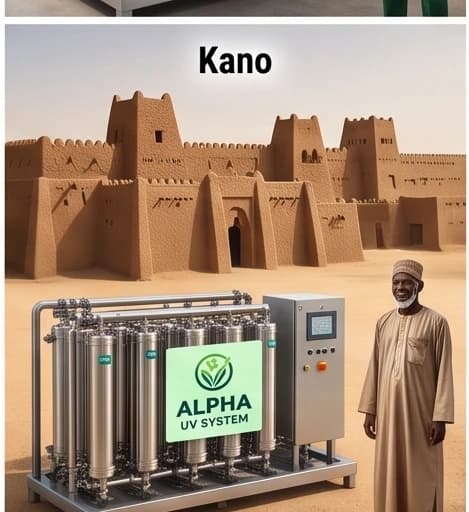
Quick Answer: Kano — northern Nigeria's largest city (4+ million population), the ancient Saharan trade hub, and Nigeria's second-largest industrial centre — presents a UV water treatment system Kano market driven by the Challawa and Sharada industrial estates (Nigeria's largest tannery and leather processing cluster, textile/garment industry, food and beverage manufacturing), groundwater-dependent supply (no major surface WTP serving Kano at the scale of Lagos), and increasingly, food export compliance requirements for leather, garments, and agricultural products. Kano State Water Board borehole and shallow aquifer supply UVT 72–82%; Challawa Gorge Dam WTP post-treatment UVT 68–76% (high suspended solids from Sahelian catchment). GOTS and LWG (Leather Working Group) zero-chemical process water requirements drive UV adoption in tanneries and textile factories. SON NIS 554:2017 and WHO 4th edition govern drinking water standards. Alpha UV ships to Malam Aminu Kano International Airport (KAN) in under 48 hours from India or road from Lagos/Apapa Port (1,200 km, 18–24 hours).
Kano's UV Water Treatment System Context
Kano — established as a major Saharan trade route city over 1,000 years ago, known for its ancient textile dyeing pits (kofar mata — UNESCO heritage-recognised ancient indigo dyeing), and still one of Nigeria's most industrial cities — operates Nigeria's largest concentration of tanning and leather processing alongside a significant garment and textile manufacturing sector.
Water supply in Kano is groundwater-dominated: the Kano State Water Board (KSWB) draws from Challawa Gorge Dam (on the Challawa River — a Sahel river with seasonal flow, UVT 68–76% post-WTP), supplemented by borehole abstraction from the Basement Complex aquifer (UVT 72–82%). Unlike Lagos (which has deep aquifers with relatively low contamination), Kano's shallow groundwater in densely populated urban areas shows elevated E. coli, nitrate, and coliform contamination from pit latrines and inadequate sanitation.
Kano's UV water treatment system market is defined by: (1) tannery and leather export sector (Leather Working Group — LWG certification, zero-chemical process water for EU-standard chrome-free leather production), (2) textile and garment export (GOTS certification zero-chlorine for organic cotton fabric), (3) food processing for northern Nigerian market (Dansa foods, Kano State groundnuts and sesame seed processing), and (4) hospitality (Kano's growing commercial hotel sector).
SON NIS 554:2017 governs drinking water. NSF/ANSI 55 Class A UV at 40 mJ/cm² is the commercial specification. IP65 enclosures are mandatory for Kano's harmattan season (November–February, extreme dust from the Sahara at PM concentrations 300–1,000 µg/m³ — among Africa's highest harmattan dust loadings).
Challawa and Sharada Industrial Estates — Tannery and Leather
Kano's Challawa and Sharada industrial estates form Nigeria's largest tannery cluster — approximately 40 registered tanneries processing cattle, goat, and sheep hides for export to Europe, China, and the Middle East. Major tannery operators include UNTL (United Nigeria Textiles Ltd — tannery division), Kano Tannery, and smaller Nigerian and Chinese-owned operations.
| Industry Segment | Location | Water Source / UVT | Standard | Alpha UV System |
|---|---|---|---|---|
| Kano tanneries (LWG certified, EU export) | Challawa, Sharada estates | Borehole + Challawa WTP 70–80% | LWG, EU REACH, zero Cl for chrome-free | AU-M 25, zero residual Cl, MODBUS RS485 |
| Textile/garment factories (GOTS organic cotton) | Challawa/Sharada | Borehole 72–82% | GOTS Section 2.4.5, OEKO-TEX, zero Cl | AU-M 25, zero residual Cl, NSF/ANSI 55 |
| Groundnut and sesame processing (export) | Challawa estate | Borehole 72–80% | SON NIS 554, NAFDAC food, EU import | AU-M 25, NSF/ANSI 55 Class A |
| Dansa Foods (Capri-Sun license, fruit juice) | Kano industrial zone | Borehole 74–82% | NAFDAC, SON, HACCP, zero Cl | AU-M 25, zero residual Cl, duty/standby |
| Flour mills (Kano agric processing) | Challawa/Bompai | Borehole 72–80% | SON NIS 554, NAFDAC food standards | AU-M 25, IP65, auto de-rating |
The Leather Working Group (LWG) — a multi-stakeholder partnership that audits and certifies tanneries for environmental and process standards — requires zero-chlorine process water for LWG Platinum and Gold rated tanneries. Chlorine-based disinfection in tannery water (used for washing hides, softening baths, and finishing water) reacts with residual organics in tannery wastewater to form chlorophenols and AOX (absorbable organic halogens) — contaminants that appear in finished leather and trigger EU REACH compliance failures. UV disinfection (zero chemical residual) eliminates this risk. Kano tanneries seeking LWG certification for EU leather export (to Italy, Germany, France for major luxury fashion brands) specify UV as their process water disinfection method.
Kano Hotels and Commercial Applications
Kano's commercial hotel sector — serving northern Nigerian business, government, and increasingly international trade visitors from Niger, Chad, and West Africa — requires HACCP-compliant water for food and beverage operations.
| Application | Location | Water Source / UVT | Standard | Alpha UV System |
|---|---|---|---|---|
| Kano airport area hotels (Linas International, Tahir Guest Palace) | Airport Road, GRA | Borehole 74–82% | SON NIS 554, HACCP, WHO 4th ed. | AU-M 25, NSF/ANSI 55 Class A |
| Kano GRA commercial compounds | Government Reserved Area | KSWB WTP + borehole 72–80% | SON NIS 554 | AU-S 15, NSF/ANSI 55 |
| Kano schools and clinics (international) | Nassarawa GRA | Borehole 74–82% | WHO 4th edition | AU-S 10 |
Frequently Asked Questions
Why do Kano tanneries need UV rather than chlorination for LWG certification?
Leather Working Group (LWG) Platinum and Gold certification (required for supply to major European and US luxury brands — Gucci, Louis Vuitton, Hermès, Coach, Prada all require LWG-certified supplier tanneries) prohibits elevated AOX (absorbable organic halogens) in tannery effluent. Chlorine-based disinfection of process water generates organochlorine compounds (chlorophenols, AOX) when chlorine reacts with organic matter in hides and tanning chemicals. AOX appearing in finished leather triggers EU REACH Article 67 non-compliance and EU eco-label (Environmental label EU 459/2014) failure. UV disinfection at NSF/ANSI 55 Class A (40 mJ/cm²) delivers microbiological safety with zero chemical residual — eliminating the AOX pathway from process water. LWG auditors (Control Union, Bureau Veritas, TÜV Rheinland) accept NSF/ANSI 55 Class A UV documentation as evidence of zero-chlorine process water disinfection in tannery HACCP plans.
What is the impact of Kano's harmattan season on UV system maintenance?
Kano's November–February harmattan season (dry northeast trade wind from the Sahara) carries Saharan dust at PM concentrations of 300–1,000 µg/m³ — among the highest in West Africa. UV controller enclosures exposed to harmattan must be IP65 rated (complete dust ingress exclusion) to prevent fine silica dust accumulation on UV intensity sensors and electronic boards. Silica dust on the UV intensity sensor (monitoring lamp output) causes false low-intensity readings, triggering unnecessary alarms and lamp replacement at factories that do not maintain IP65 seals. Alpha UV's IP65 enclosure with sealed sensor port prevents harmattan dust from reaching the intensity sensor. Annual enclosure seal inspection (January–February, after harmattan season) is recommended for all Kano industrial UV installations.
What GOTS documentation is required for Kano textile factories exporting organic cotton garments?
GOTS (Global Organic Textile Standard) Section 2.4.5 prohibits residual disinfectants (chlorine, chloramines, chlorine dioxide) in process water used for organic textile washing, rinsing, and finishing. For GOTS certification audits (by Control Union, Ecocert, CERES, IMO), textile factories in Kano Challawa and Sharada estates must provide: NSF/ANSI 55 Class A UV validation certificate confirming zero-chemical disinfection; MODBUS dose logs showing continuous >40 mJ/cm² operation; annual lamp calibration records; and absence of chlorine dosing in the water treatment pathway. Alpha UV provides GOTS-compatible documentation in English for Kano textile factory GOTS annual audits. This documentation enables Kano garment manufacturers to qualify for EU organic textile market (GOTS label), where premium pricing (30–50% above conventional garments) justifies the UV system investment.
How does Kano borehole water quality compare to Lagos, and what does this mean for UV specification?
Kano borehole water (Basement Complex aquifer, 30–90 m deep) typically shows UVT 72–82% — slightly better than Lagos Lagoon-derived supply (62–74% post-WTP) due to better natural filtration through crystalline rock. However, Kano urban shallow aquifer (<20 m depth) shows frequent E. coli and nitrate contamination (nitrate up to 80–120 mg/L in some Kano Old City areas — significantly above WHO 50 mg/L limit) from pit latrines and inadequate sanitation. For drinking water applications (tannery canteen supply, factory drinking water, hotel potable water), the borehole at UVT 72–82% is adequate for NSF/ANSI 55 Class A UV without pre-treatment. For process water applications where residual organics affect product quality (tannery chrome-free process, GOTS textile processing), GAC pre-filtration (raising UVT from 72–82% to 80–88%) is recommended before the UV reactor for optimal dose delivery efficiency.
What is the delivery route for UV systems to Kano?
For Kano: air freight to Malam Aminu Kano International Airport (KAN) from India under 48 hours (connections via London Heathrow — British Airways serves KAN directly, or Addis Ababa — Ethiopian Airlines, or Dubai — Emirates). Road freight from Lagos Apapa Port to Kano: 1,200 km via A1 highway (Abuja junction), 18–24 hours. Port Harcourt to Kano: 1,400 km, 20–28 hours. Air freight (KAN) is strongly preferred over road for UV system project deliveries — road transit through northern Nigerian highways carries elevated security and infrastructure risk, and KAN customs clearance (3–5 working days) is significantly faster than Lagos port. DHL Express from India delivers spare lamps to KAN in 5–7 working days.
Logistics and Supply Chain
Alpha UV supplies Kano primarily via air freight to Malam Aminu Kano International Airport (KAN) — under 48 hours from India via London, Addis Ababa, or Dubai connections. KAN cargo customs clearance: 3–5 working days for water treatment equipment. Road from Lagos Apapa Port to Kano (18–24 hours via A1 highway) is an alternative for large project shipments where air freight cost is prohibitive.
For tannery and textile factory deliveries in Challawa and Sharada estates (15–25 km from KAN), road freight from airport is straightforward. Spare parts (UV lamps, quartz sleeves, O-ring kits) dispatch from India by DHL Express, reaching KAN in 5–7 working days.
Documentation with every Kano installation: NSF/ANSI 55 Class A validation report, SON NIS 554:2017 compliance declaration (English), LWG zero-chlorine tannery documentation, GOTS Section 2.4.5 zero-chlorine textile confirmation, MODBUS register map, IP65 harmattan dust certification, and O&M manual in English and Hausa (for Kano tannery and factory community operators).
Alpha UV Systems — UV water treatment system Kano specialists. NSF/ANSI 55 Class A | SON NIS 554 / WHO compliant | LWG leather export zero-chemical documentation | GOTS organic textile zero-chlorine | IP65 harmattan dust-rated | Challawa industrial estate. Delivery via Kano Airport 48 hours or Lagos road. Contact us for Kano tannery or textile factory sizing.
Standards, authorities & further reading
External references used to inform this guide. Regulations evolve — check the latest revision on each authority's site before compliance decisions.
Recommended UV Systems
Alpha UV System products for this application — powered by genuine Philips UV-C lamps.
Commercial UV Water Purification System
500 – 5,000 LPH
HACCP-compliant UV water purification for hotels, restaurants, and offices
Industrial UV Water Treatment System
5,000 – 50,000 LPH
Schedule M 2025 and HACCP compliant UV for pharma, food & beverage, and process water
Not sure which system suits your application? WhatsApp our engineers for a free recommendation →
Related solutions
See how Alpha UV System applies this to your industry or city.
Need a UV system?
Talk to our UV engineers — WhatsApp for a quote in 2 hours, or browse the full catalog on IndiaMART.