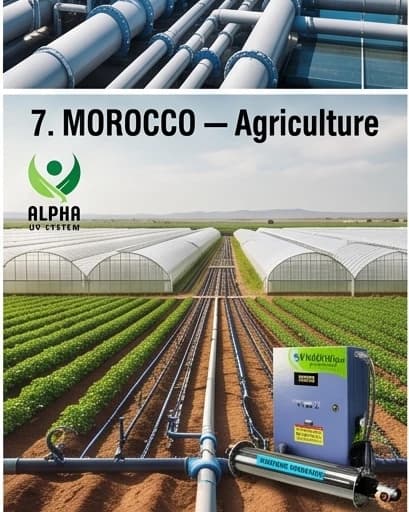
Quick Answer: UV water treatment Morocco agriculture is critical for one of North Africa's most important export horticulture economies — Morocco is the world's second-largest tomato exporter (behind Spain), Europe's largest supplier of out-of-season tomatoes (November–May), and a major global exporter of citrus (clementines, oranges — 800,000+ tonnes/year), strawberries (EU market leader), and soft fruits (blueberries, raspberries). The Souss-Massa region (Agadir province — 1,200 km south of Casablanca along Atlantic coast) produces 85% of Morocco's EU-export vegetables and 60% of citrus exports, using intensive drip irrigation from Souss River (now critically stressed — average flow 40% below historical baseline due to climate change) and deep aquifer wells (Souss aquifer — 350 m depth, declining 1–2 m/year from overextraction). Water quality for Souss-Massa export horticulture: drip irrigation water E. coli 0 CFU/100 mL (EU Regulation 2073/2005 microbiological criteria for raw consumed produce; Tesco/Carrefour/Albert Heijn zero-tolerance for E. coli on fresh produce); zero Cl mandatory (chlorine causes tip burn on strawberry petals, accelerates tomato fruit cracking, and degrades blueberry bloom wax coating — all reducing export grade and price). GlobalG.A.P. IFA v6.0 (primary EU supermarket supplier certification) requires water source risk assessment and documented treatment. NSF/ANSI 55 Class A at 40 mJ/cm². Alpha UV ships to Agadir Al Massira Airport (AGA) within 48–72 hours.
Morocco Agriculture — UV Water Treatment Context
Morocco's export horticulture geography:
- Souss-Massa (Agadir province) — Morocco's primary export agriculture zone: Tomato production (1.5 million tonnes/year; 700,000+ tonnes exported to EU, primarily Spain, France, Netherlands, Germany, UK); citrus (Nour clementines, Maroc Late oranges — 800,000+ tonnes/year); strawberries (90,000+ tonnes, EU market April–June; GlobalG.A.P. mandatory for supermarket buyers); new soft fruits (blueberries, raspberries — high-value emerging category); Souss River and deep borehole (Souss aquifer declining); drip irrigation dominant
- Meknes-Fès corridor (Middle Atlas foothills) — table grapes and stone fruit: Table grapes (Morocco is EU's third-largest table grape supplier after Spain and Italy); peaches, nectarines, apricots; Atlas Mountain springs and Oum Er-Rbia tributaries; export to EU via Strait of Gibraltar ferry (Tangier Med Port — 48-hour transport to EU market); GlobalG.A.P. mandatory
- Gharb Region (Atlantic northwest — Rabat to Kenitra) — citrus and market vegetables: Gharb irrigated perimeter (260,000 ha — Morocco's largest irrigation scheme); Sebou River supply; some Sebou River contamination concerns (urban effluent — Fès discharges to Sebou); UV for drip irrigation from Sebou-sourced canal (UVT 65–75%, lower than Souss borehole)
Souss-Massa Drip Irrigation UV Applications
| Crop / Application | Water Source | UVT | Key Pathogen / Issue | Alpha UV System |
|---|---|---|---|---|
| Tomato drip irrigation (greenhouse and open field — Agadir, Biougra, Ouled Teima) | Souss borehole (340–380 m deep) or Souss River pump station | 78–88% (borehole); 72–80% (Souss River) | Salmonella; E. coli; Listeria (EU 2073/2005 — raw tomato contamination from irrigation water is a primary Salmonella pathway; RASFF alerts on Morocco tomatoes historically Salmonella-linked); Pythium (root rot in drip-irrigated tomato — UV reduces Pythium in drip water) | AU-M 25, zero Cl, 40 mJ/cm²; Salmonella 4-log inactivation; GlobalG.A.P. and Tesco/Carrefour buyer audit documentation; MODBUS for large estate monitoring |
| Strawberry drip irrigation (Agadir region — EU market December–May) | Souss borehole (preferred — lower coliform count than surface water) | 80–90% | E. coli; Norovirus (strawberry bare-hand harvested — irrigation water E. coli is proxy for norovirus contamination risk; EU recalled Morocco strawberry lots for norovirus — 2023 RASFF alert); Botrytis (not UV target but zero Cl prevents chlorine damage to strawberry flower/fruit) | AU-M 25, zero Cl, 40 mJ/cm²; Norovirus risk reduction (UV 40 mJ/cm² achieves 2-log Norovirus inactivation — significant for strawberry safety dossier); EU buyer zero-tolerance documentation |
| Citrus drip irrigation (Nour clementines, Maroc Late — Souss-Massa and Moulouya Valley) | Borehole + Souss River mixed | 76–86% | Phytophthora citrophthora (citrus root rot — major Souss-Massa citrus risk; drip irrigation from contaminated water distributes Phytophthora throughout orchard); E. coli on surface (post-harvest wash contamination concern) | AU-M 25, zero Cl, 40 mJ/cm²; Phytophthora zoospore inactivation at 40 mJ/cm²; GlobalG.A.P. citrus documentation |
| Post-harvest washing (tomato packing station — Souss export packhouses) | Borehole or ONEE supply at packhouse | 76–86% | Salmonella; E. coli; Listeria (post-harvest wash water cross-contamination — one contaminated lot contaminates entire wash tank water; E. coli 0 CFU/100 mL in wash water mandatory for EU export packing station HACCP) | AU-M 25/30 at post-harvest wash water supply; zero Cl (chlorine causes tomato skin bleaching and soft fruit microcracking at packhouse wash stage — reduces export grade); ONSSA packhouse HACCP documentation |
EU Export Compliance — Morocco Fresh Produce
- EU Regulation (EC) 2073/2005 (microbiological criteria): Fresh vegetables and fruits destined for EU raw consumption — Salmonella absent in 25g at point of entry; E. coli <100 CFU/g; Listeria <100 CFU/g at retail. Irrigation water E. coli 0 CFU/100 mL is the primary HACCP CCP for meeting these criteria at EU entry
- GlobalG.A.P. IFA v6.0 (primary EU supermarket certification): Tesco, Carrefour, Albert Heijn, Edeka, REWE require GlobalG.A.P. IFA for all fresh produce suppliers — FV AF 1.2 (irrigation water quality) requires documented risk assessment and treatment; UV at 40 mJ/cm² NSF/ANSI 55 Class A satisfies GlobalG.A.P. evidence requirement
- EU-Morocco Association Agreement (Agadir Agreement): Preferential tariff access for Morocco fresh produce to EU — requires compliance with EU phytosanitary and food safety standards; Morocco's ONSSA export certification checks GlobalG.A.P. and water quality compliance
- RASFF (Rapid Alert System for Food and Feed) risk: Morocco was subject to EU RASFF alerts for Salmonella in tomatoes and Norovirus in strawberries — UV at irrigation stage reduces this risk; ONSSA and APEFEL (Association des Producteurs Exportateurs de Fruits et Légumes) promote UV adoption as RASFF risk mitigation
FAQ
What UV dose is required for Norovirus inactivation in Morocco strawberry irrigation?
Norovirus (human pathogenic calicivirus — primary cause of foodborne viral gastroenteritis in EU; Morocco strawberries linked to Norovirus clusters in EU in 2022–2023 via fresh strawberry consumption) UV inactivation: Norovirus GI and GII (the pathogenic human strains) are moderately UV-resistant: 2-log inactivation (99%) at 40 mJ/cm²; 4-log inactivation (99.99%) at 80–100 mJ/cm². Alpha UV's standard 40 mJ/cm² achieves 2-log Norovirus reduction in irrigation water — the standard interpretation for irrigation water risk management (not 4-log reduction because Norovirus in irrigation water is already at relatively low concentrations; 2-log reduction at 40 mJ/cm² is the EU-adopted approach for primary production risk reduction). For Morocco strawberry packhouse wash water (higher risk than field irrigation — concentrated water, higher bather density equivalent): 60 mJ/cm² is recommended as more conservative specification; Alpha UV AU-M 25 operated at 60% rated flow achieves 60 mJ/cm² when designed at 40 mJ/cm² at 100% flow.
How does Souss aquifer depletion affect UV system design for Agadir farms?
The Souss aquifer (primary irrigation water source for 250,000+ ha of irrigated agriculture in Agadir province) is declining at 1–3 m/year due to overextraction — the water table has dropped from 15 m depth in 1970 to 60–90 m depth in 2025 in heavily pumped areas. As water table declines: (1) Borehole water quality changes — deeper aquifer water in Souss has higher TDS (from deeper geological strata) and sometimes higher fluoride (800+ µg/L — above WHO 1.5 mg/L limit in some deep Souss wells); TDS 600–1,200 ppm in deep boreholes vs. 150–350 ppm in shallow 1970-era boreholes; (2) Solar-powered pumping expands — declining Souss water table requires higher-lift pumps (60–90 m head vs. 15–20 m historically); solar pump systems (ORMVA-SOUSS promotes solar irrigation pump rebates under Morocco's Green Generation Plan 2020–2030) integrate well with solar-powered UV systems; (3) Treated wastewater reuse — ORMVA-SOUSS (Agricultural Development Office Souss-Massa) promotes treated wastewater reuse for irrigation; treated wastewater (STEP — Station d'Epuration, tertiary-treated to EU2 standard) requires UV post-treatment before drip irrigation application; AU-M 30 at treated wastewater irrigation supply. Alpha UV UV systems designed for Souss agricultural clients specify: flow capacity adequate for peak summer irrigation demand (July–August, 16+ hours/day pump operation); UVT design at 74% (borehole — lower than historic 80–85% as aquifer deepens); UV-compatible pre-filtration removing iron if borehole Fe >0.3 mg/L.
Standards, authorities & further reading
External references used to inform this guide. Regulations evolve — check the latest revision on each authority's site before compliance decisions.
Recommended UV Systems
Alpha UV System products for this application — powered by genuine Philips UV-C lamps.
Commercial UV Water Purification System
500 – 5,000 LPH
HACCP-compliant UV water purification for hotels, restaurants, and offices
Industrial UV Water Treatment System
5,000 – 50,000 LPH
Schedule M 2025 and HACCP compliant UV for pharma, food & beverage, and process water
Not sure which system suits your application? WhatsApp our engineers for a free recommendation →
Related solutions
See how Alpha UV System applies this to your industry or city.
Need a UV system?
Talk to our UV engineers — WhatsApp for a quote in 2 hours, or browse the full catalog on IndiaMART.