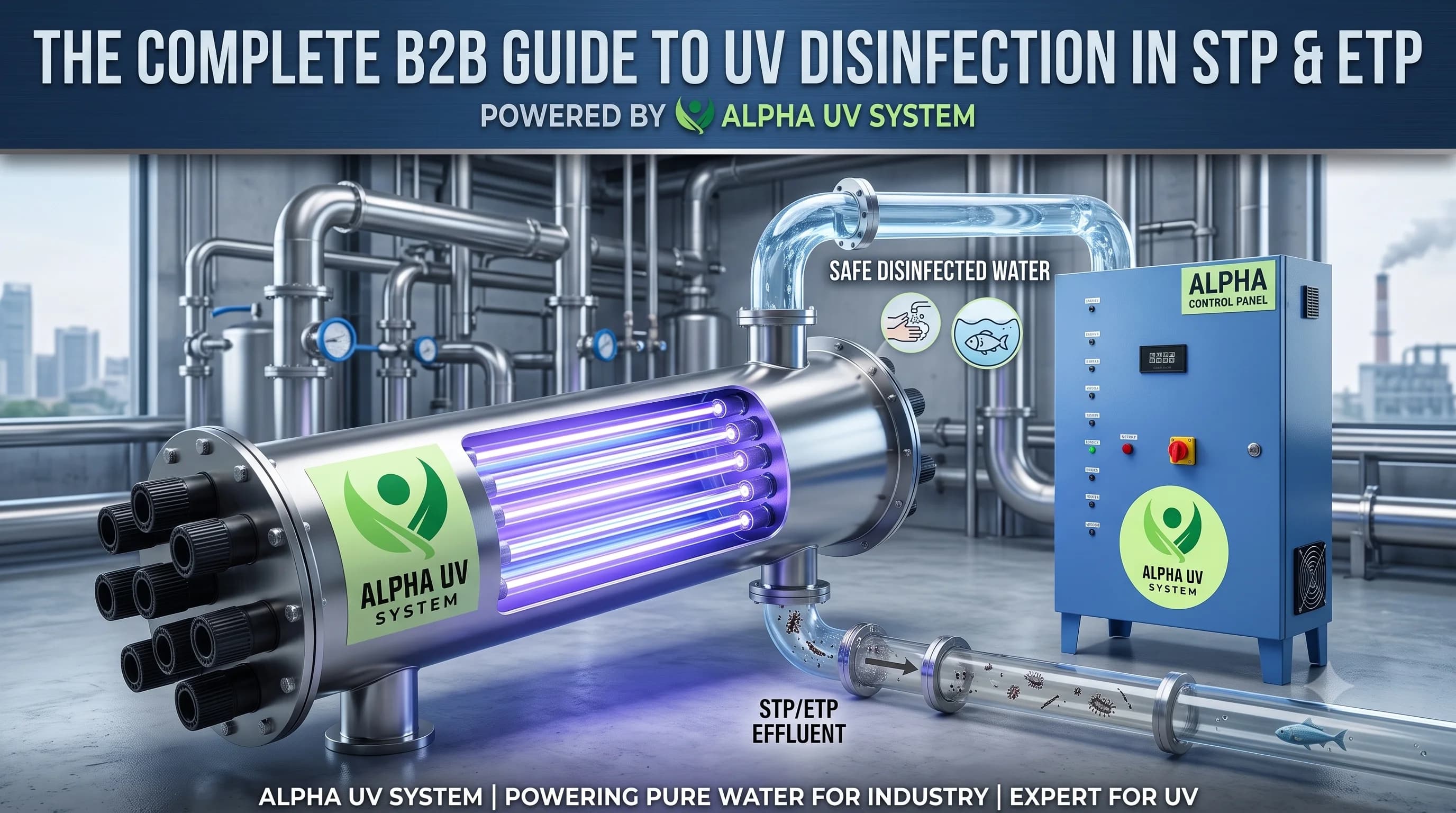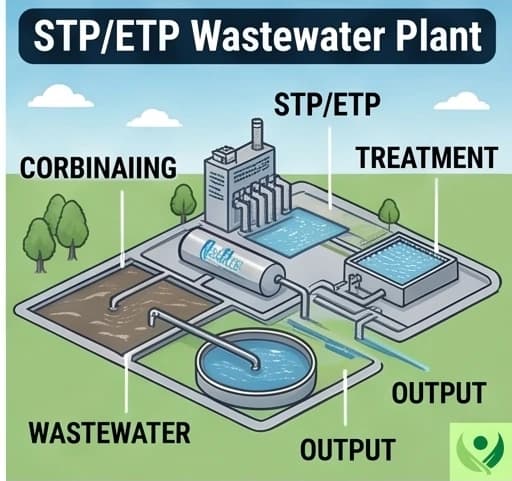
The key difference between ETP and STP is the wastewater source and pollutant type. STP (Sewage Treatment Plant) treats domestic sewage — human waste, greywater, and kitchen wastewater from residential buildings, townships, and institutions — using biological treatment to reduce BOD and coliform bacteria. ETP (Effluent Treatment Plant) treats industrial wastewater — from manufacturing, chemical processing, textile dyeing, pharmaceuticals, and food production — which contains heavy metals, solvents, dyes, and toxic compounds that require specialised physico-chemical treatment before biological stages. Both types require UV disinfection as a final step to meet CPCB discharge standards.
Every water engineer, facility manager, and environmental compliance officer working in India eventually encounters both terms — STP and ETP. Regulatory applications, PCB consent conditions, RERA filings for residential townships, and factory licences all reference one or both of these systems. Yet the two are frequently confused, sometimes used interchangeably (incorrectly), and occasionally combined in ways that create compliance problems.
Understanding the ETP vs STP difference precisely — in terms of wastewater source, pollutant types, treatment processes required, regulatory standards, and UV disinfection application — is essential for anyone designing, operating, or auditing a wastewater treatment facility in India.
What Is a Sewage Treatment Plant (STP)?
A Sewage Treatment Plant treats domestic sewage — the combined wastewater generated by human habitation. The wastewater sources that an STP handles are:
Blackwater: Toilet waste containing human faeces, urine, toilet paper, and flush water. This stream carries the highest pathogen load — E. coli, Salmonella, Rotavirus, Cryptosporidium, Hepatitis A virus — and the highest biochemical oxygen demand (BOD) from organic material.
Greywater: Wastewater from sinks, showers, and laundry — containing soap, detergents, food particles, and personal care products. Lower pathogen load than blackwater but high in surfactants, phosphate, and suspended solids.
Kitchen wastewater: From restaurants, food courts, and residential kitchens. High in fats, oils, grease (FOG), food solids, and BOD.
The pollutants in domestic sewage are primarily biological in nature — organic matter (measured as BOD and COD), suspended solids, and pathogenic microorganisms. There are no significant heavy metals, no synthetic dyes, no industrial solvents. This is why STPs are primarily biological treatment systems: the aerobic bacteria in an activated sludge or sequential batch reactor (SBR) tank are highly effective at breaking down biological organic matter.
What Is an Effluent Treatment Plant (ETP)?
An Effluent Treatment Plant treats industrial process wastewater — the wastewater generated specifically by manufacturing and processing operations, not by domestic human activity. The exact nature of the wastewater depends entirely on the industry:
Textile industry: Dye effluent containing reactive and azo dyes, surfactants, salts (NaCl), and alkalis from dyeing and printing. Highly coloured, high TDS, and high COD from synthetic dyes that biological treatment cannot break down.
Pharmaceutical industry: API (active pharmaceutical ingredient) synthesis wastewater containing solvents (methanol, acetone, toluene), unreacted intermediates, and sometimes biologically active compounds. Toxic to biological treatment bacteria at certain concentrations.
Food and beverage processing: High-BOD wastewater from starch, sugar, and protein processing — less toxic than pharma or chemical effluent, but at volumes and concentrations that overwhelm standard biological treatment without pre-treatment.
Metal finishing and electroplating: Wastewater containing chromium (Cr⁶⁺), cyanide (CN⁻), zinc, nickel, copper, and acids. Highly toxic — biological treatment is killed by these metals, so physico-chemical treatment (precipitation, reduction of Cr⁶⁺ to Cr³⁺) must precede any biological step.
Chemical manufacturing: Variable composition depending on the product — may contain chlorinated organics, acids, alkalis, heavy metals, or speciality chemicals. Often requires multiple parallel treatment streams.
ETP vs STP: Key Differences at a Glance
| Parameter | STP (Sewage Treatment Plant) | ETP (Effluent Treatment Plant) |
|---|---|---|
| Wastewater source | Domestic sewage — residential buildings, institutions, townships | Industrial process water — manufacturing, chemical processing, food production |
| Primary pollutants | BOD, TSS, total coliforms, faecal coliforms, nutrients (N, P) | Heavy metals, synthetic dyes, solvents, high COD, TDS, pH extremes, specific toxics |
| Primary treatment technology | Biological (ASP, SBR, MBR, MBBR) | Physico-chemical first (coagulation, precipitation, pH adjustment), then biological |
| Final disinfection | UV disinfection (standard) or sodium hypochlorite | UV disinfection (if reuse intended) or discharge without disinfection (if chemical-only) |
| CPCB regulatory category | Residential/institutional — Green or Orange category | Industrial — Orange, Red, or Critically Polluted Area category |
| Governing standard | Schedule VI, EP Rules 1986 (STP effluent standards) | Schedule VI, EP Rules 1986 (industry-specific effluent standards) |
| Typical installed capacity in India | 50 KLD to 10 MLD (residential to municipal) | 0.1 KLD to 1,000 KLD (micro-industrial to large process plants) |
| Typical operators | RWA, housing society, hotel, hospital, institutional campus | Factory, chemical plant, food processor, textile mill, pharma manufacturer |
STP Treatment Process — Step by Step
A standard STP for a residential township or commercial complex follows this treatment sequence:
1. Screening and grit removal: Bar screens (coarse then fine) remove rags, plastics, and solids from incoming sewage. Grit chambers settle sand and inorganic particles. This protects downstream equipment from blockage and abrasion.
2. Primary clarification: Sewage flows slowly through a primary clarifier (settling tank), allowing heavier suspended solids to settle to the bottom as primary sludge. Fats and oils float to the surface and are skimmed off. This step removes 30–40% of BOD and 50–60% of TSS before biological treatment.
3. Biological treatment (secondary): The settled sewage enters an aerobic biological reactor — Activated Sludge Process (ASP), Sequential Batch Reactor (SBR), Moving Bed Biofilm Reactor (MBBR), or Membrane Bioreactor (MBR). Aerobic bacteria consume the dissolved organic matter (BOD), reducing it from 150–300 mg/L to <30 mg/L. This is the core treatment stage for domestic sewage.
4. Secondary clarification: The biological mixed liquor flows to a secondary clarifier, where biological flocs settle. The settled sludge is partly recycled to the bioreactor (return activated sludge) and partly wasted (waste activated sludge for dewatering). The clarified effluent has BOD <30 mg/L and TSS <100 mg/L but still contains coliform bacteria at 10⁴–10⁶ MPN/100mL.
5. UV disinfection (tertiary): The clarified secondary effluent passes through a UV disinfection system. At 40 mJ/cm² UV dose and the STP effluent UVT of 50–65%, total coliform is reduced to <100 MPN/100mL (CPCB land discharge standard) or <10 MPN/100mL (surface water standard). UV disinfection is the final barrier — nothing after this point reduces coliform counts. The treated effluent then flows to the discharge point or reuse applications.
ETP Treatment Process — Step by Step
ETP treatment sequences vary significantly by industry, but a general ETP for mixed industrial effluent (such as in a CETP serving an industrial estate) follows this pattern:
1. Equalisation: All incoming industrial effluent streams are collected in an equalisation tank (8–24 hours HRT) to smooth out flow rate fluctuations and concentration spikes. Equalisation is more critical in ETPs than STPs because industrial production schedules create large batch discharges.
2. Physico-chemical pre-treatment: Depending on the effluent type: pH adjustment (lime/H₂SO₄) to the range tolerable by downstream biological treatment (6.5–8.5); chromium reduction (Cr⁶⁺ → Cr³⁺ using sodium metabisulphite at pH 2–3 before precipitation); cyanide oxidation (NaOCl at alkaline pH); heavy metal precipitation (lime addition to pH 10–11 precipitates Zn, Ni, Cu, Pb as hydroxides).
3. Coagulation, flocculation, and clarification: Coagulants (alum, FeCl₃, or polyaluminium chloride) + polymer flocculants aggregate the precipitated metals and suspended solids into settleable flocs. A DAF (Dissolved Air Flotation) unit or conventional clarifier separates the floc from the treated liquid.
4. Biological treatment: Only after the physico-chemical steps remove toxic heavy metals and pH is neutralised can biological treatment be applied. The ETP bioreactor is designed for industrial COD — typically at concentrations of 500–5,000 mg/L vs 150–300 mg/L in STPs — requiring higher MLSS, longer HRT, and more robust aeration.
5. Tertiary polishing: Depending on discharge requirements: multimedia filtration, activated carbon adsorption (for residual organics and colour), RO (for ZLD systems), and UV disinfection (if treated effluent is to be reused as process water or discharged to a water body where coliform limits apply).
CPCB Discharge Standards: STP vs ETP
| Parameter | STP Discharge (Land/Irrigation) | ETP Discharge (General Industry) | UV Treatment Addresses? |
|---|---|---|---|
| Total Coliform (MPN/100mL) | <100 (land), <10 (surface water) | Not specified (industry-specific) | Yes — primary UV function in STP |
| BOD (mg/L) | <30 | <30 | No — biological treatment |
| COD (mg/L) | <250 | <250 (general) — stricter for some sectors | No (UV-AOP can assist pre-treatment) |
| TSS (mg/L) | <100 | <100 | No — sedimentation/filtration |
| pH | 5.5–9.0 | 5.5–9.0 | No — pH adjustment |
| Total Chromium | Not specified | <2.0 mg/L | No — chemical reduction and precipitation |
| TDS (mg/L) | <2,100 | <2,100 | No — RO for ZLD systems |
CETP — Common Effluent Treatment Plant
A third category that often causes confusion is the CETP — Common Effluent Treatment Plant. A CETP is a shared ETP serving multiple small-scale industrial units that individually cannot afford a full ETP. Common in industrial estates, GIDC (Gujarat Industrial Development Corporation) plots, SIDCO (Small Industries Development Corporation) estates, and MIDC (Maharashtra Industrial Development Corporation) zones.
Individual units pre-treat their effluent to reduce toxic loads (primary treatment only), then pipe the partly treated effluent to the CETP for full treatment. The CETP operator holds a consolidated Consent to Operate from the State PCB and is responsible for ensuring the combined treated effluent meets discharge standards.
CETP design must handle the combined variability of dozens or hundreds of different industrial processes — making equalisation and physico-chemical pre-treatment more important than in a single-source ETP. UV disinfection at the CETP outlet is required if the treated effluent is discharged to a water body or used for any reuse purpose.
Where UV Disinfection Fits in STP vs ETP
| System Type | UV Application | UV Dose Required | Typical UVT | Primary Purpose |
|---|---|---|---|---|
| STP — domestic sewage | Final disinfection after secondary clarification | 40 mJ/cm² (land discharge) 80 mJ/cm² (surface water) | 50–65% | Meet CPCB coliform standard |
| ETP — food processing | Tertiary disinfection before water reuse or discharge to river | 40–80 mJ/cm² | 65–80% | Eliminate pathogens before water body discharge |
| ETP — pharma / chemical | UV-AOP (UV + H₂O₂) as pre-treatment to break down persistent organics | 500–2,000 mJ/cm² | 30–60% | Reduce COD to biodegradable levels for downstream biological treatment |
| CETP | Final disinfection at outlet | 40–80 mJ/cm² | 55–70% | Meet PCB combined discharge standards |
| STP/ETP with ZLD | Disinfection of RO permeate for process water reuse | 40 mJ/cm² | 90–98% | Ensure microbiological quality of recycled water |
When Do You Need Both STP and ETP?
Industries with both manufacturing operations and an on-site workforce (canteen, toilets, housing colony) generate both industrial effluent and domestic sewage. In these cases, a common question is whether the domestic sewage can be mixed with the industrial effluent and treated together in one ETP.
The answer is generally no — and CPCB guidance and State PCB consent conditions typically require separate treatment. Reasons:
Different biological treatment requirements: Industrial effluent biological treatment is designed for high COD (500–5,000 mg/L) with specific sludge loadings and HRT. Adding domestic sewage (BOD 150–300 mg/L) dilutes the process and creates instability. Conversely, industrial toxic loads can kill the biological process in an STP that was not designed for them.
Different discharge standards: STP discharge standards explicitly require coliform limits. ETP discharge standards focus on COD, heavy metals, and specific pollutants. Combining the streams produces a discharge that may fail both sets of standards simultaneously.
Regulatory consent conditions: State PCB consent conditions for Red category industrial facilities typically require separate STP and ETP with separate monitoring points, flow meters, and sampling ports. Combined discharge may be interpreted as a violation of consent conditions.
Large integrated manufacturing facilities — automotive OEMs, pharmaceutical plants, food processing factories — maintain separate STP (for canteen, administrative building, and housing) and ETP (for production floor effluent) with separate PCB-monitored discharge points.
Choosing Between STP, ETP, or Both for Your Facility
| Facility Type | Wastewater Generated | System Required | UV Application |
|---|---|---|---|
| Residential apartment complex / township | Domestic sewage only | STP | Final disinfection at 40 mJ/cm² |
| Hospital / medical college | Domestic sewage + medical wastewater (infectious waste) | Combined STP with enhanced disinfection | 80–120 mJ/cm² UV for medical wastewater; MoEFCC 2016 standards apply |
| Food processing factory (no on-site housing) | Industrial effluent only | ETP | Final disinfection if reuse or river discharge |
| Pharmaceutical manufacturing plant | Industrial effluent + domestic from canteen/offices | ETP + STP (separate) | UV-AOP in ETP pre-treatment; standard UV at STP outlet |
| Hotel / resort | Domestic sewage + kitchen grease + laundry | STP with FOG pre-treatment | Final disinfection at 40 mJ/cm²; treated water for garden irrigation |
| Textile dyeing unit | Dye effluent — high COD, colour, TDS | ETP (physico-chemical + biological) | UV-AOP for colour removal; final UV at outlet |
Can an ETP and STP be combined into a single plant?
Not typically — State PCB consent conditions for most industries require separate treatment and separate monitoring of industrial effluent and domestic sewage. However, small facilities (canteen-only domestic waste + a lightly polluted industrial stream) sometimes obtain PCB approval for combined treatment if the industrial stream has BOD and pollutant characteristics similar to domestic sewage and does not contain heavy metals or regulated toxics. This must be confirmed with the State PCB before plant design. Combining streams without consent approval is a compliance violation.
Is UV disinfection mandatory for all STPs in India?
UV disinfection is not universally mandated by a single national regulation, but CPCB's STP effluent discharge standards (total coliform <100 MPN/100mL for land discharge, <10 MPN/100mL for surface water) effectively require a disinfection step after secondary biological treatment. Sodium hypochlorite dosing is an alternative, but most State PCBs and urban development authorities now require UV disinfection specifically when treated STP effluent is used for toilet flushing, garden irrigation, or any application where human contact is possible. RERA guidelines for residential townships with integrated STPs increasingly specify UV disinfection in project documentation reviewed by State PCBs.
Do ETP discharge standards specify coliform limits?
General industrial ETP discharge standards under Schedule VI of the Environment Protection Rules do not specify coliform limits — industrial effluent is assessed on COD, BOD, TSS, pH, and specific pollutants (heavy metals, specific toxics). However, coliform limits apply if the treated ETP effluent is discharged to a water body used for drinking water abstraction (where additional standards under the Bureau of Indian Standards apply), or if the ETP is combined with domestic sewage for ZLD reuse. State PCB consent conditions for specific industries (food processing, meat processing, dairy) may include coliform standards — check your facility's specific consent conditions.
How is a UV system sized differently for STP vs ETP?
The key difference in UV sizing between STP and ETP is UVT. STP secondary effluent has UVT of 50–65% at 254 nm — relatively low because of residual dissolved organics and biological matter. ETP treated effluent UVT ranges from 30% (textile dye effluent, even after treatment) to 85% (food processing after biological treatment and filtration). The UV reactor for STP is sized for 50–65% UVT; the UV reactor for ETP must be sized for the specific UVT of that facility's treated effluent, measured from actual samples. For ETP applications, Alpha UV System requests a 500 mL sample of treated effluent for UVT measurement before specifying the UV system — a step that eliminates the undersizing errors that are common when generic STP sizing tables are misapplied to ETP applications.
What are the NGT requirements for STPs in residential complexes?
The National Green Tribunal (NGT) has issued multiple orders since 2020 requiring mandatory STPs in all residential complexes above 20,000 sq.m. built-up area or 50 dwelling units (thresholds vary by State PCB). NGT Order in O.A. No. 593/2017 and subsequent orders require that STP treated water meet CPCB standards before reuse or discharge, and that STP performance be monitored and reported to State PCBs. Several NGT orders specifically prohibit chlorination as the sole disinfection method due to disinfection byproduct concerns, effectively mandating UV disinfection for residential STPs where treated water is reused for toilet flushing or garden irrigation within the premises.
Alpha UV System engineers size and supply UV disinfection systems for STPs, ETPs, and CETPs across India. Whether you need final disinfection for CPCB coliform compliance or UV-AOP pre-treatment for industrial COD reduction, we provide the correctly sized system with Philips UV-C lamps and full commissioning documentation.
WhatsApp Us for STP/ETP UV System SizingStandards, authorities & further reading
External references used to inform this guide. Regulations evolve — check the latest revision on each authority's site before compliance decisions.
- Central Pollution Control Board (CPCB), Government of India
- Central Ground Water Board (CGWB)
- BIS IS 10500:2012 — Drinking Water Quality Specification
- WHO — Guidelines for Drinking-water Quality (4th ed.)
- CPCB — Environment (Protection) Rules: STP Standards
- NSF/ANSI 55 — Ultraviolet Microbiological Water Treatment Systems
Recommended UV Systems
Alpha UV System products for this application — powered by genuine Philips UV-C lamps.
UV Disinfection System for STP
10,000 – 2,00,000 LPH
CPCB-compliant UV tertiary disinfection for sewage treatment plants — closed-vessel and open-channel
UV Disinfection System for ETP
10,000 – 2,00,000 LPH
Industrial UV-C for ETP final effluent — CPCB and State PCB compliant before ZLD or discharge
Not sure which system suits your application? WhatsApp our engineers for a free recommendation →
Related solutions
See how Alpha UV System applies this to your industry or city.
Need a UV system?
Talk to our UV engineers — WhatsApp for a quote in 2 hours, or browse the full catalog on IndiaMART.