Quick Answer
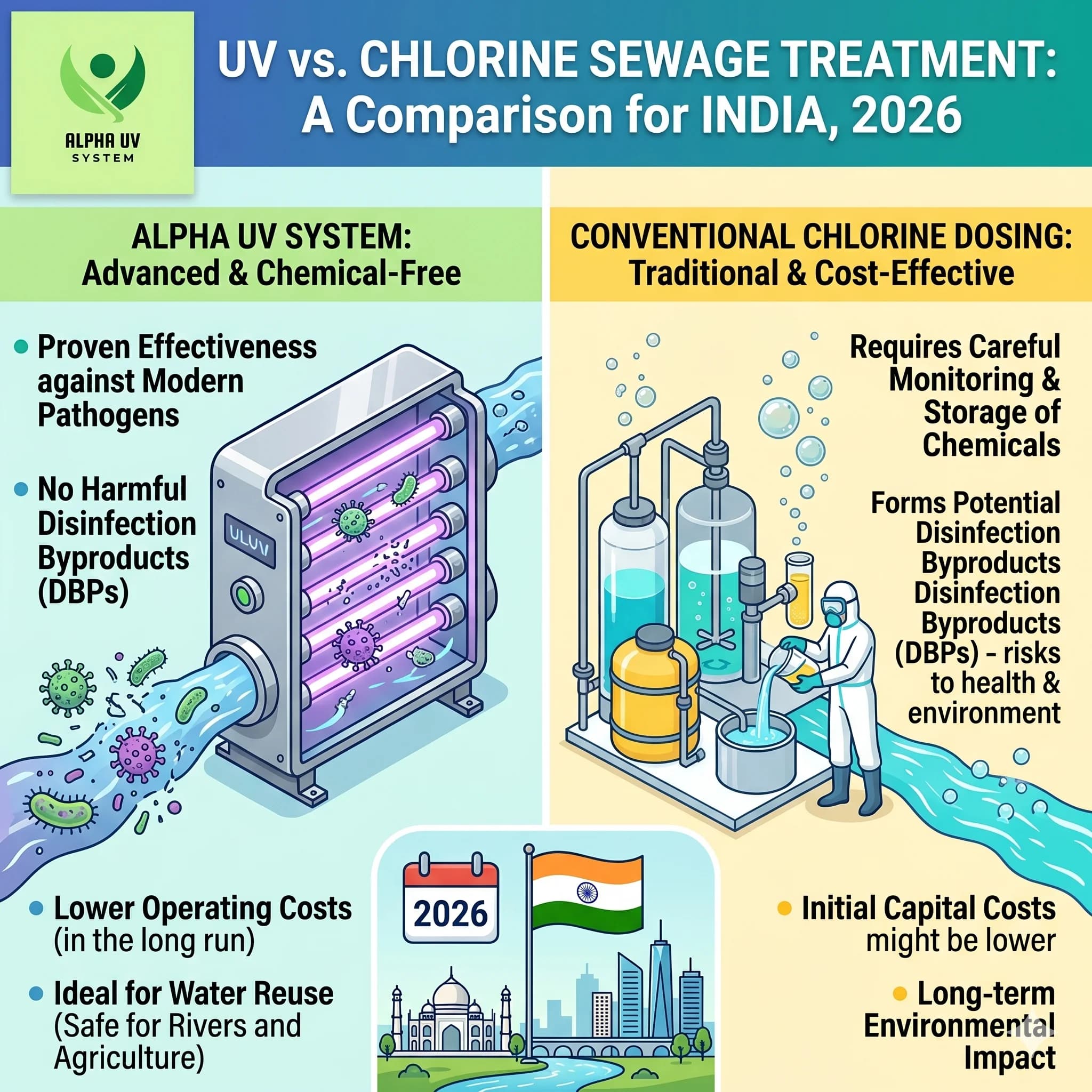
For STP disinfection India 2026, UV disinfection outperforms chlorination across compliance reliability, byproduct safety, chemical storage risk, and treated water reuse quality. UV disinfection STP India is the preferred choice for residential townships, commercial complexes, and institutional facilities subject to CPCB and NGT discharge norms. Chlorination remains appropriate only for large municipal networks requiring residual antimicrobial protection across ageing distribution pipework.
The Decision Every STP Operator in India Faces in 2026
For STP operators across Delhi NCR, Maharashtra, Haryana, and Uttar Pradesh, the question of UV vs chlorine sewage treatment India has moved from a technical preference to a compliance imperative. CPCB enforcement timelines for urban STPs have tightened. NGT orders requiring zero-liquid discharge and stringent treated water reuse standards are reshaping what "good enough" disinfection means. UP townships seeking UPPCB clearance and Haryana commercial complexes navigating HSPCB norms face a regulatory environment where chlorination's historic adequacy is increasingly under scrutiny.
In 2026, two forces are converging to push STP disinfection India toward UV. First, CPCB's revised general standards for discharge of environmental pollutants now explicitly flag disinfection byproducts in treated effluent as a monitoring parameter for STPs above 1 MLD capacity — a parameter chlorination inherently fails on. Second, NGT's ongoing oversight of residential and commercial STP compliance has highlighted chemical storage risk as a factor in consent-to-operate renewals, particularly in densely occupied buildings. For facility managers and STP operators evaluating UV vs chlorine sewage treatment India for new installations or retrofit decisions in 2026, this comparison provides the engineering data to make an informed choice.
How UV and Chlorine Actually Disinfect — Mechanism Matters
How UV Disinfection Works in STP Effluent
UV disinfection STP India works by exposing effluent to germicidal ultraviolet-C radiation at 254 nm wavelength, which penetrates microbial cell walls and disrupts DNA and RNA structure, preventing replication. A UV disinfection system — typically a bank of Philips TUV lamps housed in a stainless-steel reactor or open-channel configuration — delivers a measured dose in millijoules per square centimetre (mJ/cm²) based on UV intensity and hydraulic retention time. At 40 mJ/cm², UV disinfection achieves greater than 4-log (99.99%) reduction of E. coli, total coliform, Salmonella typhi, and enteric viruses including hepatitis A. At 80–100 mJ/cm², UV achieves equivalent or superior reduction of Cryptosporidium parvum and Giardia lamblia — protozoan cysts that chlorination cannot neutralise at any practical STP dose. Critically, UV dose is a deterministic function of lamp configuration and flow rate. If the Philips UV-C lamp is operational and UVT is within design range, the dose is delivered. There is no operator judgment, no reagent degradation, and no chemistry-dependent variability.
How Chlorination Works in STP Effluent
Chlorination STP ETP comparison begins with the mechanism: dissolved chlorine (as sodium hypochlorite or calcium hypochlorite) reacts with water to form hypochlorous acid (HOCl) and hypochlorite ion (OCl⁻), which oxidise microbial cell membranes and enzyme systems. At typical STP chlorination doses of 5–10 mg/L as Cl₂ with 30-minute contact time, chlorination achieves 3–4-log coliform reduction — broadly comparable to UV for bacteria under ideal conditions. However, chlorination effectiveness is highly sensitive to effluent pH (optimal at 6.5–7.5, which is not consistently achievable in STP secondary effluent without pH correction), ammonia content (ammonia reacts preferentially with chlorine to form chloramines, which are 50–100 times weaker as disinfectants than free chlorine), temperature, and organic load. Sodium hypochlorite solution degrades at approximately 0.5–1% per day in storage, meaning the concentration available at dosing is a moving target without daily titration. For UV vs chlorine sewage treatment India, this variability is the central operational challenge of chlorination at facility-level STPs.
Disinfection Performance Comparison
| Parameter | UV Disinfection | Chlorination |
|---|---|---|
| E. coli / Total Coliform | >4-log reduction at 40 mJ/cm² | 3–4-log reduction at 5–10 mg/L Cl₂ |
| Salmonella typhi | >4-log at 40 mJ/cm² | 3–4-log; pH-sensitive |
| Enteric Viruses (Hepatitis A, Rotavirus) | >4-log at 80 mJ/cm² | 3–4-log; requires higher Cl₂ dose |
| Cryptosporidium parvum | >3-log at 10 mJ/cm² (very sensitive) | Effectively resistant — <0.5-log at any practical STP dose |
| Giardia lamblia | >3-log at 10 mJ/cm² | Poor control; requires >150 mg/L·min CT |
| Ammonia Effect on Disinfection | No effect — UV is chemistry-independent | Severe — chloramines formed are 50–100× weaker than free Cl₂ |
| pH Sensitivity | None — effective across pH 5–9 | Significant — effectiveness halves above pH 7.5 |
| Dose Predictability | Deterministic — function of lamp output and flow | Variable — depends on hypochlorite concentration, contact time, effluent composition |
| Chloramine Formation | None | Significant in STP effluent with ammonia-N >3 mg/L |
| Residual Protection After Treatment | None — physical process only | Yes — chlorine residual persists in distribution |
| Operator Skill Dependency | Low — lamp on/off and flow monitoring only | High — daily titration, dose adjustment, contact tank management |
CPCB Compliance Reliability — UV vs Chlorine CPCB Compliance
Both UV and chlorination can, in principle, achieve CPCB's discharge standard of less than 100 MPN/100 ml total coliform for STP effluent. In practice, UV vs chlorine CPCB compliance performance diverges sharply at the operational level. The core issue is variability. A UV disinfection system is a closed-loop physical process: once the system is commissioned and validated, every cubic metre of effluent passing through at or below the rated flow receives the same dose. There is no human error in dose calculation, no degradation in reagent potency between procurement cycles, and no change in disinfection performance if the operator is absent or undertrained.
Chlorination at Indian STPs introduces compound variability. Sodium hypochlorite solution typically arrives at 10–12% active chlorine concentration and degrades at 0.5–1% per day in ambient storage. A batch procured on day 1 and used on day 20 may deliver 80% of the expected chlorine dose unless the operator runs a daily titration and adjusts the dosing pump accordingly. Few facility-level STP operators perform daily titrations. Combine this with STP effluent that contains ammonia-N (common in Indian municipal wastewater, which has high urea content), and the effective disinfection delivered by chlorination routinely falls below the theoretical dose. For UV vs chlorine sewage treatment India, this is the mechanism by which chlorinated STPs show higher day-to-day coliform count variability and more frequent CPCB exceedances than UV-treated STPs of comparable design.
UPPCB inspections of STPs in Greater Noida and Noida industrial estates have documented multiple instances where chlorinated STP effluent exceeded 100 MPN/100 ml at the point of discharge despite a functioning dosing system, attributable to chloramine interference in high-ammonia effluent. UV disinfection STP India installations at comparable plants in the same zones have consistently maintained less than 30 MPN/100 ml at the same discharge points.
Disinfection Byproducts — A Critical Difference for Indian STPs
The chemistry of chlorination in organic-rich STP effluent creates a class of compounds that UV disinfection does not: disinfection byproducts (DBPs). When chlorine reacts with natural organic matter in secondary-treated sewage effluent, it forms trihalomethanes (THMs — chloroform, bromodichloromethane, dibromochloromethane, bromoform) and haloacetic acids (HAAs — chloroacetic acid, dichloroacetic acid, trichloroacetic acid). THMs are classified as probable human carcinogens (Group 2A, IARC). HAAs are classified as possible carcinogens (Group 2B). Both persist in treated effluent and accumulate in soil and groundwater when STP effluent is used for irrigation or groundwater recharge.
For STP disinfection India 2026, this is not an abstract concern. CPCB's environmental standards for STP effluent reuse — particularly irrigation and groundwater recharge — are converging with WHO guidelines on DBP limits in reclaimed water. MPCB in Maharashtra has already issued notices to commercial STPs in Pune and Mumbai suburbs regarding DBP monitoring. For UV disinfection effluent India, no DBPs are formed. UV treatment does not add any chemistry to the effluent — it alters only the microbial load through a physical process. UV-treated effluent is chemically identical to the secondary-treated effluent that enters the UV reactor.
Disinfection Byproducts — UV vs Chlorine
| Byproduct | UV Treatment | Chlorination | Health Concern | Indian Regulatory Status |
|---|---|---|---|---|
| Trihalomethanes (THMs) | Not formed | 20–80 µg/L in STP effluent | Probable carcinogen (IARC 2A) | Under CPCB monitoring for reuse applications; BIS 10500 limit 200 µg/L (drinking water) |
| Haloacetic Acids (HAAs) | Not formed | 15–60 µg/L in secondary-treated STP effluent | Possible carcinogen (IARC 2B); reproductive toxicant | MPCB actively monitoring in Maharashtra reuse applications |
| Chloramines (combined chlorine) | Not formed | Formed in high-ammonia STP effluent; reduces disinfection efficacy | Skin and respiratory irritant; bladder cancer risk at high exposure | Not separately regulated in STP effluent discharge; emerging concern |
| Chlorate / Chlorite | Not formed | Present in sodium hypochlorite solutions; increases with hypochlorite degradation | Haematological toxicity; WHO guideline 0.7 mg/L | No specific CPCB STP limit; relevant for groundwater recharge |
| Residual Free Chlorine | Zero — no chemical addition | 0.5–2 mg/L in treated effluent | Toxic to aquatic life; disrupts soil microbiology in irrigation reuse | CPCB: residual chlorine <1 mg/L in surface water discharge |
Chemical Safety and Regulatory Compliance for Chlorine Storage
The Manufacture, Storage and Import of Hazardous Chemical Rules, 1989 (amended under the Environment Protection Act) classify sodium hypochlorite and chlorine gas as hazardous substances. For STPs storing sodium hypochlorite in quantities above the threshold quantities specified in Schedule 1, this triggers obligations including: disclosure to the local SPCB, maintenance of an on-site emergency plan, appointment of a safety officer, periodic inspection readiness, and in some states, prior approval from the local fire authority before commissioning chemical storage. For chlorine gas cylinders — still used at some large municipal STPs and older industrial ETPs — the compliance burden is substantially higher, including PESO licensing and mandatory distance requirements from occupied spaces.
Chlorine-free STP India is not merely a technical aspiration — it is increasingly a practical necessity for residential township STPs and commercial building STPs. Resident welfare associations in Noida, Gurugram, and Greater Noida have consistently objected to chlorine chemical storage in basement or ground-level STP rooms shared with parking structures. Building management companies in Delhi NCR face insurance and consent-to-operate complications when chlorine is stored in mixed-use buildings. A UV disinfection system stores and handles no chemicals at the plant. The regulatory compliance burden comparison between UV and chlorine is substantial.
Regulatory Compliance Burden — UV vs Chlorine Storage
| Requirement | UV System | Chlorination System |
|---|---|---|
| Hazardous Chemical Rules 1989 disclosure to SPCB | Not required — no hazardous chemicals | Required above Schedule 1 threshold quantities |
| On-site emergency plan | Not required | Mandatory for covered quantities under Rule 10 |
| Fire authority prior approval (state-specific) | Not required | Required in Maharashtra, Delhi, Haryana for bulk storage |
| Operator chemical handling certification | Not required | Required; recurring training and record-keeping |
| Chemical transport and procurement logistics | None | Monthly sodium hypochlorite procurement; transport compliance |
| Spill containment and secondary containment | Not required | Required for sodium hypochlorite storage area |
| Insurance and consent-to-operate implications | No impact on building insurance or CTO | May increase insurance premiums; CTO review in some states |
Capital Cost Comparison — UV vs Chlorination Across Plant Sizes
Capital cost is the most common reason facility managers initially favour chlorination in a UV vs chlorine sewage treatment India evaluation. The comparison is real: UV system capital cost is higher than a dosing pump and contact tank setup at every plant size. The relevant question is whether this premium is justified by operating cost savings, compliance reliability, and avoided regulatory cost over the plant's operating life. For most Indian STPs in 2026, the answer is yes — and the payback period is shorter than most facility managers expect.
Capital Cost Comparison — UV vs Chlorination
| Plant Size | UV System Cost (₹, installed) | Chlorination System Cost (₹, installed) | UV Capital Premium (%) | Typical Operating Cost Payback |
|---|---|---|---|---|
| 250 KLD | ₹2,00,000–3,50,000 | ₹80,000–1,50,000 | 110–130% | 18–24 months |
| 500 KLD | ₹3,50,000–5,50,000 | ₹1,50,000–2,50,000 | 100–120% | 20–28 months |
| 1 MLD | ₹6,00,000–9,00,000 | ₹2,50,000–4,00,000 | 120–140% | 22–30 months |
| 5 MLD | ₹22,00,000–32,00,000 | ₹8,00,000–14,00,000 | 130–150% | 24–36 months |
3-Year Operating Cost Analysis — UV vs Chlorination
Operating cost is where UV disinfection STP India decisively outperforms chlorination over the medium term. For a 500 KLD STP operating 20 hours per day (a typical residential township or commercial complex operating profile), the three-year operating cost comparison below illustrates why the UV capital premium is typically recovered within two to three years. The primary drivers are sodium hypochlorite procurement cost (which has increased 30–40% in India since 2023 on input cost pressures), dosing pump maintenance (peristaltic pump heads require replacement every 12–18 months), and the indirect cost of maintaining chemical compliance and handling training. UV operating cost is dominated by electricity (Philips TUV lamp banks draw 80–150W per lamp depending on configuration) and lamp replacement at the 16,000-hour design life.
3-Year Operating Cost — UV vs Chlorination for 500 KLD STP
| Cost Item | UV per Year (₹) | Chlorination per Year (₹) | 3-Year Total UV (₹) | 3-Year Total Chlorination (₹) |
|---|---|---|---|---|
| Electricity (system operation) | ₹28,000–40,000 | ₹6,000–10,000 (dosing pump only) | ₹84,000–1,20,000 | ₹18,000–30,000 |
| Sodium hypochlorite procurement | Nil | ₹90,000–1,50,000 | Nil | ₹2,70,000–4,50,000 |
| UV lamp replacement (16,000 hr life) | ₹35,000–60,000 (amortised per year) | Nil | ₹1,05,000–1,80,000 | Nil |
| Dosing pump head replacement | Nil | ₹12,000–20,000 (every 12–18 months) | Nil | ₹24,000–40,000 |
| Quartz sleeve cleaning / replacement | ₹8,000–15,000 | Nil | ₹24,000–45,000 | Nil |
| Chemical handling compliance and training | Nil | ₹8,000–15,000 | Nil | ₹24,000–45,000 |
| Total Annual Operating Cost | ₹71,000–1,15,000 | ₹1,16,000–1,95,000 | ₹2,13,000–3,45,000 | ₹3,36,000–5,65,000 |
Over three years, UV vs chlorine sewage treatment India operating cost savings of ₹1,20,000–2,20,000 for a 500 KLD STP are typical. Against a UV capital premium of approximately ₹2,00,000–3,00,000 over chlorination, the payback is 20–28 months under normal operating conditions.
Treated Water Reuse — Why UV Disinfection Effluent India Wins
For Indian STPs with treated water reuse mandates — which increasingly includes all STPs above 500 KLD capacity in new urban development approvals under CPCB and state SPCB norms — the quality of UV disinfection effluent India versus chlorinated effluent is a decisive factor. Flushing water reuse, landscape irrigation, cooling tower makeup water, and construction water all have specific quality parameters where chlorinated effluent underperforms relative to UV-treated effluent.
Residual chlorine in treated effluent used for drip irrigation damages soil microbiology and is toxic to sensitive crops at concentrations above 0.5 mg/L. At typical STP chlorination doses designed to meet discharge coliform standards, residual chlorine in the treated effluent is commonly 1–2 mg/L. UV-treated effluent contains zero residual chlorine. For cooling tower makeup water, chlorinated STP effluent introduces an uncontrolled chlorine load that interferes with the cooling tower's own biocide programme. UV-treated effluent has no such interference. For NGT compliance audits in Delhi NCR, UV-treated effluent reuse documentation demonstrating zero chemical addition is significantly easier to present than chlorinated effluent reuse data requiring residual chlorine monitoring.
Treated Water Reuse Standards — UV vs Chlorinated Effluent
| Reuse Application | Parameter | UV-Treated Effluent | Chlorinated Effluent | CPCB / BIS Standard |
|---|---|---|---|---|
| Landscape Irrigation | Residual Chlorine | 0 mg/L | 0.5–2 mg/L | WHO: <1 mg/L; CPCB: not to harm vegetation |
| Toilet Flushing (building reuse) | Total Coliform | <10 MPN/100 ml (well-designed system) | Variable; 20–200 MPN/100 ml day-to-day | CPCB reuse standard: <200 MPN/100 ml |
| Cooling Tower Makeup | Chlorine interference with tower biocide | None — compatible with all biocide programmes | Interferes with oxidative and non-oxidative biocides; requires correction | BIS cooling water standards require controlled halogen levels |
| Groundwater Recharge | Disinfection Byproducts (THMs/HAAs) | Nil | 20–80 µg/L THMs accumulate in soil and groundwater | Emerging CPCB concern; WHO groundwater recharge guidelines specify DBP monitoring |
| Construction Water | Microbial quality for worker exposure | Meets requirements with consistent coliform <100 MPN/100 ml | Adequate when properly dosed; chlorine odour may be worker concern | CPCB: <100 MPN/100 ml total coliform |
When Chlorination Remains the Right Choice
A fair UV vs chlorine sewage treatment India comparison acknowledges the applications where chlorination remains appropriate. The primary case is large municipal STP distribution networks. When treated sewage effluent travels through kilometres of distribution pipework before reaching end users — as in large municipal recycled water systems — the absence of UV residual means any post-treatment contamination (from pipe deterioration, cross-connections, or wildlife intrusion into open channels) is unaddressed. In these applications, a small chlorine dose maintained as a measurable residual at the point of delivery provides ongoing antimicrobial assurance that UV cannot provide.
For smaller facility-level STPs where the treated water moves from the UV reactor directly into a closed reuse tank or discharge point — the situation at virtually all residential township STPs, commercial building STPs, and institutional STPs in India — the absence of UV residual is irrelevant. The water is not travelling through extended distribution infrastructure. For these applications, which account for the large majority of new STP installations in India, UV disinfection is the superior choice without qualification.
Budget-constrained situations where the capital premium cannot be accommodated in the current financial year are a legitimate reason to defer UV. However, the trajectory of CPCB enforcement and the direction of state SPCB compliance requirements make chlorination-only STP disinfection an increasingly difficult position to sustain at compliance audits, particularly for STPs above 500 KLD.
Hybrid UV Plus Residual Chlorine — The Best of Both
For STPs that require both the consistent CPCB compliance performance of UV and a measurable chlorine residual in the treated water (for instance, for flushing water distribution within a large campus where pipe lengths create recontamination risk), a hybrid UV plus residual chlorine approach is available. In this configuration, UV handles primary disinfection at full dose — achieving the >4-log coliform reduction that CPCB requires. A small downstream chlorine dose (0.2–0.5 mg/L as free chlorine, well below the 1 mg/L CPCB limit for surface water discharge) provides a measurable residual without the full DBP generation of standalone chlorination at 5–10 mg/L. This approach is used in some large commercial complexes in Delhi NCR where the STP treats effluent for reuse in an extensive underground flushing water reticulation system.
The hybrid approach requires careful design to ensure the low chlorine dose does not interfere with UV-treated effluent quality documentation for CPCB or NGT audits. It is not appropriate for groundwater recharge applications where even low chlorine addition is undesirable. For most STPs, UV-only disinfection is sufficient and simpler to document.
Case Studies — UV Disinfection STP India in Practice
Case Study 1 — 500 KLD Residential Township STP, Noida
A residential township STP in Noida, serving approximately 1,200 residential units, operated for three years with a sodium hypochlorite chlorination system and consistently struggled to maintain CPCB coliform standards at the quarterly UPPCB inspection. Effluent coliform counts ranged from 80–400 MPN/100 ml across quarterly tests. The operating STP contractor identified the cause as chloramine formation: the incoming sewage had elevated ammonia-N of 18–25 mg/L after biological treatment, reducing effective free chlorine to less than 15% of the total chlorine dosed. The decision to switch to UV disinfection STP India was driven by the approaching UPPCB consent-to-operate renewal, at which two exceedances in the prior three years had been noted.
Alpha UV System installed a 25,000 LPH UV disinfection system (Philips TUV lamp configuration, stainless-steel reactor) with an upstream coarse filter as a pre-treatment upgrade. Post-commissioning testing at 30, 60, and 90 days showed effluent coliform consistently below 25 MPN/100 ml. At the subsequent UPPCB inspection, the STP achieved a clean compliance record. The engineering team provided a 24–48 hour response to a lamp indicator query in the first three months. Total project cost including retrofit civil work was ₹4,80,000. The township ceased sodium hypochlorite procurement entirely, saving approximately ₹1,10,000 per year in chemical cost.
Case Study 2 — 2 MLD Commercial Complex STP, Delhi NCR
A 2 MLD STP serving a mixed commercial complex in Delhi NCR — comprising office towers, a retail mall, and a hotel block — faced an NGT compliance audit following a complaint regarding STP effluent quality. The existing chlorination system had been operating adequately for bacterial compliance but the NGT audit panel requested DBP test data on treated effluent. THM measurements came back at 55 µg/L and HAA measurements at 38 µg/L — within no current mandatory Indian STP limit, but sufficient for the NGT panel to flag as a concern given the complex's treated water reuse programme for toilet flushing across 1.2 million square feet of occupied space.
UV disinfection effluent India was the solution adopted. Alpha UV System designed a 90,000 LPH open-channel UV disinfection system installed downstream of the existing contact tank (which was retained as a flow equalisation buffer). Post-installation, the NGT audit panel confirmed zero DBP formation in UV-treated effluent testing. The complex's facility management team documented the upgrade in their consent-to-operate renewal application to DPCC. The operating cost saving over chlorination at 2 MLD scale is approximately ₹3,50,000 per year, with capital recovery anticipated within 30 months of commissioning.
Frequently Asked Questions — UV vs Chlorine Sewage Treatment India
Does UV or chlorine work better for CPCB compliance at Indian STPs?
UV disinfection delivers more consistent CPCB compliance at Indian STPs in practice. Both can achieve the <100 MPN/100 ml coliform standard when correctly designed and operated. In practice, UV systems show lower day-to-day variation and fewer exceedances because the dose is a deterministic function of the system design, not a daily chemical management task. STP effluent with elevated ammonia-N — common in Indian municipal wastewater — significantly reduces the effective dose of chlorination through chloramine formation, while UV performance is entirely unaffected by ammonia content. For UV vs chlorine CPCB compliance at facility-level STPs, UV is the more reliable choice.
Can UV replace chlorination in sewage treatment completely?
For facility-level STPs — residential township STPs, commercial building STPs, institutional STPs, and industrial ETPs with on-site reuse — UV can completely replace chlorination. UV provides superior pathogen reduction, no chemical byproducts, no storage compliance burden, and lower operating cost. The only application where UV should not completely replace chlorination is large municipal distribution networks where treated water travels through extended pipework and requires ongoing antimicrobial residual protection against recontamination. For all other STP applications in India, UV-only disinfection is both technically complete and CPCB-compliant.
What is the capital cost difference between UV and chlorination for a 500 KLD STP?
For a 500 KLD STP in 2026, a UV disinfection system installed costs approximately ₹3,50,000–5,50,000 versus ₹1,50,000–2,50,000 for a chlorination system — a capital premium of ₹2,00,000–3,00,000. This premium is typically recovered through operating cost savings within 20–28 months, primarily through elimination of sodium hypochlorite procurement costs (₹90,000–1,50,000 per year for a 500 KLD STP). For plants that also save on chemical compliance costs and handling certification, the payback can be faster. The UV vs chlorine sewage treatment India capital comparison needs to be evaluated over the system's operating life, not in isolation.
Does UV-treated effluent contain chemical residuals?
No. UV disinfection is a physical process that adds no chemistry to the effluent. UV-treated effluent is chemically identical to the secondary-treated effluent that enters the UV reactor — the only change is microbial. There are no residual chlorine, no trihalomethanes, no haloacetic acids, and no chloramines in UV disinfection effluent India. This is a significant advantage for treated water reuse applications and for facilities that need to document clean effluent chemistry for CPCB, UPPCB, or MPCB audits.
Is UV-treated effluent safe for reuse like irrigation or toilet flushing?
Yes — UV-treated STP effluent meets CPCB reuse standards for irrigation, toilet flushing, cooling tower makeup, and construction water when the UV system is correctly sized and the upstream STP treatment is performing to design. UV-treated effluent for these reuse applications is preferable to chlorinated effluent because it contains no residual chlorine (which can damage vegetation and soil microbiology in irrigation applications) and no disinfection byproducts (which accumulate in soil and groundwater with sustained irrigation use). For toilet flushing reuse in residential townships across Noida, Greater Noida, and Gurugram, UV disinfection effluent India is the standard recommended by STP consultants and accepted by CPCB reuse documentation frameworks.
What if a UV lamp fails — does the STP fail CPCB norms immediately?
No — a properly designed UV disinfection system includes redundant lamp capacity so that the failure of a single lamp does not take the system below the required dose. Standard UV system design for Indian STPs includes a minimum of one redundant lamp (N+1 configuration), and well-designed systems include automatic lamp failure alarms and UV intensity monitoring that alerts the STP operator before the dose falls below the CPCB-required disinfection threshold. Philips TUV lamps also have a rated life of 16,000 hours with a predictable output decline curve, so planned preventive lamp replacement can be scheduled before output degradation affects compliance. Alpha UV System provides 24–48 hour response for lamp supply and technical support across Delhi NCR, Greater Noida, Noida, Gurugram, and major urban centres in UP, Haryana, and Maharashtra.
Conclusion — UV vs Chlorine Sewage Treatment India 2026
The UV vs chlorine sewage treatment India decision in 2026 has a clear answer for the large majority of STP applications: UV disinfection is technically superior, operationally simpler, cheaper to operate over three years, and better suited to the regulatory trajectory of CPCB and state SPCB enforcement. UV disinfection STP India installations consistently outperform chlorinated STPs on CPCB coliform compliance, discharge byproduct profile, treated water reuse quality, and chemical safety compliance burden. The capital premium for UV over chlorination is recovered within 20–30 months at most plant sizes through sodium hypochlorite cost elimination alone.
Chlorination-free STP India is not a future aspiration — it is the practical operating standard for well-managed residential and commercial STPs in Delhi NCR, Maharashtra, UP townships, and Haryana commercial complexes in 2026. For STP operators evaluating a first installation, a chlorination system retrofit, or a compliance-driven upgrade ahead of a CPCB or NGT audit, UV disinfection is the engineering-backed choice.
For a sizing recommendation specific to your plant capacity and effluent UVT, visit our STP UV application page or contact our engineering team directly.
How can UV disinfection reduce dependence on liquid chlorine at Indian water treatment plants?
UV disinfection eliminates the need for liquid chlorine (sodium hypochlorite) dosing at the final disinfection stage by achieving the same or better fecal coliform inactivation — the CPCB STP standard of less than 230 MPN/100 ml — without any chemical addition. UV at 30–40 mJ/cm² consistently achieves the CPCB STP discharge standard for fecal coliforms, matching sodium hypochlorite performance without producing trihalomethanes (THMs), chloramines, or other halogenated disinfection byproducts. Indian WTPs and STPs that switch from liquid chlorine to UV disinfection eliminate chemical procurement, storage, and handling costs; remove chemical safety compliance obligations; and avoid the soil and groundwater accumulation of chlorination byproducts that affects irrigation-reuse applications. The capital cost premium for UV over a liquid chlorine dosing system is typically recovered within 20–30 months through operating cost savings alone at plant sizes from 500 KLD to 5 MLD.
Does UV disinfection meet CPCB fecal coliform standards for STP discharge in India?
Yes. A correctly sized UV disinfection system consistently meets the CPCB STP discharge standard of fecal coliforms less than 230 MPN/100 ml. UV at 30 mJ/cm² achieves 3-log (99.9%) fecal coliform reduction, and at 40 mJ/cm² achieves 4-log (99.99%) reduction — well within the CPCB standard for STPs discharging to water bodies or land application. The CPCB standard does not specify a residual disinfectant requirement, so UV's lack of residual chlorine is not a compliance issue for STP discharge. UV also meets CPCB standards for reuse applications (toilet flushing, irrigation, cooling tower makeup) where chlorine residual in the treated effluent can damage vegetation and soil.
What is the total annual operating cost of UV vs sodium hypochlorite for a 1 MLD STP in India?
For a 1 MLD STP in 2026, annual UV operating cost (electricity + Philips lamp replacement every 9,000–12,000 hours + basic AMC) runs at approximately INR 40,000–60,000 per MLD. Sodium hypochlorite dosing for the same plant costs INR 85,000–1,40,000 per MLD annually including chemical procurement at current market rates (INR 12–18/litre), dosing pump maintenance, storage tank inspection, and chemical safety compliance. The UV premium over chlorination at the capital stage (typically INR 80,000–1,50,000 additional per MLD depending on flow rate) is recovered within 18–30 months at these operating cost differentials. At 3 MLD+ scale, UV's capital cost premium per MLD drops further, improving the payback period.
When should an Indian STP choose chlorination over UV disinfection?
UV disinfection is preferred for the large majority of Indian STP applications, but sodium hypochlorite may be appropriate where: (1) a long-distance effluent distribution pipeline requires residual disinfectant protection over 30+ minutes of travel time; (2) the STP operator has no access to reliable electricity for more than 4 hours per day without diesel generator backup; or (3) the upstream treatment is performing poorly, with effluent UVT below 40%, which would require an impractically large UV reactor at low-UVT conditions. For all other Indian STP situations — urban townships, commercial complexes, hotels, industrial parks, residential STPs from 100 KLD to 10 MLD — UV is technically superior and operationally simpler than liquid chlorine dosing.
Get a UV Disinfection System Quote for Your STP
Alpha UV System supplies and installs Philips UV-C disinfection systems for STPs from 100 KLD to 10 MLD across Delhi NCR, Noida, Greater Noida, Gurugram, and major cities in UP, Haryana, and Maharashtra. Share your plant capacity and UVT measurement for a system recommendation within 24–48 hours.
Standards, authorities & further reading
External references used to inform this guide. Regulations evolve — check the latest revision on each authority's site before compliance decisions.
- Central Pollution Control Board (CPCB), Government of India
- Central Ground Water Board (CGWB)
- BIS IS 10500:2012 — Drinking Water Quality Specification
- WHO — Guidelines for Drinking-water Quality (4th ed.)
- CPCB — Environment (Protection) Rules: STP Standards
- NSF/ANSI 55 — Ultraviolet Microbiological Water Treatment Systems
Recommended UV Systems
Alpha UV System products for this application — powered by genuine Philips UV-C lamps.
UV Disinfection System for STP
10,000 – 2,00,000 LPH
CPCB-compliant UV tertiary disinfection for sewage treatment plants — closed-vessel and open-channel
UV Disinfection System for ETP
10,000 – 2,00,000 LPH
Industrial UV-C for ETP final effluent — CPCB and State PCB compliant before ZLD or discharge
Not sure which system suits your application? WhatsApp our engineers for a free recommendation →
Need a UV system?
Talk to our UV engineers — WhatsApp for a quote in 2 hours, or browse the full catalog on IndiaMART.