Quick Answer
UV disinfection wastewater treatment India — Sewage treatment plants (STPs) and effluent treatment plants (ETPs) across India are replacing sodium hypochlorite dosing with UV disinfection to meet CPCB coliform discharge limits without chemical residuals. A UV system at 40 mJ/cm² achieves greater than 4-log E. coli reduction, consistently delivering effluent below 100 MPN/100ml total coliform — the CPCB standard for discharge to land and irrigation reuse. For river discharge or water reuse targets below 10 MPN/100ml, a UV dose of 80–100 mJ/cm² using Philips UV-C high-output lamps is specified. Sizing a UV system for an STP requires three inputs: plant capacity in m³/day, pumping hours per day, and the measured UV transmittance (UVT) of the secondary-treated effluent. This guide provides CPCB standards tables, a UV vs chlorination comparison, sizing calculations for 500 KLD, 1 MLD, and 5 MLD plants, and two case studies from Noida and Delhi NCR installations.
Why Indian STPs Are Shifting from Chlorination to UV Disinfection
For decades, chlorination was the default final disinfection step in sewage treatment plants across India. Sodium hypochlorite was inexpensive, familiar, and available from local chemical suppliers. That calculus has shifted sharply over the past five years — driven by CPCB enforcement action, National Green Tribunal (NGT) directives on chemical discharge, and the practical hazards of chlorine storage in densely populated residential townships where most new STP capacity is being built.
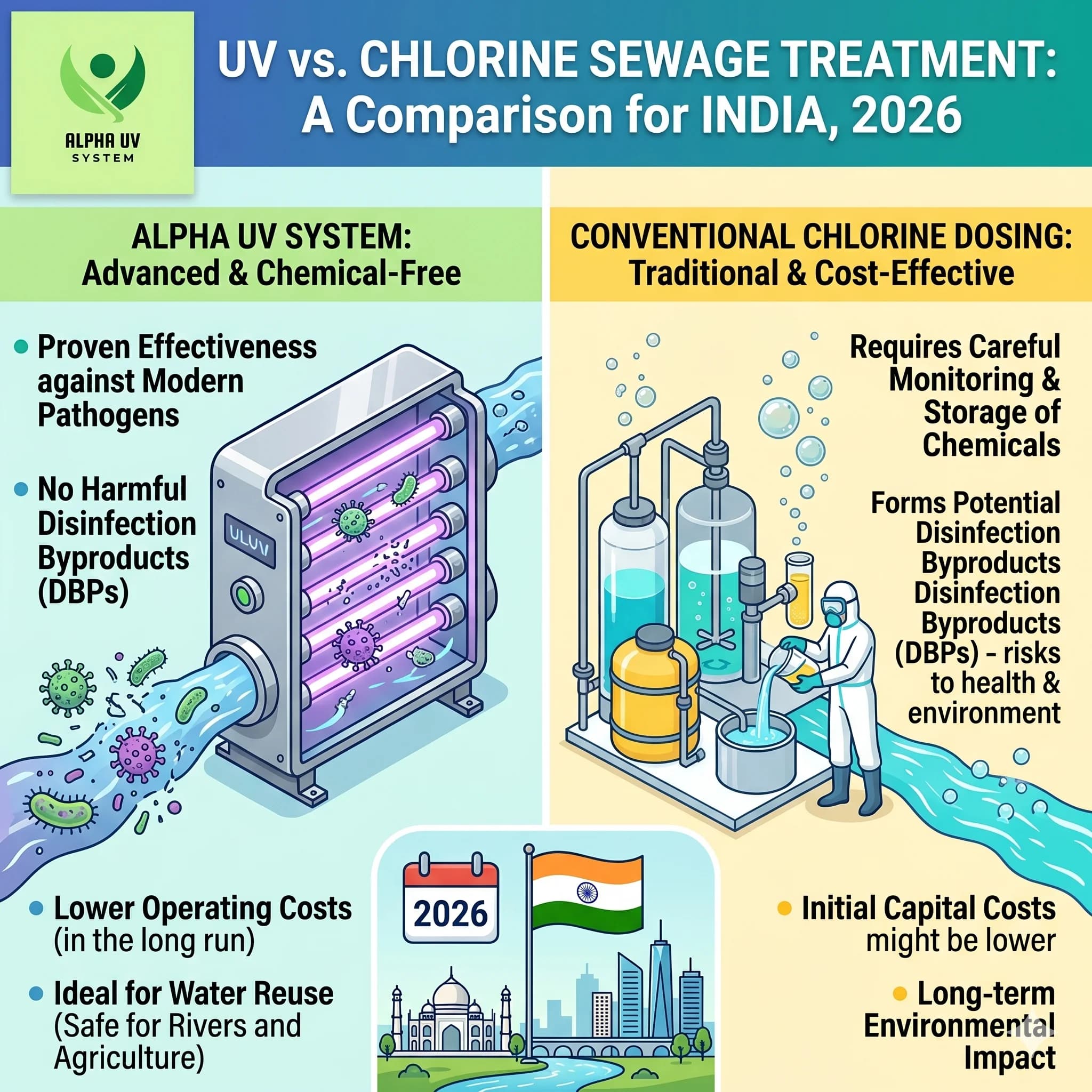
The NGT's 2022 consolidated order on STP compliance in Delhi NCR specifically flagged disinfection byproducts — trihalomethanes (THMs) and haloacetic acids (HAAs) — as a concern in treated effluent being discharged to stormwater drains and minor rivers. Chlorination of STP effluent that contains residual organic matter produces these byproducts at concentrations that can breach permissible limits in river discharge standards. UV disinfection produces no chemical residuals of any kind — making it the cleanest final treatment step for UV disinfection wastewater treatment India applications.
The second driver is CPCB enforcement. The Central Pollution Control Board's real-time monitoring mandate for STPs above 1 MLD now includes online coliform sensors at the final effluent outlet on many installations. Chlorination's coliform reduction is sensitive to dosing accuracy, contact time, and the pH and turbidity of the effluent — all of which vary with influent quality. UV disinfection delivers a consistent, measurable dose per unit of flow regardless of organic load fluctuations, making it far more reliable under real-time CPCB monitoring.
The third driver is residential STP deployment. Integrated townships, group housing societies, and commercial complexes in Noida, Gurgaon, Faridabad, and across Delhi NCR are legally required to operate captive STPs. In these settings, storing liquid chlorine or sodium hypochlorite creates fire, chemical exposure, and regulatory liability — particularly after the UPPCB began including chemical storage safety in STP compliance inspections from 2023. UV systems are chemical-free: no storage, no handling risk, and no hazardous material transportation to manage.
The result is that UV disinfection wastewater treatment India installations have grown from a niche specification to the dominant choice for new STP ETP projects and for retrofitting existing chlorination systems.
CPCB Effluent Standards for STP Discharge
The Central Pollution Control Board specifies effluent discharge standards under the Environment (Protection) Act, 1986 and the Environment (Protection) Rules, 1986. For sewage treatment plants, the relevant standards depend on the receiving body — land application, inland surface water (rivers and streams), or controlled irrigation. The table below summarises the key parameters relevant to UV disinfection sizing for STP UV system India installations.
| Discharge Destination | Total Coliform (MPN/100ml) | BOD (mg/L) | TSS (mg/L) | UV Dose Required |
|---|---|---|---|---|
| Land disposal / irrigation | <100 | <30 | <100 | 30–40 mJ/cm² |
| Inland surface water (non-river) | <50 | <20 | <50 | 40–60 mJ/cm² |
| River / lake discharge | <10 | <10 | <20 | 80–100 mJ/cm² |
| Water reuse (flushing / cooling towers) | <10 | <10 | <10 | 80–100 mJ/cm² |
All UV dose figures above are specified at the minimum UVT of the treated effluent entering the UV system. If UVT improves — as it does after a media filter polishing step — the UV system delivers the same dose with greater margin. The CPCB norms above represent the national baseline; individual state pollution control boards (UPPCB, MPPCB, TNPCB, MPCB) may specify stricter standards — always verify against your specific consent to operate conditions.
UV vs Chlorination for STP — Detailed Comparison
The most frequent question from STP operators and consultants evaluating UV vs chlorination STP India options is not simply about capital cost — it is about the risk-adjusted total cost of compliance over the plant's operating life. The table below compares the two technologies across the dimensions that matter most for Indian STP regulatory and operational contexts.
| Parameter | UV Disinfection | Sodium Hypochlorite Dosing |
|---|---|---|
| Dose delivery consistency | Measured in real time by UV sensor; dose controlled automatically | Dependent on dosing pump calibration, NaOCl concentration, and contact time |
| Chemical residuals in effluent | None — zero residual chlorine or DBPs | Residual chlorine present; THM/HAA byproducts generated with organic matter |
| CPCB/UPPCB compliance reliability | High — dose is measured and logged; audit-ready data output | Variable — coliform failures common at fluctuating organic loads |
| NGT acceptance | Accepted; preferred for chemical-free discharge | Accepted but flagged for DBP risk in NGT orders for Delhi NCR STPs |
| Safety in residential/commercial STPs | No hazardous chemicals on premises | Chemical storage and handling risk; UPPCB safety inspections applicable |
| Capital cost (500 KLD STP) | Rs 4–7 lakh installed | Rs 1–2 lakh for dosing system |
| Operating cost (power + consumables) | Rs 3,000–6,000/month (lamps replaced at 16,000 hours) | Rs 5,000–12,000/month (chemical procurement, storage, dosing) |
| Dechlorination required | No | Yes — if effluent is reused or discharged to sensitive water bodies |
| Maintenance skill requirement | Lamp and quartz sleeve replacement at defined intervals | Dosing pump maintenance, chemical procurement, concentration checks |
For operators of sewage treatment plant UV systems in residential townships, the operating cost inversion — where UV becomes less expensive than chlorination within 18–24 months — is the deciding factor in addition to the elimination of chemical safety liability.
UVT of STP Effluent: Why It Matters and How to Measure It
UV transmittance (UVT) is the single most important site-specific parameter in UV system design for wastewater applications. UVT measures how much UV-C light at 254 nm passes through a 10mm path length of the effluent sample — expressed as a percentage. A UVT of 65% means 65% of the UV light reaches the far wall of the sample cell; the remaining 35% is absorbed or scattered by suspended solids, dissolved organics, and colour in the effluent.
STP effluent UVT varies significantly depending on the treatment process upstream of the UV system. The table below gives typical UVT ranges by treatment stage — these are field observations from UV disinfection wastewater treatment India installations, not theoretical values.
| Treatment Stage Before UV | Typical UVT (%) | Design Approach |
|---|---|---|
| Secondary clarifier only (no filtration) | 30–50% | High-output UV-C lamps; multiple lamp banks; UVT margin built into sizing |
| Secondary + sand/dual-media filtration | 50–65% | Standard UV-C configuration; dose verified by UV sensor |
| MBR (membrane bioreactor) effluent | 65–80% | Optimised UV system; fewer lamps required for same dose |
| Tertiary RO permeate | 85–95% | Standard drinking-water-grade UV; minimum lamp count |
UVT must be measured at your plant, on your effluent, using a calibrated UV spectrophotometer at 254 nm — not estimated from literature values. Seasonal variation in influent quality (higher TSS in monsoon season, higher organic load with population surges) can shift UVT by 10–15 percentage points. Alpha UV System's engineers collect a minimum of three UVT measurements across different operating conditions before finalising the UV system design for any ETP UV disinfection or STP application.
Philips UV-C Lamps for Wastewater Applications
Not all UV lamps perform equally in the low-UVT conditions typical of STP and ETP effluent. Standard low-pressure UV-C lamps — designed for drinking water with UVT above 90% — lose significant output as UVT drops below 70%. For UV disinfection wastewater treatment India at the UVT ranges typical of secondary-treated STP effluent (40–65%), Philips UV-C high-output lamps are specified for three reasons.
First, Philips UV-C lamps operate at a higher internal arc temperature — this means the lamp's UV output is less sensitive to the thermal effect of lower-UVT effluent cooling the quartz sleeve. Standard low-pressure lamps lose efficiency disproportionately as effluent temperature varies between 18°C (winter) and 35°C (summer monsoon), which is the typical operating range for Indian STP installations.
Second, the UV output per lamp is 3 to 5 times higher than a standard low-pressure lamp of the same physical length. This means fewer lamp banks are required to deliver the same UV dose — reducing the footprint of the UV system in STP plant rooms where space is constrained, and reducing the number of quartz sleeves that require periodic cleaning and replacement.
Third, Philips UV-C lamps maintain greater than 85% of rated UV output at 16,000 hours of operation. Comparative low-pressure lamps require replacement at 9,000 hours. The extended lamp life reduces the total cost of lamp replacement over a five-year operating period by approximately 40% — a meaningful factor in the operating cost comparison for sewage treatment plant UV installations running 16 to 20 hours per day.
Every Philips UV-C lamp supplied by Alpha UV System carries a Certificate of Authenticity with serial number from Signify (Philips Lighting). This certificate forms part of the technical compliance documentation package for CPCB and state PCB audit submissions.
STP UV System Sizing: Formula and Worked Examples
Sizing a UV system for an STP begins with converting the plant's daily design capacity into an instantaneous flow rate — because the UV system must treat the full daily volume within the actual daily pumping window, not across 24 hours. The standard sizing formula for STP UV system India installations is:
UV system flow rate (LPH) = Plant capacity (m³/day) × 1000 ÷ Pumping hours per day
The result is the minimum UV system flow rate at rated UV dose. A design margin of 10–15% is added to this figure to accommodate peak flow events and end-of-lamp-life UV output reduction.
Worked Example: 500 KLD STP
Plant capacity: 500 m³/day. Pumping hours: 16 hours/day. Effluent UVT: 55% (after sand filtration). Target CPCB standard: less than 100 MPN/100ml (land disposal).
Base flow rate: 500 × 1000 ÷ 16 = 31,250 LPH. With 15% design margin: 36,000 LPH. UV dose required: 40 mJ/cm² at UVT 55%. Specified system: 36,000 LPH Philips UV-C system, 2-lamp bank configuration.
Worked Example: 1 MLD STP
Plant capacity: 1,000 m³/day. Pumping hours: 16 hours/day. Effluent UVT: 60% (after dual-media filter). Target: less than 50 MPN/100ml (inland surface water).
Base flow rate: 1,000 × 1000 ÷ 16 = 62,500 LPH. With 15% design margin: 72,000 LPH. UV dose required: 50 mJ/cm² at UVT 60%. Specified system: 72,000 LPH Philips UV-C system, 3-lamp bank configuration.
Worked Example: 5 MLD STP
Plant capacity: 5,000 m³/day. Pumping hours: 20 hours/day. Effluent UVT: 48% (secondary clarifier, no filtration). Target: less than 10 MPN/100ml (river discharge).
Base flow rate: 5,000 × 1000 ÷ 20 = 250,000 LPH. With 15% design margin: 288,000 LPH. UV dose required: 100 mJ/cm² at UVT 48%. Specified system: Open-channel UV, multiple Philips UV-C lamp rack arrays. CFD hydraulic design required.
STP UV System Sizing Reference Table
| STP Capacity | Pumping Hours/Day | Base Flow Rate (LPH) | UV System LPH (with margin) | Typical Lamp Configuration | System Type |
|---|---|---|---|---|---|
| 100 KLD | 12 | 8,333 | 9,600 | 1 lamp bank | Closed vessel |
| 250 KLD | 14 | 17,857 | 20,000 | 2 lamp banks | Closed vessel |
| 500 KLD | 16 | 31,250 | 36,000 | 2–3 lamp banks | Closed vessel |
| 1 MLD | 16 | 62,500 | 72,000 | 3–4 lamp banks | Closed vessel |
| 2 MLD | 18 | 111,111 | 128,000 | 4–5 lamp banks | Closed vessel or open channel |
| 5 MLD | 20 | 250,000 | 288,000 | Multi-rack array | Open channel |
| 10 MLD | 20 | 500,000 | 575,000 | Multi-channel, multi-rack | Open channel |
All sizing figures above assume a minimum UVT of 55% and a target UV dose of 40 mJ/cm². Plants with lower UVT or more stringent CPCB targets require recalculation with site-specific UVT measurements.
Closed-Vessel vs Open-Channel UV for STPs
The choice between a closed-vessel (pressure) UV system and an open-channel UV system is one of the key design decisions in UV disinfection wastewater treatment India STP projects. Both configurations deliver UV disinfection effectively — the selection depends on plant capacity, available hydraulic head, and site layout constraints.
Closed-Vessel UV Systems
In a closed-vessel configuration, UV lamps are enclosed in a stainless-steel cylindrical chamber through which effluent flows under pressure. The system connects into the pipe network between the secondary clarifier (or filter) and the final effluent storage or discharge point. Closed-vessel systems are compact — a 72,000 LPH unit fits on a floor area of approximately 0.6m × 1.2m — making them ideal for STP plant rooms with limited space.
The hydraulic requirement is that the effluent has sufficient pressure to flow through the UV chamber — typically 0.3–0.8 bar. Closed-vessel systems are the standard choice for residential and commercial STP installations up to 2 MLD where a pumped effluent pipeline already exists. Capital cost for a closed-vessel system at 500 KLD STP is in the range of Rs 4–7 lakh installed, including control panel, UV sensor, and installation.
Open-Channel UV Systems
Open-channel UV systems mount UV lamp rack assemblies directly in open concrete channels — the existing effluent channels that large STPs already use for gravity flow between process stages. There is no additional pressure requirement: effluent flows by gravity through the lamp arrays. Open-channel systems are standard for municipal STPs above 2–5 MLD, where the effluent volume makes closed-vessel systems impractical and the site has existing treatment channels.
Open-channel UV design requires computational fluid dynamics analysis to confirm that the flow velocity and channel geometry deliver the correct UV dose distribution across the full channel cross-section — including near the walls and channel floor where velocity profiles can create low-dose zones. Alpha UV System's IIT-trained engineering team designs open-channel systems from first principles, verified by CFD modelling before fabrication.
Decision Guide: Which Configuration for Your STP
| Condition | Recommended Configuration |
|---|---|
| STP capacity below 2 MLD, pumped effluent pipeline | Closed-vessel |
| Residential or commercial township STP, limited plant room space | Closed-vessel |
| Retrofit of existing chlorination system (same pipework) | Closed-vessel |
| Municipal STP above 2 MLD with gravity flow treatment channels | Open-channel |
| STP with low hydraulic head — insufficient pressure for closed vessel | Open-channel |
| CPCB-mandated real-time monitoring requiring accessible lamp inspection | Open-channel (easier lamp access and sensor installation) |
ETP UV Disinfection Applications
Effluent treatment UV India applications extend beyond sewage treatment to industrial effluent treatment plants (ETPs) where the discharge standards and effluent characteristics differ significantly from domestic STP effluent. The three highest-volume ETP UV applications in India are food processing, pharmaceutical manufacturing, and textile effluent.
Food Processing ETP UV Disinfection
Food processing ETPs — dairy, beverage, meat, and packaged food manufacturing — produce effluent with high organic load (BOD 500–2,000 mg/L before treatment) and high coliform counts. After biological treatment and secondary clarification, the effluent UVT is typically in the 45–60% range. FSSAI and CPCB discharge standards for food processing effluent to inland waters require total coliform below 10 MPN/100ml — the more stringent river discharge standard. UV disinfection at 80–100 mJ/cm² using Philips UV-C lamps achieves this target reliably for effluent treatment UV India food processing applications.
Pharmaceutical ETP UV Disinfection
Pharmaceutical manufacturing ETPs are subject to both CPCB standards and pharmaceutical regulator inspection requirements. The specific concern in pharma ETP UV design is that active pharmaceutical ingredients (APIs) and antibiotic residuals in the effluent can reduce UVT below the values typical of standard industrial ETPs. UVT measurements for pharma ETP UV sizing must be taken at the actual plant on actual process effluent — not estimated. API-loaded effluent with UVT of 30–40% requires a Philips UV-C high-output configuration with a significantly higher lamp count per unit flow than a standard STP UV system.
Textile ETP UV Disinfection
Textile dyeing ETPs present the most challenging UVT conditions in Indian industrial wastewater — colour from reactive and disperse dyes absorbs strongly at 254 nm, depressing UVT to 15–35% even after biological treatment and decolourisation. ETP UV disinfection for textile applications requires a UVT analysis specific to each plant's dye chemistry and decolourisation process. In some textile ETP configurations, UV is applied after activated carbon filtration to recover UVT to 50–65% before the UV system, making the lamp configuration feasible.
UV Dose Requirements by Discharge Standard
| Discharge Standard | Coliform Target (MPN/100ml) | Required UV Dose (mJ/cm²) | Lamp Type | Applicable ETP/STP Type |
|---|---|---|---|---|
| CPCB land disposal | <100 | 30–40 | Philips UV-C | Residential STP, irrigation reuse |
| CPCB inland water | <50 | 40–60 | Philips UV-C high-output | Commercial STP, small industrial ETP |
| CPCB river discharge | <10 | 80–100 | Philips UV-C high-output | Municipal STP, food/pharma ETP |
| UPPCB enhanced (Delhi NCR rivers) | <10 | 100 | Philips UV-C high-output | Noida/Gurgaon STPs, NGT-monitored plants |
| Water reuse — toilet flushing | <10 | 80 | Philips UV-C high-output | Township STP with dual plumbing |
| Water reuse — cooling towers | <10 | 100 | Philips UV-C high-output | Commercial complex STP, industrial ETP |
Case Study: Noida Township 500 KLD STP — Chlorine Failures to UPPCB Compliance
A 1,200-flat integrated residential township in Noida, Uttar Pradesh operated a 500 KLD STP with sodium hypochlorite dosing for final effluent disinfection. The STP had been operational for four years with an ongoing UPPCB compliance challenge: routine inspections consistently recorded total coliform counts of 800 to 2,200 MPN/100ml in the final effluent — far above the CPCB limit of 100 MPN/100ml for land disposal and the township's own irrigation reuse requirement.
The root cause analysis identified three contributing factors: inconsistent sodium hypochlorite concentration from the procurement supplier (delivered at 8–10% concentration but degrading to 4–6% in storage before use), an undersized chlorine contact tank providing only 12 minutes of effective contact time against a design requirement of 30 minutes, and seasonal variation in STP influent quality during monsoon months pushing BOD and TSS above the chlorination system's design parameters.
Alpha UV System installed a 36,000 LPH closed-vessel Philips UV-C UV disinfection system — sized for 16 pumping hours per day with 15% flow margin — at the outlet of the sand filter, replacing the chlorine contact tank. The UV system's integrated UV intensity sensor provides real-time dose monitoring, with data logged to the control panel for UPPCB compliance record submission.
Post-installation monitoring results over six months showed total coliform consistently below 25 MPN/100ml — a greater than 40-fold improvement from the pre-installation baseline. The township's subsequent UPPCB compliance inspection resulted in a clean compliance report for the first time since the STP was commissioned. Chemical storage was eliminated from the STP premises, resolving a separate safety violation that had been flagged in a prior UPPCB inspection. The township RWA subsequently approved reuse of the UV-treated effluent for landscape irrigation — reducing the township's potable water consumption from NOIDA Authority water supply by an estimated 35%.
Case Study: 2 MLD Commercial Complex STP — Open-Channel UV and CPCB Audit
A 2 MLD STP serving a large commercial complex in Delhi NCR was commissioned with an open-channel UV disinfection system as the primary final treatment step — no chlorination was installed. The decision to go chemical-free from commissioning was driven by the building management's requirement to use treated effluent for cooling tower makeup water, for which residual chlorine in the recirculating water would have created corrosion and scaling management complications.
The open-channel UV system was designed for the STP's gravity-flow effluent channel between the secondary clarifier and the treated water storage tank. Two UV lamp rack arrays with Philips UV-C high-output lamps were mounted in the 600mm-wide channel, designed to deliver 80 mJ/cm² UV dose at the channel's maximum design flow velocity and at the measured effluent UVT of 58%.
A CPCB verification audit was conducted 14 months after commissioning. The audit team collected effluent samples at the UV system outlet during normal operating conditions and during a deliberate high-load test (two-hour period of maximum influent loading). Results: total coliform below 8 MPN/100ml under normal conditions and below 18 MPN/100ml during the high-load test — both within the less than 50 MPN/100ml standard applicable to the complex's discharge point. The audit report noted the real-time UV dose logging as a positive compliance feature. The complex has continued to use UV-treated STP effluent for cooling tower makeup, eliminating approximately 400 m³/day of fresh water demand from the municipal supply.
Water Reuse: UV-Treated STP Effluent Applications
The economic case for UV disinfection wastewater treatment India is strongest when the UV-treated effluent is reused within the same facility rather than discharged. STP effluent that meets the less than 10 MPN/100ml total coliform standard after UV treatment is suitable for three primary reuse applications in Indian residential and commercial contexts.
Landscape irrigation: UV-treated STP effluent is widely used for garden and landscape irrigation in integrated townships across Noida, Greater Noida, and Gurgaon. UPPCB has approved reclaimed water irrigation for residential complexes provided the STP effluent meets the CPCB land disposal coliform standard. Using reclaimed water for irrigation reduces potable water demand from municipal supply by 20–40% in large townships, depending on landscaped area relative to resident population.
Toilet flushing: Dual-plumbing systems — where UV-treated STP effluent is distributed to a separate non-potable water network serving toilet flushing in all units — are now included in the specification for new large residential developments in Delhi NCR under green building certification requirements. The UV dose requirement for toilet flushing reuse is 80 mJ/cm², meeting the less than 10 MPN/100ml standard.
Cooling tower makeup water: Commercial complexes with large central HVAC systems can use UV-treated STP effluent as makeup water for cooling towers. The elimination of residual chlorine from the UV treatment process — compared to chlorinated STP effluent — reduces the corrosion and scaling management burden on the cooling water treatment programme. The UV dose requirement for cooling tower makeup is 100 mJ/cm² to prevent Legionella risk in the recirculating system.
Frequently Asked Questions
Does UV disinfection meet CPCB coliform standards for STP discharge?
Yes. A correctly sized UV disinfection system operating at 40 mJ/cm² UV dose achieves greater than 4-log reduction of E. coli and total coliform in secondary-treated STP effluent, consistently delivering effluent below 100 MPN/100ml — the CPCB standard for discharge to land and irrigation. For river discharge (less than 10 MPN/100ml), a UV dose of 80–100 mJ/cm² is required, achievable with Philips UV-C high-output lamps. The CPCB does not specify the disinfection technology — it specifies the output coliform standard. UV disinfection meets this standard and is accepted by all state PCBs including UPPCB, MPCB, TNPCB, and MPPCB.
What UVT is required for UV disinfection to work in STP effluent?
UV disinfection for CPCB wastewater UV applications works across a wide UVT range — from as low as 30% (after secondary clarifier, no filtration) up to 95% (RO permeate). The UVT of the effluent determines the UV system design: lower UVT requires higher-output lamps, more lamp banks, or a shorter UV exposure chamber to increase lamp concentration per unit volume. Secondary-treated STP effluent without filtration typically has UVT of 35–50%; after sand or dual-media filtration, UVT rises to 55–70%. The UV system must be sized and specified for the minimum expected UVT — not the average or best-case value.
When should an STP choose open-channel UV over closed-vessel UV?
Open-channel UV is the right choice for municipal STPs above 2–5 MLD where gravity-flow treatment channels are already present, where hydraulic head is insufficient for a pressurised closed-vessel system, or where CPCB monitoring requirements call for easily accessible lamp inspection. Closed-vessel UV is the right choice for residential and commercial STPs where the effluent is already in a pressurised pipeline, space is limited, and the operator wants a compact system that can be installed in the existing STP plant room without civil modification. For most STPs below 2 MLD in India, closed-vessel UV is the practical and cost-effective choice.
Is UV disinfection for ETPs different from STP UV systems?
The UV disinfection mechanism — photochemical inactivation of microbial DNA at 254 nm — is the same for both ETP UV disinfection and STP applications. The key difference is effluent UVT and the specific coliform or pathogen reduction targets. Industrial ETP effluent from food processing, pharmaceutical, and textile plants often has lower UVT than domestic STP effluent — requiring higher-output lamps and more conservative sizing margins. Pharmaceutical ETPs also require validated dose delivery documentation. ETP UV sizing must always be based on measured UVT and the specific discharge standard applicable to the industrial sector — CPCB general standards, sector-specific standards, or consent-to-operate conditions.
What does a UV disinfection system cost for a 500 KLD STP in India?
A complete installed UV disinfection system for a 500 KLD STP — including the UV chamber with Philips UV-C lamps, quartz sleeves, UV intensity sensor, control panel with automatic lamp failure alarm, and stainless-steel inlet and outlet flanges — is in the range of Rs 4 to 7 lakh installed, depending on the target UV dose and the number of lamp banks required. This compares to a chlorination dosing system capital cost of Rs 1–2 lakh, but with a higher operating cost and ongoing chemical safety liability. The UV system's operating cost — principally electricity for the lamps — is Rs 3,000 to 6,000 per month for a 500 KLD plant, with lamp replacement at 16,000 hours adding to the five-year total. For most residential STP operators, the UV system reaches total cost parity with chlorination within 18–24 months of operation.
Is a UV-treated STP truly chemical-free?
UV disinfection adds no chemicals to the water being treated. The photochemical process inactivates microbial DNA using UV-C light — no chlorine, no sodium hypochlorite, no ozone, and no chemical residuals in the treated effluent. UV-treated STP effluent contains zero residual disinfectant — which is both the key environmental advantage (no disinfection byproducts, no toxic residuals in discharge or reuse water) and a limitation to be aware of: UV provides no persistent disinfection residual in distribution. For STP effluent reuse in a distribution network of any significant length, a small residual chlorine dose is sometimes added post-UV to maintain water quality in the pipe. In direct reuse applications — irrigation, cooling towers, toilet flushing direct from storage — no post-treatment is required.
Conclusion — UV Disinfection as the Standard for Indian STP Compliance
UV disinfection wastewater treatment India has moved from an alternative technology to the standard specification for new STP installations and chlorination retrofits across residential, commercial, and industrial applications. The convergence of CPCB enforcement, NGT chemical-free discharge requirements, UPPCB safety inspections of STP chemical storage, and the water reuse economics of UV-treated effluent has made UV disinfection the technically and operationally superior choice for the vast majority of Indian STP and ETP applications.
The key requirements for a compliant UV disinfection system are: a Philips UV-C lamp specification verified for the effluent UVT of your specific plant, a flow rate calculation based on actual pumping hours rather than assumed continuous flow, a UV intensity sensor with real-time dose logging for CPCB audit documentation, and a design margin that accounts for seasonal UVT variation and end-of-lamp-life output reduction. These are engineering decisions, not product selections — the quality of the UV system engineering is as important as the quality of the UV lamps.
Alpha UV System designs and supplies UV disinfection systems for STPs and ETPs across India — from 100 KLD residential STPs to 10 MLD municipal STP open-channel installations. All systems use Philips UV-C lamps with Signify Certificate of Authenticity, and include CPCB-compliant UV dose monitoring and logging as standard. Engineering support is provided within 24–48 hours of inquiry, including UVT assessment review and preliminary sizing for your specific plant capacity and discharge standard.
For a sizing recommendation for your STP or ETP, visit our STP UV disinfection application page or contact our engineering team with your plant capacity, pumping schedule, and current effluent quality data.
Standards, authorities & further reading
External references used to inform this guide. Regulations evolve — check the latest revision on each authority's site before compliance decisions.
Recommended UV Systems
Alpha UV System products for this application — powered by genuine Philips UV-C lamps.
UV Disinfection System for STP
10,000 – 2,00,000 LPH
CPCB-compliant UV tertiary disinfection for sewage treatment plants — closed-vessel and open-channel
UV Disinfection System for ETP
10,000 – 2,00,000 LPH
Industrial UV-C for ETP final effluent — CPCB and State PCB compliant before ZLD or discharge
Not sure which system suits your application? WhatsApp our engineers for a free recommendation →
Related solutions
See how Alpha UV System applies this to your industry or city.
Need a UV system?
Talk to our UV engineers — WhatsApp for a quote in 2 hours, or browse the full catalog on IndiaMART.