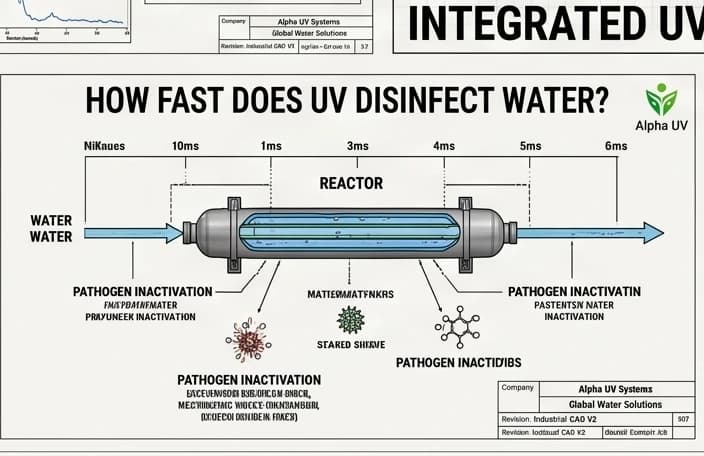
Quick answer: UV disinfects water in seconds — not minutes, not hours. As water flows through a UV chamber, UV-C photons strike and inactivate pathogens in microseconds. At typical residential flow rates, water spends 5–30 seconds inside the chamber, which is far longer than the UV exposure time actually needed to achieve a 4-log kill. There is no holding time, no waiting period, and no delay between treatment and use.
The Physics of UV Speed
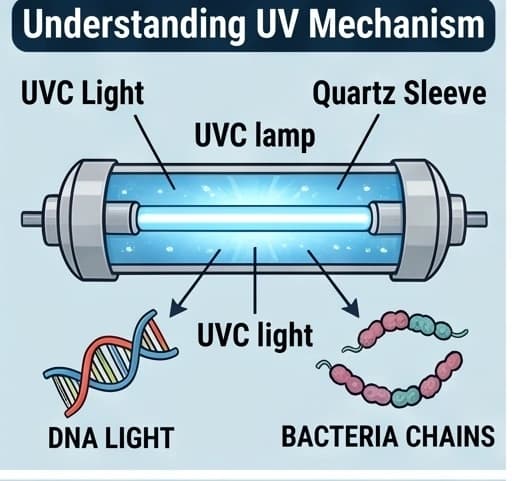
Understanding how fast UV disinfects water starts with the mechanism. UV disinfection is a photochemical process, not a chemical one. When UV-C light at 254 nm strikes the DNA or RNA of a pathogen, it causes thymine dimer formation — covalent bonds between adjacent thymine bases on the same DNA strand that prevent the organism from replicating. This molecular damage happens in microseconds, the moment the UV-C photon is absorbed.
This is fundamentally different from chlorine, which is a chemical reaction that requires diffusion — the chlorine molecule must physically reach the pathogen, penetrate its cell wall, and react with cellular components. That diffusion and reaction process takes time, which is why chlorine disinfection is described using a CT value: concentration (mg/L) multiplied by contact time (minutes). For Giardia cysts, the USEPA requires a chlorine CT of 150 mg·min/L at 20°C. That is a significant quantity of chemical held in contact with water for an extended period.
UV-C has no such requirement. The UV dose that determines how fast UV disinfects water is expressed in mJ/cm² (millijoules per square centimetre), which is a product of UV intensity (mW/cm²) and exposure time (seconds). Because modern Philips UV-C lamps operate at intensities of 10–40 mW/cm² at the chamber wall, the time required to accumulate 40 mJ/cm² — the standard minimum dose for drinking water — is in the range of 1 to 4 seconds of actual UV exposure. The rest of the chamber residence time is a buffer that adds further dose beyond the minimum.
UV-C Dose and Inactivation Time by Pathogen
Different pathogens require different UV doses for inactivation. The table below shows how fast UV disinfects water for eight key pathogens, along with the chlorine CT required for an equivalent level of kill. These figures are based on published USEPA and WHO guidance values.
| Pathogen | UV Dose Required (mJ/cm²) | Time at 10 mW/cm² Intensity | Log Reduction | Chlorine CT for Equivalent Kill (mg·min/L) |
|---|---|---|---|---|
| E. coli O157:H7 | 6.0 | 0.6 seconds | 4-log (99.99%) | 0.08 (very low — chlorine effective) |
| Salmonella typhi | 8.0 | 0.8 seconds | 4-log (99.99%) | 0.40 |
| Legionella pneumophila | 5.5 | 0.55 seconds | 4-log (99.99%) | 75 (chlorine very slow for Legionella) |
| Giardia lamblia (cysts) | 10.0 | 1.0 second | 3-log (99.9%) | 150 (extremely high CT requirement) |
| Cryptosporidium parvum (oocysts) | 10.0 | 1.0 second | 3-log (99.9%) | 7,200 (chlorine effectively useless) |
| Rotavirus | 40.0 | 4.0 seconds | 4-log (99.99%) | 0.5–1.0 |
| Hepatitis A virus | 40.0 | 4.0 seconds | 4-log (99.99%) | 8.0 |
| Norovirus (Norwalk virus) | 39.0 | 3.9 seconds | 4-log (99.99%) | 3.0–6.0 |
Two points stand out from this table. First, how fast UV disinfects water for bacterial pathogens is remarkably quick — under 1 second of actual UV exposure for most bacteria. Second, for protozoan cysts like Cryptosporidium, where chlorine CT values reach 7,200 mg·min/L (making chlorine essentially impractical), UV achieves equivalent inactivation in 1 second at modest intensity. This is why UV is considered the gold standard for Cryptosporidium and Giardia in drinking water.
How Long Water Spends in a UV Chamber
The UV disinfection speed experienced in practice is the chamber residence time — the number of seconds water spends flowing through the UV chamber. This is a function of chamber volume and volumetric flow rate: residence time (seconds) = (chamber volume in litres × 3,600) ÷ flow rate in LPH.
UV system manufacturers, including Alpha UV System, engineer chamber geometry so that at the maximum rated flow rate, every parcel of water receives at least 40 mJ/cm² of UV dose — the minimum standard for drinking water disinfection. The residence time values below show how fast UV disinfects water across system sizes.
| System Capacity (LPH) | Chamber Volume (Litres) | Residence Time at Full Flow | UV Dose at Full Flow |
|---|---|---|---|
| 200 LPH (residential under-sink) | 0.35 | ~6 seconds | 40 mJ/cm² |
| 500 LPH (small household / apartment) | 0.70 | ~5 seconds | 40 mJ/cm² |
| 1,000 LPH (residential overhead tank) | 1.20 | ~4.3 seconds | 40 mJ/cm² |
| 3,000 LPH (small commercial) | 3.00 | ~3.6 seconds | 40 mJ/cm² |
| 10,000 LPH (medium commercial) | 8.50 | ~3.1 seconds | 40 mJ/cm² |
| 30,000 LPH (large commercial / apartment complex) | 22.0 | ~2.6 seconds | 40 mJ/cm² |
| 1,00,000 LPH (industrial / municipal) | 60.0 | ~2.2 seconds | 40 mJ/cm² |
| 2,00,000 LPH (large industrial) | 100.0 | ~1.8 seconds | 40 mJ/cm² |
Notice that larger industrial systems achieve shorter residence times while still meeting the 40 mJ/cm² dose requirement — this is because multi-lamp chamber designs deliver higher aggregate UV intensity, so less time is needed to accumulate the required dose. The UV disinfection speed stays consistent regardless of system scale.
UV vs Chlorine: Speed Comparison
The clearest way to understand how fast UV disinfects water relative to chlorine is to compare CT values directly. Chlorine's CT value is contact time in minutes multiplied by concentration in mg/L. UV dose is intensity in mW/cm² multiplied by exposure time in seconds. The table below puts both technologies side by side for the same pathogens.
| Pathogen | UV Dose (mJ/cm²) | UV Treatment Time | Chlorine Dose (mg/L) | Chlorine Contact Time (min) |
|---|---|---|---|---|
| E. coli (4-log kill) | 6 | < 1 second | 0.2 | 0.4 min |
| Salmonella (4-log kill) | 8 | < 1 second | 0.2 | 2.0 min |
| Legionella (4-log kill) | 5.5 | < 1 second | 1.0 | 75 min |
| Giardia (3-log kill) | 10 | 1 second | 1.5 | 100 min |
| Cryptosporidium (3-log kill) | 10 | 1 second | 80 | 90 min (impractical) |
| Hepatitis A (4-log kill) | 40 | 4 seconds | 1.0 | 8 min |
The UV vs chlorine speed comparison becomes especially stark for Legionella and Cryptosporidium — two pathogens of major concern in India's hospitality and healthcare sectors. Legionella requires 75 minutes of chlorine contact time at 1 mg/L, while UV achieves the same kill in under one second. For Cryptosporidium, the chlorine CT required (7,200 mg·min/L) makes chlorination completely impractical; UV accomplishes it in a single second of exposure.
For continuous-flow water supply systems — such as those in hotels, hospitals, and apartment complexes — the UV disinfection speed advantage means no large chlorine contact tanks are needed, no trihalomethane (THM) byproducts form, and treated water is immediately available at full flow rate.
UV vs Boiling: A Detailed Comparison
Boiling is the oldest known water disinfection method and remains the WHO-recommended emergency backup. But when comparing how fast UV disinfects water against boiling, the difference in speed and practicality is substantial for everyday use.
Boiling requires heating water from ambient temperature (typically 25–35°C in India) to 100°C, maintaining a rolling boil for 1 minute at sea level (or 3 minutes above 2,000 m elevation), then allowing the water to cool to a drinkable temperature before it can be consumed. From cold-water-in to cool-water-out, the total elapsed time is typically 15–25 minutes. UV treats the same volume of water in seconds as it flows through the chamber.
| Parameter | UV Treatment | Boiling | Advantage |
|---|---|---|---|
| Time to safe water (1 litre) | 3–6 seconds | 15–25 minutes | UV (250× faster) |
| Energy consumption per litre | 0.003–0.010 kWh | 0.08–0.12 kWh | UV (10–30× less energy) |
| Cryptosporidium inactivation | Yes — 10 mJ/cm² achieves 3-log kill | Yes — rolling boil kills oocysts | Both effective |
| Virus inactivation | Yes — 40 mJ/cm² for 4-log kill of Hepatitis A | Yes — boiling denatures viruses | Both effective |
| Chemical byproducts | None | None | Equal |
| Effect on water taste | No change | Flat taste (dissolved O₂ loss) | UV |
| Works at scale (continuous flow) | Yes — any flow rate | No — batch process only | UV |
| Removes dissolved chemicals | No | No | Equal (neither removes TDS) |
The key practical difference is that UV is a flow-through, continuous process. A hotel serving 500 guests cannot boil water on demand — but a properly sized UV system treats water continuously at whatever flow rate the building demands. For any commercial or semi-commercial setting, boiling is simply not a viable alternative to how fast UV disinfects water at scale.
Warm-Up Time: Does the UV Lamp Need to Reach Full Output?
This is a practical question that directly affects how fast UV disinfects water in real-world installations. The answer depends on lamp type.
Low-pressure mercury vapour lamps (including the Philips TUV series used in Alpha UV System products) require approximately 1–2 minutes from a cold start to reach their full rated UV-C output. During this warm-up period, UV output rises from zero to 100% progressively. The lamp emits UV-C immediately upon striking, but the intensity climbs as mercury vapour pressure inside the lamp stabilises.
Medium-pressure UV lamps — used in large industrial systems — reach near-full output in under 30 seconds due to their higher operating temperature and pressure.
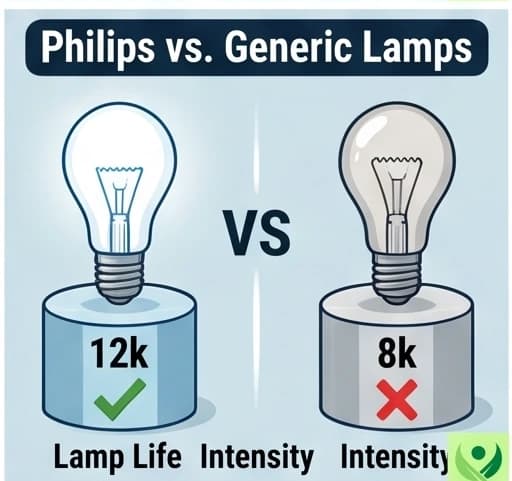
For residential and small commercial UV systems, the standard recommendation is continuous operation — the Philips UV-C lamp stays energised at all times, drawing approximately 8–30 W depending on system size. Because the lamp is always at full output, water is treated immediately when a tap is opened. There is no "wait for warm-up" step in daily use.
For installations where the UV system is switched on only when water is demanded (common in some industrial setups with automated controls), a 90–120 second delay relay can be installed to hold the solenoid valve closed during warm-up, ensuring the first water through the chamber receives full-dose treatment.
Does UV Speed Vary with Water Clarity? The Role of UVT
UV Transmittance (UVT) is the percentage of UV-C light that passes through a 1 cm column of water at 254 nm. Clean, clear groundwater may have UVT of 95–98%. Turbid or tannin-stained surface water may have UVT of 70–80% or lower. UVT directly affects how fast UV disinfects water at a given flow rate, because lower UVT means UV-C is absorbed by dissolved organic matter before it reaches pathogens.
| UVT (%) | Water Type | Effective Intensity Reduction | Dose at Rated Flow | Action Required |
|---|---|---|---|---|
| 95–98% | Clean groundwater / treated municipal | Negligible (< 5%) | Full rated dose — no adjustment | None |
| 85–94% | Typical municipal supply, light organics | 10–20% reduction | Dose still above 40 mJ/cm² minimum | Verify with UV sensor |
| 75–84% | Surface water, well water with iron/manganese | 25–35% reduction | Dose may fall below 40 mJ/cm² at full flow | Reduce flow rate or pre-treat |
| 65–74% | High-turbidity surface water, tannin-rich bore water | 40–55% reduction | Significantly below rated dose at full flow | Mandatory pre-filtration (5 µm + carbon) |
| < 65% | Heavily polluted / industrial effluent | > 55% reduction | UV ineffective at rated flow without pre-treatment | System redesign required |
The practical implication: how fast UV disinfects water at rated flow is guaranteed only when water UVT meets or exceeds the design specification. Alpha UV System sizes all systems with a UVT margin — typically specifying systems for UVT of 85% unless the customer's water has been tested to confirm higher transmittance. Pre-filtration through a 5-micron sediment filter and activated carbon block is standard in all Alpha UV System installations precisely to protect UVT and ensure the full dose is delivered at rated flow.
High-Flow Industrial UV: Does Speed Hold Up at Scale?
A common question from industrial buyers is whether UV disinfection speed degrades at very high flow rates. The answer is no — UV systems are engineered so that the residence time at maximum rated flow always delivers the specified dose. For large industrial systems at 1,00,000 to 2,00,000 LPH, this is achieved through multi-lamp chamber design: multiple Philips UV-C lamps arranged in parallel across a large-diameter chamber increase aggregate intensity so that even with shorter individual residence times, the accumulated dose meets specification.
Industrial UV systems also incorporate UV intensity sensors (UV monitors) mounted in the chamber wall. These sensors measure real-time UV-C intensity and trigger an alarm or a solenoid valve shutoff if intensity falls below the level needed to deliver rated dose — providing continuous verification that how fast UV disinfects water matches design intent, even as lamps age and output declines over their 9,000-hour service life.
UV Disinfection Speed for Indian Commercial Applications
The UV disinfection speed advantage is particularly valuable for Indian commercial settings where water demand is high, continuous, and unpredictable. Boiling is impractical; chlorine contact tanks require large footprints and chemical handling. UV systems treat water in seconds regardless of flow rate, making them the preferred technology for the following applications across Delhi NCR, Mumbai, Bengaluru, and major Indian cities.
| Application | Typical Flow Rate | UV Residence Time | Why Speed Matters Here |
|---|---|---|---|
| 3-star / 4-star hotel (Delhi NCR) | 5,000–20,000 LPH | 3–5 seconds | Guests demand hot and cold water on demand — no buffer tank hold time acceptable |
| Multi-storey apartment complex (Mumbai) | 10,000–50,000 LPH | 2–4 seconds | Simultaneous peak demand from hundreds of flats requires continuous-flow treatment |
| Private hospital / nursing home | 3,000–15,000 LPH | 3–5 seconds | Legionella risk in hot water systems; UV eliminates Legionella in under 1 second of exposure |
| Food processing plant | 10,000–1,00,000 LPH | 2–3 seconds | Process water must be pathogen-free without chemical tainting of food products |
| Pharmaceutical / biotech facility | 1,000–10,000 LPH | 3–5 seconds | Regulatory compliance requires documented dose delivery; UV sensors log real-time performance |
| School / college campus | 2,000–8,000 LPH | 3–5 seconds | Large student populations require instant treated water; no chemical residue risk |
For all of these commercial settings in India, Alpha UV System offers site assessment and system sizing within 24–48 hours of enquiry, with installation typically completed within the same week for standard flow rates up to 50,000 LPH.
Frequently Asked Questions
How long does it take for UV water to be safe to drink?
Water treated by a properly sized UV system is safe to drink immediately as it exits the UV chamber outlet. There is no holding time, no minimum wait period, and no requirement to store treated water before consumption. The question of how fast UV disinfects water has a single-sentence answer for practical purposes: it is already done by the time water reaches your tap. UV-C photon absorption by pathogen DNA — the inactivation event — occurs in microseconds. The residence time in the UV chamber (3–30 seconds depending on system size) is the engineering buffer that ensures every parcel of water at any position in the chamber cross-section receives the full rated dose.
Is UV faster than chlorine for water disinfection?
Yes, significantly faster for most pathogens, and dramatically faster for protozoan cysts. Chlorine disinfection is governed by CT values — concentration multiplied by time. For bacteria such as E. coli, chlorine works in under a minute at normal doses. But for Giardia, chlorine requires a CT of 150 mg·min/L, and for Cryptosporidium, a CT of 7,200 mg·min/L makes chlorine effectively useless at practical doses. UV achieves 3-log inactivation of both Giardia and Cryptosporidium in 1 second of UV exposure at 10 mJ/cm². For Legionella — a growing concern in Indian hotel hot water systems — chlorine needs 75 minutes of contact time; UV needs under 1 second. The UV disinfection speed advantage over chlorine is most pronounced precisely for the pathogens that cause the most serious waterborne disease.
Is UV faster than boiling for home use?
Yes — UV is approximately 250 times faster than boiling for the same volume of water. Boiling 1 litre of water from ambient temperature, maintaining a rolling boil for the recommended 1 minute, then cooling to drinking temperature takes 15–25 minutes in total. UV treats the same litre in 3–6 seconds as it flows through the chamber. Beyond speed, UV consumes 10–30 times less energy per litre treated, does not affect water taste (boiled water loses dissolved oxygen and tastes flat), and functions as a continuous-flow system rather than a batch process. For Indian households with municipal supply connected to an overhead tank, a UV system treats all water continuously without any manual intervention.
Does cold water disinfect faster or slower with UV?
Water temperature does not directly affect how fast UV disinfects water in the way it affects chemical reactions. UV disinfection is a photochemical process driven by photon absorption, not by thermal energy or chemical reaction kinetics. A UV-C photon causes DNA damage in cold water just as rapidly as in warm water. However, cold water can indirectly affect UV disinfection speed in one way: very cold water increases the viscosity of water slightly and may affect lamp jacket temperature in certain designs, potentially causing a minor reduction in lamp output. This is negligible for systems using quartz lamp sleeves. In practical terms, a UV system rated for 40 mJ/cm² delivers that dose at the rated flow rate regardless of whether inlet water temperature is 10°C or 35°C.
Does the UV lamp need to warm up before water is safe?
Low-pressure UV lamps, including Philips TUV lamps used in Alpha UV System products, take approximately 1–2 minutes from a cold start to reach 100% UV-C output. During this period, output ramps up from zero to full rated intensity. For systems operating continuously — which is the recommended mode for all residential and most commercial installations — the lamp is always at full output and no warm-up is relevant. Water is safe from the first second it flows through the chamber. For systems with automated on/off control based on demand, a 90-second delay relay ensures the solenoid inlet valve opens only after the lamp has reached full output. Alpha UV System configures delay relays as standard on all automated commercial installations.
How fast does UV disinfect water in an industrial plant at high flow rates?
In industrial UV systems operating at 1,00,000 to 2,00,000 LPH, the chamber residence time is typically 1.8–2.5 seconds at rated full flow. Multi-lamp designs — with arrays of Philips UV-C lamps across a large-diameter stainless steel chamber — deliver sufficient aggregate intensity that even with this short residence time, the accumulated dose meets or exceeds 40 mJ/cm². Real-time UV intensity sensors mounted in the chamber wall continuously verify dose delivery and trigger alarms or automatic shutoff if lamp output falls below the threshold needed to maintain rated dose at the operating flow rate. So the answer to how fast UV disinfects water at industrial scale is: equally fast as residential scale — 2–4 seconds of chamber residence time — because the chamber is designed for exactly that flow rate. The physics of UV disinfection speed scales linearly with chamber design; the photochemical mechanism itself is unchanged at any scale.
If you need a UV system sized for your specific flow rate — whether a 500 LPH residential unit or a 2,00,000 LPH industrial installation — WhatsApp our team at +91 95995 00580. We provide flow rate assessment and system specification within 24–48 hours.
Standards, authorities & further reading
External references used to inform this guide. Regulations evolve — check the latest revision on each authority's site before compliance decisions.
Recommended UV Systems
Alpha UV System products for this application — powered by genuine Philips UV-C lamps.
Commercial UV Water Purification System
500 – 5,000 LPH
HACCP-compliant UV water purification for hotels, restaurants, and offices
Industrial UV Water Treatment System
5,000 – 50,000 LPH
Schedule M 2025 and HACCP compliant UV for pharma, food & beverage, and process water
Not sure which system suits your application? WhatsApp our engineers for a free recommendation →
Need a UV system?
Talk to our UV engineers — WhatsApp for a quote in 2 hours, or browse the full catalog on IndiaMART.