UV disinfection at 254 nm inactivates Legionella pneumophila at a dose of 12–22 mJ/cm² (3-log reduction) in low-turbidity water. In building water systems — cooling towers, hot water recirculation loops, and make-up water — UV is used as a primary Legionella control measure that requires no chemicals, produces no disinfection by-products, and cannot be overwhelmed by high Legionella concentrations the way biocide shock doses can. UV must be combined with correct system design (eliminating dead legs, maintaining water temperatures outside the 25–45°C Legionella growth range) for effective Legionella water safety management.
Legionnaires' disease is a severe, potentially fatal form of pneumonia caused by inhaling water droplets contaminated with Legionella pneumophila bacteria. The bacteria thrive in building water systems — particularly anywhere water sits at 25–45°C with biofilm providing nutrients and shelter. Globally, reported Legionnaires' disease cases have been rising consistently, and India's building stock — hotel cooling towers, hospital hot water systems, apartment complex water tanks, and industrial water treatment facilities — presents significant unmanaged Legionella risk.
UV disinfection is a central tool in modern Legionella water safety management. Understanding the UV dose requirements, system integration points, and the combination of UV with thermal and chemical controls is essential for building managers, facility engineers, and water treatment consultants working to prevent Legionella outbreaks in Indian buildings and industrial facilities.
Legionella Biology and Why It Matters for Water Treatment
Legionella pneumophila is a Gram-negative bacterium that naturally inhabits freshwater environments — rivers, lakes, soil, and cooling towers. In natural environments at low concentrations, it poses minimal risk. It becomes dangerous when conditions in a building water system allow it to amplify to infective concentrations.
The critical conditions for Legionella growth are:
Temperature: Legionella is dormant below 20°C and is killed above 60°C. Active growth occurs between 25°C and 45°C, with peak growth at 35–40°C. This temperature range exactly coincides with the operating temperature of cooling tower water, warm water tanks, and poorly designed hot water systems.
Biofilm: Legionella cannot survive long in open water without nutrients. It colonises biofilm — the slime matrix of bacteria, algae, amoebae, and organic debris that forms on pipe walls, cooling tower fill media, and showerhead surfaces. Biofilm protects Legionella from biocides and UV radiation; planktonic (free-floating) Legionella released from biofilm into the water column is the form that UV disinfection targets.
Stagnation: Dead legs, infrequently used outlets, and storage tanks with poor turnover create stagnant zones where Legionella multiplies unchecked. Even a well-designed UV system cannot protect water that sits in a dead leg for days between uses.
Amoebae: Legionella is an intracellular parasite of free-living amoebae (Acanthamoeba, Naegleria) in water systems. Inside the amoeba host, Legionella is protected from biocides and UV radiation. Controlling amoebae (which biofilm supports) is therefore essential alongside direct Legionella disinfection.
UV Inactivation of Legionella — Dose Requirements
Legionella pneumophila is relatively sensitive to UV radiation at 254 nm compared to more resistant organisms like Cryptosporidium or adenoviruses. This makes UV-based Legionella control achievable at lower doses than might be expected:
| Log Reduction | Reduction in Viable Bacteria | UV Dose Required (254 nm) | Target Application |
|---|---|---|---|
| 1-log | 90% inactivation | ~4 mJ/cm² | General background control |
| 2-log | 99% inactivation | ~8 mJ/cm² | Cooling tower make-up water |
| 3-log | 99.9% inactivation | ~12–22 mJ/cm² | ASHRAE 188 Legionella control target |
| 4-log | 99.99% inactivation | ~40 mJ/cm² | Hospital and healthcare facilities |
| 6-log | 99.9999% inactivation | ~120 mJ/cm² | Immunocompromised patient environments (bone marrow transplant units) |
Note: These dose values are for planktonic (free-floating) Legionella in clean water. Legionella within biofilm, amoebae, or particulate matter receives significantly less UV dose and requires higher delivered UV doses at the water level or complementary biofilm control measures.
Water Systems at Risk of Legionella in Indian Buildings
| Water System | Risk Level | Why High Risk | UV Control Point |
|---|---|---|---|
| Cooling towers (open circuit) | Very High | Warm water (28–35°C), large biofilm surface on fill media, aerosol drift carries Legionella up to 3 km | Make-up water UV + recirculation line UV |
| Hot water storage tanks and heaters | High | Set temperature often 45–55°C (below Legionella kill threshold); cold water ingress creates stratification at 25–40°C near base | Hot water recirculation loop UV on return line |
| Evaporative condensers | High | Similar to cooling towers — water evaporates, concentrates dissolved solids, creates biofilm on heat transfer surface | Make-up water UV |
| Decorative fountains / water features | Medium–High | Warm ambient air temperature, aerosolisation by fountain spray, low biocide residual in decorative circuits | Recirculation line UV |
| Hospital plumbing (hot water to patient rooms) | Very High | Immunocompromised patients; dead legs in ward plumbing; temperature stratification | Point-of-use UV at each outlet, or central loop UV with point-of-use UF |
| Spa pools and hydrotherapy pools | Very High | Warm water (35–40°C), heavy bather load, aerosolisation from jets and blowers | Recirculation UV + maintained chlorine residual |
UV Disinfection for Cooling Towers
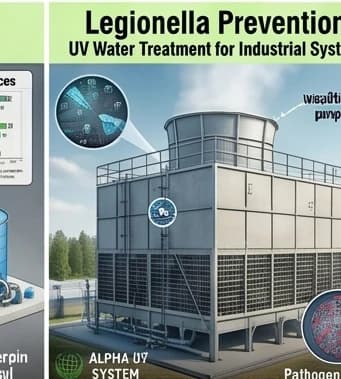
Cooling towers are the highest-risk Legionella source in most commercial and industrial facilities. The warm (28–35°C), aerated, biofilm-laden water in a cooling tower is a perfect Legionella habitat. Aerosol drift from the cooling tower carries Legionella-laden water droplets up to 3 kilometres downwind — creating a public health risk beyond the facility boundaries.
UV disinfection in cooling tower systems is applied at two points:
Make-up water UV: Installed on the incoming make-up water line (the water added to compensate for evaporative losses). A UV dose of 40 mJ/cm² on the make-up water ensures that any Legionella in the municipal supply or groundwater source is inactivated before entering the cooling tower. This is a standard application of a disinfection UV reactor at the make-up water flow rate — typically 1–20 m³/h depending on tower capacity.
Recirculation line UV: Installed on the recirculating water line, typically on the cold water basin outlet or the return from the tower to the chiller. This continuously treats the full cooling water volume as it circulates — providing ongoing Legionella control in addition to the chemical biocide programme. A higher UV dose (80–120 mJ/cm²) is used on the recirculation line to compensate for the higher turbidity and biofilm-derived particulate matter in cooling water vs clean make-up water.
UV does not provide a residual — it only inactivates Legionella that passes through the reactor at the moment of exposure. Chemical biocides (chlorine, isothiazolone, glutaraldehyde) provide the residual protection in the water between UV exposures. The combination of UV (for consistent, chemical-free inactivation) and reduced biocide dosing (for residual protection and biofilm control) is now the accepted best practice for Legionella management in cooling towers, offering better performance at lower chemical cost and reduced disinfection by-product formation.
UV for Hot Water and Domestic Water Legionella Control
Hot water systems in hotels, hospitals, apartment complexes, and factories are the second major Legionella risk category. The core problem is temperature: water above 60°C kills Legionella, but hot water at the storage tank (typically set at 55–60°C) often arrives at showerheads and taps at 40–50°C after losing heat in distribution pipes — exactly the Legionella growth range.
In a correctly designed hot water system, the recirculation loop maintains water above 55°C throughout the distribution circuit. In practice, many Indian hotel and hospital plumbing systems have dead legs, mixing valves set too low, and storage tanks with cold-water ingress at the base that creates a stratified Legionella growth zone.
UV disinfection on the hot water recirculation loop return line provides a continuous disinfection barrier independent of temperature. Even if the loop temperature drops below 55°C in a remote section, any Legionella released into the circulating water is inactivated when it passes through the UV reactor on the return. A UV dose of 40–80 mJ/cm² at the recirculation flow rate (typically 1–10 m³/h for a hotel or hospital wing) is standard.
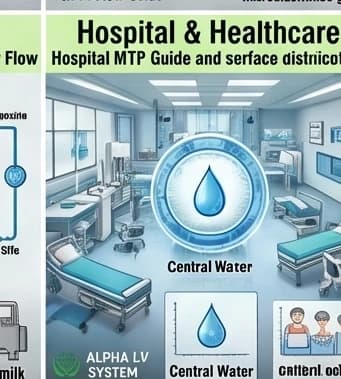
Legionella Control in Hospitals — Enhanced UV Requirements
Hospital patients — particularly those in oncology, bone marrow transplant (BMT), organ transplant, and ICU wards — are severely immunocompromised. Legionnaires' disease in an immunocompromised patient carries mortality rates of 30–80%. For this reason, hospital Legionella water safety plans specify more stringent targets than those applied in commercial buildings.
The WHO and most national health authorities recommend a Legionella target of <1 CFU/litre in potable water at point-of-use in high-risk clinical areas. Achieving this requires:
Central UV system: UV disinfection at 80–120 mJ/cm² on the main hospital water supply, with UVT-compensated dosing to account for variable water quality.
Point-of-use UV: Small UV units (or UF membranes) installed directly at high-risk outlets — showers, taps in BMT units and ICUs — as a final barrier. Even a brief biofilm colonisation in a ward plumbing dead leg between the central UV and the patient tap would defeat the central UV system.
Continuous monitoring: Monthly microbiological sampling of water from representative outlets and risk areas, with quantitative Legionella culture (ISO 11731) and/or qPCR testing. A positive result above the action level triggers immediate remediation — flushing, thermal disinfection, and UV dose verification.
ASHRAE 188 and Indian Legionella Regulations
The primary international standard for building Legionella water safety management is ASHRAE 188: Legionellosis: Risk Management for Building Water Systems. ASHRAE 188 requires a Water Management Plan (WMP) for all covered water systems — a documented programme that identifies risk areas, control measures (including UV dose targets), monitoring protocols, and corrective action procedures.
India does not have a dedicated Legionella regulation equivalent to ASHRAE 188. Applicable regulatory frameworks include:
| Regulation / Standard | Applicability | Legionella Relevance |
|---|---|---|
| Factories Act 1948 and Rules | Manufacturing facilities with workforce of 10+ | General duty of care for occupational health — Legionella from industrial cooling towers is covered |
| National Building Code 2016 (NBC) | All new building construction | Requires hot water systems to maintain 60°C storage, 55°C distribution — Legionella control by temperature |
| MoHFW Hospital Standards (NABH) | NABH-accredited hospitals | Water quality monitoring requirements include microbial testing; Legionella management increasingly required for JCI / NABH accreditation |
| ASHRAE 188 (voluntary, adopted by 5-star hotels and MNCs) | Hotels, multinational corporate facilities | Full WMP requirement including UV dose targets and quarterly Legionella monitoring |
| IATF 16949 / ISO 14001 (automotive) | Automotive OEM and tier-1 suppliers | Environmental and occupational health management systems — Legionella from cooling towers is a documented risk |
Sizing UV Systems for Legionella Control
| Application | Typical Flow Rate | UVT | UV Dose Target | Lamp Configuration |
|---|---|---|---|---|
| Cooling tower make-up water (commercial building) | 2–10 m³/h | 85–95% | 40 mJ/cm² | 1–2 × Philips UV-C lamps |
| Cooling tower recirculation (commercial) | 20–100 m³/h | 75–88% | 80 mJ/cm² | 4–8 × Philips UV-C lamps |
| Hot water recirculation loop (hotel) | 2–8 m³/h | 88–95% | 40–80 mJ/cm² | 1–2 × Philips UV-C lamps |
| Hospital potable water supply | 5–30 m³/h | 90–97% | 80–120 mJ/cm² | 2–4 × Philips UV-C lamps |
| Spa pool recirculation | 10–30 m³/h | 75–85% | 40 mJ/cm² | 2–3 × Philips UV-C lamps |
| Industrial cooling tower (large) | 50–300 m³/h | 75–88% | 80 mJ/cm² | Multiple parallel reactors |
Can UV alone eliminate Legionella risk in a cooling tower?
No. UV disinfection provides continuous inactivation of Legionella in the water passing through the reactor, but it does not penetrate biofilm, kill Legionella inside amoebae, or protect water in dead legs and stagnant zones between UV exposures. A complete Legionella management programme requires UV disinfection (for consistent planktonic Legionella control) + chemical biocides (for residual protection and biofilm control) + physical design measures (elimination of dead legs, temperature control, regular flushing of infrequently used outlets) + monitoring (quarterly Legionella sampling at key risk points). ASHRAE 188 refers to this as a "multiple barrier" approach — UV is one critical barrier, not the complete solution.
Does water temperature affect UV disinfection of Legionella?
UV disinfection efficiency is only marginally affected by water temperature in the ranges relevant to Legionella control systems (15–55°C). LP mercury lamp UV output actually increases slightly at higher water temperatures. The more important temperature-related consideration is that hot water UV reactors (installed on hot water recirculation loops at 50–65°C) must use materials rated for continuous hot water service — EPDM o-rings, stainless steel body rated to >70°C, and Philips UV-C lamps confirmed for hot water reactor installation. Alpha UV System supplies hot-water-rated UV reactors for hospital and hotel hot water Legionella control applications.
How is Legionella tested in water systems in India?
Legionella testing in India is performed by laboratories accredited under NABL (National Accreditation Board for Testing and Calibration Laboratories) using ISO 11731:2017 culture method or Legionella qPCR. Samples are collected in sterile bottles with sodium thiosulphate neutraliser (to quench any residual biocide), transported at 4–10°C, and processed within 24 hours. The culture method takes 10–14 days for a negative result (Legionella grows slowly); qPCR provides a result in 24–48 hours but cannot distinguish live from dead Legionella. Action levels commonly used in India follow WHO/HSE guidance: <100 CFU/litre (no action), 100–1,000 CFU/litre (investigate and review control measures), >1,000 CFU/litre (immediate remediation required).
Which Indian facilities are at highest Legionella risk?
5-star hotels with cooling towers and multiple hot water circuits — particularly those serving multinational guests whose home countries have Legionella outbreak reporting requirements — are at the highest regulatory and liability risk. Hospitals with BMT units, organ transplant wards, or oncology departments face the greatest patient safety risk. Large IT campuses and corporate parks with cooling towers serving dense open-plan offices face the highest occupational exposure risk. Industrial facilities with large cooling towers — refineries, power plants, steel plants — face both occupational and community risk from aerosol drift. In all these settings, UV disinfection combined with a documented water management plan is now the standard of care for Legionella prevention.
Is UV or chlorine more effective for Legionella control?
Both are effective, but in different ways and with different limitations. Chlorine (as sodium hypochlorite or chlorine dioxide) provides a residual that protects water throughout the distribution system and suppresses biofilm growth between treatment points. UV provides no residual but achieves consistent Legionella inactivation without forming trihalomethane by-products or requiring chemical storage and handling. The most effective Legionella water management programmes use UV and residual chlorination together — UV handles the bulk inactivation load, while a lower chlorine residual (0.2–0.5 mg/L free chlorine vs 1.0–2.0 mg/L when relying on chlorine alone) provides ongoing biofilm suppression. This combination reduces total chlorine demand by 60–70%, extends biocide efficacy, and reduces chlorinated DBP formation — a major advantage in hotels and hospitals where treated water quality directly affects guests and patients.
What UV dose kills Legionella pneumophila in water systems?
Legionella pneumophila is inactivated at a UV dose of 22 mJ/cm² (4-log, 99.99% reduction). The standard 40 mJ/cm² water treatment UV dose provides a 2× safety margin above the Legionella inactivation threshold. Hot water recirculation and cooling tower systems are typically sized at 80 mJ/cm² to maintain the 4-log safety margin as UVT varies with water quality. UV inactivates Legionella in the water phase only — it has no action on Legionella within biofilm or inside protozoan host cells, which is why UV is combined with chemical biocides in complete Legionella management programmes.
Can UV prevent Legionella colonisation of building hot water systems?
UV disinfection prevents Legionella colonisation by continuously inactivating Legionella cells in water before they can settle on surfaces and form biofilm. A UV reactor on the hot water return loop treats all recirculating water on every pass — if correctly sized for the recirculation flow rate and hot water UVT, Legionella counts in the bulk water are maintained below the WHO alert level of 100 CFU/litre. UV alone cannot eradicate existing biofilm in colonised systems — thermal shock or biocide decontamination is required first, after which UV maintains the clean state.
Is UV or chlorine dioxide more effective for Legionella control in hotels and hospitals?
Both are effective through different mechanisms. Chlorine dioxide provides a residual that protects water throughout the distribution system and penetrates biofilm more effectively than free chlorine. UV achieves consistent Legionella inactivation without forming regulated disinfection byproducts. The most effective approach for hotels and hospitals is UV combined with a low-level biocide residual — UV handles the bulk inactivation on every water pass, while the biocide maintains residual protection in dead legs and infrequently used outlets. This combination allows 60–70% lower biocide dose rates than biocide-only programmes.
Alpha UV System designs and supplies UV disinfection systems for cooling towers, hot water recirculation loops, and hospital water systems across India. We provide Legionella risk assessment, UV system sizing for your specific application, and commissioning support for ASHRAE 188 and NABH water quality compliance.
WhatsApp Us for Legionella UV System SizingRecommended UV Systems
Alpha UV System products for this application — powered by genuine Philips UV-C lamps.
Commercial UV Water Purification System
500 – 5,000 LPH
HACCP-compliant UV water purification for hotels, restaurants, and offices
Industrial UV Water Treatment System
5,000 – 50,000 LPH
Schedule M 2025 and HACCP compliant UV for pharma, food & beverage, and process water
Not sure which system suits your application? WhatsApp our engineers for a free recommendation →
Related solutions
See how Alpha UV System applies this to your industry or city.
Need a UV system?
Talk to our UV engineers — WhatsApp for a quote in 2 hours, or browse the full catalog on IndiaMART.