UV Validation Testing for Potable Water Reuse in India: What Is Required?
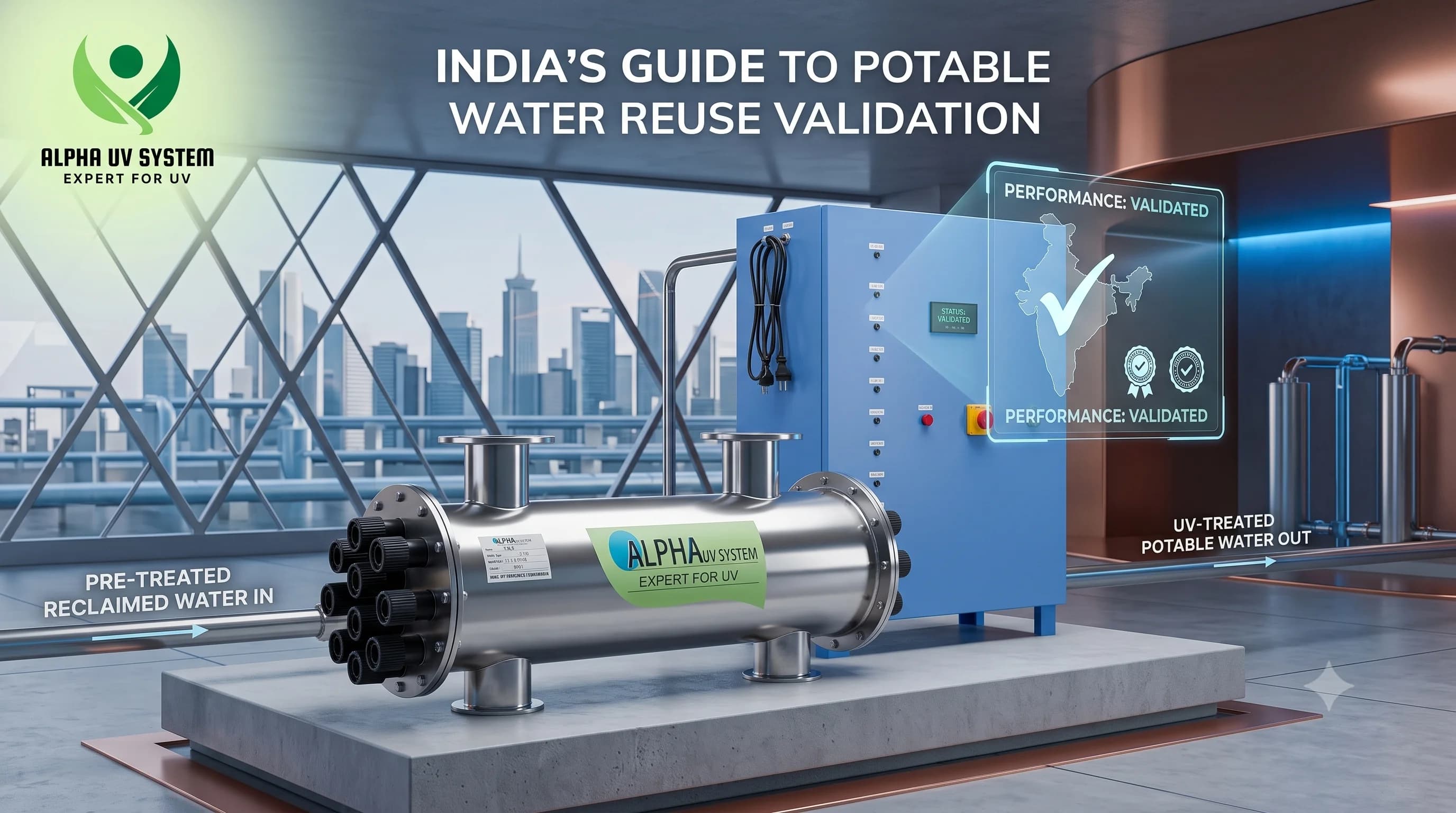
Potable water reuse — treating reclaimed wastewater or heavily treated STP effluent to drinking water quality standards — is an emerging water security strategy in India, particularly in water-stressed states like Maharashtra, Gujarat, Rajasthan, and Tamil Nadu. UV disinfection is a required or strongly recommended treatment step in all potable reuse frameworks, and the validation requirements for UV systems in potable reuse applications are more rigorous than for conventional water treatment. This guide explains what validation testing is required for UV systems used in potable water reuse under Indian regulatory guidelines, international reference frameworks, and how Indian buyers should specify UV system validation in procurement documents.
Indian Regulatory Framework for Potable Water Reuse
India does not yet have a single comprehensive national standard specifically for potable water reuse. The applicable regulatory framework is assembled from multiple sources:
- BIS IS 10500:2012 — Drinking Water Specification: the microbiological quality standard that potable reuse water must meet (zero E. coli per 100 ml, total coliforms less than 1 MPN/100 ml)
- BIS IS 17446:2022 — UV Disinfection Systems for Drinking Water: the Indian standard for UV reactor performance validation, lamp specification, UV intensity sensor requirements, and dose verification methodology for drinking water UV systems
- CPHEEO Manual on Water Supply and Treatment — the Central Public Health and Environmental Engineering Organisation manual, which references UV as an acceptable disinfection technology and specifies minimum dose requirements for drinking water
- CPCB Guidelines for Reclaimed Water Use — provides quality standards for treated wastewater at different reuse categories; potable reuse requires IS 10500 standards
- State Water Authority Guidelines — Maharashtra Jeevan Pradhikaran (MJP), Delhi Jal Board (DJB), and Tamil Nadu Water Supply and Drainage Board (TWAD) issue project-specific guidelines for water reuse schemes that reference BIS IS 17446 and IS 10500
For potable reuse applications, the conservative interpretation — treating reclaimed water to IS 10500 standard using UV validated to BIS IS 17446 — is the standard position that Indian regulatory authorities and water consultants apply in the absence of dedicated potable reuse standards.
What Is UV System Validation?
UV system validation is the process of demonstrating, through controlled testing, that a UV reactor achieves the required UV dose (measured in mJ/cm²) at the design flow rate and minimum UVT condition. There are two levels of UV validation:
Hydraulic Validation (Computational Fluid Dynamics + Tracer Testing)
Hydraulic validation uses computational fluid dynamics (CFD) modelling or physical tracer testing to confirm the hydraulic residence time distribution inside the UV reactor — specifically, that the shortest flow path (minimum residence time) delivers sufficient UV dose. Dead zones or short-circuit flow paths reduce effective UV exposure time and can cause under-dosing without being detectable from UV sensor readings alone. For potable water reuse UV systems, hydraulic validation by CFD modelling is expected for any system above 10 m³/h.
Biodosimetry (Bioassay) Validation
Biodosimetry — also called bioassay validation or microbiological validation — measures the actual UV dose delivered by a reactor using a challenge microorganism (typically MS2 bacteriophage or Bacillus subtilis spores) whose UV inactivation kinetics are well-characterised. The UV dose delivered to the challenge organism under controlled test conditions is used to derive a dose-response curve that confirms the reactor delivers the required dose. BIS IS 17446 references biodosimetry as the preferred method for UV reactor dose validation for Indian drinking water applications. For potable water reuse, biodosimetry validation is mandatory for any UV system intended to serve as the primary Cryptosporidium barrier in an indirect or direct potable reuse scheme.
BIS IS 17446 Validation Requirements for Drinking Water UV Systems
BIS IS 17446:2022 — Ultraviolet Disinfection Systems for Drinking Water — specifies the following validation requirements that apply directly to UV systems used in potable water reuse:
| Validation Element | BIS IS 17446 Requirement | Documentation Required |
|---|---|---|
| UV dose delivery | Minimum 40 mJ/cm² at rated flow and minimum UVT | Biodosimetry test report from accredited laboratory |
| UV lamp specification | UV-C lamp at 253.7 nm, rated output in mW at 254 nm | Lamp manufacturer COA (Certificate of Analysis) |
| UV intensity sensor | Calibrated sensor with traceable calibration certificate | NABL-accredited calibration certificate |
| Reactor material | SS316L or equivalent corrosion-resistant material | Mill test certificate for reactor chamber material |
| Performance verification | On-site commissioning test at design flow and measured UVT | Commissioning report with flow rate, UVT, and UV sensor reading |
| Dose calculation | UVT-corrected dose calculation at minimum design UVT | Engineering dose calculation report |
What UV Dose Is Required for Potable Water Reuse?
The required UV dose for potable water reuse is higher than for conventional drinking water treatment because the target is typically Cryptosporidium and Giardia — waterborne protozoa that are resistant to chlorination but highly sensitive to UV. The WHO and US EPA guidance on potable water reuse specifies:
- 40 mJ/cm² — minimum for 4-log (99.99%) E. coli inactivation and 3-log Giardia inactivation. Required minimum for IS 10500 drinking water compliance.
- 100 mJ/cm² — 4-log (99.99%) Cryptosporidium inactivation. Required for any indirect potable reuse scheme where Cryptosporidium is a treatment objective.
- 186 mJ/cm² — 4-log Adenovirus inactivation (low-pressure UV). Required for direct potable reuse schemes under US EPA LT2 rule guidance; increasingly referenced in India for high-risk potable reuse applications.
For Indian potable water reuse applications, the conservative specification is 100 mJ/cm² as the validated minimum dose — this covers Cryptosporidium inactivation and provides adequate safety margin for IS 10500 compliance. CPHEEO and state water authority project consultants typically specify 40–100 mJ/cm² depending on the upstream treatment quality and risk assessment for the specific reuse scheme.
International Reference Standards Applied in India
In the absence of dedicated Indian potable reuse validation standards, Indian water consultants and project engineers reference these international frameworks:
- US EPA UV Disinfection Guidance Manual (UVDGM) — the primary international reference for UV validation methodology, bioassay protocols, and dose verification. Referenced by Indian municipal project consultants for large WTP UV validation.
- DVGW W 294 (Germany) — European UV reactor validation standard for drinking water. Referenced by European-funded Indian water projects and projects involving European project consultants.
- ÖNORM M 5873 (Austria) — Austrian UV standard, widely referenced in the global UV industry as the stringent European benchmark for UV reactor performance and dose delivery verification.
- NSF/ANSI 55 Class A — US standard for UV microbiological water treatment systems. Certifies UV systems that deliver 40 mJ/cm² minimum dose. NSF/ANSI 55 Class A certification is accepted by some Indian state water authorities as equivalent to BIS IS 17446 validation.
Validation Documentation Checklist for Indian Potable Reuse Procurement
For any UV system intended for potable water reuse in India, the following documentation should be specified in the procurement tender or purchase order:
- Biodosimetry test report — from an NABL-accredited or internationally accredited laboratory, showing validated UV dose at the specified flow rate and minimum UVT
- CFD hydraulic modelling report — for systems above 10 m³/h, confirming hydraulic residence time distribution and absence of short-circuit flow
- UV lamp COA (Certificate of Analysis) — from the lamp manufacturer (Philips, Trojan, or equivalent) confirming UV output at 253.7 nm at rated wattage
- NABL-accredited UV intensity sensor calibration certificate — traceable to CSIR-NPL (National Physical Laboratory) or equivalent national standards body
- SS316L mill test certificate — for reactor chamber, confirming material grade and composition
- BIS IS 17446 compliance declaration — manufacturer's declaration of conformity to BIS IS 17446:2022
- On-site commissioning report — with actual measured flow rate, UVT reading, and UV sensor output at commissioning conditions
- Annual dose verification protocol — methodology for annual verification that UV dose delivery is maintained after lamp aging and quartz sleeve fouling
What Alpha UV System Provides for Potable Reuse Validation
Alpha UV System provides the following as standard deliverables for UV systems supplied for potable water reuse or high-criticality drinking water applications:
- BIS IS 17446:2022 compliance documentation
- Philips UV-C lamp COA for each lamp batch supplied
- NABL-accredited UV intensity sensor calibration certificate
- SS316L mill test certificate for reactor chamber
- Engineering dose calculation report (UVT-corrected, at minimum design UVT)
- On-site commissioning report with measured flow, UVT, and UV sensor readings
- Annual lamp replacement schedule based on rated Philips lamp life (16,000 hours for amalgam TUV lamps)
For projects requiring third-party biodosimetry validation or CFD hydraulic modelling, Alpha UV System can arrange through NABL-accredited test laboratories and coordinate submission documentation for project regulatory approval.
What validation testing is required for UV in potable water reuse under Indian guidelines?
Under Indian guidelines (BIS IS 17446:2022 and CPHEEO Manual on Water Supply and Treatment), UV systems used for potable water reuse must provide: (1) biodosimetry (bioassay) validation confirming the reactor delivers the required UV dose — minimum 40 mJ/cm² for IS 10500 compliance, 100 mJ/cm² for Cryptosporidium barrier; (2) UV lamp Certificate of Analysis (COA) from the lamp manufacturer confirming UV-C output at 253.7 nm; (3) NABL-accredited UV intensity sensor calibration certificate; (4) SS316L reactor material mill test certificate; and (5) on-site commissioning report. For systems above 10 m³/h, CFD hydraulic validation is expected. These requirements apply under BIS IS 17446:2022 for drinking water UV systems and are referenced by state water authority project consultants for potable reuse schemes.
What UV dose is required for Cryptosporidium inactivation in Indian potable water reuse?
For 4-log (99.99%) Cryptosporidium parvum inactivation — the standard target for potable water reuse applications where Cryptosporidium is a treatment objective — a UV dose of 100 mJ/cm² using low-pressure UV (254 nm) is required. This is significantly higher than the 40 mJ/cm² minimum specified for IS 10500 E. coli compliance. Indian water consultants and CPHEEO project engineers typically specify 40–100 mJ/cm² depending on the upstream treatment quality and risk category of the specific potable reuse scheme. For indirect potable reuse with substantial soil aquifer treatment (SAT) or reverse osmosis as upstream treatment barriers, 40 mJ/cm² may be acceptable; for direct potable reuse with minimal upstream treatment, 100 mJ/cm² is the conservative and recommended specification.
Is NSF/ANSI 55 Class A certification accepted for Indian potable reuse UV systems?
NSF/ANSI 55 Class A certification — the US standard for UV microbiological water treatment systems delivering a minimum 40 mJ/cm² dose — is accepted by some Indian state water authorities as equivalent to BIS IS 17446 validation, particularly on projects with international project financing (World Bank, ADB, JICA) where international standards are contractually specified. For purely domestic Indian government procurement (AMRUT, JJM, state water missions), BIS IS 17446:2022 compliance is the specified requirement. Alpha UV System provides BIS IS 17446 documentation as the primary compliance path for all Indian potable water and potable reuse applications.
UV System Validation Documentation for Your Potable Reuse Project?
Alpha UV System supplies UV disinfection systems for potable water reuse applications with complete BIS IS 17446 validation documentation — lamp COA, NABL sensor calibration, SS316L mill certificates, engineering dose calculations, and commissioning reports. Contact our engineering team with your project specifications and UVT data for a system recommendation and documentation package.
Standards, authorities & further reading
External references used to inform this guide. Regulations evolve — check the latest revision on each authority's site before compliance decisions.
Recommended UV Systems
Alpha UV System products for this application — powered by genuine Philips UV-C lamps.
Commercial UV Water Purification System
500 – 5,000 LPH
HACCP-compliant UV water purification for hotels, restaurants, and offices
Industrial UV Water Treatment System
5,000 – 50,000 LPH
Schedule M 2025 and HACCP compliant UV for pharma, food & beverage, and process water
Not sure which system suits your application? WhatsApp our engineers for a free recommendation →
Related solutions
See how Alpha UV System applies this to your industry or city.
Need a UV system?
Talk to our UV engineers — WhatsApp for a quote in 2 hours, or browse the full catalog on IndiaMART.