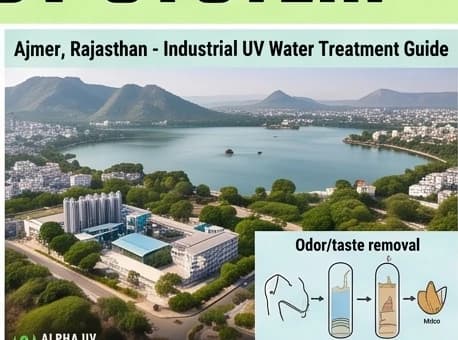
UV water treatment in Ajmer addresses four key needs: (1) post-overhead-tank disinfection for Ajmer's dense residential areas — AMC (Ajmer Municipal Corporation) supply from Ana Sagar Lake and Bisalpur Dam loses residual chlorine in overhead tanks during Rajasthan's extreme desert heat (temperatures reach 44–48°C in May–June in the Ajmer basin); (2) Dargah Sharif and religious tourism UV — the Dargah of Hazrat Khwaja Moinuddin Chishti (one of the most visited Islamic shrines in South Asia) receives 3–4 million pilgrims annually; the langar and community kitchen serving thousands of devotees daily requires FSSAI food contact water with no chemical residuals; (3) Pushkar tourism UV — the Pushkar Camel Fair (October–November, 200,000+ tourists) and the Brahma temple (one of only two Brahma temples in India) make Pushkar a unique tourism UV market; and (4) RPCB STP compliance for Ajmer's residential developments. Alpha UV System supplies Philips UV-C lamp UV systems to Ajmer with 5–7 day delivery and RPCB documentation support.
Ajmer — surrounded by the Aravalli Hills at the centre of Rajasthan — is simultaneously one of India's most important pilgrimage cities and an emerging industrial centre. The Ajmer Sharif Dargah (the tomb of Sufi saint Khwaja Moinuddin Chishti, who brought the Chishti order of Sufism to India in the 12th century) is visited by Muslims, Hindus, Sikhs, and people of other faiths — making it one of India's most syncretic pilgrimage sites. The Urs festival (celebrating Khwaja Sahib's death anniversary, held in the Islamic calendar month of Rajab) draws millions of pilgrims to Ajmer annually, creating concentrated water demand at the Dargah Sharif and the surrounding Nala Bazaar area.
UV water treatment in Ajmer must address Rajasthan's most challenging water context: Ana Sagar Lake (an artificial lake built by the Chahamana ruler Anaji in the 12th century) is the primary urban reservoir, supplemented by Bisalpur Dam water (transported 100 km to Ajmer). Ana Sagar's water quality is stressed by the lake's shallow depth, high evaporation rate (Rajasthan's desert climate causes 2–3 metres of evaporation annually), and nutrient loading from the surrounding urban zone. Summer temperatures regularly exceed 46°C, and the combination of intense heat, water scarcity, and high pilgrim density makes UV water treatment in Ajmer an essential public health infrastructure for the city's residential, hospitality, and religious sectors.
The Kishangarh marble belt (30 km from Ajmer) — processing Rajasthan's famous Makrana marble (used in the Taj Mahal) and other Indian marble — and the Beawar textile sector are additional industrial UV demand zones in the Ajmer region. RPCB compliance for marble cutting slurry ETP and textile dyeing ETP creates regulatory UV demand in the surrounding industrial towns.
Ajmer Water Quality by Zone and UV Requirement
| Zone / Area | Supply Type | Key Water Quality Issue | Recommended UV Solution |
|---|---|---|---|
| Central Ajmer (Nala Bazaar, Dargah zone) | AMC piped supply (Ana Sagar Lake / Bisalpur Dam) | Ana Sagar algae and eutrophication; 47°C summer bacterial regrowth; pilgrim density; supply intermittency in peak summer | Post-tank UV at 40 mJ/cm²; 5 µm pre-filter; Dargah langar FSSAI UV; chemical-free preferred |
| Pushkar (pilgrim and tourism town) | Pushkar municipal supply + borewell + Pushkar Lake | Pushkar Camel Fair (200,000+ tourists); Brahma temple; Pushkar Lake (sacred — not for potable use); borewell fluoride risk in Aravalli zone | Hotel UV; camel fair tourism UV; FSSAI food stall water; NABL test borewell for fluoride; Pushkar Lake not potable |
| RIICO industrial area (Ajmer / Beawar) | RIICO supply + borewell | Pharmaceutical manufacturing; textile dyeing (Beawar); engineering; RPCB STP compliance | Pharmaceutical UV (185+254 nm); textile dyeing ETP UV-AOP; RPCB STP UV; Schedule M 2025 |
| Kishangarh (marble processing town) | Kishangarh municipal + borewell | Makrana and Italian marble cutting — silica slurry ETP; RPCB compliance; worker potable water; borewell TDS 500–1,500 mg/L | Marble worker potable UV; RPCB ETP UV; RO+UV for high TDS borewell if TDS >500 mg/L |
| New Ajmer residential (Vaishali Nagar, Ramsar) | AMC supply + borewell | Rapid residential growth; RPCB STP mandatory; borewell TDS 500–2,000 mg/L (Aravalli zone hard rock aquifer) | Post-tank UV; STP UV; RO+UV mandatory for high TDS borewell (>500 mg/L); RPCB documentation |
UV Water Treatment for Ajmer Dargah Sharif and Religious Tourism
The Ajmer Sharif Dargah — managed by the Dargah Khwaja Saheb Committee (a statutory body under the Ministry of Minority Affairs, Government of India) — operates one of India's largest community kitchens serving the millions of pilgrims and devotees at the Dargah annually. The community langar (known as degh) involves the preparation of enormous cauldrons of rice pudding (kheer or qorma) in the Dargah's traditional deghs (the two massive iron deghs — one donated by Emperor Akbar — are among Ajmer's most famous sights). Food and water safety at the Dargah's community feeding operations fall under FSSAI's institutional food safety framework.
UV water treatment in Ajmer's Dargah context: the community kitchen water supply must be FSSAI-compliant. Chemical disinfection (chlorination) of the cooking and preparation water at the Dargah has religious sensitivity — water used in the preparation of food at a sacred shrine should ideally be free of chemical additives. UV provides the food safety compliance without the chemical residual concern. The Dargah Committee's water supply — AMC connection with overhead storage — benefits from UV at the kitchen supply inlet to eliminate any post-storage bacterial contamination before the degh preparation. Additionally, the thousands of pilgrims drinking from water points (sabeel or cold water points) at the Dargah benefit from UV-treated water that meets BIS 10500 potable water standards without chlorine taste that many pilgrims find objectionable.
Pushkar's tourism UV demand: Pushkar (11 km from Ajmer) during the November Camel Fair receives 200,000+ domestic and international tourists, making it one of Rajasthan's most concentrated tourism events. Hotels, guesthouses, and food stalls at Pushkar serving international tourists during the fair require WHO-standard drinking water. UV water treatment in Pushkar hotels and restaurants — combined with RO for the high-TDS Pushkar borewell water (TDS 800–2,000 mg/L in the Aravalli hard rock zone) — provides the water quality that international tourists from Europe, USA, and Japan expect.
UV System Sizing for Ajmer Applications
| Application | Flow Rate | UV Dose Required | Key Notes |
|---|---|---|---|
| Residential apartment (Ajmer city) | 1–3 m³/h | 40 mJ/cm² | Post-overhead-tank UV; 5 µm pre-filter; 47°C May–June desert heat critical; borewell TDS check |
| Dargah langar / community kitchen | 5–20 m³/h | 40 mJ/cm² | FSSAI institutional kitchen; chemical-free (sacred food context); degh preparation water; Urs festival peak sizing |
| Pushkar hotel / Camel Fair accommodation | 2–10 m³/h | 40 mJ/cm² | International tourist WHO standard; RO+UV for high-TDS borewell; peak November Camel Fair capacity |
| Pharmaceutical purified water (RIICO Ajmer) | 2–10 m³/h | 80 mJ/cm² | 185+254 nm; Schedule M 2025 IQ/OQ/PQ; RPCB documentation; CDSCO inspection-ready |
| Marble worker potable water (Kishangarh) | 1–3 m³/h | 40 mJ/cm² | RO+UV mandatory if TDS >500 mg/L; Factories Act worker water; silica dust exposure workforce |
| Textile dyeing ETP (Beawar RIICO) | 5–30 m³/h | 1,500–3,000 mJ/cm² | UV-AOP with H₂O₂; RPCB colour limit 400 ADMI; Luni basin discharge; NGT Rajasthan enforcement |
| STP 300 KLD (Ajmer residential) | 20–30 m³/h | 40 mJ/cm² | Philips TUV 95W × 4; RPCB consent documentation; Ana Sagar lake protection programme |
Recommended UV Systems for Ajmer — Philips UV-C Lamp Models
UV water treatment in Ajmer spans from compact residential systems for the city's older residential zones to large-scale pilgrim infrastructure UV for the Dargah and Pushkar. All Alpha UV System products use Philips UV-C lamps with rated 9,000+ hour lamp life — critical in Ajmer where the harsh desert environment (dust, extreme heat) means maintenance access can be challenging, and long lamp life reduces maintenance frequency.
| Application / Segment | Recommended UV System | Philips Lamp Model | Flow Capacity | Key Advantage for Ajmer |
|---|---|---|---|---|
| Residential / small guesthouse | Alpha UV 16W Domestic | Philips TUV 16W | Up to 1.5 m³/h | Compact; 9,000h lamp life; low maintenance for desert climate |
| Hotel / restaurant / clinic | Alpha UV 36W Commercial | Philips TUV 36W | Up to 3 m³/h | FSSAI food contact; 316L SS; chemical-free for religious tourism context |
| Dargah kitchen / large guesthouse | Alpha UV 55W SS316L | Philips TUV 55W | Up to 8 m³/h | High-flow institutional kitchen; FSSAI compliance; no chlorine residual |
| STP 100–300 KLD / pharmaceutical | Alpha UV 95W Industrial | Philips TUV 95W | Up to 20 m³/h | RPCB STP documentation; industrial grade; intensity monitoring |
| Large STP / Camel Fair temporary UV | Alpha UV Multi-lamp 95W × 4 | Philips TUV 95W × 4 | Up to 80 m³/h | High-capacity for Urs / Camel Fair peaks; modular installation |
Regulatory Compliance Reference for Ajmer UV Systems
| Regulation / Authority | Applicable Sector | UV Requirement | Key Documentation |
|---|---|---|---|
| RPCB STP Consent (Rajasthan) | Residential / commercial complexes ≥50 KLD | UV at 40 mJ/cm² on STP final effluent; faecal coliform <1,000 MPN/100 mL; BOD <30 mg/L | UV commissioning report; intensity monitoring log; RPCB consent renewal records |
| FSSAI (Institutional kitchen / langar) | Dargah langar, hotels, Camel Fair food stalls | FSSAI food safety water; IS 10500 microbial compliance; UV records for FSSAI renewal | FSSAI license file; UV commissioning certificate; pre-filter replacement log |
| CDSCO Schedule M 2025 (Pharmaceutical) | RIICO Ajmer / Beawar pharmaceutical units | Purified Water UV; IQ/OQ/PQ validation documentation | UV IQ/OQ/PQ validation report; periodic PW quality records; CDSCO file |
| RPCB ETP (Textile / marble) | Beawar textile dyeing / Kishangarh marble ETP | ETP final effluent UV; RPCB colour limit (textile); Luni basin discharge norms | RPCB ETP consent conditions; UV commissioning; discharge monitoring records |
| Rajasthan Tourism Dept / FSSAI (Pushkar) | Pushkar hotels, guesthouses, Camel Fair vendors | FSSAI food and water safety; Rajasthan Tourism Board registered properties UV compliance | Tourism registration file; FSSAI license; UV commissioning certificate |
Frequently Asked Questions — UV Water Treatment in Ajmer
Is Ana Sagar Lake water safe after AMC treatment, or is UV still needed?
Ana Sagar Lake's water quality is degraded by nutrient loading from Ajmer's dense urban catchment (algae growth, increased BOD) and by the lake's shallow nature (shallow lakes heat up faster in Rajasthan's summer, accelerating algal bloom formation). The AMC's WTP treats Ana Sagar and Bisalpur Dam water to BIS 10500 standards. However, Ajmer's distribution network is aging, supply is intermittent in summer, and overhead tank storage at 47–48°C temperatures creates rapid bacterial regrowth. UV at the household outlet is essential to protect against contamination introduced after the WTP — in Ajmer's summer conditions, this post-WTP contamination risk is among the highest in India.
Pushkar borewell water has very high TDS — does UV help with TDS?
No — UV does not reduce TDS (Total Dissolved Solids). Pushkar's borewell water from the hard rock Aravalli aquifer has TDS 800–2,500 mg/L (the BIS acceptable limit is 500 mg/L, permissible up to 2,000 mg/L). This water tastes salty, is unpalatable for drinking, and can cause health issues with long-term consumption above 1,000 mg/L. UV treats only the microbial (biological) contamination in the water. For Pushkar's high-TDS borewell water, the treatment sequence must be: RO (Reverse Osmosis) first to reduce TDS below 500 mg/L, then UV after RO to disinfect the RO permeate. Installing UV on high-TDS Pushkar borewell water without RO will give microbiologically safe water that still has unacceptably high mineral content. Always combine RO with UV for Pushkar's hard water borewell sources.
Is fluoride a concern in Ajmer's borewell water?
Fluoride in groundwater is a known concern in parts of Rajasthan, particularly in areas overlying Aravalli rock formations that contain fluorite minerals. While the Ajmer city area (which relies primarily on surface water from Ana Sagar and Bisalpur) does not typically have severe fluoride issues in piped supply, outlying areas of Ajmer district and some zones of Kishangarh and Beawar have borewell fluoride concentrations of 1.5–5 mg/L. The BIS permissible limit is 1.5 mg/L. Critically: UV does NOT remove fluoride. If your borewell water has fluoride above 1.5 mg/L, activated alumina defluoridation or RO is required before UV. Have your borewell water tested by a NABL-accredited laboratory for fluoride before specifying any treatment system in the Ajmer area.
Is there any religious requirement for water purity at the Dargah Sharif that UV addresses?
Islamic teachings on ritual purity (tahara) require that water used in ablution (wudu), cooking, and religious food preparation be tahir (pure) — free of contaminating substances. The chemical addition of chlorine to water at a sacred shrine is a matter of religious sensitivity in some interpretations, though most Islamic scholars accept treated municipal water for all uses. UV treatment — which uses light (not chemicals) for disinfection, leaves no residual in the water, and produces no by-products — is the most religiously neutral form of water treatment available. The Dargah Khwaja Saheb Committee, which manages the Dargah's infrastructure, has practical incentives to use UV-treated water for the langar and sabeel (water distribution) operations: UV maintains the natural taste of water (pilgrims at the Dargah report preference for non-chlorinated water at the sabeel), and UV's documentation trail satisfies the FSSAI institutional food safety compliance requirements that apply to the Dargah's community kitchen.
Alpha UV System supplies UV disinfection systems to the Dargah Sharif, Pushkar hotels, pharmaceutical units, marble processors, residential complexes, and STP operators across Ajmer, Pushkar, Kishangarh, Beawar, and the Ana Sagar basin. RPCB STP documentation. FSSAI Dargah langar kitchen UV. Pushkar tourism water safety UV. Schedule M 2025 pharma UV. Philips UV-C lamps. 5–7 day delivery to Ajmer.
WhatsApp Us for Ajmer UV System SupplyStandards, authorities & further reading
External references used to inform this guide. Regulations evolve — check the latest revision on each authority's site before compliance decisions.
Recommended UV Systems
Alpha UV System products for this application — powered by genuine Philips UV-C lamps.
Commercial UV Water Purification System
500 – 5,000 LPH
HACCP-compliant UV water purification for hotels, restaurants, and offices
Industrial UV Water Treatment System
5,000 – 50,000 LPH
Schedule M 2025 and HACCP compliant UV for pharma, food & beverage, and process water
Not sure which system suits your application? WhatsApp our engineers for a free recommendation →
Related solutions
See how Alpha UV System applies this to your industry or city.
Need a UV system?
Talk to our UV engineers — WhatsApp for a quote in 2 hours, or browse the full catalog on IndiaMART.