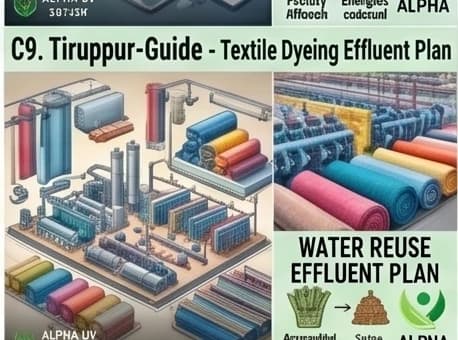
UV water treatment in Tiruppur addresses three distinct but critical needs: (1) post-overhead-tank disinfection for Tiruppur's dense residential and worker colony areas — TMC (Tiruppur Municipal Corporation) supply from the Noyyal River and Thirumurthy Dam loses residual chlorine in overhead tanks during Tiruppur's warm weather (temperatures reach 36–40°C in April–May); (2) UV-AOP (UV Advanced Oxidation Process) for Tiruppur's massive hosiery dyeing and bleaching ETP sector — Tiruppur is India's largest knitwear export city ("Dollar City") and its concentrated dyeing cluster has faced TNPCB Zero Liquid Discharge (ZLD) mandates since the Madras High Court and NGT interventions on Noyyal River; and (3) textile RO reject and ZLD concentrated brine treatment — UV-AOP is used as a final colour polishing step in ZLD schemes before forced evaporation. Alpha UV System supplies Philips UV-C lamp UV systems to Tiruppur with 5–7 day delivery and TNPCB documentation support.
Tiruppur — known as "Dollar City" for its massive foreign exchange earnings from knitwear exports and "Knitting Capital of India" for its central role in India's hosiery and knitwear production — is a city where water and textiles are inseparably linked. The city produces approximately $4–5 billion in knitwear exports annually (T-shirts, innerwear, sportswear, children's garments) primarily to EU, USA, and UK markets. This production requires enormous volumes of water for dyeing, bleaching, and finishing — making Tiruppur one of Tamil Nadu's largest industrial water consumers and one of the TNPCB's most closely monitored industrial clusters.
The Noyyal River — which flows through Tiruppur on its way to join the Cauvery — was one of Tamil Nadu's most polluted rivers through the 1990s and 2000s, heavily impacted by untreated dyeing and bleaching effluent. A series of Madras High Court orders (culminating in a 2011 closure order against non-complying dyeing units) and subsequent TNPCB enforcement has driven Tiruppur's knitwear sector toward combined ETP systems and ZLD technology. UV-AOP plays a key role in the ZLD and final ETP polishing stage for Tiruppur textile units.
Tiruppur Water Quality by Zone
| Zone / Area | Supply Type | Key Water Issue | UV Solution |
|---|---|---|---|
| Central Tiruppur (Avinashi Road, Palladam Road) | TMC piped supply (Noyyal / Thirumurthy Dam) | Bacterial regrowth in tanks April–May; supply intermittency in dry season; old distribution in knitting cluster core | Post-tank UV at 40 mJ/cm²; 5 µm pre-filter; April–May critical |
| Dyeing and bleaching cluster (TIDCO, Kangeyam Rd) | TIDCO supply + borewell + tanker | Reactive/direct dye effluent — TNPCB ZLD mandate; Noyyal River colour compliance; online monitoring | UV-AOP with H₂O₂; medium-pressure lamps; TNPCB colour limit; ZLD scheme UV-AOP polishing |
| Kangeyam SIDCO industrial area | SIDCO supply + borewell | Knitting and finishing units; accessories manufacturing; TNPCB STP compliance | Post-tank UV; STP UV; process water UV; TNPCB documentation |
| Dharapuram / Palladam satellite towns | TWAD supply + borewell | Extended dyeing cluster towns; agricultural areas; borewell TDS 300–700 mg/L; STP compliance | Post-tank UV; STP UV; RO + UV only if borewell TDS >500 mg/L |
| Worker colony residential (knitwear sector) | TMC supply + borewell | Dense worker housing — FSSAI mess hall water; large-flow dormitory UV; safe drinking water for migrant workforce | Worker mess UV; dormitory post-tank UV; FSSAI food contact water compliance |
UV-AOP in Tiruppur's Zero Liquid Discharge Scheme
Tiruppur's Combined Effluent Treatment Plants (CETPs) — the Tirupur Dyers Association (TDA) CETP and the several other regional CETPs — process the combined effluent from hundreds of member dyeing units. The ZLD scheme adopted after the 2011 court orders requires that no liquid effluent is discharged to the Noyyal — all water must be recovered and recycled or evaporated. The ZLD technology chain typically follows this sequence: (1) biological treatment (activated sludge or MBBR); (2) primary membrane filtration (microfiltration or ultrafiltration); (3) RO for salt recovery and high-quality permeate; (4) evaporation of RO concentrate; and (5) UV-AOP on the RO permeate as a final colour and microbial polishing step before recirculation to process water tanks.
The role of UV-AOP at the ZLD polishing stage: even after RO, some reactive dye fragments (low molecular weight, below the RO membrane rejection threshold) can pass into the permeate. These residual colour compounds — too low in concentration for conventional biological removal but above the visual threshold — are efficiently degraded by UV-AOP at 1,000–2,000 mJ/cm² with H₂O₂ at 30–60 mg/L. The UV-AOP step at the RO permeate stage also provides additional microbial inactivation that is valuable for water being recycled to food-contact dyeing processes (where fabrics being dyed for intimate wear or children's clothing have EU Oeko-Tex chemical standards that include microbial limits).
TNPCB online monitoring at Tiruppur CETPs: TNPCB's real-time effluent monitoring at Tiruppur CETPs (colour, COD, pH, TSS) means that any UV-AOP system failure is immediately visible in the monitoring data. UV-AOP systems at Tiruppur CETPs should be specified with redundant lamp configuration (dual chamber or standby lamp) so that a single lamp failure does not cause colour discharge exceedance visible to TNPCB before maintenance can be arranged.
| Application | Flow Rate | UV Dose | Notes |
|---|---|---|---|
| Residential / worker colony apartment (Tiruppur) | 1–3 m³/h | 40 mJ/cm² | Post-overhead-tank UV; 5 µm pre-filter; April–May critical; worker colony FSSAI mess compliance |
| Dyeing unit ETP colour polishing (reactive dyes) | 10–100 m³/h | 1,500–3,000 mJ/cm² | UV-AOP with H₂O₂; medium-pressure lamps; TNPCB 400 ADMI colour limit; redundant lamp configuration for online monitoring sites |
| CETP ZLD — RO permeate UV-AOP polishing | 20–200 m³/h | 1,000–2,000 mJ/cm² | ZLD permeate quality polishing; residual reactive dye fragment degradation; Oeko-Tex water quality compliance for export fabrics |
| Bleaching unit ETP (optical brightener) | 5–30 m³/h | 2,000–4,000 mJ/cm² | Optical brightener degradation; medium-pressure lamps; TNPCB consent documentation |
| Knitwear factory drinking water / kitchen | 1–3 m³/h | 40 mJ/cm² | FSSAI factory canteen; migrant worker food safety; no chemicals in drinking water |
| STP outlet — 300 KLD (Tiruppur residential) | 20–30 m³/h | 40 mJ/cm² | Philips TUV 95W; TNPCB consent documentation; Noyyal-Cauvery basin ZLD compliance |
Tiruppur dyeing units are under ZLD mandate — do they still need UV, or does the ZLD system handle everything?
ZLD (Zero Liquid Discharge) handles volume — it ensures no liquid is discharged to the Noyyal. But ZLD does not guarantee quality at every stage of the water cycle — and this is where UV plays a critical role in Tiruppur's ZLD system.
Three specific UV requirements within a Tiruppur ZLD scheme: (a) RO permeate colour polishing: The RO membrane in a ZLD system rejects most dye molecules (those above ~200 Dalton molecular weight), but reactive dye hydrolysates (the water-reacted form of reactive dyes) can be smaller and may partially pass through. UV-AOP on the RO permeate degrades these residual colour compounds before the water is recycled to process tanks; (b) Recycled process water microbial safety: Water being recycled through multiple cycles in a ZLD system can accumulate microorganisms that are resistant to the biological treatment step. UV at 40 mJ/cm² on the recycled water stream before reuse in the dyeing process ensures the recycled water doesn't introduce bacterial contamination that causes dye mottling or spotting defects on the fabric; (c) Employee drinking water: In Tiruppur's crowded dyeing cluster, safe drinking water for workers is a legal obligation under the Factories Act. Even where ZLD is fully implemented for process water, separate UV treatment for employee drinking water is required.
In summary: ZLD compliance and UV treatment are complementary, not alternatives. Tiruppur dyeing units need both — ZLD for volume management and TNPCB compliance, UV-AOP for quality management within the ZLD cycle.
Alpha UV System supplies UV disinfection and UV-AOP systems to dyeing ETPs, CETP ZLD schemes, knitwear factories, residential complexes, and STP operators across Tiruppur, Avinashi Road dyeing cluster, Kangeyam SIDCO, Dharapuram, and Palladam. TNPCB ETP and STP documentation. NGT-compliant textile UV-AOP. ZLD RO permeate polishing UV. Philips UV-C lamps. 5–7 day delivery to Tiruppur.
WhatsApp Us for Tiruppur UV System SupplyRecommended UV Systems
Alpha UV System products for this application — powered by genuine Philips UV-C lamps.
Commercial UV Water Purification System
500 – 5,000 LPH
HACCP-compliant UV water purification for hotels, restaurants, and offices
Industrial UV Water Treatment System
5,000 – 50,000 LPH
Schedule M 2025 and HACCP compliant UV for pharma, food & beverage, and process water
Not sure which system suits your application? WhatsApp our engineers for a free recommendation →
Related solutions
See how Alpha UV System applies this to your industry or city.
Need a UV system?
Talk to our UV engineers — WhatsApp for a quote in 2 hours, or browse the full catalog on IndiaMART.