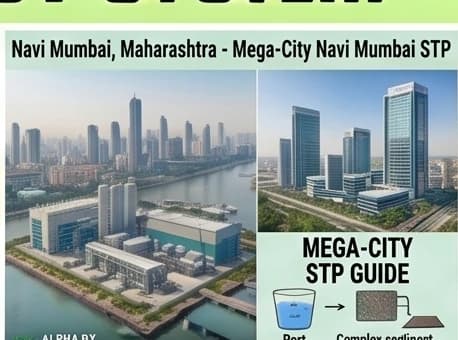
UV water treatment in Mumbai addresses four specific needs: (1) post-overhead-tank disinfection in high-rise residential buildings where BMC supply loses its chloramine residual after 24–48 hours of warm storage; (2) Legionella prevention in the cooling towers and hot water systems of Mumbai's 5-star hotels, corporate towers, and data centres in BKC, Nariman Point, Lower Parel, and Andheri; (3) pharmaceutical-grade purified water for API manufacturers and formulation plants in the Thane-Belapur MIDC, Ambernath, and Dombivli industrial belts; and (4) UV disinfection for MPCB STP compliance at residential complexes across Navi Mumbai, Thane, Kalyan-Dombivli, and Mumbai suburban zones. Alpha UV System supplies Philips UV-C lamp systems to Mumbai with 5–7 day delivery and MPCB documentation.
Mumbai — India's commercial capital and most densely populated major city — presents a distinct UV water treatment profile driven by its geography and real estate typology. The city's high-rise density (hundreds of residential towers above 20 floors in Worli, Bandra, Andheri, Malad, and emerging locations like Vikhroli and Mulund) means that water pumped to rooftop tanks travels a vertical distance of 50–120 metres and sits in uninsulated tanks in Mumbai's humid, warm climate (average temperature 27–34°C year-round) for extended periods before use.
BMC (Brihanmumbai Municipal Corporation) operates one of India's largest water supply systems, drawing from Bhatsa, Vaitarna, Tulsi, Tansa, and other reservoirs. BMC water quality at the main is generally good by Indian standards — but the combination of ageing distribution pipes, intermittent supply in some zones, and rooftop tank storage creates the same bacterial regrowth problem seen in every major Indian city, compounded by Mumbai's high ambient temperatures.
Mumbai Water Quality and UV Need by Zone
| Mumbai Zone / Area | Supply Type | Key Water Issue | UV Solution |
|---|---|---|---|
| South Mumbai (Nariman Point, Colaba, Fort) | BMC piped supply (Tansa/Bhatsa) | Aged distribution pipes — some areas show elevated lead and iron; bacterial regrowth in building tanks | Post-tank UV at 40 mJ/cm²; RO+UV for drinking in older buildings |
| BKC, Bandra, Kurla | BMC piped supply | Commercial towers — Legionella risk in cooling towers; STP compliance for commercial buildings | Cooling tower UV (Legionella); potable water UV; STP outlet UV |
| Andheri, Goregaon, Malad (Western suburbs) | BMC piped supply + borewell backup in some buildings | Intermittent supply in some pockets — tanks run dry, causing contamination on refill; bacterial regrowth | Post-tank UV at 40 mJ/cm², 2–8 m³/h |
| Thane, Belapur, Vashi (Navi Mumbai) | NMMC piped supply (Morbe dam) | Generally good supply quality but industrial zones have groundwater contamination concerns; STP compliance for growing residential stock | STP UV; pharma plant UV; residential post-tank UV |
| Kalyan, Dombivli, Ambernath | KDMC supply + borewell | Iron in borewell (0.5–3 mg/L in some areas); E. coli in urban fringe areas; industrial area groundwater | Iron removal + UV; post-tank UV for piped supply |
| Virar, Vasai, Mira-Bhayander | VMC supply + tanker + borewell | High demand, less reliable supply; tanker water quality variable; borewell E. coli in peri-urban areas | Pre-filter + UV; RO + UV for drinking water |
UV for Mumbai's High-Rise Residential Buildings
Mumbai's high-rise residential buildings — from the luxury towers in Worli and Bandra to the mass housing developments in Malad and Mira Road — are almost universally supplied through a multi-stage pumping and storage system: BMC supply into an underground sump → transfer pump → intermediate break tank (mid-floor) → top pump → rooftop overhead tank → gravity distribution to individual apartments.
The rooftop overhead tank is the critical point for UV installation. By the time water reaches the rooftop tank, the BMC chloramine residual may be near zero after distribution main transit. In the rooftop tank — where ambient temperatures can reach 40°C in summer, and where tank access covers are often imperfectly sealed against birds, insects, and dust — bacteria can multiply within 12–24 hours of tank filling. Water flowing from the rooftop tank to apartments in the building has no active disinfectant protecting it.
A UV system at 40 mJ/cm² installed on the rooftop tank outlet (typical flow rate for a 50-flat tower: 2–5 m³/h; for a 200-flat tower: 5–15 m³/h) provides a reliable final disinfection barrier. Installation is straightforward — the UV reactor is inserted inline on the existing tank outlet pipe with two flanged connections and a power supply to the nearest electrical point. No plumbing demolition is required. Installation time for a typical high-rise UV system: 2–4 hours.
Legionella Management UV for Mumbai's Hotels and Corporate Towers
Mumbai's luxury hotel belt — South Mumbai's The Taj Mahal Palace, The Oberoi, Trident; BKC's Westin, Renaissance, JW Marriott; Andheri's Hyatt Regency, Courtyard by Marriott — operates under international brand standards that require Legionella Water Management Plans. Under IHG, Marriott, Hilton, and Accor brand standards, a documented WMP with UV disinfection as a primary control measure on cooling towers and hot water recirculation loops is a brand compliance requirement.
Mumbai's tropical climate creates year-round Legionella risk in cooling towers — water temperatures of 28–35°C in the basin are in the peak growth range throughout the year, not just in summer. UV disinfection at 40–80 mJ/cm² on cooling tower make-up water provides the primary planktonic Legionella control, combined with reduced biocide programme for biofilm management. Monthly Legionella culture testing from risk points (cooling tower basin, hot water return, patient showers in hotel health clubs) completes the WMP.
Corporate towers in BKC and Lower Parel hosting multinational tenants (Morgan Stanley, Goldman Sachs, JPMorgan, HSBC) similarly operate under global real estate management standards that require Legionella WMPs. Building management companies managing these properties — Jones Lang LaSalle (JLL), CBRE, Colliers International — typically specify UV disinfection as a mandatory Legionella control measure in their facility management contracts.
UV for Thane-Belapur Pharmaceutical Industry
The Thane-Belapur MIDC corridor — running from Thane through Airoli, Ghansoli, Kopar Khairne, Belapur, and Taloja in Navi Mumbai — is one of India's most established pharmaceutical manufacturing zones. Companies including Sun Pharma, Cipla, Nicholas Piramal, Lupin, Alkem Laboratories, and dozens of API and formulation manufacturers operate plants in this corridor.
Pharmaceutical water UV requirements in the Thane-Belapur zone follow Schedule M 2025 (CDSCO) exactly as in other Indian pharma manufacturing clusters — 185 nm fused silica UV for TOC reduction and 254 nm UV for loop disinfection. The zone's MPCB enforcement presence is strong — MPCB offices in Thane and Navi Mumbai conduct regular GMP-related utility inspections alongside environmental inspections, and pharmaceutical plants in the zone typically receive combined MPCB environmental + CDSCO pharmaceutical water quality reviews annually.
MPCB STP Compliance in Mumbai MMR
The Mumbai Metropolitan Region's residential construction boom — particularly in Navi Mumbai (Panvel, Kharghar, Ulwe), Thane (Ghodbunder Road, Majiwada), Kalyan-Dombivli, and Mira-Bhayander — has generated thousands of residential complex STPs. MPCB enforcement of STP compliance in MMR is among the most active in India, driven by NGT directions for the Ulhas River basin (Ambernath, Badlapur textile effluent contributed to severe Ulhas River pollution) and the Mumbai Harbour waters.
| STP Capacity (KLD) | Peak Flow Rate (m³/h) | UV Dose | Lamp Specification | MPCB Documentation |
|---|---|---|---|---|
| 50 KLD | 4–6 m³/h | 40 mJ/cm² | 1–2 × Philips TUV 36W | Commissioning report + UV intensity monitoring log |
| 100 KLD | 8–12 m³/h | 40 mJ/cm² | 2 × Philips TUV 55W | Monthly NABL coliform test + UV log |
| 300 KLD | 20–30 m³/h | 40 mJ/cm² | 4 × Philips TUV 95W | Commissioning report + ongoing UV log |
| 500 KLD | 35–50 m³/h | 40 mJ/cm² | 6 × Philips TUV 95W | Quarterly MPCB-witnessed sampling required |
| 1,000 KLD (1 MLD) | 70–90 m³/h | 40 mJ/cm² | Multiple parallel reactors, 8–12 × Philips TUV 95W total | Full MPCB consent renewal documentation |
UV for Mumbai's Data Centre Cooling
Mumbai is India's leading data centre hub — with major colocation facilities operated by Nxtra (Airtel), STT GDC India (Singapore Technologies Telemedia), CtrlS, Yotta, Hiranandani Greenbase, and others in Navi Mumbai (Mahape, Airoli), Thane, and suburban Mumbai zones. Data centres consume enormous amounts of cooling water — a typical hyperscale data centre in Navi Mumbai uses 2–5 million litres of water per day for cooling tower systems.
Data centre cooling towers operate at 25–35°C water temperature in Mumbai's year-round warm climate — ideal for Legionella growth. ASHRAE 188 compliance (mandated by Tier IV and Tier III data centre certification requirements) requires a documented Legionella WMP with UV disinfection as a primary control. Data centre operators contract facility management companies to manage Legionella risk, and UV disinfection systems at 40–80 mJ/cm² on cooling tower make-up and recirculation lines are standard specifications in these contracts.
What does an MPCB STP inspection look like in Mumbai?
MPCB STP inspections in Mumbai typically occur under two triggers: routine consent renewal inspections (every 5 years for Orange category facilities, annually for Red category), and complaint-driven inspections following resident or NGO complaints about odour or effluent quality. During inspection, MPCB officers check: STP operational records (daily flow meter readings, sludge disposal records); UV intensity monitoring log (daily UV sensor readings, lamp change records with Philips COA numbers); spot sampling of raw inlet and treated outlet (BOD, COD, TSS, pH — results available in 24–48 hours from NABL lab); and visual inspection of STP plant condition including UV system operation (is the lamp illuminated? Is the intensity sensor reading above the minimum?). Buildings with UV systems that show expired lamps (beyond 9,000 hours rated life) or missing intensity logs receive immediate improvement notices. Alpha UV System provides a lamp life tracking service and scheduled replacement reminder programme for Mumbai STP clients.
Which floor of a high-rise building should the UV system be installed?
For a typical Mumbai high-rise with a rooftop overhead tank, the UV system should be installed at the lowest practical point below the overhead tank outlet — typically at the rooftop plant room or the tank room just below the overhead tank. This ensures that all water leaving the tank passes through the UV reactor before entering the building plumbing distribution system. Installing at a lower floor provides no advantage (and potentially disadvantage, as water could become recontaminated between the tank and the UV unit if the pipe section above is not clean). For buildings with both underground sumps and overhead tanks, the primary UV installation should be at the overhead tank outlet, with an optional secondary UV at the underground sump outlet if the underground sump itself is a contamination risk (damaged lid, nearby sewage line).
Alpha UV System supplies UV disinfection systems to residential high-rises, hotels, pharmaceutical plants, data centres, and STP operators across Mumbai, Thane, Navi Mumbai, and the Mumbai Metropolitan Region. MPCB STP documentation. Philips UV-C lamps. Hotel Legionella WMP support. 5–7 day delivery to Mumbai.
WhatsApp Us for Mumbai UV System SupplyRecommended UV Systems
Alpha UV System products for this application — powered by genuine Philips UV-C lamps.
Commercial UV Water Purification System
500 – 5,000 LPH
HACCP-compliant UV water purification for hotels, restaurants, and offices
Industrial UV Water Treatment System
5,000 – 50,000 LPH
Schedule M 2025 and HACCP compliant UV for pharma, food & beverage, and process water
Not sure which system suits your application? WhatsApp our engineers for a free recommendation →
Related solutions
See how Alpha UV System applies this to your industry or city.
Need a UV system?
Talk to our UV engineers — WhatsApp for a quote in 2 hours, or browse the full catalog on IndiaMART.