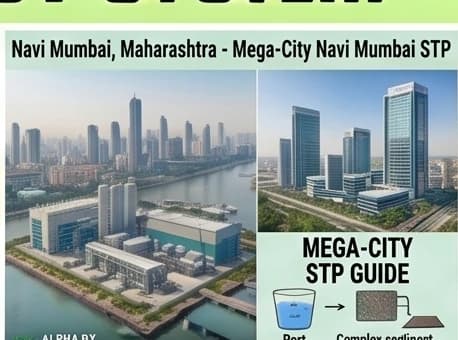
UV water treatment in Navi Mumbai addresses 5 key needs: Taloja MIDC pharmaceutical WHO-GMP and Schedule M 2025 compliance, CIDCO residential STP tertiary disinfection under MPCB's strictest Maharashtra enforcement zone, RERA occupancy certificate dependency on working UV, Panvel–Uran borewell supplemental disinfection, and IT campus drinking water (zero coliforms, no chlorine taste). Alpha UV System supplies Philips TUV-lamp systems from 2 LPM (lab) to 500+ m³/h (industrial) with full documentation for MPCB inspection and WHO-GMP audits.
Why UV Water Treatment Matters in Navi Mumbai
UV water treatment in Navi Mumbai operates across one of India's most demanding regulatory landscapes. Navi Mumbai — planned and developed by CIDCO across 344 km² — is simultaneously a pharmaceutical export hub (Taloja MIDC), a major IT corridor (Belapur CBD, Vashi, Mahape), a large-scale residential township (Kharghar, Ulwe, Dronagiri), and an emerging port-logistics zone (Uran, Jawaharlal Nehru Port). Each sector imposes its own UV compliance requirements, and MPCB enforces them with the same rigour it applies across the Mumbai Metropolitan Region.
CIDCO's piped water supply to Navi Mumbai draws from Morbe Dam (primary) and MIDC's Balganga and Barvi Dam supply. This water reaches residential zones treated, but chlorine residuals dissipate across the long distribution network, leaving the last-mile vulnerable — especially in high-rise buildings with rooftop tanks. UV water treatment at the building inlet or rooftop tank outlet ensures coliforms introduced by tank contamination are eliminated without adding further chlorine, which causes taste complaints in drinking water.
In Taloja MIDC, UV water treatment in Navi Mumbai is non-negotiable for pharmaceutical manufacturers exporting to the US, EU, and regulated markets. WHO-GMP, Schedule M 2025 (CDSCO's updated pharmaceutical manufacturing standard), and US FDA 21 CFR Part 11 electronic records requirements all mandate documented, validated UV disinfection for Purified Water (PW), Water for Injection (WFI) feeds, and process water. Taloja hosts over 120 pharmaceutical units — making it one of Maharashtra's highest-density pharma clusters.
RERA (Real Estate Regulation and Development Act) compliance in Navi Mumbai requires builders to certify functional STP and water treatment systems before receiving an Occupancy Certificate. MPCB conducts joint RERA inspections and specifically checks UV lamp intensity logs and effluent coliform counts. A non-functional UV unit or a lamp past its rated 9,000-hour life can delay OC issuance by 3–6 months, blocking apartment possession for hundreds of buyers — making UV water treatment in Navi Mumbai a critical-path item for real estate projects.
Navi Mumbai Water Quality by Zone
UV water treatment in Navi Mumbai must account for significant variation in source water quality across the city's different nodes:
| Zone / Node | Primary Source | Key Water Challenge | UV Priority |
|---|---|---|---|
| Vashi, Airoli, Turbhe (Node 1–5) | CIDCO Morbe Dam | Chlorine dissipation in high-rises, rooftop tank contamination | Building inlet UV |
| Kharghar, Kamothe, Taloja (Node 10–12) | MIDC Balganga / CIDCO blended | Intermittent supply, STP return water reuse, borewell supplement | STP UV + drinking UV |
| Taloja MIDC (Industrial) | MIDC industrial supply | WHO-GMP PW quality: TOC <500 µg/L, coliform zero, validated UV | High-dose pharma UV (80 mJ/cm²) |
| Panvel, Kalamboli | CIDCO + borewell supplement | Borewell TDS 400–900 mg/L, monsoon coliform spike | Post-RO UV (if TDS >500) |
| Uran, Dronagiri (Coastal) | Borewell / tanker | Salinity, TDS 800–2,000 mg/L (coastal aquifer), vibrio risk | RO mandatory + UV post-RO |
| Ulwe, Pushpak Nagar (New nodes) | CIDCO supply (under extension) / tanker | Tanker water coliform contamination during supply gaps | Tanker-point UV or sump UV |
Coastal borewell water in Uran and Dronagiri carries salinity and TDS of 800–2,000 mg/L. UV water treatment does NOT remove TDS, salt, or heavy metals. Install RO (reverse osmosis) before UV in all coastal Navi Mumbai borewell applications. UV then disinfects the RO permeate to zero coliforms. Skipping RO and installing UV alone on high-TDS coastal water will not make the water safe for drinking or process use.
Taloja MIDC: Pharmaceutical UV Requirements
UV water treatment in Navi Mumbai's Taloja MIDC cluster is driven by Schedule M 2025, WHO-GMP, and — for US-export plants — US FDA 21 CFR Part 11. The pharmaceutical sector here manufactures bulk APIs, formulated drugs, and specialty chemicals exported globally. CDSCO inspections specifically verify:
- Validated UV system with Installation Qualification (IQ), Operational Qualification (OQ), and Performance Qualification (PQ) documentation
- UV dose ≥ 40 mJ/cm² for standard Purified Water; ≥ 80 mJ/cm² for WFI loops and sterile manufacturing zones
- Intensity monitoring: calibrated UV sensor with continuous logging (paper chart or 21 CFR Part 11 compliant electronic audit trail)
- Lamp replacement records: Philips TUV lamps rated 9,000–12,000 hours; replacement at rated life regardless of visual inspection (UV output degrades before visible failure)
- TOC ≤ 500 µg/L: UV does not reduce TOC — use pre-treatment (activated carbon, UF) to achieve TOC target upstream of UV
- Periodic re-qualification: annual OQ/PQ revalidation; any lamp change triggers re-qualification cycle
US FDA 21 CFR Part 11 additionally mandates that UV monitoring electronic records be audit-trail enabled, access-controlled, and computer-readable — paper logs are insufficient for FDA-registered sites. Alpha UV System supplies 21 CFR Part 11 compliant UV controllers for Taloja MIDC pharmaceutical clients.
MPCB STP Compliance: RERA and Residential Projects
UV water treatment in Navi Mumbai residential developments is heavily regulated by MPCB under Maharashtra's strictest urban STP enforcement regime. MPCB's MMR (Mumbai Metropolitan Region) enforcement inspects residential STPs for:
- Coliform count in STP treated effluent: must be zero for reuse, <230 MPN/100 mL for general discharge
- UV lamp intensity logs (minimum 30-day rolling record presented on demand)
- Lamp age documentation (any lamp over 9,000 hours flagged as non-compliant)
- Physical inspection of UV chamber seals, quartz sleeve condition, and electrical connections
Builders in Kharghar, Kamothe, Taloja residential, Panvel, Kalamboli, and Ulwe who have not maintained their UV systems face dual risk: MPCB show-cause notices (which can result in Occupancy Certificate withdrawal) and RERA complaints from residents citing non-functional water treatment. UV water treatment in Navi Mumbai's RERA framework effectively makes UV a mandatory infrastructure item with ongoing maintenance obligations — not a one-time installation.
IT Campuses and Commercial Buildings
Navi Mumbai's IT corridor — Belapur CBD, Mahape, Vashi, Kopar Khairane — houses offices of major Indian and multinational IT companies. UV water treatment in Navi Mumbai's commercial sector addresses:
- Drinking water points: zero coliforms, no chlorine aftertaste (FSSAI IS 10500 compliance)
- Cooling tower Legionella: large commercial buildings with cooling towers require ASHRAE 188 Legionella Water Management Plans; UV sidestream treatment at 40–80 mJ/cm² reduces Legionella risk without biocide chemicals
- Canteen/cafeteria water: FSSAI food contact water compliance — zero coliforms, food safety audit trail
- Sewage treatment plant tertiary: MPCB STP outlet compliance for building reuse (flushing, landscaping)
UV System Sizing for Navi Mumbai Applications
| Application | Flow Rate | UV Dose | Typical Configuration | Notes |
|---|---|---|---|---|
| Apartment building inlet (50–200 flats) | 1–5 m³/h | 40 mJ/cm² | 1× TUV 16W or TUV 36W | Post rooftop tank |
| Residential tower STP (100–500 flats) | 25–75 KLD | 40 mJ/cm² | TUV 36W or TUV 55W | MPCB STP compliance, RERA OC |
| Large township STP (1,000+ flats) | 200–500 KLD | 40 mJ/cm² | TUV 95W×2 to ×6 | Parallel bank configuration |
| Pharma PW / WFI (Taloja MIDC) | 0.5–10 m³/h | 80 mJ/cm² | Fused silica sleeve, 185+254 nm | IQ/OQ/PQ validated |
| IT campus drinking water | 2–15 m³/h | 40 mJ/cm² | TUV 36W or TUV 55W | FSSAI IS 10500 compliance |
| Uran / coastal borewell (post-RO) | 0.5–3 m³/h | 40 mJ/cm² | TUV 16W post-RO membrane | RO mandatory first for TDS reduction |
Philips TUV Lamp Product Recommendations
UV water treatment in Navi Mumbai relies on Philips TUV (TUV = Tunable Ultraviolet, Philips brand) low-pressure amalgam lamps as the industry standard across pharmaceutical, residential, and industrial applications. These lamps output 254 nm germicidal wavelength at stable intensity across their 9,000–12,000 hour rated life.
| Philips Lamp Model | UV Output | Max Flow (40 mJ/cm²) | Best Application (Navi Mumbai) | Annual Lamp Cost (Approx.) |
|---|---|---|---|---|
| Philips TUV 16W | 4.8 W UV | ~1.5 m³/h | Small apartment building, borewell point-of-entry, lab | ₹1,200–₹1,800 |
| Philips TUV 36W | 10.8 W UV | ~3 m³/h | Residential STP 25–50 KLD, IT campus drinking water | ₹2,200–₹3,000 |
| Philips TUV 55W | 16.5 W UV | ~5 m³/h | Mid-rise STP 75–150 KLD, Taloja pharma PW loop | ₹3,500–₹4,500 |
| Philips TUV 95W | 28.5 W UV | ~9 m³/h | Large township STP 200–300 KLD, Taloja API plant | ₹5,500–₹7,000 |
| Philips TUV 95W × 4–6 bank | 114–171 W UV | 40–60 m³/h | Large township STP 500+ KLD, Taloja bulk API plant | ₹22,000–₹42,000 (total bank) |
Regulatory Compliance Matrix
| Regulation / Standard | Applicable Sector | UV Requirement | Documentation Needed |
|---|---|---|---|
| Schedule M 2025 (CDSCO) | Taloja MIDC pharma manufacturers | Validated UV ≥ 40 mJ/cm² (PW), ≥ 80 mJ/cm² (WFI/sterile) | IQ/OQ/PQ validation report, lamp change log, intensity log |
| WHO-GMP | Taloja export pharma (WHO prequalified) | UV in PW treatment train; coliform zero in finished water | SOPs, periodic microbial monitoring records |
| US FDA 21 CFR Part 11 | US FDA-registered Taloja API plants | Electronic UV logs: audit trail, access control, tamper-evident | 21 CFR Part 11 compliant controller, validation protocol |
| MPCB MMR STP Rules | All residential/commercial STPs | UV or chlorination at STP outlet; zero coliforms for reuse | 30-day intensity log, lamp replacement records, coliform test reports |
| RERA Maharashtra | Residential builders (Kharghar, Panvel, Ulwe) | Working UV system required for Occupancy Certificate | Installation certificate, functional test report for MPCB/RERA |
| FSSAI IS 10500 | IT campus canteens, food businesses | Zero coliforms, no chemical contamination in food contact water | Monthly water quality test report, UV maintenance log |
Monsoon Turbidity and UV Performance
UV water treatment in Navi Mumbai faces a seasonal challenge during June–September monsoon. CIDCO's Morbe Dam supply can temporarily carry elevated turbidity (>5 NTU) during heavy rainfall events when dam catchment runoff increases. High turbidity in water entering a UV chamber reduces UV transmittance — particles shield pathogens from UV photons, reducing effective dose.
For residential buildings and STP applications, install a 20-micron cartridge filter or sand filter upstream of UV during monsoon months. For pharmaceutical applications (Taloja), the pre-treatment train (multimedia filter → activated carbon → UF) already addresses turbidity; no additional action needed. Monitor the UV intensity sensor alarm during monsoon — a sudden drop in intensity reading can indicate either a failing lamp or high turbidity in the incoming water.
CIDCO Supply Interruptions and Tanker Water
New nodes in Navi Mumbai — Ulwe, Pushpak Nagar, Dronagiri SEZ — are still receiving intermittent CIDCO piped supply. During supply gaps, residents and builders use tanker water. Tanker water quality is highly variable, with coliform contamination common due to unclean tanker storage. UV water treatment at the sump entry point (post-tanker filling, pre-pump) is the most effective disinfection strategy for tanker-dependent buildings. A TUV 36W or TUV 55W system operating continuously at 3–5 m³/h capacity covers a 50,000-litre sump fill in 10–15 hours at rated flow.
Frequently Asked Questions
Why do Taloja MIDC pharmaceutical plants need 80 mJ/cm² UV dose instead of the standard 40 mJ/cm²?
Standard UV water treatment systems operate at 40 mJ/cm² — sufficient to achieve 4-log (99.99%) reduction of most bacteria and viruses including E. coli, Cryptosporidium, and Giardia as per USEPA and IS 10500 standards. For pharmaceutical Purified Water and WFI loops (Schedule M 2025, WHO-GMP, US FDA), the 80 mJ/cm² dose targets endotoxin-forming biofilm organisms, UV-resistant spore formers (Bacillus subtilis test organism at 80 mJ/cm²), and pharmaceutical-grade sterility assurance. At 80 mJ/cm², the Philips TUV lamp system provides validated 6-log reduction for the most resistant test organisms used in pharmaceutical validation protocols. Residential and commercial applications in Navi Mumbai do not require 80 mJ/cm² — 40 mJ/cm² is fully sufficient and compliant.
Is MPCB specifically checking UV systems in Navi Mumbai more frequently than other parts of Maharashtra?
Yes — UV water treatment compliance enforcement in Navi Mumbai falls under MPCB's MMR (Mumbai Metropolitan Region) enforcement zone, which receives higher inspection frequency than non-MMR districts. MPCB's MMR team specifically looks for: (1) UV lamp hours — if a lamp has exceeded its 9,000-hour rated life, the system is cited as non-compliant even if it appears to be functioning; (2) Intensity logs — continuous or daily intensity recording is expected; verbal assurances are not accepted; (3) Coliform test results — MPCB takes its own random water samples from STP outlets during inspection. Navi Mumbai's rapid development (high number of RERA projects) means MPCB–RERA joint inspections are more frequent here than in most of Maharashtra.
Can UV water treatment work for the coastal borewell water in Uran without RO?
No. UV water treatment disinfects water by inactivating microorganisms — it does not remove dissolved salts, TDS, or salinity. Uran and Dronagiri coastal borewell water with TDS 800–2,000 mg/L and significant salinity cannot be made potable by UV alone. RO (reverse osmosis) is mandatory first to reduce TDS to below 500 mg/L and remove excess minerals, nitrates, and salinity. After RO, the RO permeate should pass through a UV system (TUV 16W or TUV 36W) to eliminate any microorganisms that pass through the RO membrane pores. The combined RO + UV system is the only complete solution for UV water treatment in Navi Mumbai's coastal borewell zone.
What happens if a builder in Navi Mumbai doesn't install UV before applying for the RERA Occupancy Certificate?
MPCB's joint inspection for the Occupancy Certificate specifically checks for a functioning STP with UV or equivalent disinfection at the outlet. If UV is absent or non-functional, MPCB issues a non-compliance notice to the builder, which blocks RERA from issuing the OC. The builder must then install and commission the UV system, run it for a minimum period, and resubmit — typically adding 3–6 months to the OC timeline. During this period, residents cannot take formal possession of apartments even if construction is complete, which creates legal and financial liability for the builder under RERA provisions. UV water treatment in Navi Mumbai is effectively a mandatory infrastructure item on the RERA critical path.
Whether you need WHO-GMP validated UV for Taloja MIDC, RERA-compliant STP UV for your residential project, or MPCB-ready documentation for your industrial unit — Alpha UV System supplies Philips TUV lamp systems with complete IQ/OQ/PQ validation support, MPCB inspection logs, and on-site installation in Navi Mumbai, Taloja MIDC, Panvel, Kharghar, Kamothe, Vashi, and Uran.
WhatsApp Us for Navi Mumbai UV QuoteStandards, authorities & further reading
External references used to inform this guide. Regulations evolve — check the latest revision on each authority's site before compliance decisions.
Recommended UV Systems
Alpha UV System products for this application — powered by genuine Philips UV-C lamps.
Commercial UV Water Purification System
500 – 5,000 LPH
HACCP-compliant UV water purification for hotels, restaurants, and offices
Industrial UV Water Treatment System
5,000 – 50,000 LPH
Schedule M 2025 and HACCP compliant UV for pharma, food & beverage, and process water
Not sure which system suits your application? WhatsApp our engineers for a free recommendation →
Related solutions
See how Alpha UV System applies this to your industry or city.
Need a UV system?
Talk to our UV engineers — WhatsApp for a quote in 2 hours, or browse the full catalog on IndiaMART.