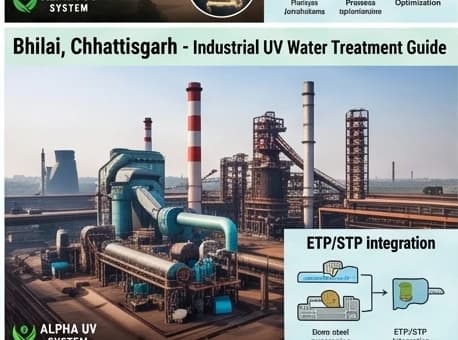
UV water treatment in Bhilai addresses 5 key needs: (1) Bhilai Steel Plant (BSP–SAIL) cooling tower Legionella control via ASHRAE 188-compliant sidestream UV at 10–25% recirculation (mirroring SAIL RSP Rourkela approach); (2) BSP township colony water safety for 2.5 lakh residents across Sector 1–10 and Durg-Bhilai township; (3) Sheonath River water quality protection — CSPCB (Chhattisgarh State Pollution Control Board) industrial discharge standards for Sheonath basin industries; (4) Bhilai Institute of Technology (BIT) and NIMS Hospital NABH water safety compliance; and (5) Durg-Bhilai-Raipur industrial corridor pharmaceutical and food processing GMP water systems. Bhilai's Sheonath River source water has good quality — UV without RO is appropriate for most township and household applications.
Why UV Water Treatment Matters in Bhilai
Bhilai is the "Steel City of Chhattisgarh" — built around the SAIL (Steel Authority of India Limited) Bhilai Steel Plant (BSP), established in 1955 with Soviet assistance as one of independent India's iconic industrial projects. BSP is India's largest integrated steel plant by revenue, producing approximately 6 MTPA of crude steel. Like Jamshedpur (Tata Steel), Bhilai has a planned industrial township infrastructure — BSP manages its own township water supply, sanitation, and utility services through the BSP Civic Administration Department.
UV water treatment in Bhilai is particularly significant at two scales: the massive industrial scale of BSP's cooling tower systems (similar to Jamshedpur's Tata Steel operations, requiring ASHRAE 188 Legionella control) and the township residential scale where 2.5 lakh BSP employees, their families, and associated population require safe drinking water at the building level. The Sheonath River — Bhilai's primary water source — has relatively good quality in normal season, making UV without RO generally appropriate for most township water applications.
Bhilai's Water Sources and Quality Profile
BSP draws water from the Sheonath River (via the Maroda Dam) and the Tandula reservoir for both industrial process use and township water supply. Sheonath River water has moderate TDS (150–300 mg/L), low iron (<0.3 mg/L generally), and manageable coliform after conventional WTP treatment. BSP's water treatment plant produces high-quality township water at the WTP outlet — but the township distribution network's aging pipes (sectors built in the 1960s–1980s) introduce coliform risk at the point of consumption.
Groundwater in the Bhilai-Durg area (Chhattisgarh alluvial zone) shows TDS 200–500 mg/L, generally low iron (Chhattisgarh's central plateau has less iron ore than the Sundargarh or Durg-Rajnandgaon iron belts), and low fluoride. This is a relatively UV-friendly water profile — sediment filtration plus UV is the typical treatment sequence for most Bhilai household and commercial applications without requiring RO.
Water Quality by Zone — Bhilai
| Zone / Source | TDS (mg/L) | Iron (mg/L) | Coliform Risk | Pre-treatment Required |
|---|---|---|---|---|
| BSP township water (Sheonath WTP) | 150–300 | <0.2 | Low–moderate (pipe aging) | 5µ sediment + UV |
| Bhilai-Durg alluvial borewell | 200–500 | 0.1–0.5 | Moderate | 5µ + UV (no RO typically) |
| BSP plant cooling tower water | 800–2,500 (concentrated) | 0.5–2.5 | High (biofilm) | ASHRAE 188 sidestream UV |
| Industrial estate / GIDC (Durg-Bhilai) | 200–450 | 0.1–0.4 | Low–moderate | 5µ + UV (or RO + UV for pharma) |
| Sheonath River industrial ETP effluent | 500–1,500 | 0.5–3.0 | High (industrial biological) | Full ETP sequence + UV final |
Bhilai Steel Plant — ASHRAE 188 Cooling Tower Legionella Control
BSP's integrated steel plant operates multiple large cooling tower systems — blast furnace gas quenching towers, coke oven ammonia cooling circuits, oxygen plant cooling systems, and power plant cooling towers. BSP's cooling towers recirculate warm (28–40°C) water at very high flow rates, creating the precise Legionella growth conditions that ASHRAE 188 targets. BSP has implemented Water Management Plans (WMPs) as part of its ISO 14001 environmental management system and OHSAS 18001/ISO 45001 occupational health system.
UV sidestream treatment at BSP treats 10–25% of recirculating cooling water flow continuously through dedicated UV chambers, achieving 3–4 log Legionella inactivation without chemical biocide build-up in the cooling water or blowdown discharge. BSP's Sheonath River blowdown compliance (CSPCB standards) means chemical biocide residuals in cooling water blowdown are monitored — UV reduces the need for high biocide dosing while maintaining Legionella control, simultaneously reducing blowdown's environmental chemical load. BSP EHS department maintains ASHRAE 188 WMP quarterly reviews with UV intensity logs and Legionella culture test results from cooling tower water samples.
BSP Township — Colony Water Safety
BSP's planned township (Sectors 1–10, Civil Lines, Nehru Nagar, Supela) houses approximately 2.5 lakh residents — BSP employees, their families, and retirees. BSP Civic Administration Department manages the township water supply from the Sheonath WTP. The township's older sectors (Sector 2, 4, 6 — built in the 1960s) have aging GI and AC pipe networks where coliform re-contamination between the WTP and household taps is a known issue. UV at building/flat inlets in BSP quarters provides the final biological safety barrier for township residents.
BSP's township management has been progressive — BSP started piloting UV treatment at water outlets in critical areas (maternity and children's health centres within the township) following sporadic waterborne gastroenteritis outbreaks documented in BSP's occupational health records. The pilot results showed significant reduction in waterborne illness incidence with UV installation, and BSP Civic Administration is expanding UV coverage across the township's older sectors.
Pharmaceutical and Food Processing — CSPCB Compliance
The Durg-Bhilai-Raipur Industrial Corridor (DBRIC) hosts pharmaceutical formulation units, food processing, and engineering component manufacturers. Pharma units in the Urla Industrial Estate (Raipur) and Chhattisgarh GIDC units near Bhilai seeking WHO-GMP or Schedule M 2025 certification require RO → UV (185+254 nm) purified water systems with IQ/OQ/PQ documentation for CDSCO inspection compliance. Food processing units under FSSAI require zero E. coli process water with treatment documentation for annual license renewal.
UV System Sizing — Bhilai Applications
| Application | Flow Rate | UV Dose | Recommended System | Notes |
|---|---|---|---|---|
| BSP township household | 15–25 LPH | 40 mJ/cm² | Philips TUV 16W | UV without RO — low TDS Sheonath water |
| BSP cooling tower (sidestream) | 50,000–3,00,000 LPH | 40–80 mJ/cm² | TUV 95W × 50–150 bank | ASHRAE 188 WMP |
| BSP canteen / hospital | 1,000–5,000 LPH | 40 mJ/cm² | Philips TUV 55W (×1–3) | Factories Act + FSSAI canteen |
| NIMS / BIT hospital ICU / OT | 300–1,000 LPH | 80 mJ/cm² | Philips TUV 95W (high-dose) | NABH IPSG-8 |
| Pharma PW (Urla / GIDC) | 500–2,000 LPH | 185+254 nm | Dual-wavelength TUV 55W | Schedule M 2025 IQ/OQ/PQ |
| Sheonath basin ETP final stage | 3,000–15,000 LPH | 40 mJ/cm² | TUV 95W × 4–12 bank | CSPCB compliance monitoring |
Philips TUV Product Recommendations — Bhilai
| Philips TUV Model | Wattage | Flow Capacity | Best For | Lamp Life |
|---|---|---|---|---|
| Philips TUV 16W | 16W | Up to 1,500 LPH | BSP township household, sector flat | 9,000 hours |
| Philips TUV 36W | 36W | Up to 3,000 LPH | Apartment block, BSP welfare hall | 9,000 hours |
| Philips TUV 55W | 55W | Up to 5,000 LPH | BSP canteen, pharma PW, large office | 12,000 hours |
| Philips TUV 95W | 95W | Up to 9,000 LPH | Hospital ICU/OT (80 mJ/cm²) | 12,000 hours |
| TUV 95W × 50–150 bank (industrial) | 4.75kW–14.25kW | 50,000–3,00,000 LPH | BSP cooling tower Legionella | 12,000 hours |
Frequently Asked Questions — UV Water Treatment Bhilai
Q1: How does BSP Bhilai's cooling tower UV compare to SAIL Rourkela's approach?
Both BSP Bhilai and SAIL RSP Rourkela have implemented ASHRAE 188-aligned Legionella Water Management Plans with UV sidestream treatment. The technical approach is identical — 10–25% sidestream of recirculating cooling water through UV at 40–80 mJ/cm², with online UV intensity monitoring and quarterly Legionella culture testing. The scale differs: BSP Bhilai's larger blast furnace and steel making cooling systems require proportionally larger UV banks. Both plants follow SAIL Corporate EHS standards for cooling tower water management, which reference ASHRAE 188 as the applicable international standard. BSP Bhilai's EHS team documents UV performance in the cooling tower WMP reviewed quarterly by the Corporate EHS division.
Q2: Does BSP township water need UV given BSP manages its own WTP?
BSP's township WTP produces IS 10500:2012-compliant water at the plant outlet. However, Bhilai township's older sectors (built 1960s–80s) have aging GI and AC pipe networks — coliform contamination between the WTP and household taps is a documented issue in BSP's occupational health records (periodic waterborne gastroenteritis cases in older sectors). BSP Civic Administration has begun installing UV at community water kiosks and recommends household UV at building inlets, particularly in Sectors 1–4 with oldest pipe infrastructure. The incremental cost of household UV (TUV 16W system, approximately ₹500–700/month total) is negligible relative to BSP employee welfare value.
Q3: What CSPCB standard applies to BSP's Sheonath River discharge?
BSP's industrial effluent to the Sheonath River (via internal drainage channels to the Maroda drain) must comply with CSPCB effluent standards under the Water (Prevention and Control of Pollution) Act 1974 and Chhattisgarh State Environmental Impact Assessment Authority (SEIAA) consent conditions: BOD <30 mg/L, COD <250 mg/L, TSS <100 mg/L, temperature <40°C, coliform <1,000 MPN/100 mL. UV at BSP's final effluent stages provides the coliform compliance data with intensity logs as CSPCB audit evidence. BSP's ISO 14001 environmental management documentation includes UV system performance records in the ETP operation and maintenance logs.
Q4: Is NIMS hospital in Bhilai NABH accredited and what UV does it need?
NIMS (Nehru Institute of Medical Sciences) at Bhilai and BIT Durg's medical college hospital are significant healthcare institutions in the Durg-Bhilai corridor. NABH accreditation water quality requirements are consistent: UV at 80 mJ/cm² for ICU, OT, NICU, and CSSD; 40 mJ/cm² for general supply; RO + UV + 0.1µ UF for dialysis units. Monthly water quality microbiological test reports from hospital sampling points (ICU tap, OT scrub water, NICU outlet) with zero coliform, zero E. coli results, and UV maintenance logs form the NABH IPSG-8 documentation package. NIMS serving BSP employees — who have a high standard of healthcare expectations given BSP's corporate welfare provisions — benefits from NABH accreditation for staff confidence.
Q5: Can household UV systems in Bhilai township run without RO, given low TDS Sheonath water?
Yes — Bhilai is one of the favourable cases where UV without RO is genuinely appropriate for most household applications. BSP township water sourced from the Sheonath River has TDS 150–300 mg/L — among the most UV-friendly water profiles in Central India. A 5-micron sediment pre-filter followed by UV at 40 mJ/cm² provides IS 10500:2012-compliant zero-coliform water. RO is not required for BSP township supply — it would unnecessarily waste water (RO produces reject water) and add cost in a situation where the TDS is already acceptable. Save RO investment for applications where TDS truly exceeds 500 mg/L (borewell backup water, certain outer-Bhilai areas). Test your TDS before deciding — if TDS <500 mg/L, UV without RO is the right choice in Bhilai.
Alpha UV Systems supplies Philips TUV-based UV systems to BSP Steel Plant cooling towers, township colony apartments, hospitals, pharma units, and industrial ETPs across Bhilai, Durg, and the Chhattisgarh industrial corridor. We include ASHRAE 188 Legionella WMP documentation, CSPCB ETP compliance records, and NABH hospital water audit support.
WhatsApp Us for Bhilai QuoteStandards, authorities & further reading
External references used to inform this guide. Regulations evolve — check the latest revision on each authority's site before compliance decisions.
Recommended UV Systems
Alpha UV System products for this application — powered by genuine Philips UV-C lamps.
Commercial UV Water Purification System
500 – 5,000 LPH
HACCP-compliant UV water purification for hotels, restaurants, and offices
Industrial UV Water Treatment System
5,000 – 50,000 LPH
Schedule M 2025 and HACCP compliant UV for pharma, food & beverage, and process water
Not sure which system suits your application? WhatsApp our engineers for a free recommendation →
Related solutions
See how Alpha UV System applies this to your industry or city.
Need a UV system?
Talk to our UV engineers — WhatsApp for a quote in 2 hours, or browse the full catalog on IndiaMART.