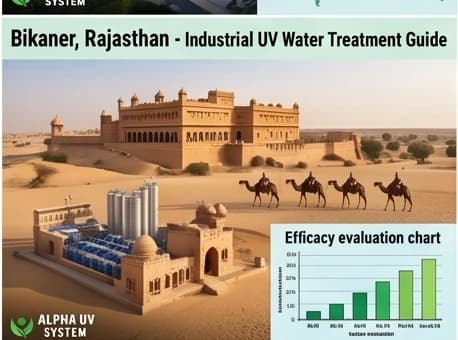
UV water treatment in Bikaner addresses four critical needs in India's Thar Desert: (1) post-overhead-tank disinfection — BMC (Bikaner Municipal Corporation) supply from the Indira Gandhi Nahar Project (IGNP) canal loses residual chlorine in overhead tanks during Bikaner's extreme desert summer heat (temperatures reach 47–50°C in May–June, making Bikaner one of India's hottest cities and creating extreme bacterial growth conditions); (2) Bikaneri food processing UV — Bikaner is famous for Bikaneri bhujia (the GI-tagged spiced gram flour snack), namkeen, and papad; FSSAI food safety compliance for these food manufacturers requires UV-treated water at all food contact points; (3) camel leather and wool processing UV — Bikaner is India's largest camel trading market and the primary camel leather and wool processing centre, with tannery ETP and leather processing RPCB compliance requirements; and (4) RPCB STP compliance for Bikaner's growing residential stock in the desert zone. Alpha UV System supplies Philips UV-C lamp UV systems to Bikaner with 5–7 day delivery and RPCB documentation support.
Bikaner's borewell water from the Thar Desert aquifer typically has TDS 2,000–8,000 mg/L (the BIS permissible limit is 2,000 mg/L), fluoride 2–8 mg/L (limit 1.5 mg/L), and elevated nitrate in some areas. UV does NOT reduce TDS, fluoride, or nitrate. For Bikaner borewell water, RO (Reverse Osmosis) is MANDATORY before UV to bring TDS and fluoride to acceptable levels. The IGNP canal supply has much lower TDS (300–500 mg/L after treatment) and is the recommended source for UV treatment without RO pre-treatment. Always test borewell water at a NABL lab before specifying any treatment system.
Bikaner — 330 km northwest of Jaipur in the heart of the Thar Desert — is a city defined by water scarcity. The city sits in one of the world's most arid zones, with rainfall below 300 mm annually and summer temperatures that regularly approach 50°C. Before the Indira Gandhi Nahar Project (IGNP) canal — bringing Himalayan water from the Sutlej-Beas river system across Rajasthan's desert — Bikaner's water supply was historically dependent on tanks (step wells), tankers, and brackish groundwater. The IGNP canal, completed in phases from 1958 onward, transformed Bikaner's water security by providing treated surface water to the city.
UV water treatment in Bikaner operates in this extreme context: IGNP canal-derived supply (after WTP treatment) is the preferred base for UV treatment because the canal water has manageable TDS (300–500 mg/L in the treated supply), unlike the desert groundwater. However, Bikaner's 47–50°C summer temperatures — among India's highest — create extreme bacterial growth in overhead tanks that makes UV essential at every storage-to-tap transition. In summer, a tank filled at 7 AM in Bikaner can have detectable coliform contamination by late morning if any bacteria are present in the supply.
Bikaner's food processing sector — centred on Bikaneri bhujia (GI-tagged since 2010), namkeen, papad, rasgulla, and a growing packaged food industry — creates substantial FSSAI food contact water UV demand. The camel economy (India's 60% of camel population lives in Rajasthan, with Bikaner as the primary trading and processing hub) creates leather and wool processing ETP requirements. UV water treatment in Bikaner spans all these sectors.
Bikaner Water Quality by Zone and UV Requirement
| Zone / Area | Supply Type | Key Water Quality Issue | Recommended UV Solution |
|---|---|---|---|
| Central Bikaner (Kote Gate, Rani Bazar) | BMC piped supply (IGNP canal WTP) | 48°C summer peak — extreme bacterial regrowth; IGNP supply intermittency in summer peak demand; aging old city distribution | Post-tank UV at 40 mJ/cm²; 5 µm pre-filter; May–June critical; summer pre-filter check monthly |
| Bikaneri bhujia / namkeen processing zone | BMC supply + borewell (RO pre-treated) | FSSAI food safety water; GI-tagged bhujia — export quality EU/US food audit; borewell TDS 2,000–5,000 mg/L (RO mandatory) | FSSAI food UV after RO; bhujia processing water UV; 316L SS food-grade; no chlorine in bhujia; EU export audit |
| Camel leather tannery zone (Bikaner RIICO) | RIICO supply + borewell | Camel leather chrome tanning — RPCB heavy metal ETP; tannery effluent coliform; borewell saline | Tannery ETP final UV; RPCB compliance; worker potable UV; chrome ETP — UV does NOT remove chrome |
| Wool processing area | BMC supply + tanker | Camel and sheep wool scouring — RPCB ETP; IWTO wool washing water compliance; export buyer audit | Wool scouring water UV; RPCB ETP UV; export quality wool water safety; no chlorine in premium wool contact |
| New Bikaner residential (Stadium Road, Murlidhar Vyas Colony) | BMC supply + borewell (RO pre-treated) | New residential; RPCB STP compliance; borewell saline (TDS 2,000–8,000 mg/L, fluoride 2–6 mg/L) — RO mandatory | RO+UV for borewell; post-tank UV for BMC supply; RPCB STP UV; NABL borewell test first |
UV Water Treatment for Bikaner's Bikaneri Bhujia and Food Processing Industry
Bikaner's bhujia industry — with Haldiram's, Bikaji Foods, Bikano, and hundreds of smaller manufacturers — produces India's most iconic snack food. Bikaneri bhujia (GI-tagged since 2010, must be made in Bikaner to use the GI designation) is made from moth bean flour (matki/moth dal) spiced with carom seeds and black pepper, extruded into the characteristic thin wire shape. The production process requires water at multiple points: dough preparation (water mixed with besan and moth bean flour to form dough), equipment washing (extruder and fryer cleaning), and packaging area hygiene.
FSSAI food safety requirements for bhujia and namkeen processing: FSSAI mandates IS 10500 potable water quality at all food contact points. For Bikaner's bhujia exporters (Haldiram's Bikaner exports to 80+ countries; Bikaji Foods exports to US, UK, Australia, Canada), international buyer audits (BRC, FSSC 22000, SQF) specifically include water quality assessment. UV at 40 mJ/cm² on the dough-making water and equipment washing water, with documented intensity monitoring and pre-filter replacement records, satisfies both FSSAI and international buyer audit water quality requirements.
Why no chlorine in bhujia contact water: chlorine residual in the dough water reacts with the wheat and gram flour proteins and fats to produce chlorinated compounds that affect the bhujia's characteristic flavour and shelf life (chlorinated fat oxidation products develop off-flavours faster). Premium bhujia exporters — particularly those supplying the Middle East Halal market and the US Indian diaspora grocery market — have zero-tolerance for chlorine contact with their food products. UV-treated water (no chemical residuals) is the only acceptable disinfection for Bikaner's export-quality bhujia production.
UV System Sizing for Bikaner Applications
| Application | Flow Rate | UV Dose Required | Key Notes |
|---|---|---|---|
| Residential apartment (BMC IGNP supply) | 1–3 m³/h | 40 mJ/cm² | Post-overhead-tank UV; 5 µm pre-filter; 48°C summer critical; IGNP supply: no RO needed; borewell: RO mandatory first |
| Bhujia / namkeen food processing (medium unit) | 2–10 m³/h | 40 mJ/cm² | FSSAI food contact; GI bhujia export quality; no chlorine; 316L SS food-grade; BRC/FSSC 22000 audit-ready |
| Haldiram's / Bikaji large food plant | 10–30 m³/h | 40 mJ/cm² | Large-scale FSSAI food UV; RO permeate polishing UV; 316L SS; multinational export buyer audit |
| Camel leather tannery ETP (RIICO) | 5–20 m³/h | 40 mJ/cm² | RPCB coliform limit; chrome ETP final UV; Thar desert discharge; worker potable UV separate |
| Wool scouring process water | 2–10 m³/h | 40 mJ/cm² | RPCB ETP; export wool quality; no chlorine in premium fibre contact; 316L SS preferred |
| Hospital potable (PBM Hospital Bikaner) | 5–20 m³/h | 40–80 mJ/cm² | NABH documentation; ICU 80 mJ/cm²; dialysis water AAMI/ISO 13959; Bikaner district major hospital |
| STP 300 KLD (Bikaner residential) | 20–30 m³/h | 40 mJ/cm² | Philips TUV 95W × 4; RPCB consent; Thar Desert water-scarce zone — STP reuse UV recommended |
Recommended UV Systems for Bikaner — Philips UV-C Lamp Models
UV water treatment in Bikaner's extreme desert environment requires UV systems that operate reliably at ambient temperatures up to 50°C in the equipment room and with IGNP canal-derived supply that may have seasonal turbidity variation. Alpha UV System's product range, using Philips UV-C lamps rated for continuous operation, performs reliably in Bikaner's demanding conditions.
| Application / Segment | Recommended UV System | Philips Lamp Model | Flow Capacity | Key Advantage for Bikaner |
|---|---|---|---|---|
| Residential (BMC IGNP supply) | Alpha UV 16W Domestic | Philips TUV 16W | Up to 1.5 m³/h | Reliable in 48°C summer; compact for apartment installation; annual lamp replacement |
| Small bhujia / namkeen unit | Alpha UV 36W SS316L | Philips TUV 36W | Up to 3 m³/h | 316L SS food-grade; FSSAI bhujia compliance; no chlorine residual |
| Medium food processor / hotel | Alpha UV 55W SS316L | Philips TUV 55W | Up to 8 m³/h | FSSC 22000 audit-ready; export quality food UV; 316L SS |
| Large food plant / STP 100–300 KLD | Alpha UV 95W Industrial | Philips TUV 95W | Up to 20 m³/h | Haldiram's / Bikaji scale; RPCB STP documentation; intensity monitoring |
| STP 300 KLD+ / tannery ETP | Alpha UV Multi-lamp 95W × 4 | Philips TUV 95W × 4 | Up to 80 m³/h | RPCB Thar zone enforcement; dual-lamp redundancy; online monitoring compatible |
Regulatory Compliance Reference for Bikaner UV Systems
| Regulation / Authority | Applicable Sector | UV Requirement | Key Documentation |
|---|---|---|---|
| RPCB STP Consent (Rajasthan) | Residential / commercial complexes ≥50 KLD | UV at 40 mJ/cm² on STP final effluent; faecal coliform <1,000 MPN/100 mL; BOD <30 mg/L | UV commissioning report; intensity log; lamp replacement record; RPCB consent copy |
| FSSAI (GI Bhujia / food processors) | Bikaneri bhujia manufacturers, namkeen, papad | IS 10500 food contact water; zero coliforms; UV commissioning and maintenance records for FSSAI audit | FSSAI license file; UV commissioning certificate; no-chlorine water certificate for export buyers |
| FSSAI / BRC / FSSC 22000 (Export food) | Haldiram's, Bikaji Foods, export namkeen units | FSSC 22000 / BRC food safety audit — water quality documentation; no chemical residuals; UV records | Buyer audit water quality file; UV system certificate; intensity monitoring log; export compliance |
| RPCB ETP Consent (Leather / Wool) | Camel leather tannery / wool scouring ETP | ETP final UV; RPCB heavy metal and coliform limits; Thar zone discharge | RPCB ETP consent; UV commissioning; ETP monitoring records |
| BIS IS 10500 (Drinking Water) | All potable applications in Bikaner | Zero coliforms; IGNP supply + UV achieves this; borewell requires RO before UV for TDS and fluoride | Post-UV NABL water test; post-RO+UV test for borewell; system commissioning |
Frequently Asked Questions — UV Water Treatment in Bikaner
Bikaner reaches 50°C — is this temperature dangerous for UV system equipment?
UV system hardware (reactor body, lamp, ballast) is designed to operate in ambient temperatures up to 40–50°C in the utility room where the UV is installed. The Philips TUV lamp series operates reliably at ambient temperatures up to 50°C ambient air temperature — which matches Bikaner's peak summer heat. However, two precautions are important for Bikaner installations: (a) do not install the UV system in direct sunlight or on a south-facing wall exposed to direct summer afternoon sun — even at 50°C ambient, the UV reactor should be in a shaded utility room or indoors; (b) the electronic ballast (which drives the UV lamp) should have adequate air circulation — do not enclose it in a sealed cabinet without ventilation in Bikaner's peak summer heat. With these precautions, UV water treatment systems in Bikaner operate normally through the 48–50°C summer peak.
Can I install UV directly on Bikaner borewell water without RO?
No — Bikaner borewell water from the Thar Desert aquifer has TDS 2,000–8,000 mg/L, fluoride 2–8 mg/L, and sometimes elevated nitrate. UV addresses none of these parameters. Installing UV on Bikaner borewell water without RO gives you water that is microbiologically safe but still has 3,000 mg/L TDS, 5 mg/L fluoride, and the characteristic salty taste of desert groundwater — it is not safe for long-term drinking. The treatment sequence for Bikaner borewell water: (1) NABL water test for TDS, fluoride, nitrate, iron, hardness; (2) RO system sized to produce permeate at TDS <500 mg/L and fluoride <1.0 mg/L; (3) UV after RO at 40 mJ/cm² for microbiological safety of the RO permeate. IGNP canal-derived BMC supply (TDS 300–500 mg/L in treated form) does not need RO before UV and is a much more practical base water source.
Does GI certification for Bikaneri bhujia require specific water treatment?
The Geographical Indication (GI) registration for Bikaneri Bhujia specifies that bhujia must be made in Bikaner using the traditional recipe. While the GI specification does not explicitly mandate UV water treatment, FSSAI's food safety regulations (which apply to all GI-tagged food products as manufactured goods) require that food contact water at licensed food facilities meets IS 10500 potable water standards. UV at 40 mJ/cm² achieves IS 10500 microbial compliance. Additionally, international buyers purchasing GI-tagged Bikaneri bhujia for import to the EU and USA conduct food safety audits under FSSC 22000 or BRC standards — these international food safety standards explicitly require documented water treatment at food contact points. UV commissioning records and maintenance logs are checked by these auditors during supplier qualification. In practice, any Bikaner bhujia manufacturer seeking EU, US, or Australian export approval needs UV water treatment as part of their food safety management system.
Bikaner tanneries use chrome tanning for camel leather — does UV remove chromium?
No — UV does not remove chromium (Cr³⁺ in trivalent chrome tanning baths, or Cr⁶⁺ hexavalent chromium if it forms in the process). Bikaner's camel leather tanneries use chrome tanning (the same process used in Kanpur and Vellore leather tanneries) where chromium sulphate is the primary tanning agent. RPCB's ETP standards for tannery effluent discharge require chromium below 2 mg/L (total) and 0.1 mg/L (hexavalent) before discharge. Chrome removal from tannery effluent requires chemical precipitation (addition of alkali to precipitate Cr(OH)₃), settling, and filtration — this removes chrome to acceptable levels. UV on the final ETP effluent (after chrome removal) addresses the biological parameter — faecal coliform — which RPCB requires to be <100 MPN/100 mL for inland discharge. UV in Bikaner tannery ETPs is always positioned after the chrome removal system, never as a substitute for it.
Alpha UV System supplies UV disinfection systems to bhujia and namkeen food processors, camel leather tanneries, wool processors, residential complexes, hospitals, and STP operators across Bikaner, Lunkaransar, Gajner, and the Thar Desert region. RPCB STP documentation. FSSAI GI bhujia and namkeen food safety UV. Camel leather ETP UV. Philips UV-C lamps. 5–7 day delivery to Bikaner.
WhatsApp Us for Bikaner UV System SupplyRecommended UV Systems
Alpha UV System products for this application — powered by genuine Philips UV-C lamps.
Commercial UV Water Purification System
500 – 5,000 LPH
HACCP-compliant UV water purification for hotels, restaurants, and offices
Industrial UV Water Treatment System
5,000 – 50,000 LPH
Schedule M 2025 and HACCP compliant UV for pharma, food & beverage, and process water
Not sure which system suits your application? WhatsApp our engineers for a free recommendation →