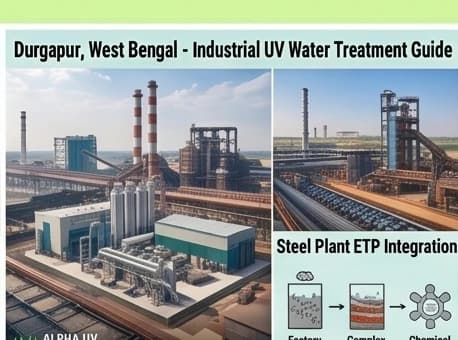
UV water treatment in Durgapur addresses four distinct needs: (1) post-overhead-tank disinfection for Durgapur's residential townships — DMC (Durgapur Municipal Corporation) supply from the Damodar River (post-DVC barrage) loses residual chlorine in overhead tanks during West Bengal's summer heat (temperatures reach 42–44°C in April–May in the Chhota Nagpur plateau transition zone); (2) SAIL Durgapur Steel Plant cooling tower Legionella management — Durgapur Steel Plant (2.88 MTPA) has large-scale cooling infrastructure requiring ASHRAE 188 Legionella Water Management Plan compliance; (3) Durgapur Chemicals, DPL (Durgapur Projects Limited), and the chemical industrial cluster UV for process water and ETP compliance under WBPCB; and (4) WBPCB STP compliance for Durgapur's planned township and new residential developments discharging to the Damodar basin. Alpha UV System supplies Philips UV-C lamp UV systems to Durgapur with 5–7 day delivery and WBPCB documentation support.
Durgapur — built from the 1950s onward as one of independent India's planned industrial cities alongside Bhilai, Rourkela, and Bokaro — is Paschim Bardhaman district's industrial nucleus. The city houses SAIL's Durgapur Steel Plant, Durgapur Chemicals Limited (DCL), Durgapur Projects Limited (DPL, the power utility), Hindustan Cables, and dozens of ancillary manufacturing units that support the steel and energy industries. Durgapur sits on the Damodar River — the "Sorrow of Bengal" before the DVC (Damodar Valley Corporation) barrage system was built post-1947, and now a regulated water source for both agriculture and industrial use.
UV water treatment in Durgapur is shaped by two distinct demand categories: the large-scale industrial applications (cooling tower Legionella, chemical process water, ETP final effluent) driven by SAIL, DCL, and DPL; and the residential/commercial applications in Durgapur's planned township zones (Steel Township, City Centre, Bidhan Nagar, Benachity) where the Durgapur Municipal Corporation provides piped Damodar supply. The city's proximity to the Raniganj-Asansol coal belt also creates coal mine drainage water treatment requirements in the broader Paschim Bardhaman zone.
The Damodar River's water quality at Durgapur has improved significantly since the DVC barrage regulation and the WBPCB's enforcement on coal mining effluent upstream. However, the river receives runoff from the Raniganj coal fields (acid mine drainage contributes iron, manganese, and sulfate) and the Damodar's low-flow summer months create water quality stress that makes post-treatment UV at the household level important during the April–June period when UV water treatment in Durgapur is most critical.
This guide covers UV water treatment in Durgapur's residential, industrial, and institutional sectors — with water quality zone analysis, application sizing, Philips UV-C product recommendations, regulatory compliance, and a comprehensive FAQ for Durgapur buyers.
Durgapur Water Quality by Zone and UV Requirement
| Zone / Area | Supply Type | Key Water Quality Issue | Recommended UV Solution |
|---|---|---|---|
| Steel Township / City Centre (planned zones) | DMC piped supply (Damodar River, DVC barrage) | Good DVC-regulated source quality; post-tank bacterial regrowth in 43°C summer; aging planned city distribution in older sectors | Post-tank UV at 40 mJ/cm²; 5 µm pre-filter; April–May summer critical; WBPCB STP for residential complexes |
| SAIL Durgapur Steel Plant (township and plant) | DSP dedicated Damodar intake + recycled water | Blast furnace, BOF cooling; coke oven water; cooling tower Legionella (ASHRAE 188); SAIL EHS standards | Cooling tower Legionella UV at 40–80 mJ/cm²; ASHRAE 188 WMP; no chlorine in heat exchanger water; sidestep UV |
| Durgapur Chemicals / DPL industrial cluster | WBSIDC supply + Damodar River abstraction | Chemical manufacturing effluent; power plant cooling; WBPCB ETP/STP compliance; Damodar basin discharge | Chemical ETP UV; power plant cooling Legionella; WBPCB coliform limit; ASHRAE 188 |
| Raniganj / Asansol (coal belt satellite) | Borewell + river + municipal supply | Coal mine drainage iron and manganese (Fe 3–15 mg/L, Mn 0.5–3 mg/L common); acid mine drainage; WBPCB STP | Iron and manganese removal MANDATORY before UV; post-treatment UV; coal township water safety |
| Andal / Faridpur (WBSIDC growth areas) | WBSIDC supply + borewell | New industrial growth; aerospace (HAL Nasik component suppliers); borewell TDS 300–700 mg/L; WBPCB STP | Post-tank UV; industrial UV; STP UV; WBPCB documentation |
UV for SAIL Durgapur Steel Plant — Cooling Tower Legionella Management
SAIL (Steel Authority of India Limited) Durgapur Steel Plant's cooling water system — covering blast furnace tuyere cooling, BOF vessel cooling, continuous caster mould cooling, and the rolling mill descaling system — represents one of the most demanding UV water treatment challenges in East India's industrial sector. Durgapur Steel Plant's cooling towers (used for power plant condensation cooling and process heat rejection) create Legionella risk via drift (aerosol) generation at cooling tower banks.
SAIL's EHS (Environment, Health and Safety) standards — which align with the ASHRAE 188 Legionella Water Management Plan framework — require documented Legionella control in all cooling tower systems. UV water treatment in SAIL Durgapur's cooling towers addresses this requirement through sidestep UV (a portion of the cooling tower recirculating water is continuously passed through a UV reactor at 40–80 mJ/cm²), which inactivates Legionella pneumophila in the recirculating water without the corrosion risk that high chlorine dosing creates in SAIL's steel heat exchanger tubes. UV treatment also reduces the biocide (biocide dosing costs) in the cooling water chemical treatment programme, creating economic value beyond compliance.
UV water treatment in Durgapur's coal mine drainage context: the Raniganj coal belt's borewell water (used by coal mine townships and ancillary industries) has iron 3–15 mg/L from acid mine drainage. As with all high-iron water, iron removal (greensand or birm filter) is mandatory before UV installation in Raniganj-Asansol zone. Alpha UV System's Durgapur supply includes pre-treatment assessment to identify whether iron removal is required before UV specification.
UV System Sizing for Durgapur Applications
| Application | Flow Rate | UV Dose Required | Key Notes |
|---|---|---|---|
| Residential apartment (Steel Township / Benachity) | 1–3 m³/h | 40 mJ/cm² | Post-overhead-tank UV; 5 µm pre-filter; Damodar supply; April–May summer critical |
| SAIL cooling tower (sidestep UV) | 20–100 m³/h (sidestep 5–10% of recirculation) | 40–80 mJ/cm² | ASHRAE 188 WMP; SAIL EHS standard; no chlorine corrosion; sidestep configuration; continuous operation |
| Chemical plant process water (DCL zone) | 5–30 m³/h | 40 mJ/cm² | WBPCB process water UV; chemical plant clean utility water; WBPCB ETP final effluent UV |
| Coal township potable (Raniganj / Asansol) | 1–5 m³/h | 40 mJ/cm² | Iron/Mn removal filter MANDATORY first; post-filter UV; coal mining township water safety |
| Hospital potable (Mission Hospital / SAIL Hospital) | 5–20 m³/h | 40–80 mJ/cm² | NABH documentation; ICU water 80 mJ/cm²; dialysis AAMI/ISO 13959; SAIL hospital EHS |
| STP 100 KLD (residential complex) | 8–12 m³/h | 40 mJ/cm² | Philips TUV 55W × 2; WBPCB consent; Damodar basin; intensity monitoring alarm |
| STP 300 KLD (large residential / commercial) | 20–30 m³/h | 40 mJ/cm² | Philips TUV 95W × 4; WBPCB consent; dual-lamp redundancy; lamp replacement log |
Recommended UV Systems for Durgapur — Philips UV-C Lamp Models
UV water treatment in Durgapur spans a wide range of applications — from small residential units in Steel Township apartments to large industrial UV systems for SAIL's cooling towers and DCL's process water. Alpha UV System's product range covers all scales, with Philips UV-C lamps as the standard across all UV system models.
| Application / Segment | Recommended UV System | Philips Lamp Model | Flow Capacity | Special Notes |
|---|---|---|---|---|
| Residential (individual flat, Steel Township) | Alpha UV 16W Domestic | Philips TUV 16W | Up to 1.5 m³/h | Compact; easy lamp replacement; standard for Durgapur residential |
| Small commercial / residential block | Alpha UV 36W SS316 | Philips TUV 36W | Up to 3 m³/h | 316L SS body; 50 KLD STP equivalent |
| Industrial / hospital / large commercial | Alpha UV 95W Industrial | Philips TUV 95W | Up to 20 m³/h | 300 KLD STP equivalent; WBPCB documentation |
| SAIL / DPL cooling tower (industrial) | Alpha UV Multi-lamp 95W × 4–8 | Philips TUV 95W × 4 or × 8 | Up to 80–160 m³/h | ASHRAE 188 compliant; continuous sidestep; intensity monitoring; SAIL EHS documentation |
| Coal township (post iron-removal filter) | Alpha UV 36W with pre-filter assembly | Philips TUV 36W | Up to 3 m³/h | Greensand iron removal filter upstream mandatory; post-filter UV; Raniganj-Asansol zone |
Regulatory Compliance Reference for Durgapur UV Systems
| Regulation / Authority | Applicable Sector | UV Requirement | Key Documentation |
|---|---|---|---|
| WBPCB STP Consent (Damodar basin) | Residential / commercial complexes ≥50 KLD | UV at 40 mJ/cm² on final STP effluent; BOD <30 mg/L; faecal coliform <1,000 MPN/100 mL | UV commissioning report; intensity log; lamp replacement schedule; WBPCB consent copy |
| ASHRAE 188 (Legionella WMP) | SAIL cooling towers / DPL / DCL | Legionella WMP including UV treatment records; quarterly Legionella testing; risk assessment | WMP document; UV system flow and dose records; Legionella test certificates; audit log |
| WBPCB ETP Consent (industrial) | DCL chemicals / DPL power plant ETP | UV on final industrial ETP effluent; faecal coliform limits for Damodar discharge | WBPCB ETP consent conditions; UV commissioning; online monitoring compliance |
| NABH (Hospital Accreditation) | SAIL hospital / Mission hospital / private | Potable water UV; ICU water quality documentation; dialysis water AAMI/ISO 13959 | NABH facility accreditation water safety file; UV records; periodic testing |
| BIS IS 10500 (Drinking Water) | All potable applications in Durgapur | Zero coliforms in 100 mL; E. coli absent; UV at rated flow achieves this | Post-UV NABL water test; commissioning certificate; annual water quality report |
Frequently Asked Questions — UV Water Treatment in Durgapur
Is Damodar River water at Durgapur affected by upstream coal mining?
The Damodar River at Durgapur is regulated by the DVC (Damodar Valley Corporation) barrage system, which stores and releases water from the Maithon and Panchet reservoirs. This regulation has significantly improved Damodar water quality at Durgapur compared to the pre-DVC era. However, the Raniganj-Jharia coal field's acid mine drainage (AMD) — which carries iron, manganese, sulfate, and trace metals from the coal seams — enters Damodar tributaries and affects the river's water chemistry in the Bardhaman-Durgapur zone. The Durgapur Barrage's water is treated at DMC's WTP to BIS 10500 standards before distribution. Treated supply quality is generally acceptable, but post-storage UV treatment remains important for the reasons of residual chlorine dissipation and overhead tank contamination described throughout this guide.
Why is iron removal critical before UV for Raniganj-Asansol borewell water?
Coal mine drainage in the Raniganj belt acidifies groundwater and mobilises dissolved iron from coal seam pyrite (FeS₂ oxidation produces sulfuric acid and ferrous iron). Raniganj-Asansol borewell water commonly has iron 3–15 mg/L — far above the UV system's 0.3 mg/L iron tolerance. When this water passes through a UV reactor: the UV-C radiation oxidises dissolved ferrous iron (Fe²⁺) to ferric iron (Fe³⁺), which immediately precipitates as rust-red ferric hydroxide on the quartz sleeve. The coating blocks UV-C transmission, reducing the UV dose delivered to the water. Within days to weeks, the system becomes microbiologically ineffective despite showing the lamp as "on." The only solution is a greensand filter (or birm filter, or iron-specific ion exchange) installed upstream of UV. After iron removal below 0.3 mg/L, UV functions normally and the quartz sleeve stays clean. Alpha UV System's site assessment for Raniganj-Asansol zone customers always includes iron testing as a first step.
What is ASHRAE 188 and does SAIL Durgapur need to comply with it?
ASHRAE 188 (ANSI/ASHRAE Standard 188 — Legionellosis: Risk Management for Building Water Systems) is the US standard for Legionella Water Management Plans (WMPs) in building water systems including cooling towers. While ASHRAE 188 is a US standard, it has been adopted by major Indian industrial groups (Tata Group, SAIL, Reliance, L&T) as their EHS benchmark because no equivalent Indian standard exists. SAIL's corporate EHS policy — which governs all SAIL plants including Durgapur Steel Plant — aligns with ASHRAE 188 for Legionella management. Durgapur Steel Plant's occupational health team is required to maintain WMPs for all cooling towers, with documented UV treatment records as part of the WMP. UV water treatment in Durgapur's SAIL context is therefore not optional — it is part of a documented corporate EHS compliance programme with periodic internal and external audits.
What WBPCB documentation is required for Durgapur residential STP UV systems?
WBPCB's STP consent for Durgapur residential complexes requires: (1) UV system commissioning report (on Alpha UV System letterhead with system specifications, installation details, and rated UV dose at specified flow); (2) UV intensity monitoring log (weekly UV intensity reading in mW/cm²; if intensity drops below 70% of rated value, lamp replacement must be recorded); (3) lamp replacement records (date, Philips lamp model, invoice); (4) pre-filter replacement records; and (5) quarterly STP effluent test reports (BOD, COD, TSS, faecal coliform from NABL lab — faecal coliform should be <1,000 MPN/100 mL after UV). Alpha UV System provides all documentation templates with UV system supply — the commissioning report is signed by our engineer and ready for submission to WBPCB Bardhaman district office.
Durgapur reaches 44°C in May — how fast do bacteria grow in overhead tanks at this temperature?
E. coli and coliforms have a doubling time of 20–30 minutes at 37°C (body temperature). At 44°C — the temperature inside a black HDPE overhead tank on a south-facing roof in Durgapur's May heat wave — bacterial growth slows slightly but remains rapid for mesophilic organisms like Salmonella (optimal growth 37–43°C), Vibrio (optimal 37°C), and coliforms (30–37°C optimal, still active at 44°C). A tank that is properly treated at 7 AM when morning supply fills it can have detectable coliform regrowth by midday and significant contamination by evening if any bacteria were present in the incoming supply. The residual chlorine in DMC supply dissipates within 2–4 hours of storage at these temperatures. UV at the tank outlet — treating water as it exits the tank — is the only practical way to ensure all water drawn from the overhead tank throughout the day is safe for drinking and cooking.
Alpha UV System supplies UV disinfection systems to SAIL steel plant, Durgapur Chemicals, residential townships, hospitals, and STP operators across Durgapur, Asansol, Raniganj, Andal, and the Damodar valley. WBPCB STP documentation. ASHRAE 188 cooling tower Legionella WMP. Coal township iron-removal and UV systems. Philips UV-C lamps. 5–7 day delivery to Durgapur.
WhatsApp Us for Durgapur UV System SupplyRecommended UV Systems
Alpha UV System products for this application — powered by genuine Philips UV-C lamps.
Commercial UV Water Purification System
500 – 5,000 LPH
HACCP-compliant UV water purification for hotels, restaurants, and offices
Industrial UV Water Treatment System
5,000 – 50,000 LPH
Schedule M 2025 and HACCP compliant UV for pharma, food & beverage, and process water
Not sure which system suits your application? WhatsApp our engineers for a free recommendation →