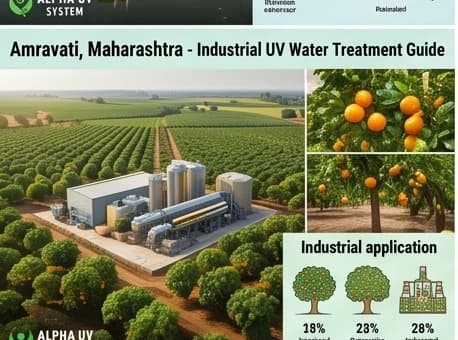
UV water treatment in Amravati addresses three key needs: (1) post-overhead-tank disinfection for Amravati's residential areas — AMC (Amravati Municipal Corporation) supply from the Wardha River and Upper Wardha Dam loses residual chlorine in overhead tanks during Amravati's extreme Vidarbha summer heat (temperatures reach 44–47°C in May — Amravati district is among Maharashtra's hottest, with Vidarbha's heat wave belt); (2) cotton ginning, oil mill, and agri-processing UV — Amravati is the commercial hub of Vidarbha's cotton belt (Maharashtra is India's largest cotton state; Amravati district produces significant Bt cotton), with cotton gin, cottonseed oil, and edible oil processing requiring FSSAI food contact water; and (3) MPCB STP compliance for Amravati's residential and MIDC complexes in the Wardha-Wainganga river system. Alpha UV System supplies Philips UV-C lamp UV systems to Amravati with 5–7 day delivery and MPCB documentation support.
Amravati — one of Maharashtra's six divisional headquarters and the administrative and commercial capital of Vidarbha's western zone — sits at the heart of the Amravati-Nagpur cotton belt. Vidarbha (the eastern region of Maharashtra, comprising Amravati and Nagpur divisions) is India's most significant cotton-growing area, producing medium and short staple Bt cotton that feeds Maharashtra's ginning, spinning, and textile industry. Amravati district's Morshi, Daryapur, and Chandur Bazaar talukas are among Maharashtra's most productive cotton talukas.
Amravati is also known for a more difficult reality: Vidarbha's chronic farmer distress, linked to cotton price volatility, erratic monsoons, and water scarcity. The region's water situation — dependent on Upper Wardha Dam reservoir and the Wardha River — is subject to significant seasonal variation. Amravati city itself has reasonable municipal water supply in normal years, but the extreme summer temperatures (Amravati is one of India's hottest cities, regularly recording May temperatures above 46–47°C) create severe bacterial regrowth problems in overhead tanks that make UV treatment essential for safe drinking water.
Amravati Water Quality by Zone
| Zone / Area | Supply Type | Key Water Issue | UV Solution |
|---|---|---|---|
| Central Amravati (Rajapeth, Ramdaspeth) | AMC piped supply (Upper Wardha Dam) | 47°C summer peak — extreme bacterial regrowth; supply intermittency in drought years; dense old city distribution | Post-tank UV at 40 mJ/cm²; 5 µm pre-filter; May–June critical; tank insulation (white UV-resistant tanks) |
| Badnera MIDC industrial area | MIDC supply + borewell | Cotton ginning, oil mills, light engineering; MPCB STP compliance; borewell TDS 300–600 mg/L | Oil mill and food processing UV; MPCB STP UV; FSSAI food contact water compliance |
| Achalpur / Morshi cotton belt | TWAD supply + borewell | Cotton gin and cottonseed oil processing — FSSAI food contact water; Bt cotton seed processing; agri-processing water safety | FSSAI food UV; cottonseed oil process water UV; 316L SS body; no chlorine in food contact |
| New Amravati residential (Paratwada Road) | AMC supply + borewell | Residential growth; STP compliance; borewell TDS 200–500 mg/L; MPCB building consent norms | Post-tank UV; STP UV; MPCB documentation |
| Daryapur / Chandur Bazaar (satellite towns) | Municipal supply + borewell | Cotton market towns; agri-processing; sporadic borewell iron (1–3 mg/L in basaltic zones) | Post-tank UV; iron check before UV (Deccan basalt zone iron can exceed 1 mg/L); MPCB STP |
UV for Amravati's Cotton Ginning and Edible Oil Processing
Amravati's agri-processing sector — driven by Vidarbha's cotton and soybean production — includes cotton ginning (separation of cotton fibre from seed), cottonseed oil extraction, soybean oil processing, and edible oil refining. These industries use water at multiple food-contact stages where FSSAI compliance requires UV-treated water.
Cottonseed oil processing: cottonseed — the by-product of cotton ginning — is crushed and solvent-extracted to produce cottonseed oil (an edible cooking oil used across India). The oil-water separator stage, degumming water, and equipment cleaning water are all food-contact applications requiring FSSAI-compliant UV water treatment. Amravati's large oil seed crushing units — processing Bt cotton seeds from the surrounding Vidarbha belt — need UV at the food contact water supply points for FSSAI license compliance.
Soybean processing: Vidarbha is Maharashtra's significant soybean zone (soybean is the main kharif crop in the drier parts of Amravati, Yavatmal, and Washim districts). Soy milk, tofu, soy flour, and soy protein processing units in the Amravati-Badnera cluster have the same FSSAI food contact water requirements as other food processors. UV at 40 mJ/cm² with no chlorine in water contact with soy protein products (chlorine can react with soy proteins to produce off-flavours and chlorinated organic compounds) makes UV the only acceptable food-contact water disinfection method.
| Application | Flow Rate | UV Dose | Notes |
|---|---|---|---|
| Residential apartment (Amravati city) | 1–3 m³/h | 40 mJ/cm² | Post-overhead-tank UV; 5 µm pre-filter; May–June 47°C critical; white/insulated tank recommended |
| Cottonseed oil processing unit | 2–10 m³/h | 40 mJ/cm² | FSSAI food contact water; edible oil processing; 316L SS food-grade body; no chlorine |
| Soybean processing / soy protein plant | 2–10 m³/h | 40 mJ/cm² | FSSAI food contact; no chlorine (protein chlorination off-flavour); 316L SS body; EU/US soy export audit |
| Cotton gin worker potable water | 1–3 m³/h | 40 mJ/cm² | Factories Act worker water standard; seasonal operation (Kharif cotton season Oct–Feb) |
| MIDC institutional complex (Badnera) | 2–10 m³/h | 40 mJ/cm² | MPCB STP; industrial township potable water; FSSAI canteen water |
| STP outlet — 300 KLD (Amravati residential) | 20–30 m³/h | 40 mJ/cm² | Philips TUV 95W; MPCB consent documentation; Wardha-Wainganga basin compliance |
Vidarbha faces drought years — how should UV systems be managed during low water supply periods?
Amravati and Vidarbha's drought vulnerability — the region has faced multiple severe drought years where Upper Wardha Dam levels dropped critically — creates a specific UV system management challenge: during droughts, AMC supply becomes intermittent (2–4 hours per day rather than continuous), and residents rely more heavily on tanker water, which has higher contamination risk than piped supply.
UV system considerations during Vidarbha drought conditions: (a) Tanker water UV is more important, not less: When AMC supply is intermittent, the water stored in overhead tanks is held longer — sometimes 48–72 hours between supply periods. Longer storage time at high summer temperatures (tanks in Amravati can reach 50°C+ in May afternoon sun) means more bacterial growth. UV at the tank outlet is critical during these periods; (b) Tanker water quality variation: Private tankers in Amravati draw from various sources (ponds, wells, boreholes) with unknown water quality. A 5 µm pre-filter before UV is essential to handle the higher turbidity and suspended solids that tanker water can carry compared to treated piped supply; (c) Borewell backup: Many Amravati residents install borewells as drought backup. Deccan basalt aquifer water in Amravati zone has variable quality — iron (0.5–3 mg/L in some locations) and hardness are common. Have borewell water tested before UV installation; if iron exceeds 0.3 mg/L, an iron removal filter must precede the UV system to prevent quartz sleeve fouling.
Alpha UV System supplies UV disinfection systems to edible oil processors, agri-processing units, residential complexes, MIDC industries, and STP operators across Amravati, Badnera MIDC, Achalpur, Morshi, Daryapur, and Vidarbha's cotton belt. MPCB STP documentation. FSSAI cottonseed and soybean processing water safety UV. Philips UV-C lamps. 5–7 day delivery to Amravati.
WhatsApp Us for Amravati UV System SupplyStandards, authorities & further reading
External references used to inform this guide. Regulations evolve — check the latest revision on each authority's site before compliance decisions.
Recommended UV Systems
Alpha UV System products for this application — powered by genuine Philips UV-C lamps.
Commercial UV Water Purification System
500 – 5,000 LPH
HACCP-compliant UV water purification for hotels, restaurants, and offices
Industrial UV Water Treatment System
5,000 – 50,000 LPH
Schedule M 2025 and HACCP compliant UV for pharma, food & beverage, and process water
Not sure which system suits your application? WhatsApp our engineers for a free recommendation →
Related solutions
See how Alpha UV System applies this to your industry or city.
Need a UV system?
Talk to our UV engineers — WhatsApp for a quote in 2 hours, or browse the full catalog on IndiaMART.