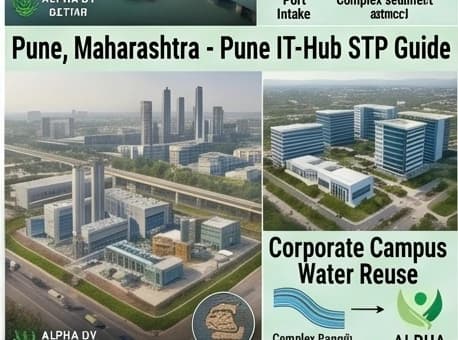
UV water treatment in Pune and Maharashtra is required for residential water safety (overhead tank bacterial regrowth in PMC supply zones), industrial process water quality (auto OEM paintshops, pharma plants, IT campuses), and STP MPCB compliance (coliform reduction at STP outlets before discharge). Alpha UV System supplies UV disinfection systems across Pune, Mumbai, Nashik, Aurangabad, Kolhapur, and Nagpur with 5–7 day delivery, Philips UV-C lamps, and Maharashtra-specific MPCB STP documentation. UV systems at 40 mJ/cm² meet MPCB total coliform standard of <100 MPN/100mL for land discharge.
Maharashtra is India's most industrialised state and the second-largest by GDP — with Pune as its fastest-growing city and the hub of its auto manufacturing, IT services, and pharmaceutical export sectors. The state's water treatment needs span the full range from small residential UV units in Pune's new-build townships to industrial UV-AOP systems in Nashik's chemical clusters and large-capacity STP UV systems for Mumbai's commercial complexes.
Pune's Pimpri-Chinchwad Municipal Corporation (PCMC) area — home to the Chakan auto cluster, the Talawade IT park, and the Bhosari industrial belt — relies heavily on Pavana and Mula rivers for supply, both of which show seasonal quality variation during the monsoon. Pune Municipal Corporation (PMC) supplies Khadakwasla reservoir water with relatively good quality but faces the same overhead tank regrowth problem common to all Indian cities.
Pune Water Quality Issues and UV Relevance
| Pune Zone / Area | Supply Source | Key Water Quality Issue | UV Treatment Needed |
|---|---|---|---|
| PMC core city (Shivajinagar, Kothrud, Karve Nagar) | PMC piped supply (Khadakwasla) | Bacterial regrowth in overhead tanks; seasonal turbidity spike during monsoon | Post-tank UV at 40 mJ/cm² |
| Pimpri-Chinchwad (PCMC) — Bhosari, Nigdi | PCMC piped supply (Pavana / Mula) | Chloramine fluctuation during monsoon; pressure variation causing backflow contamination | Post-tank UV at 40 mJ/cm² |
| Hadapsar, Manjri, Wagholi | Mix of PMC supply and borewell | E. coli in borewell; high TDS in some areas (groundwater from industrial estate seepage) | Borewell: pre-filter + UV; PMC: post-tank UV |
| Chakan, Talegaon | Primarily borewell / tanker | High hardness, TDS up to 1,500 mg/L; occasional E. coli from shallow wells | RO + UV for drinking; UV-only for industrial process |
| Hinjawadi IT Park | PCMC supply + borewell backup | Legionella risk in cooling towers (dense IT campus buildings); STP compliance for campus STPs | Cooling tower UV; STP outlet UV |
| Nashik (Satpur, Ambad MIDC) | Municipal supply + borewell | Chemical industry area groundwater; high demand during grape season for winery water | UV for process water in wineries and food processing |
UV Water Treatment for Pune's Auto Manufacturing Sector
The Chakan-Talegaon-Ranjangaon auto manufacturing belt — home to Volkswagen, Mercedes-Benz, General Motors, Bajaj Auto, Tata Motors, Mahindra, and dozens of tier-1 auto component manufacturers — is one of the largest automotive manufacturing concentrations in Asia. Auto manufacturing's water treatment requirements are dominated by paintshop process water (UV for DI water loop disinfection, UV-AOP for paint effluent treatment) and the MPCB Zero Liquid Discharge requirements that several Chakan plants now operate under.
UV systems for auto industry process water in Pune typically include:
Paintshop DI water loop UV: 5–20 m³/h at 40–80 mJ/cm², low-pressure amalgam lamps, 316L SS sanitary construction, UV intensity sensor with alarm for paint line SCADA integration.
Paintshop effluent UV-AOP: Medium-pressure UV systems at 500–2,000 mJ/cm² with H₂O₂ injection, sized for 5–30 m³/h post-DAF paint effluent flow. These systems reduce COD by 40–60% and colour to below MPCB consent conditions before the activated sludge plant polishing step.
Cooling tower UV: 10–50 m³/h on cooling tower make-up water for Legionella control in the large cooling towers that serve paint curing ovens and CNC machine tool cooling circuits.
UV Water Treatment for Pune's Pharmaceutical Sector
Pune's pharmaceutical manufacturing cluster — the Hinjawadi, Talawade, and Ranjangaon zones, plus long-established plants in Pimpri and Bhosari — includes formulation plants, API manufacturers, and contract manufacturers supplying both Indian and export markets. Schedule M 2025 compliance requires pharmaceutical water systems with UV at two positions: 185 nm for TOC reduction and 254 nm for loop disinfection.
Water for injection (WFI) systems at Pune pharmaceutical plants are typically verified by CDSCO inspectors based in Mumbai. CDSCO inspection requirements for pharmaceutical water UV systems in Pune are identical to the national Schedule M 2025 standard — UV intensity monitoring with 4–20 mA output, IQ/OQ/PQ validation documentation, Philips lamp COA, and minimum 12 months of UV intensity trend data available for review.
MPCB STP Compliance Requirements for Pune
The Maharashtra Pollution Control Board (MPCB) has run several enforcement drives targeting residential township STPs in Pune's rapidly developed outer zones — Wakad, Baner, Balewadi, Undri, and Kondhwa — following NGT orders directing MPCB to ensure STP compliance across all major Maharashtra cities.
| Parameter | Standard (Land / Irrigation Discharge) | Standard (Surface Water Body) | UV Role |
|---|---|---|---|
| Total Coliform (MPN/100mL) | <100 | <10 | Primary — UV dose determines coliform reduction |
| BOD (mg/L) | <30 | <10 | None — secondary biological treatment |
| COD (mg/L) | <250 | <100 | None |
| TSS (mg/L) | <100 | <20 | Indirect — lower TSS improves UV efficiency |
| Faecal Coliform (MPN/100mL) | <500 | <100 | Primary — achieved with total coliform reduction |
| pH | 5.5–9.0 | 6.0–8.5 | None — UV does not alter pH |
MPCB STP inspections now commonly include a check of the UV system intensity monitoring logbook — specifically whether the sensor reading is recorded daily and whether any alarm events (low UV intensity, indicating lamp failure or sleeve fouling) have been logged and acted upon. UV systems without intensity sensors (lamp-indicator-only models) increasingly fail this inspection requirement. Alpha UV System's UV reactors include UV intensity sensors as standard across all models.
UV Water Treatment in Mumbai and Mumbai Metropolitan Region
The Mumbai Metropolitan Region (MMR) — including Thane, Navi Mumbai, Kalyan-Dombivli, and Mira-Bhayander — is the largest urban agglomeration in India. BMC (Brihanmumbai Municipal Corporation) supplies treated water from Bhatsa, Vaitarna, Tulsi, and other reservoirs with relatively good source water quality but faces the same distribution system and storage tank contamination issues as all Indian cities.
Key UV water treatment applications in MMR:
High-rise residential buildings: Mumbai's residential high-rises (20–60 floors) use overhead tanks at the top floor for domestic water distribution. UV systems at 40 mJ/cm² on the tank outlet (flow rate 2–10 m³/h for a typical 100-flat tower) protect against bacterial regrowth in the extended distribution drop from the overhead tank to lower floors.
Commercial and hotel buildings: Mumbai's commercial real estate — BKC, Nariman Point, Lower Parel, Andheri — and its 5-star hotel district require Legionella management plans for cooling towers. UV at 40–80 mJ/cm² on cooling tower make-up water is standard practice in JW Marriott, Taj Hotels, and major corporate campuses across Mumbai.
Pharmaceutical and chemical plants (Thane-Belapur, Ambernath, Dombivli): The MIDC industrial areas east and north of Mumbai have concentrated pharmaceutical and chemical manufacturing. MPCB consent conditions for these zones are among the strictest in Maharashtra — UV systems must be accompanied by monthly effluent test certificates and quarterly MPCB-witnessed sampling.
UV System Sizing Reference for Pune and Maharashtra
| Application | Flow Rate | UV Dose | Notes |
|---|---|---|---|
| Residential villa / bungalow (Pune) | 0.5–1 m³/h | 40 mJ/cm² | 5 µm pre-filter for borewell applications |
| Apartment complex — 50–100 flats | 2–8 m³/h | 40 mJ/cm² | Post-overhead-tank installation preferred |
| Auto plant DI water (paintshop) | 5–20 m³/h | 40–80 mJ/cm² | 316L SS, UV intensity sensor for paint line PLC |
| Pharmaceutical purified water (Pune pharma belt) | 2–10 m³/h | 80 mJ/cm² | 185 nm + 254 nm; Schedule M 2025 IQ/OQ/PQ documentation |
| IT campus cooling tower (Hinjawadi) | 5–30 m³/h | 40–80 mJ/cm² | ASHRAE 188 Legionella WMP documentation |
| STP outlet — 200 KLD residential STP (Pune) | 15–20 m³/h | 40 mJ/cm² | UVT 55–65% typical; Philips TUV 95W recommended |
| Hotel STP / hospital STP (Pune) | 8–20 m³/h | 40–80 mJ/cm² | MoEFCC biomedical standards for hospitals; MPCB for hotels |
| Winery process water (Nashik wine belt) | 2–10 m³/h | 40 mJ/cm² | No chemical residual — UV essential; grape juice contact applications |
Does MPCB require ZLD for industrial units in Pune?
MPCB mandates ZLD for certain categories of Red and Orange category industries in Maharashtra, particularly those discharging to water bodies in river basins subject to CPCB Critically Polluted Area designations. In the Pune region, industries in the Bhama-Askhed basin and along the Mula-Mutha river corridor face ZLD requirements under MPCB orders from 2019 and 2022. Auto OEM plants in Chakan with consent conditions referencing the Indrayani river basin have been required to implement ZLD with water recovery above 95%. UV disinfection of the ZLD system's RO permeate is standard, ensuring recycled process water meets microbiological quality for reuse in DI water loops and cooling tower make-up.
My Pune apartment already has an RO system. Do I still need UV?
RO removes dissolved salts, heavy metals, hardness, and most bacteria through membrane filtration. However, a small fraction of bacteria (10⁻³ to 10⁻⁵ of the inlet concentration) passes through RO membranes in the permeate, and bacteria can colonise the RO storage tank if it is not sanitised regularly. For drinking water, a UV polishing step after the RO storage tank — at a flow rate of 0.2–0.5 m³/h at 40 mJ/cm² — provides a final disinfection barrier. This is particularly important in Pune buildings with known overhead tank contamination. The RO removes chemicals and reduces the bacterial load; UV eliminates the residual bacteria that passed through or regrew in storage. The combination is more reliable than either technology alone.
How quickly can Alpha UV System deliver to Pune and Maharashtra?
Standard UV systems for residential and small commercial applications (up to 10 m³/h) are typically dispatched within 2–3 working days and arrive in Pune in 5–7 working days via express logistics. Larger industrial UV systems (10–100 m³/h) are built to order with a lead time of 2–4 weeks. Replacement Philips UV-C lamps and quartz sleeves for all models we supply are stocked and can be dispatched same-day for express delivery to Pune. For urgent STP compliance requirements ahead of a MPCB inspection, we offer priority manufacturing and dispatch — WhatsApp our team at +91 95995 00580 with your timeline and we will confirm feasibility.
Alpha UV System supplies UV disinfection systems to residential complexes, auto plants, pharmaceutical manufacturers, IT campuses, hospitals, hotels, and STP operators across Pune, Mumbai, Nashik, Aurangabad, Kolhapur, and Nagpur. MPCB documentation provided. Philips UV-C lamps. 5–7 day delivery to Pune.
WhatsApp Us for Pune UV System SupplyStandards, authorities & further reading
External references used to inform this guide. Regulations evolve — check the latest revision on each authority's site before compliance decisions.
Recommended UV Systems
Alpha UV System products for this application — powered by genuine Philips UV-C lamps.
Commercial UV Water Purification System
500 – 5,000 LPH
HACCP-compliant UV water purification for hotels, restaurants, and offices
Industrial UV Water Treatment System
5,000 – 50,000 LPH
Schedule M 2025 and HACCP compliant UV for pharma, food & beverage, and process water
Not sure which system suits your application? WhatsApp our engineers for a free recommendation →
Related solutions
See how Alpha UV System applies this to your industry or city.
Need a UV system?
Talk to our UV engineers — WhatsApp for a quote in 2 hours, or browse the full catalog on IndiaMART.