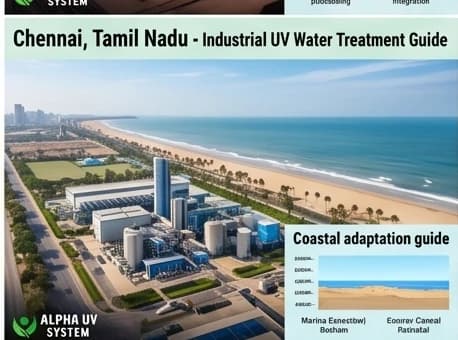
UV water treatment in Chennai and Tamil Nadu serves four critical needs: (1) disinfection of desalination plant permeate and tanker water used in Chennai's water-scarce zones (T. Nagar, Anna Nagar, OMR) — desalinated water has no chlorine residual and high bacterial regrowth risk in storage tanks; (2) UV for pharmaceutical and medical device manufacturing in the Chennai–Sriperumbudur pharma corridor under Schedule M 2025; (3) UV disinfection for auto OEM paintshops and component manufacturers in the Sriperumbudur–Oragadam auto cluster; and (4) UV-AOP and UV disinfection for TNPCB STP compliance across Chennai's rapidly growing residential and commercial zones. Tiruppur's textile cluster requires UV-AOP for effluent colour removal to below the TNPCB 400 ADMI limit.
Chennai is unique among India's major cities in its water supply structure — the city has periodically faced acute water crises (the 2019 "Day Zero" scenario when reservoirs ran dry) and relies on an unusually diverse supply portfolio: water from Poondi, Chembarambakkam, Veeranam, and Red Hills reservoirs; desalination from plants at Minjur and Nemmeli; water transfer from Veeranam lake in Cuddalore; and tanker supply from nearby agricultural areas during droughts.
This supply diversity creates a water quality challenge that no other Indian city faces in quite the same way: the same building may receive reservoir-sourced CMWSSB supply on some days, desalinated water on others, and tanker water during supply interruptions. Each source has a different chlorine residual (or none at all, in the case of desalinated water received without post-treatment dosing). UV disinfection at the building storage tank outlet provides a consistent final disinfection barrier regardless of which source supplied the water that day.
Chennai's Water Sources and UV Relevance
| Water Source | Typical Chlorine Residual at Tank Inlet | Bacterial Risk in Storage | UV Priority |
|---|---|---|---|
| CMWSSB reservoir supply (piped) | 0.05–0.15 mg/L (depleted after distribution) | Medium — bacteria regrow during tank storage in Chennai summer (35–40°C) | High — post-tank UV at 40 mJ/cm² |
| Desalinated water (Minjur / Nemmeli RO plants) | Near zero — desalinated water typically has no post-treatment dosing in distribution | Very high — no residual protection at all; bacteria multiply rapidly in hot storage tanks | Critical — UV essential for any desalinated water used without active chlorination |
| Tanker water (agricultural wells, private supply) | Variable — often zero | High — tanker hygiene and source quality are highly variable | Critical — UV after filtration is mandatory for tanker-supplied buildings |
| Borewell / open well (peri-urban Chennai) | None | High in many areas — E. coli detected in 40–60% of Chennai peri-urban borewell samples | Critical — pre-filter + UV; RO + UV for high-TDS areas |
UV for Desalinated Water in Chennai
Chennai's two seawater reverse osmosis desalination plants — the 100 MLD Minjur plant (north of Chennai, operated by IVRCL) and the 100 MLD Nemmeli plant (south of Chennai, operated by VA Tech Wabag) — produce technically high-quality water with low TDS and no turbidity. However, desalinated water has characteristics that make post-storage UV disinfection particularly important:
No disinfectant residual: The RO membranes in desalination plants cannot tolerate chlorine (polyamide membranes are oxidised by free chlorine). Desalinated water typically receives minimal or no chlorination before distribution. By the time it reaches a building storage tank after hours in the distribution network, there is no active disinfectant protecting it from bacterial contamination entering through tank access points, pipe joints, and overflow connections.
Low mineral content acts as a bacterial growth medium: Desalinated water with very low TDS (50–150 mg/L) and no humic acids or natural organic matter is paradoxically an ideal bacterial growth environment because competition from natural environmental bacteria and inhibition by humic substances are absent. Bacteria introduced into a desalinated water storage tank can reach high concentrations rapidly.
UV disinfection at 40 mJ/cm² installed on the outlet of underground sumps or overhead tanks supplied by desalinated water provides the disinfection residual that the supply itself lacks. This is not an optional extra — buildings in Chennai's OMR tech corridor and T. Nagar residential zone supplied by desalinated water without UV treatment have experienced bacterial contamination events that would have been prevented by UV installation.
UV for the Sriperumbudur–Oragadam Auto Cluster
The Sriperumbudur–Oragadam industrial corridor west of Chennai hosts India's largest concentration of automotive OEM assembly plants — Hyundai, Renault-Nissan, BMW, Royal Enfield (Oragadam), Ford (now closed), Daimler Trucks, and dozens of tier-1 suppliers. This auto cluster's water treatment requirements parallel those of Pune's Chakan belt:
Paintshop DI water UV: All automotive OEM paintshops in the corridor use DI water for electrocoat and waterborne topcoat mixing. UV disinfection at 40–80 mJ/cm² on the DI water recirculation loop prevents microbial film defects. Flow rates: 5–20 m³/h for individual line UV systems.
Cooling tower Legionella control: The auto cluster's large cooling towers operate year-round in Chennai's tropical climate. Summer cooling water temperatures (28–36°C) are in the peak Legionella growth range. UV at 40–80 mJ/cm² on cooling tower make-up and recirculation is specified in the environmental and occupational health management systems of all major OEM operators.
ETP compliance (TNPCB): Auto OEM ETPs in the Sriperumbudur area discharge under TNPCB consent conditions referencing the Palar River basin standards. TNPCB enforcement in this zone has been particularly stringent since 2020 NGT orders addressing Palar River pollution. UV at the ETP outlet provides the final coliform barrier for land irrigation reuse or river discharge.
UV-AOP for Tiruppur's Textile Industry
Tiruppur — the knitwear export capital of India, responsible for 90% of India's cotton hosiery exports — is also home to one of the world's most concentrated textile dyeing clusters. The Noyyal River, which runs through Tiruppur, was declared unfit for any use in a 2011 NGT order after decades of textile effluent discharge. The NGT's Tiruppur closure order forced the establishment of CETPs and mandated TNPCB colour compliance of <400 ADMI for all textile effluent discharge.
UV-AOP (UV + H₂O₂) is now the standard colour removal technology in Tiruppur's CETPs and individual dyehouse ETPs. The reactive dyes used in cotton knitwear dyeing — azo and anthraquinone reactive dyes in a wide range of shades — respond well to hydroxyl radical oxidation at UV doses of 1,500–3,000 mJ/cm² with H₂O₂ doses of 40–80 mg/L, achieving colour reduction from 2,000–8,000 ADMI (post-biological) to below the 400 ADMI TNPCB limit.
UV Water Treatment Across Tamil Nadu Cities
| City / Region | Primary Industry / Use Case | Key UV Application | Volume Demand |
|---|---|---|---|
| Coimbatore | Textile machinery, engineering, pump manufacturing, hospitals | Industrial process water UV; hospital STP UV; residential building UV | Medium — growing fast with IT and manufacturing expansion |
| Trichy (Tiruchirappalli) | Power equipment (BHEL), cement, sugar, hospitals (medical tourism) | BHEL boiler feed water UV; hospital water UV; residential apartments UV | Medium |
| Madurai | Textile, garment, granite, hospitals (Apollo, Meenakshi) | Textile ETP colour removal UV-AOP; hospital STP UV | Medium |
| Salem | Steel (Salem Steel Plant), textiles, agriculture | Industrial process water UV; textile effluent UV-AOP | Low–medium |
| Tirunelveli / Thoothukudi | Wind energy, salt, cement, fisheries | Fisheries / aquaculture UV; food processing UV | Low–medium |
| Vellore / Ranipet | Leather tanning (Ranipet — one of India's worst polluted areas historically) | Tannery ETP UV-AOP (chrome-containing effluent); residential water UV | Low |
TNPCB STP and ETP Compliance for Tamil Nadu
The Tamil Nadu Pollution Control Board (TNPCB) has been among the most active state PCBs in enforcing STP and ETP compliance — driven by both the Tiruppur textile crisis and ongoing NGT directions for the Cauvery, Palar, and Vaigai river basins. TNPCB standards for STP effluent discharge are aligned with CPCB national standards, with some zone-specific additions for colour (for textile areas) and heavy metals (for tannery areas).
| Standard | Parameter | Limit | UV Relevance |
|---|---|---|---|
| TNPCB STP discharge | Total Coliform | <100 MPN/100mL (land/irrigation) | Primary UV function — 40 mJ/cm² achieves this |
| TNPCB STP discharge (surface water) | Total Coliform | <10 MPN/100mL | 80 mJ/cm² UV required |
| TNPCB textile ETP (Tiruppur / textile zones) | Colour (ADMI) | <400 ADMI | UV-AOP for colour removal to below this limit |
| TNPCB general ETP | BOD, COD, TSS | BOD <30; COD <250; TSS <100 | No direct UV contribution (biological treatment handles these) |
UV System Sizing Reference for Chennai and Tamil Nadu
| Application | Flow Rate | UV Dose | Notes |
|---|---|---|---|
| Residential apartment — desalinated water supply (Chennai) | 2–8 m³/h | 40 mJ/cm² | Critical — no residual in desalinated supply; tank regrowth risk is very high |
| Tanker water — building supply | 1–5 m³/h | 40 mJ/cm² | 5 µm pre-filter mandatory; tanker water quality variable |
| Auto OEM paintshop DI loop (Sriperumbudur) | 5–20 m³/h | 40–80 mJ/cm² | 316L SS body; UV intensity for PLC alarm |
| Tiruppur dyehouse UV-AOP (CETP) | 10–100 m³/h | 1,500–3,000 mJ/cm² | Medium-pressure lamps; H₂O₂ injection 40–80 mg/L; pilot test first |
| STP outlet — 200 KLD (Chennai OMR) | 15–20 m³/h | 40 mJ/cm² | UVT 55–65%; Philips TUV 95W; TNPCB consent documentation |
| Pharma plant purified water (Chennai pharma SEZ) | 3–15 m³/h | 80 mJ/cm² | 185 nm + 254 nm; Schedule M 2025 IQ/OQ/PQ |
Is UV disinfection necessary for desalinated water in Chennai?
Yes — more so than for almost any other water source in India. Desalinated water has no disinfectant residual after leaving the RO plant, and the CMWSSB distribution system does not reliably add chlorine to desalinated water before it reaches storage tanks. In Chennai's summer temperatures (35–42°C in rooftop tanks), bacteria in desalinated water can double in concentration every 20–30 minutes, reaching dangerously high levels within 4–8 hours of tank entry. Studies of Chennai residential buildings supplied by desalinated water have found coliform counts 10–100 times above BIS 10500 limits in overhead tank samples collected within 12 hours of tank filling. UV at the tank outlet eliminates these bacteria at the point just before water enters building plumbing — the critical last line of defence for Chennai's most water-secure buildings.
Can UV-AOP be retrofitted into an existing Tiruppur CETP?
Yes, and this is the most common implementation. Tiruppur's established CETPs were designed with conventional biological treatment and coagulation/DAF for colour removal, but coagulation alone cannot achieve the <400 ADMI TNPCB standard for reactive dye effluent. UV-AOP is most practically retrofitted as an additional stage between the secondary clarifier and the existing tertiary polishing step — the secondary clarifier effluent (COD 300–800 mg/L, colour 1,000–5,000 ADMI) enters the UV-AOP reactor system, is treated with H₂O₂ + medium-pressure UV, and the decolourised output enters the existing multimedia filter stage before discharge monitoring. The UV-AOP reactor footprint is compact — typically 1–2 medium-pressure UV reactor vessels for a 500–2,000 m³/day CETP. No civil construction is required beyond a small H₂O₂ dosing skid and H₂O₂ storage tank. Alpha UV System has executed UV-AOP retrofits at Tiruppur CETPs within 4–6 weeks from order to commissioning.
Alpha UV System supplies UV disinfection and UV-AOP systems across Chennai, Coimbatore, Tiruppur, Trichy, Madurai, and Salem — desalinated water disinfection, pharma purified water, auto industry process water, textile UV-AOP, and STP TNPCB compliance. Philips UV-C lamps. 5–7 day delivery to Chennai.
WhatsApp Us for Chennai UV System SupplyStandards, authorities & further reading
External references used to inform this guide. Regulations evolve — check the latest revision on each authority's site before compliance decisions.
Recommended UV Systems
Alpha UV System products for this application — powered by genuine Philips UV-C lamps.
Commercial UV Water Purification System
500 – 5,000 LPH
HACCP-compliant UV water purification for hotels, restaurants, and offices
Industrial UV Water Treatment System
5,000 – 50,000 LPH
Schedule M 2025 and HACCP compliant UV for pharma, food & beverage, and process water
Not sure which system suits your application? WhatsApp our engineers for a free recommendation →
Related solutions
See how Alpha UV System applies this to your industry or city.
Need a UV system?
Talk to our UV engineers — WhatsApp for a quote in 2 hours, or browse the full catalog on IndiaMART.