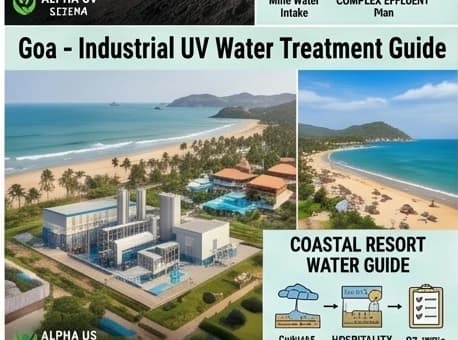
UV water treatment in Goa addresses four specific needs driven by the state's tourism economy: (1) beach resort and hotel water safety — Goa's international tourist clientele (8+ million visitors annually) is highly susceptible to traveller's diarrhoea from water-borne E. coli, and UV at 40 mJ/cm² on hotel water supply provides the final disinfection barrier that protects guest health and hotel reputation; (2) restaurant and food service UV disinfection — North Goa's dense restaurant and beach shack belt requires UV on kitchen water for FSSAI compliance and to prevent foodborne illness complaints from international tourists; (3) coastal borewell treatment — many Goa properties use borewell water that is laterite-filtered and generally acceptable in quality, but requires pre-filter + UV for microbiological safety; and (4) GSPCB STP compliance for the dense resort and villa complex stock in North and South Goa. Alpha UV System supplies Philips UV-C lamp UV systems to Goa with 5–7 day delivery and GSPCB documentation support.
Goa — India's smallest state by area and one of its highest-income states by per capita — is fundamentally a tourism economy. The state receives 8+ million domestic and 700,000+ international tourists annually, generating the highest tourist density per square kilometre of any Indian state. This concentration of international hospitality — 5-star beach resorts, luxury villa rentals, boutique heritage hotels in old Portuguese mansions, beach shacks, and restaurants — creates a UV water treatment market heavily weighted toward food service and hospitality applications rather than the residential and industrial focus of larger Indian states.
Goa's water supply is managed by the PWD (Public Works Department) Goa, which draws from the Mandovi, Zuari, Salaulim, and other rivers. PWD supply quality is generally reasonable but faces monsoon-season turbidity challenges (Goa receives 2,500–3,500 mm of rainfall during the June–September monsoon — one of India's highest). Many Goa properties — particularly in the beach belts of North Goa (Calangute, Baga, Anjuna, Vagator) and South Goa (Cavelossim, Benaulim, Palolem) — rely on borewell water from laterite aquifers, which has generally lower TDS than Rajasthan or Gujarat groundwater but still requires microbiological treatment.
Goa Water Quality by Zone and UV Need
| Zone / Area | Supply Type | Key Water Issue | UV Solution |
|---|---|---|---|
| Panaji / Panjim (capital) | PWD piped supply (Mandovi River) | Monsoon turbidity in Mandovi supply; old distribution pipes in old Panaji; post-storage bacterial regrowth | Post-tank UV at 40 mJ/cm²; 5 µm pre-filter during monsoon |
| North Goa beach belt (Calangute, Baga, Anjuna) | Borewell (laterite aquifer) + PWD piped (partial) | High tourist density — hotel and restaurant water safety critical; beach shack food safety; borewell E. coli in dense tourist areas | Post-tank UV for all hotels; restaurant kitchen UV; pre-filter + UV for borewell |
| Margao / South Goa commercial | PWD piped supply (Salaulim/Zuari) + borewell | Commercial centre; residential STP compliance; borewell quality variable by area | Post-tank UV; STP UV; RO + UV for borewell if iron elevated |
| South Goa luxury resort belt (Cavelossim, Arossim) | Borewell (treated) + water tanker + PWD | 5-star resort Legionella risk — spa pools, cooling towers, extensive hot water networks; international guest water safety; GSPCB STP compliance | UV at 40–80 mJ/cm²; Legionella WMP; spa water UV; STP UV |
| Vasco da Gama / Mormugao (port zone) | PWD piped + borewell | Port industrial zone; phosphate and iron ore export dust affecting area; residential STP compliance | Post-tank UV; GSPCB STP UV; residential compliance |
| Inland Goa (Ponda, Bicholim, Sattari) | Borewell + PWD piped (partial) | Laterite groundwater — iron 0.5–2 mg/L in some zones; pharmaceutical unit water (Ponda pharma cluster); E. coli in rural borewell | Iron pre-filter + UV; pharma UV (Ponda); residential post-tank UV |
Legionella Management UV for Goa's Hotels and Resorts
Goa's luxury hotel and resort sector — including properties managed by Taj, Marriott, IHG (Holiday Inn, Crowne Plaza), Hyatt, Leela, and dozens of boutique properties — operates under international brand standards that require Legionella Water Management Plans (WMPs). Goa's tropical climate (average temperature 27–33°C year-round, humidity 80–90% during monsoon) creates a year-round Legionella risk environment — unlike temperate climate hotels where Legionella risk peaks in summer, Goa hotels face continuous Legionella growth risk in cooling towers, spa whirlpools, and hot water recirculation systems.
Key Legionella risk points in Goa hotels requiring UV:
Cooling tower make-up water: Hotel cooling towers in Goa operate continuously for air conditioning (particularly during October–May tourist season). Cooling tower basin water at 28–32°C is in the Legionella optimal growth range throughout the year. UV at 40–80 mJ/cm² on cooling tower make-up water provides primary planktonic Legionella control. Under Marriott, IHG, and Accor brand standards, documented UV disinfection on cooling tower water is a Legionella WMP requirement for India properties.
Spa and swimming pool water: Goa's luxury resorts operate spa pools, Jacuzzis, and temperature-controlled pools. Spa water at 35–40°C is in the optimal Legionella growth range. UV at 40–80 mJ/cm² on spa water recirculation (in addition to chemical disinfection) provides the primary pathogen control for hotel spa Legionella management.
Guest room hot water: Hotel hot water recirculation loops — particularly in older properties with complex plumbing — can develop Legionella in sections of pipe below 60°C. UV at 40 mJ/cm² on the hot water loop return provides a continuous disinfection barrier alongside thermal management.
UV for Goa's Restaurant and Beach Shack Sector
North Goa's beach restaurant and shack belt — Baga, Calangute, Vagator, Anjuna, Morjim — serves millions of domestic and international tourists annually with fresh seafood, Goan cuisine, and international food. FSSAI (Food Safety and Standards Authority of India) requires that all food service operations use water that meets IS 10500 drinking water standards for food contact purposes — cooking, washing produce, ice making, and beverage preparation.
The specific risk in Goa beach restaurants is twofold: borewell water quality is variable across the dense tourist belt (high-season water tables can drop, introducing microbiological contamination), and tanker water — used by many shacks during peak season when borewell supply is insufficient — has no guaranteed quality. UV at 40 mJ/cm² on the kitchen water supply eliminates E. coli, Vibrio, Salmonella, and Norovirus from food contact water, protecting tourists from foodborne illness and protecting restaurant operators from the reputational and legal consequences of food safety incidents.
For beach shacks operating seasonal businesses (October–May), a compact UV system (1–2 m³/h, Philips TUV lamp) provides the required kitchen water disinfection at minimal operating cost — the only consumable is the UV lamp replaced every 9,000 hours (approximately one tourist season of heavy use).
GSPCB STP Compliance in Goa
The Goa State Pollution Control Board (GSPCB) enforces STP compliance for residential complexes, hotels, and resorts across the state. Goa's tourism economy has driven significant villa and apartment complex construction in North and South Goa coastal zones — many of which require GSPCB-consented STPs. UV at the STP outlet (40 mJ/cm²) provides the total coliform compliance required by GSPCB before treated effluent is discharged or reused for landscaping irrigation.
| Application | Flow Rate | UV Dose | Notes |
|---|---|---|---|
| Residential villa / apartment (Goa) | 0.5–2 m³/h | 40 mJ/cm² | Post-tank UV; laterite borewell: 5 µm pre-filter; monsoon pre-filter replacement critical |
| Beach resort (100 rooms, 5-star) | 10–30 m³/h | 40–80 mJ/cm² | Cooling tower UV; spa water UV; hot water loop UV; GSPCB STP UV — each separate system |
| Beach shack / restaurant kitchen | 1–3 m³/h | 40 mJ/cm² | FSSAI compliance; compact UV; seasonal lamp replacement schedule |
| Spa pool recirculation | 5–20 m³/h | 40–80 mJ/cm² | Temperature 35–40°C — peak Legionella zone; UV + bromine disinfection combination |
| Boutique heritage hotel (old Panaji mansion) | 2–8 m³/h | 40 mJ/cm² | Old plumbing Legionella risk; thermal flush + UV; guest room water safety for international guests |
| STP outlet — 100 KLD (resort / villa complex) | 8–12 m³/h | 40 mJ/cm² | Philips TUV 55W; GSPCB consent documentation; irrigation reuse compliance |
| Seafood processing (local export unit) | 3–15 m³/h | 40 mJ/cm² | Vibrio control; MPEDA export certification; no chlorine in fish contact water |
My North Goa borewell water looks clear — do I still need UV?
Clarity of water has no relationship to its microbiological safety — water can be crystal clear and still contain E. coli, Norovirus, Vibrio, and other pathogens at concentrations that cause illness. Goa's laterite borewell water in many areas does have low turbidity and relatively low TDS (100–400 mg/L) — it looks and tastes clean. However, bacterial contamination from surface infiltration (Goa's dense tourist infrastructure includes septic systems, open drains, and food waste) can reach laterite aquifers, particularly in areas with high water table during monsoon. The only way to determine if your borewell is microbiologically safe is an NABL laboratory test for E. coli and total coliforms. If the test shows coliforms present (as is common in North Goa's dense beach belt boreholes), UV at 40 mJ/cm² with a 5 µm pre-filter eliminates the risk. If the test is clean, UV still provides insurance against future contamination events — especially relevant for hospitality operations where a single waterborne illness incident can generate Google reviews that affect booking for years.
Should I switch from borewell to tanker during Goa's monsoon?
Many Goa hotels and restaurants switch from borewell to tanker supply during the peak monsoon months (June–August) when borewell water tables rise rapidly and the risk of surface water infiltration into shallow laterite aquifers is highest. However, tanker water quality in Goa is not guaranteed — tanker operators draw from various sources including PWD supply, private boreholes, and (in some cases) rivers. The correct approach is: UV treatment on whatever water source you are using, not switching sources to avoid UV. A UV system at 40 mJ/cm² with a 5 µm pre-filter installed on your main water inlet (before the overhead tank) treats borewell water, PWD supply, and tanker water equally effectively. Monsoon-season pre-filter maintenance (replace the 5 µm cartridge monthly during June–September rather than quarterly) is the critical operational adjustment for Goa properties during the monsoon season.
Alpha UV System supplies UV disinfection systems to beach resorts and hotels, restaurants and beach shacks, residential villas and apartments, seafood processors, and STP operators across North Goa, South Goa, Panaji, Margao, and Vasco. GSPCB STP documentation. Legionella WMP support for international hotel brands. FSSAI food contact water UV. Philips UV-C lamps. 5–7 day delivery to Goa.
WhatsApp Us for Goa UV System SupplyRecommended UV Systems
Alpha UV System products for this application — powered by genuine Philips UV-C lamps.
Commercial UV Water Purification System
500 – 5,000 LPH
HACCP-compliant UV water purification for hotels, restaurants, and offices
Industrial UV Water Treatment System
5,000 – 50,000 LPH
Schedule M 2025 and HACCP compliant UV for pharma, food & beverage, and process water
Not sure which system suits your application? WhatsApp our engineers for a free recommendation →
Related solutions
See how Alpha UV System applies this to your industry or city.
Need a UV system?
Talk to our UV engineers — WhatsApp for a quote in 2 hours, or browse the full catalog on IndiaMART.