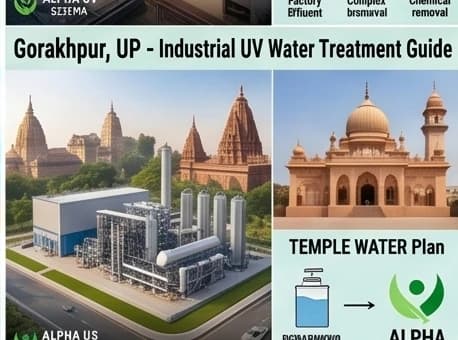
UV water treatment in Gorakhpur addresses four key needs: (1) post-overhead-tank disinfection for Gorakhpur's residential areas — GMC (Gorakhpur Municipal Corporation) supply from the Rapti River loses residual chlorine in overhead tanks during Gorakhpur's extreme summer heat (temperatures reach 44–46°C in May–June); (2) AIIMS Gorakhpur hospital water treatment — the All India Institute of Medical Sciences at Gorakhpur, established as part of the UP AIIMS expansion, requires UV-treated water for patient safety including ICU (80 mJ/cm²), dialysis (AAMI/ISO 13959), and NABH compliance; (3) IFFCO Gorakhpur fertiliser plant process water and cooling tower Legionella management — IFFCO's revived Gorakhpur urea plant (one of India's largest fertiliser plants) requires industrial UV for cooling tower and process water; and (4) UPPCB and NMCG STP compliance for Gorakhpur's residential sectors in the Ganga basin. Alpha UV System supplies Philips UV-C lamp UV systems to Gorakhpur with 5–7 day delivery and UPPCB/NMCG documentation support.
Gorakhpur — the administrative headquarters of eastern UP's Gorakhpur division and the base of the Nath sampraday's Gorakhpur Mutt (the Gorakhnath temple, currently led by Yogi Adityanath who is also UP's Chief Minister) — is a growing industrial and medical hub in eastern Uttar Pradesh. The city's economic trajectory has accelerated since the revival of the historic Gorakhpur Fertiliser Plant (now operated by IFFCO after years of shutdown) and the establishment of AIIMS Gorakhpur, which is transforming the city into a significant healthcare destination for the eastern UP and Nepal border region.
Gorakhpur's Rapti River supply — the Rapti is a Ghaghara tributary originating in Nepal — has water quality that varies significantly by season: relatively clean during the pre-monsoon period, but carrying heavy agricultural runoff and upstream urban sewage during monsoon. Gorakhpur's extremely hot summers (the Terai region between the Himalayas and the Gangetic plain is one of India's hottest zones in May–June) create severe bacterial regrowth risk in overhead tanks.
Gorakhpur Water Quality by Zone
| Zone / Area | Supply Type | Key Water Issue | UV Solution |
|---|---|---|---|
| Central Gorakhpur (Golghar, Civil Lines) | GMC piped supply (Rapti River) | Bacterial regrowth in 46°C summer peak; old city distribution; dense commercial-residential mix | Post-tank UV at 40 mJ/cm²; 5 µm pre-filter; summer monthly pre-filter check |
| AIIMS Gorakhpur campus | GMC supply + campus deep borewell | NABH hospital accreditation water safety; ICU immunocompromised patients; dialysis water; OT water | UV at 40–80 mJ/cm²; NABH documentation; dialysis AAMI/ISO 13959; ICU 80 mJ/cm² |
| IFFCO fertiliser plant (Gorakhpur) | IFFCO internal supply (Rapti diversion) + borewell | Cooling tower Legionella — large fertiliser plant cooling infrastructure; process water UV; UPPCB industrial STP | Cooling tower UV (40–80 mJ/cm²); process water UV; UPPCB STP UV; IFFCO EHS standard |
| Taramandal / Sahjanwa (residential growth) | GMC piped supply + borewell | New residential growth zone; STP compliance; borewell TDS 200–500 mg/L in eastern UP alluvial plain | Post-tank UV; STP UV; NABL test borewell first (check arsenic in alluvial zone) |
| Deoria / Kushinagar (Terai district) | PHED supply + borewell | Buddhist pilgrimage zone (Kushinagar — where Buddha attained Mahaparinirvana); alluvial borewell — check arsenic; NMCG compliance | NABL arsenic test mandatory for alluvial borewell; UV after arsenic treatment; Buddhist monument water safety |
The Gorakhpur-Deoria-Kushinagar belt lies in the eastern UP alluvial Ganga-Ghaghra plain — a geological zone where naturally occurring arsenic from Himalayan mineral dissolution is found in shallow aquifer borewell water (depths under 50 metres). Arsenic above the IS 10500 limit of 10 µg/L has been reported in borewell water in this region. UV treatment does NOT remove arsenic. Test any borewell in the eastern UP alluvial zone for arsenic at an NABL laboratory before installing UV. If arsenic is elevated, install an arsenic removal system (GFH media or RO) before UV.
UV for AIIMS Gorakhpur
AIIMS Gorakhpur — one of the 22 new AIIMS established under the PM's Pradhan Mantri Swasthya Suraksha Yojana (PMSSY) to bring tertiary healthcare to underserved regions — serves the eastern UP and Bihar border population. As a NABH (and eventually JCI) accredited teaching hospital, AIIMS Gorakhpur requires UV water treatment for: potable water (40 mJ/cm²), ICU and transplant ward (80 mJ/cm²), dialysis water (AAMI/ISO 13959 — two-pass RO + UV + endotoxin filter), operating theatres (80 mJ/cm²), central sterile services department (CSSD) instrument rinse water, and cooling tower Legionella management.
AIIMS hospital UV water treatment UV documentation for NABH: installation qualification record (reactor serial number, lamp wattage, flow rate, calculated UV dose at certified UV transmittance), monthly UV intensity monitoring log, quarterly NABL-certified coliform test from UV-treated water tap, and annual lamp replacement record. Alpha UV System provides the complete NABH water safety documentation package with each hospital UV system.
| Application | Flow Rate | UV Dose | Notes |
|---|---|---|---|
| Residential apartment (Civil Lines / Taramandal) | 1–3 m³/h | 40 mJ/cm² | Post-overhead-tank UV; 5 µm pre-filter; summer peak critical; borewell NABL test for arsenic |
| AIIMS Gorakhpur hospital (ICU/OT) | 5–30 m³/h | 80 mJ/cm² | NABH water safety; ICU 80 mJ/cm²; dialysis AAMI/ISO 13959; NABH documentation package |
| AIIMS dialysis water | 2–10 m³/h | 40–80 mJ/cm² | Post double-pass RO UV; AAMI/ISO 13959; endotoxin monitoring; NABH records |
| IFFCO Gorakhpur cooling tower | 50–200 m³/h | 40–80 mJ/cm² | Fertiliser plant cooling Legionella WMP; ASHRAE 188; IFFCO EHS standard |
| Gorakhnath temple langar kitchen | 2–10 m³/h | 40 mJ/cm² | Religious community kitchen FSSAI UV; chemical-free disinfection preferred; Rapti basin compliance |
| STP outlet — 300 KLD (Gorakhpur residential) | 20–30 m³/h | 40 mJ/cm² | Philips TUV 95W; UPPCB/NMCG consent documentation; Ghaghara-Ganga basin compliance |
Is UV water treatment relevant for preventing encephalitis outbreaks in Gorakhpur?
Gorakhpur has a tragic history with Acute Encephalitis Syndrome (AES) — the BRD Medical College Gorakhpur hospital encephalitis ward saw hundreds of child deaths annually for years, and the 2017 BRD hospital oxygen supply failure crisis focused national attention on this region. AES in Gorakhpur district has multiple causes including Japanese Encephalitis virus (transmitted by mosquitoes, not water), scrub typhus, and other vector-borne and enteric pathogens.
UV water treatment is relevant to the waterborne component of AES in the Gorakhpur-Deoria region: contaminated drinking water in rural areas contributes to enteric infections that lower immunity and increase vulnerability to other pathogens. UV at 40 mJ/cm² on borewell or surface water supply provides protection against waterborne bacteria, viruses (including enteroviruses at 40 mJ/cm²), and protozoa. UV does NOT prevent mosquito-borne Japanese Encephalitis virus — that requires vaccination and mosquito vector control. But UV water treatment for community water supplies in the eastern UP Terai belt does reduce the overall burden of waterborne disease in a population that is already vulnerable to AES from multiple causes. Village-level UV systems for community water supply in Gorakhpur district's endemic AES zones are a public health priority that Alpha UV System supports with appropriate system sizing for community supply volumes.
Alpha UV System supplies UV disinfection systems to AIIMS hospital, IFFCO industrial, religious institutions, residential complexes, and STP operators across Gorakhpur, Taramandal, Sahjanwa, Deoria, and Kushinagar. UPPCB/NMCG STP documentation. NABH hospital water safety documentation. Philips UV-C lamps. 5–7 day delivery to Gorakhpur.
WhatsApp Us for Gorakhpur UV System SupplyRecommended UV Systems
Alpha UV System products for this application — powered by genuine Philips UV-C lamps.
Commercial UV Water Purification System
500 – 5,000 LPH
HACCP-compliant UV water purification for hotels, restaurants, and offices
Industrial UV Water Treatment System
5,000 – 50,000 LPH
Schedule M 2025 and HACCP compliant UV for pharma, food & beverage, and process water
Not sure which system suits your application? WhatsApp our engineers for a free recommendation →