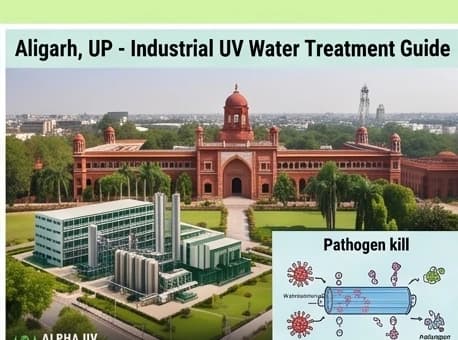
UV water treatment in Aligarh addresses three key needs: (1) post-overhead-tank disinfection for Aligarh's dense residential areas — AMC (Aligarh Municipal Corporation) supply from the Upper Ganga Canal loses residual chlorine in overhead tanks during Aligarh's extreme summer heat (temperatures reach 44–47°C in May–June); (2) Aligarh Muslim University (AMU) campus water safety — AMU is one of India's largest residential universities with 30,000+ students in campus hostels, where water safety for a large captive population requires documented UV treatment; and (3) UPPCB STP compliance for Aligarh's residential complexes under the Yamuna-Ganga NCR basin programme — Aligarh discharges into the Kali River (Kali West), which joins the Yamuna and is under NMCG/NGT monitoring. Alpha UV System supplies Philips UV-C lamp UV systems to Aligarh with 5–7 day delivery and UPPCB documentation support.
Aligarh — famous for the Aligarh lock (Aligarh produces 70%+ of India's security padlocks and door hardware) and Aligarh Muslim University (one of India's oldest and most respected central universities, founded 1875) — is a mid-sized UP city with a distinct industrial and educational character. The lock manufacturing industry — concentrated in the Aligarh City's Jamalpur area and distributed across small workshops throughout the city — produces millions of padlocks annually ranging from basic iron padlocks to high-security brass and stainless steel locks for export.
Aligarh's Upper Ganga Canal supply — from the canal that carries Ganga water from Haridwar across western UP — provides a reasonable treated water base. However, the canal water quality is influenced by agricultural runoff from the intensively cultivated western UP plains, and post-treatment bacterial contamination in Aligarh's extreme summer heat is the primary residential water safety concern.
Aligarh Water Quality by Zone
| Zone / Area | Supply Type | Key Water Issue | UV Solution |
|---|---|---|---|
| Central Aligarh (Jamalpur, Mahim Chowk) | AMC piped supply (Upper Ganga Canal) | Bacterial regrowth in 47°C summer peak; dense lock manufacturing zone; old city distribution | Post-tank UV at 40 mJ/cm²; 5 µm pre-filter; May–June critical |
| AMU campus (University Road) | AMU internal water supply + AMC piped | 30,000+ student residential campus; 12 boys' hostels; campus kitchens; FSSAI institutional food compliance | Campus hostel UV; kitchen water UV; large-flow campus supply UV |
| Atrauli Road industrial area | AMC supply + borewell + UPSIDC | Lock manufacturing — electroplating rinse water (chrome, nickel plating); UPPCB heavy metal ETP compliance | Electroplating rinse water UV; UPPCB ETP UV; worker potable UV; UPPCB documentation |
| Ramghat Road / Marris Road (residential) | AMC piped supply + borewell | Residential growth zone; STP compliance; borewell TDS 300–700 mg/L; Kali West basin discharge | Post-tank UV; STP UV; RO + UV for elevated TDS borewell |
UV for Aligarh's Lock and Hardware Manufacturing Industry
Aligarh's lock manufacturing sector — from small-scale family workshops producing a few hundred locks per day to medium-scale factories producing hundreds of thousands of locks monthly for export to the USA, Europe, and Southeast Asia — uses water in electroplating, polishing, and assembly washing operations. The UV relevance in lock manufacturing:
Electroplating rinse water: Chrome plating (on padlock bodies and shackles for corrosion resistance) and nickel plating (for decorative finish) are common in Aligarh lock manufacturing. Electroplating process includes multiple rinse stages — chromic acid rinse, nickel strike rinse, final rinse — where UPPCB heavy metal effluent standards apply. UV on the final rinse water prevents bacterial contamination that can cause spotting on freshly plated surfaces. More importantly, the electroplating ETP final effluent requires UV as a coliform reduction step before UPPCB-regulated discharge into the Kali West river system.
Worker potable water: Lock manufacturing workshops — many of which are small-scale with hundreds of workers — require potable water for the workforce. Workshops in the Jamalpur industrial area often use borewell water (TDS 300–600 mg/L in most Aligarh zones) — UV at the workshop water outlet ensures worker drinking water safety.
| Application | Flow Rate | UV Dose | Notes |
|---|---|---|---|
| Residential apartment (Ramghat Road / Marris Rd) | 1–3 m³/h | 40 mJ/cm² | Post-overhead-tank UV; 5 µm pre-filter; May–June extreme heat critical |
| AMU campus hostel water | 5–30 m³/h | 40 mJ/cm² | Campus supply UV; FSSAI hostel kitchen compliance; 30,000 student water safety |
| Lock manufacturing worker potable water | 1–3 m³/h | 40 mJ/cm² | Workshop borewell UV; worker safety; UPPCB Factories Act water standard |
| Electroplating ETP final effluent (Jamalpur) | 5–20 m³/h | 40 mJ/cm² | UPPCB coliform limit; Kali West river discharge; heavy metal ETP post-treatment UV |
| STP outlet — 300 KLD (Aligarh residential) | 20–30 m³/h | 40 mJ/cm² | Philips TUV 95W; UPPCB/NMCG consent documentation; Kali-Yamuna basin compliance |
Is Aligarh's Kali West River under NGT monitoring like the Ganga tributaries?
Yes — the Kali River (Kali West, not to be confused with the Kali East in eastern UP) flows through Aligarh district before joining the Yamuna near Aligarh. The Kali West receives industrial and municipal effluent from Aligarh's lock manufacturing, textile dyeing, and food processing industries, and has been flagged by the NGT and UPPCB as a severely polluted river segment. As a Yamuna tributary, the Kali West falls under the NMCG (National Mission for Clean Ganga) monitoring framework — the Supreme Court's Yamuna action plan includes Kali West pollution abatement as a component of the broader Yamuna cleanup.
The practical implications for Aligarh industries and residential complexes discharging into the Kali West: UPPCB consent conditions require STP/ETP UV before discharge; NMCG online monitoring tracks effluent quality in real time; and the NGT has issued show-cause notices to Aligarh Municipal Corporation and industries for Kali West pollution. Residential complexes in Aligarh generating sewage above 50 KLD per day must have UPPCB-consented STP with UV at 40 mJ/cm² on the final effluent. Alpha UV System provides UPPCB-compliant STP UV systems for Aligarh residential complexes — WhatsApp us for your sewage generation volume and UPPCB consent requirements.
Alpha UV System supplies UV disinfection systems to AMU campus, lock manufacturing units, residential complexes, and STP operators across Aligarh, Jamalpur industrial area, Atrauli Road, and Hathras. UPPCB/NMCG STP documentation. Philips UV-C lamps. 5–7 day delivery to Aligarh.
WhatsApp Us for Aligarh UV System SupplyStandards, authorities & further reading
External references used to inform this guide. Regulations evolve — check the latest revision on each authority's site before compliance decisions.
Recommended UV Systems
Alpha UV System products for this application — powered by genuine Philips UV-C lamps.
Commercial UV Water Purification System
500 – 5,000 LPH
HACCP-compliant UV water purification for hotels, restaurants, and offices
Industrial UV Water Treatment System
5,000 – 50,000 LPH
Schedule M 2025 and HACCP compliant UV for pharma, food & beverage, and process water
Not sure which system suits your application? WhatsApp our engineers for a free recommendation →
Related solutions
See how Alpha UV System applies this to your industry or city.
Need a UV system?
Talk to our UV engineers — WhatsApp for a quote in 2 hours, or browse the full catalog on IndiaMART.