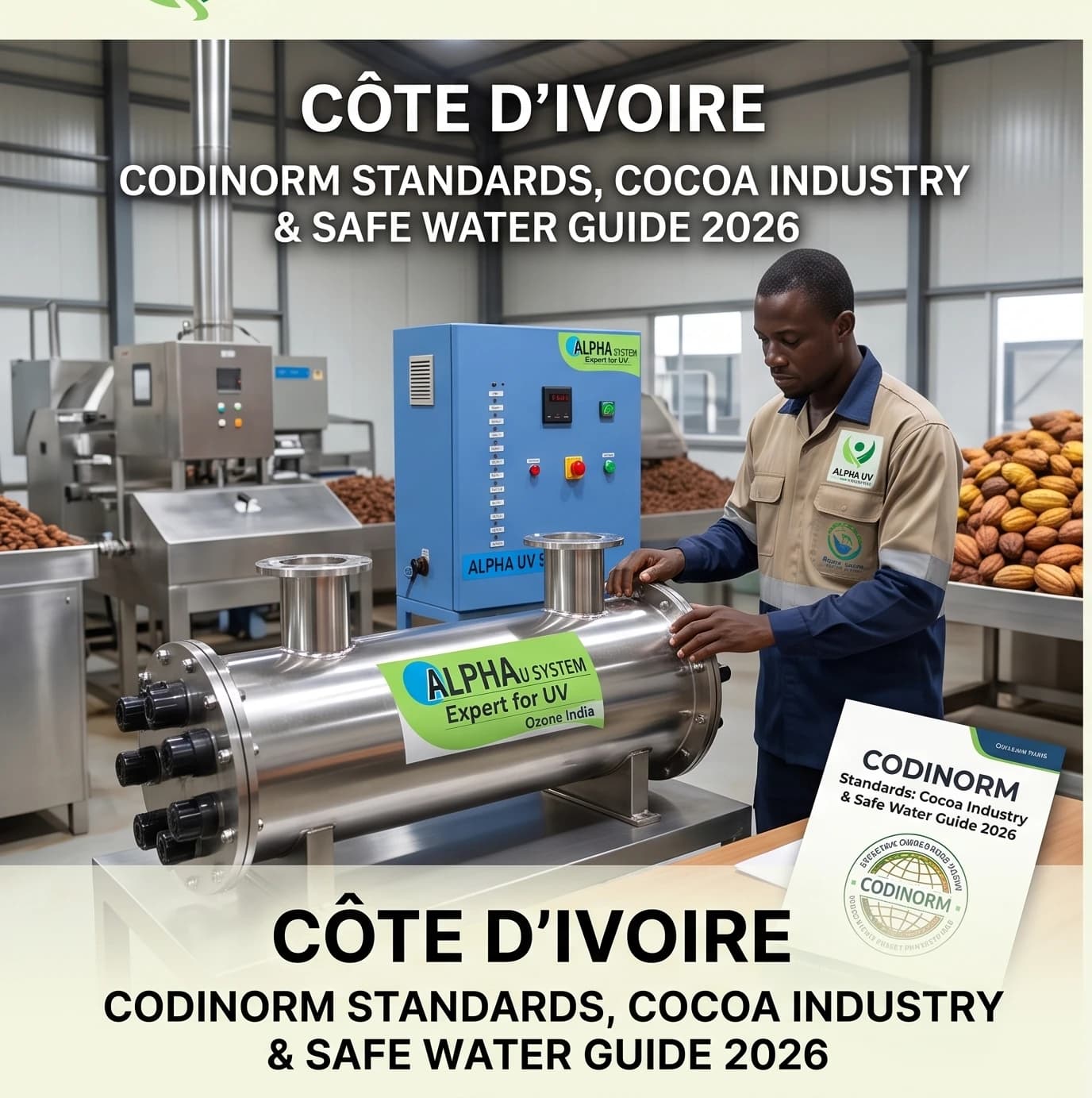
Quick Answer: UV water treatment in Côte d'Ivoire is the validated chemical-free disinfection method for CODINORM-compliant packaged water plants, BRC-certified cocoa and coffee processing water, Abidjan commercial borehole water systems, petroleum industry camp water at offshore and onshore installations, and French food safety-standard export agro-processing. Alpha UV's NSF/ANSI 55 Class A certified systems deliver 40–80 mJ/cm² validated dose with SS 316L chambers, shipping from Mundra or JNPT to Abidjan Port (Port Abidjan) in 18–22 days with French-language CODINORM-format technical documentation.
Côte d'Ivoire's Water Market and UV Treatment Context
Côte d'Ivoire — the Ivory Coast — is West Africa's largest economy by GDP and the world's largest cocoa producer, accounting for approximately 40 percent of global cocoa supply. The country's economic capital Abidjan is West Africa's commercial hub, with a population exceeding 6 million and a skyline of modern office towers that rivals any African city south of Casablanca. The SODECI (Société de Distribution d'Eau de la Côte d'Ivoire) manages Abidjan's water supply from the Banco lagoon and La Mé river treatment works — providing piped supply to approximately 85 percent of Abidjan residents. Secondary cities (Bouaké, Daloa, Korhogo, San-Pédro) have lower piped supply coverage.
Côte d'Ivoire's UV water treatment market is shaped by the country's integration into global commodity supply chains: cocoa processors exporting to Nestlé, Cargill, Barry Callebaut, and Olam require BRC Global Standard water quality documentation; palm oil and rubber processors for EU markets require EU Regulation EC 852/2004 food hygiene water quality compliance; and the offshore petroleum sector (operated by CNR International, Foxtrot International, Vivo Energy) requires WHO-GDWQ water quality at offshore platform and onshore terminal facilities.
Abidjan's French cultural and commercial heritage — Côte d'Ivoire is a Francophone country with strong French regulatory alignment — means UV water treatment specifications reference French and EU standards. CODINORM (Côte d'Ivoire Institute of Standardisation) aligns Ivorian standards with French and ISO norms. French food buyer audit standards (BRC, IFS — International Featured Standards, popular in France/Germany) and EU food import regulations drive UV specification in Côte d'Ivoire's export food processing sector.
Water Source and Quality by Region
Abidjan — Lagoon-Sourced Supply and Borehole Extraction
Abidjan's SODECI supply draws from the La Mé River (treated at the La Mé treatment works, 120,000 m³/day capacity) and from the Banco and Adzopé infiltration galleries. La Mé River water quality is generally adequate for conventional treatment — turbidity 10–50 NTU dry season, 100–500 NTU during the major rains (April–June) — with UVT of treated supply at building entry reaching 82–90 percent. Abidjan's commercial district (Plateau, Zone 4, Cocody Deux Plateaux) draws on both SODECI supply and deep boreholes in the Quaternary coastal sediment aquifer. Borehole TDS: 200–600 mg/L, low-moderate iron, adequate UVT for UV polishing with 5-micron filtration.
San-Pédro — Deepwater Port and Cocoa Export Zone
San-Pédro Port handles approximately one-third of Côte d'Ivoire's cocoa exports and is growing as an industrial port complementing Abidjan. San-Pédro's water supply draws from the Davo River — a rural river source with seasonal turbidity — and from a growing network of treated boreholes. The San-Pédro Special Economic Zone (in development) will attract processing industries requiring documented water quality. UV water treatment Ivory Coast at San-Pédro industrial facilities uses AU-M series systems with pre-treatment appropriate for Davo River-derived supply (sand filter + cartridge).
Bouaké and Central Côte d'Ivoire — Bandama River Supply
Bouaké — Côte d'Ivoire's second city and commercial capital of the interior — draws from the Bandama River, treated at the Kossou reservoir system. Bandama water quality after conventional treatment is adequate — UVT 83–90 percent — for UV building-entry polishing. Bouaké's textile industry (Gonfreville textile mill) and food processing sector use UV in process water systems aligned with EU buyer audit requirements.
Offshore Atlantic — Petroleum Sector Water
Côte d'Ivoire's offshore oil and gas sector (blocks CI-100, CI-101, CI-205 operated by CNR International, Foxtrot, and others) uses SWRO desalination for potable water on production platforms, with UV polishing as the standard final treatment step. Alpha UV's marine-specification UV systems (IP66 enclosure, vibration-resistant, DNV/ABS-compatible documentation) are specified for offshore platform potable water systems in Côte d'Ivoire's Atlantic basin fields.
CODINORM Regulatory Framework and French Food Standards
CODINORM (Institut Ivoirien de Normalisation) develops and administers Ivorian technical standards, with drinking water standards (NI 09-002) aligned with WHO GDWQ and French/EU norms. The LANADA (Laboratoire National d'Appui au Développement Agricole) regulates food processing water quality for the agricultural export sector. DGSN (Direction Générale de la Santé) oversees packaged water licensing.
| Regulatory Body | Standard | UV Requirement | Alpha UV Documentation |
|---|---|---|---|
| CODINORM / DGSN | NI 09-002 (Drinking Water) / WHO GDWQ | UV as approved disinfection; 40 mJ/cm² for 4-log E. coli reduction | NSF/ANSI 55 Class A + French-language CODINORM technical data |
| LANADA / Ministry of Agriculture | Food processing water quality (EU-aligned) | Validated disinfection; EC 852/2004 food hygiene standard | NSF/ANSI 55 Class A + HACCP-format CCP documentation in French |
| BRC / IFS | Food export audit standards (cocoa, palm oil, rubber) | Documented UV disinfection for processing water, NSF certificate required | NSF/ANSI 55 Class A certificate + audit-ready dose delivery records |
| Ministry of Health (pharmaceutical) | Ivorian GMP guidelines (WHO-GMP aligned) | 80 mJ/cm² in pharmaceutical PW loops | AU-H series 80 mJ/cm² validation documentation |
| UNICEF / EU Development | WHO GDWQ (WASH development programmes) | 40 mJ/cm² minimum; NSF/ANSI 55 Class A | NSF/ANSI 55 certificate; UNGM vendor registration |
Key Application Sectors
Cocoa and Coffee Processing — World's Largest Cocoa Sector
Côte d'Ivoire processes approximately 40 percent of the world's cocoa — a responsibility that makes its cocoa sector's food safety standards a global food system concern. The Abidjan and San-Pédro cocoa processing industry includes international commodity trading and processing companies: Cargill, Barry Callebaut, Olam, SIFCA (through SIFCO), and Touton SA. These processors export cocoa butter, cocoa powder, and cocoa paste to European chocolate manufacturers — Nestlé, Mondelez, Lindt — all of whom audit their Ivorian suppliers against BRC Global Standard for Food Safety or IFS Food Standard. Process water quality documentation at cocoa processing facilities, including UV disinfection with NSF/ANSI 55 certification, is a standard BRC and IFS audit requirement. UV water treatment Ivory Coast in cocoa processing eliminates the bacterial contamination risk in water used for cocoa bean cleaning, fermentation management, and nibs cleaning.
Palm Oil and Rubber Processing
Côte d'Ivoire is West Africa's largest palm oil producer (PALMCI, SANIA) and has significant natural rubber production (SAPH, SOGB). Both palm oil and rubber processing use large volumes of water in product cleaning, processing, and steam generation. EU food safety requirements for palm oil imports and US FDA requirements for rubber products used in food-contact applications both require process water quality documentation. UV water treatment Ivory Coast in PALMCI and SANIA palm oil processing facilities provides the microbial control documentation that EU vegetable oil buyer auditors require. Alpha UV's high-flow AU-M series handles the large water volumes used in palm oil sterilisation and clarification circuit water supply.
Abidjan Commercial Buildings and Real Estate
Abidjan's Plateau district, Zone 4, Marcory, and the rapidly developing Riviera-Palmeraie corridor host international company headquarters (multinational commodity traders, French banks, telecoms, mining companies) and premium residential developments. Building developers and facility managers in Abidjan's premium real estate segment — AERIA (Abidjan Real Estate) developments, French construction firms such as Bouygues Bâtiment Côte d'Ivoire — specify UV water treatment at building rooftop tank inlet as a standard feature. UV at building water entry provides protection against the SODECI distribution pipe contamination that is documented in Abidjan's older pipe network sections.
International Hotels and Hospitality
Abidjan's hotel sector — with Sofitel Abidjan Hotel Ivoire (the country's iconic luxury hotel), Pullman Abidjan, Radisson Blu, and Novotel — specifies UV water treatment by international Accor Group and Radisson engineering standards. Cocody's Les Deux Plateaux and Zone 4 boutique hotel and restaurant sector — serving Abidjan's large expatriate French community — also specifies UV in kitchen and bar water supply. NSF/ANSI 55 Class A documentation is the universally required performance standard for French hotel chain engineering departments.
System Design for Ivorian Water Sources
| Application | Pre-Treatment | UV System | Target Dose |
|---|---|---|---|
| Abidjan SODECI supply (building entry) | 5μm cartridge filter | AU-S or AU-M series | 40 mJ/cm² |
| Abidjan coastal borehole (low TDS) | 5μm cartridge filter | AU-S series | 40 mJ/cm² |
| San-Pédro industrial (Davo River) | Sand filter → 5μm cartridge | AU-M series | 40 mJ/cm² |
| Cocoa processing facility | Sand filter → 5μm cartridge | AU-M series | 40 mJ/cm² |
| Offshore platform (post-SWRO) | 5μm cartridge (post-RO) | AU-S or AU-M series (IP66, marine) | 40 mJ/cm² |
| DGSN packaged water plant | RO → UV polishing | AU-M series | 40 mJ/cm² |
| Pharmaceutical PW (GMP) | RO + EDI | AU-H series (sanitary) | 80 mJ/cm² |
CFD Reactor Validation for Côte d'Ivoire's Tropical Rainy Season UVT Variation
Côte d'Ivoire's bimodal tropical rainfall pattern — major rains (April–June) and minor rains (October–November) — creates turbidity pulses in river-sourced water supply. The La Mé River turbidity during the major rains (April–June), even after conventional SODECI treatment, can temporarily reduce UVT at building-entry cartridge filtration to 78–83 percent. Alpha UV's IIT-trained engineers modelled reactor performance at this minimum seasonal UVT using ANSYS Fluent CFD analysis, confirming that the reactor delivers the validated 40 mJ/cm² dose at 78 percent UVT when flow is de-rated to 85 percent of the rated maximum (per the reactor's published UVT-flow performance curve).
For Ivorian cocoa processing facilities — where production continuity during the major rain season (which coincides with the mid-crop cocoa harvest of April–June) is critical — Alpha UV installs the UV system with a UV intensity sensor-linked flow controller that automatically modulates UV system flow based on real-time UVT measurement. During the April–June period when UVT drops, the flow controller reduces throughput proportionally while maintaining 40 mJ/cm² dose, preventing the seasonal water quality deterioration from compromising the BRC-certified processing water quality that European cocoa buyers require year-round.
Import and Logistics via Abidjan Port
Port Abidjan is West Africa's second-busiest port after Tema, Ghana — handling approximately 25 million tonnes annually and serving as the primary trade gateway for Côte d'Ivoire, Burkina Faso, Mali, and Niger. India-Côte d'Ivoire shipping operates on the India-West Africa container lane, with transshipment at Colombo, Jebel Ali, or Tanger Med. Sea freight from Mundra or JNPT to Abidjan: 18–24 days. Port Abidjan (SETV container terminal) customs clearance: 3–7 working days. BIVAC (Bureau de Vérification) pre-shipment inspection may be required — Alpha UV arranges pre-shipment inspection through Bureau Veritas where required by Ivorian customs requirements.
Alpha UV prepares Côte d'Ivoire import documentation in French: CODINORM-format technical data sheets in French, NSF/ANSI 55 Class A certificates with French translations, Certificate of Origin, commercial invoice with HS 8421.21 classification, and packing list. For BRC and IFS-audited cocoa processor buyers, Alpha UV provides the complete technical documentation package required for food safety audit evidence files, including the UV validation report and HACCP-format Critical Control Point (CCP) documentation for the water disinfection step.
Frequently Asked Questions
What water quality documentation does Barry Callebaut require from Ivorian cocoa suppliers?
Barry Callebaut — one of the world's largest cocoa and chocolate processors — operates its own sustainability programme (Forever Chocolate) and requires its Ivorian cocoa supplier processing facilities to meet food safety standards including water quality management. Barry Callebaut's supplier code of conduct and its BRC-aligned audit requirements specify that process water at cocoa bean cleaning and processing must be potable quality (zero E. coli/100 mL) with documented treatment. UV disinfection documented with NSF/ANSI 55 Class A certification and quarterly microbial testing results from an ANCC (Agence Nationale de Certification) accredited laboratory satisfies Barry Callebaut's water quality audit requirements. Alpha UV provides the NSF certificate, HACCP water CCP documentation template, and maintenance record format that Ivorian cocoa processors need for Barry Callebaut and other European cocoa buyer audit compliance.
Is UV safe to use in cocoa fermentation water systems where temperature varies?
Cocoa fermentation is a natural microbial process using the yeasts and bacteria naturally present on the cocoa pulp — UV disinfection of the fermentation environment would interfere with this natural process and is not appropriate. UV water treatment in cocoa processing is applied to: (1) the water used to clean and wash cocoa beans before and after fermentation; (2) water used for drying area cleaning; (3) water used for workers' hygiene in the processing area; and (4) water used in the cocoa nibs cleaning stage if wet-process methods are used. UV treatment is not applied to fermentation tank water directly. This distinction — UV for cleaning and hygiene water, not for fermentation process water — is clearly communicated in Alpha UV's HACCP documentation template provided to Ivorian cocoa processor buyers.
Can Alpha UV systems be used in Côte d'Ivoire's offshore oil platforms?
Yes. Alpha UV's marine-specification UV systems (AU-S and AU-M series with IP66 stainless steel enclosures, vibration-resistant lamp mounts, marine-grade electrical connections) are suitable for offshore oil platform potable water systems in Côte d'Ivoire's Atlantic basin. Alpha UV can provide DNV (Det Norske Veritas) or ABS (American Bureau of Shipping) marine classification documentation for offshore platform UV installations where the vessel's classification society requires equipment certification. For CNR International, Foxtrot, and other operators' Ivorian platform FPSO or fixed platform water system specifications, Alpha UV provides a full technical package including IP66 certification, marine vibration resistance test reports, and WHO-GDWQ water quality compliance documentation.
What is BIVAC pre-shipment inspection and how does Alpha UV handle it?
BIVAC (Bureau de Vérification) is the pre-shipment inspection regime mandated by certain African governments — including Côte d'Ivoire for goods above a specified CIF value threshold — to verify that imported goods conform to declared specifications and value before shipment. For UV water treatment systems subject to BIVAC inspection, an accredited inspection body (Bureau Veritas, operating BIVAC in Côte d'Ivoire) inspects the goods at Alpha UV's factory in Ahmedabad before they are loaded for shipment. Alpha UV schedules BIVAC inspection as part of the standard Côte d'Ivoire export process, with typical inspection completion within 3–5 working days of production readiness. The BIVAC certificate accompanies the shipment documents and is required for customs clearance at Port Abidjan. Alpha UV's export team manages this process end-to-end.
How does Alpha UV provide after-sales service in Abidjan?
Alpha UV maintains an authorised service and spare parts partner in Abidjan with French-speaking technical staff, stocking UV lamps, quartz sleeves, O-rings, and UV sensor units for Alpha UV systems. Service covers Abidjan and the Petite Côte zone directly, with spare parts courier service to secondary cities (Bouaké, San-Pédro, Daloa) via COLISSIMO Côte d'Ivoire or direct transport arrangement. For cocoa processing season (September–March, main crop), Alpha UV's Abidjan service partner prioritises spare part availability and response times for BRC-audited cocoa processor customers where equipment downtime during the processing season has direct cost implications. Remote diagnostics via WhatsApp video call with Alpha UV's Ahmedabad engineering team is provided as standard for under-warranty troubleshooting.
Conclusion: UV Water Treatment Ivory Coast — Certified Solutions for West Africa's Cocoa Capital
Côte d'Ivoire's UV water treatment market is defined by the world's largest cocoa sector's food safety requirements: when 40 percent of global cocoa passes through Ivorian processing facilities audited by Barry Callebaut, Cargill, Nestlé, and Mondelez to BRC and IFS standards, the water quality documentation required in Ivorian cocoa processing is a global food system concern. UV water treatment Ivory Coast — documented to NSF/ANSI 55 Class A, with HACCP-format water CCP records and BRC-ready audit files — is Alpha UV's core offering for the Ivorian cocoa supply chain.
Alpha UV's French-language CODINORM documentation, BIVAC pre-shipment inspection management, Abidjan French-speaking service partner, and seasonal UVT-adaptive reactor performance validated by ANSYS Fluent CFD — delivered to Port Abidjan in 18–22 days from Ahmedabad — provide what Côte d'Ivoire's demanding food export, petroleum, and commercial building UV water treatment market requires. Contact Alpha UV's Africa and MENA export team for Côte d'Ivoire pricing, BRC-format cocoa processing water documentation, and offshore platform UV specification support.
Standards, authorities & further reading
External references used to inform this guide. Regulations evolve — check the latest revision on each authority's site before compliance decisions.
Recommended UV Systems
Alpha UV System products for this application — powered by genuine Philips UV-C lamps.
Commercial UV Water Purification System
500 – 5,000 LPH
HACCP-compliant UV water purification for hotels, restaurants, and offices
Industrial UV Water Treatment System
5,000 – 50,000 LPH
Schedule M 2025 and HACCP compliant UV for pharma, food & beverage, and process water
Not sure which system suits your application? WhatsApp our engineers for a free recommendation →
Related solutions
See how Alpha UV System applies this to your industry or city.
Need a UV system?
Talk to our UV engineers — WhatsApp for a quote in 2 hours, or browse the full catalog on IndiaMART.