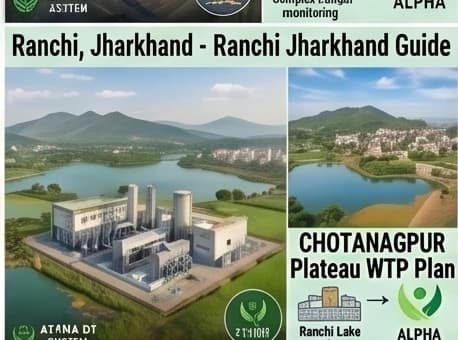
UV water treatment in Ranchi and Jharkhand requires one critical pre-treatment warning: Jharkhand's Chota Nagpur Plateau has extensive iron-rich borehole geology — borewell iron concentrations of 2–15 mg/L are common across Ranchi, Jamshedpur, Hazaribagh, and Bokaro districts. Iron above 0.3 mg/L must be removed BEFORE UV treatment — iron deposits on the UV quartz sleeve within days, reducing UV transmittance and UV dose to zero, rendering the UV system non-functional. Iron removal (greensand filter or aeration + iron removal filter) is mandatory before UV in all Jharkhand borewell UV installations. Beyond this, UV water treatment in Jharkhand addresses: (1) post-overhead-tank disinfection for Ranchi's residential areas — RMC (Ranchi Municipal Corporation) supply from the Kanchi River loses residual chlorine in tanks; (2) Tata Steel Jamshedpur complex cooling tower Legionella management and process water UV; (3) Dhanbad coal mine drainage water UV for JSPCB compliance; and (4) JSPCB STP compliance for Jharkhand's growing residential stock. Alpha UV System supplies Philips UV-C lamp UV systems to Ranchi and Jharkhand with 5–7 day delivery and JSPCB documentation support.
Jharkhand — carved from Bihar in 2000 to create India's 28th state — is India's most mineral-rich state: it holds approximately 40% of India's mineral reserves including coal (Dhanbad-Jharia coalfield), iron ore (Singhbhum), copper, uranium (Jaduguda), mica, and manganese. This mineral wealth has created an economy built on heavy industry: Tata Steel's Jamshedpur complex (one of the world's most integrated steel plants), Bokaro Steel City (SAIL's Bokaro Steel Plant), Hindustan Copper's Ghatsila operations, and CCL (Central Coalfields Limited) and BCCL (Bharat Coking Coal Limited) coal mining operations in the Dhanbad-Jharia coalfield.
Jharkhand's water treatment profile is distinct: the Chota Nagpur Plateau's ancient crystalline rock geology means borewell water across the state has elevated iron and manganese from natural mineral dissolution. This makes Jharkhand one of the most important markets in India for iron removal pre-treatment before UV — a step that is non-negotiable for effective UV system operation in the state.
Jharkhand borewell iron concentrations of 2–15 mg/L are standard across the Chota Nagpur Plateau. Iron at these concentrations deposits on UV quartz sleeves within 72 hours, coating the sleeve and blocking UV light transmission completely. A UV system installed on high-iron borewell water without iron pre-treatment will stop providing effective disinfection within days of installation even though it appears to be running. Test your borewell iron level at an NABL laboratory before installing UV — if iron exceeds 0.3 mg/L (the IS 10500 limit), install an iron removal filter (aeration + greensand or iron-specific resin) before the UV system. Never bypass iron removal to save cost — it makes the UV system non-functional.
Jharkhand Water Quality by Zone
| Zone / Area | Supply Type | Key Water Issue | UV Solution |
|---|---|---|---|
| Ranchi city (Harmu Road, Doranda) | RMC piped supply (Kanchi River) + borewell | Bacterial regrowth in tanks; borewell iron 2–10 mg/L in many Ranchi areas; old distribution in old Ranchi core | Iron removal → UV for borewell; post-tank UV for piped supply; NABL test first |
| Jamshedpur (Tata Steel city) | Tata Steel / JMC (Jugsalai MC) supply (Subarnarekha) + borewell | Tata Steel cooling towers — Legionella WMP; steel plant process water; township potable UV; Subarnarekha river quality | Cooling tower UV (40–80 mJ/cm²); steel plant UV; Tata township potable UV; iron removal before borewell UV |
| Dhanbad / Jharia (coal belt) | PHED supply (limited) + borewell | Coal mine drainage water; acid mine drainage pH; borewell iron 5–15 mg/L in mining zones; JSPCB coal mine compliance | Iron removal → UV; coal mine drainage UV; JSPCB STP UV; NABL test mandatory first |
| Bokaro Steel City | SAIL/BSL internal supply + borewell | Steel plant cooling towers; SAIL township water; Damodar River supply quality; JSPCB industrial STP | Cooling tower UV; township potable UV; industrial STP UV; iron removal if borewell |
| Hazaribagh / Ramgarh | PHED supply + borewell | Mica mining area; coal mining; borewell iron 3–12 mg/L; rural district supply; JSPCB STP compliance | Iron removal → UV; JSPCB STP UV; RO + UV for mineral-contaminated borewell |
UV for Tata Steel Jamshedpur
Tata Steel's Jamshedpur complex — one of the world's largest integrated steel plants, built in 1907 by Jamsetji Tata and now producing 10+ MTPA (million tonnes per annum) of steel — is one of India's most sophisticated industrial water users. The Jamshedpur plant requires UV water treatment for: cooling tower make-up water (Legionella WMP — Tata Steel follows its own global EHS water safety standard aligned with ASHRAE 188), coke oven cooling water, blast furnace cooling circuit water, and the Tata Steel township potable water supply (Jamshedpur is a planned city owned and managed by Tata Steel; the township supplies water to approximately 250,000 residents).
Tata Steel's global safety standards (Tata Group Safety Policy aligned with IFC Environmental Health and Safety Guidelines) require monthly Legionella culture testing from all cooling tower risk points, UV at 40–80 mJ/cm² on cooling tower make-up water, and annual Legionella WMP review. Tata Steel's Jamshedpur procurement team sources UV systems through approved vendor lists — Alpha UV System's Philips UV-C lamp systems are qualified for Tata vendor requirements.
| Application | Flow Rate | UV Dose | Notes |
|---|---|---|---|
| Residential (Ranchi — piped supply) | 1–3 m³/h | 40 mJ/cm² | Post-tank UV; 5 µm pre-filter; borewell requires iron removal before UV |
| Borewell (Jharkhand — iron 2–10 mg/L) | After iron removal | 40 mJ/cm² | Iron removal filter mandatory; NABL iron test first; UV after iron removal <0.3 mg/L |
| Tata Steel / Bokaro Steel cooling tower | 50–500 m³/h | 40–80 mJ/cm² | Tata/SAIL EHS Legionella WMP; ASHRAE 188; monthly Legionella testing; Subarnarekha/Damodar compliance |
| Steel plant township potable (Jamshedpur) | 10–50 m³/h | 40 mJ/cm² | Tata Steel township 250,000 resident supply; Subarnarekha river intake; post-WTP UV |
| Coal mine drainage (Dhanbad) | 20–100 m³/h | 40 mJ/cm² | JSPCB coal mine STP compliance; acid mine drainage pH correction before UV |
| STP outlet — 300 KLD (Ranchi residential) | 20–30 m³/h | 40 mJ/cm² | Philips TUV 95W; JSPCB consent documentation; Subarnarekha/Damodar basin compliance |
Is arsenic a concern in Jharkhand borewell water like it is in Bihar?
Jharkhand's arsenic situation is different from Bihar. Bihar's arsenic contamination is primarily in the alluvial plain Ganga belt (ancient alluvial sediments that contain naturally occurring arsenic). Jharkhand's geology is predominantly the ancient Chota Nagpur Plateau crystalline rock — hard rock terrain that generally does not have the alluvial arsenic contamination pattern. However, there are specific arsenic-related concerns in Jharkhand:
Mining-related arsenic: Gold ore mining at Mosaboni and copper mining at Ghatsila/Rakha in Singhbhum district can generate acid mine drainage containing arsenic from ore processing. Borewell water near historical mining operations should be tested for arsenic as well as iron and pH.
Natural arsenic in specific districts: Some districts in Jharkhand have reported elevated arsenic in isolated pockets — always test NABL for arsenic before using any Jharkhand borewell for drinking water, especially in former mining areas.
The critical point: UV treatment does NOT remove arsenic — it is a disinfection technology, not a chemical removal technology. If your Jharkhand borewell has arsenic above the IS 10500 limit of 10 µg/L, you need either RO (which removes 90%+ of arsenic) or a specific arsenic removal media (GFH — Granular Ferric Hydroxide, or activated alumina). Only use UV on arsenic-free water. Alpha UV System will advise you on whether your specific Jharkhand borewell test results indicate a need for arsenic removal treatment before UV — WhatsApp us your NABL test report for advice.
Alpha UV System supplies UV disinfection systems (with mandatory iron removal pre-treatment advice for Jharkhand borewell users) to residential complexes, Tata Steel and SAIL facilities, coal mine operators, and STP operators across Ranchi, Jamshedpur, Dhanbad, Bokaro, and the Jharkhand state. JSPCB STP documentation. Philips UV-C lamps. 5–7 day delivery to Jharkhand.
WhatsApp Us for Jharkhand UV System SupplyStandards, authorities & further reading
External references used to inform this guide. Regulations evolve — check the latest revision on each authority's site before compliance decisions.
Recommended UV Systems
Alpha UV System products for this application — powered by genuine Philips UV-C lamps.
Commercial UV Water Purification System
500 – 5,000 LPH
HACCP-compliant UV water purification for hotels, restaurants, and offices
Industrial UV Water Treatment System
5,000 – 50,000 LPH
Schedule M 2025 and HACCP compliant UV for pharma, food & beverage, and process water
Not sure which system suits your application? WhatsApp our engineers for a free recommendation →
Related solutions
See how Alpha UV System applies this to your industry or city.
Need a UV system?
Talk to our UV engineers — WhatsApp for a quote in 2 hours, or browse the full catalog on IndiaMART.